Extra strength for your UPS(Uninterrupted Power Supply)
Installed in 1996 - still running at 2018
Nope, that one gave out in 8-2023(I
just changed the pellet stove UPS battery July 2018, installed them in 2007
July, 2018 I also bought a
used Tripp Lite OMNI 1500 LCDT to replace this one. All of $45)
An
older
Tripp Lite connected to my wife's computer toasted a battery,
found out the
unit was 12 years old,
I wrote to Trip Lite as to why it over charged and
toasted a battery rather then shutting off.
They said it was a very
old 12 year old UPS, that's why !
Some UPSs may have space for a larger battery.
UPDATE: July 2023: My computer screen and network routers started to turn on/off. Those items (and a few small items) y are on my 1994 UPS that I had on that old UPS. It stated Low Battery. Go in the basement, nope. Both showed 12v and 26v going upstairs and the sticker say they are only 2 years old. So my 29 year old UPS gave up the ghost. I found on Ebay someone selling a APC Smart 750 UPS for $75.. no batteries and free shipping ! ! A lot of the other UPS machines with batteries were shipping for $60 - $95, depending on the amp hours (weight). So two days later I get the USP, switch the wires (sneak it under the front plastic panel) and bingo 100% battery and 10% usage. It has a network cable, so you can check it remotely, rather then looking under my desk.
(Update 7-2018) My pellet stove UPS died in the spring, red "replace battery" came on. So I checked the contacts and stuff, nope. Checked voltage, each gave 12v and 27v together. I hooked one of the batteries to a 12v UPS. It starts, but does not last 5 sec when on battery. So I looked close and saw the dates punched out on the battery... 2007 ! ! Over 10 years old... guess they need replacing. $87 each for 100Ah marine batteries. Hooked them up and the old 1996 UPS still kicks on. I am going to have to replace that UPS, 22 year running plus it was a throw away from a former school so add another 3-4 years. Back in 1996 the batteries cost as much as the UPS.
(Update: 10-2011 Halloween storm North East.. my UPS ran for 15 hours ! ! See "how long will my UPS run"
(Update Aug. 2010) - I replaced the UPS on my computer with a
"smart" UPS. It will shut down my PC if the power goes out longer then the
UPS can handle it. As many web sites state, the PC UPS will not run off my
main UPS. So the experts that say the "sine wave" is not the same coming
out of a UPS is correct. You can't extend one UPS by plugging into a
second UPS.
My second UPS is still on my hubs, routers and other PC items. I also
bought a Netgear NAS and a UPS that can control it. So if the power goes out the
NAS will shut down automatically after 20 min or so. Only certain UPS
units can work with this NAS and I picked up a refurb unit. The NAS shut
down incorrectly a week after purchase and so did the USP. I found out my
son's cat had walked on the UPS and hit the power button. So now the UPS
is sideways ! The cats also have turned on/off the Christmas tree lights
as the remote switch is stepped on my the cat. Glad they only stay for a
few days! )
(Update Oct. 2009) - A "winter storm" hit and lots of snow covered the trees with leaves. Not good. Many branches went down and power was out, in some areas of NJ, for 4 days. My town got hit and power was out until 7 PM. When it was restored, my Jacuzzi had a blown 30 amp fuse. That's all that happened to that. Nothing on my UPSs had a problem.)
(Update - Dec. 2008)... still going... had a long power outage (7 hours) and one held up as there was little drain on it, but my PC one drained. I don't have it connected to the PC as it has a serial connector. So it was running all that time. Some day I have to replace that UPS with a newer USB connector and software so it will shut down after a few hour of being on the UPS.)
(Update - June 4, 2007 The power went out at 2:30 am. It finally went back on at 4 am. The USP on my PC with the two sealed car batteries had no problem. The monitor was turned off but the PC, the router and hub were all powered by the UPS. It is a small unit (APC 600LS) and I don't have lights to show how much power was left when the power came back on unlike my larger unit. The PC was still working in the morning so it didn't restart over the 1 1/2 hours power outage. The other larger UPS was not running anything (Pellet stove or new LCD TV) so there was no drain.
(Update - as of Sept. '06) I still have the same setup. I went through 3 sets of batteries (one set due to my neglect to fill the battery with water) and one connection was corroded. I resoldered a new connection. Those old UPSs are still working. Power has gone out a few times and hundreds of time they kick in when the pool, jacuzzi and dryer are running together. I still use wet cell marine batteries. I changed one set to sealed standard car batteries. It's been a couple of years with those.)I am not waiting in fear of Y2K or end of the world. I just don't want the TV, computer or my electric powered phone to become useless for an hour when the power goes out. I was just tired of resetting the VCR channels and clock again! I also have a Pellet Stove in my house plugged into this UPS.
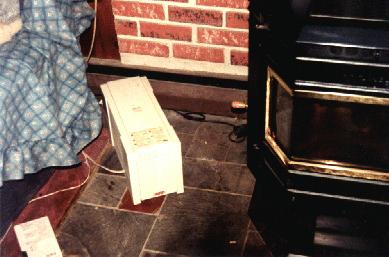 |
If the power goes out on a pellet stove, even for 30 seconds, the Pellet Stove quits until you restart it. Plus smoke will start coming out of a pellet stove as the fan to blow the smoke outside quits when the power goes out. This has happened to me twice. I live in a quiet part of NW New Jersey. Problem is people seem to love to hit telephone poles with their 4X4s, either that or the damn deer we keep hitting are cutting power lines to get back at us! Our power goes out at least twice a year. Lighting storms can kill the power for 1-10 min. Also my '60 built home has a 100 amp power box with many stretched circuits. The refrigerator kicks on and my living room light dims for a half second. Our area is also hot for short backouts. A UPS, with my electronic equipment plugged into it, may save them from getting toasted by line surges. I lost a Jacuzzi 40 amp fuse during a freak snow storm in Oct. '09 (Jacuzzi still worked after replacing the fuse) as well as an AC converter and X10 box got fried. |
My solution was to purchase a real big UPS. The price, oh well a bit high for me. So I looked around and happen to see a UPS being thrown out were I work. I found out why they were in the "junk heap". After the batteries die on these units, the replacement batteries can cost almost as much as a new unit. Usually the batteries last 4-5 years, then they die and need to be replaced. As special as a UPS is, so are these batteries, plus they are not really "user replacement" items. The only other use for these types of batteries are home alarm systems and the battery operated emergency lights required by businesses should the power die. (update '06 : more and more kiddy toys use these dry cell batteries and more home are buying these. That drops the price of the UPS and replacement batteries over the past 6 years) Hence, the batteries are a high price specialty item. Even on WEB pages, the smaller of the 12 volt lead cell (gel cell) batteries cost $40 each. Most UPSs need 24 volts that are converted to 120 volts. So that's $80 for the two batteries plus shipping. And LEAD ACID batteries contain LEAD and they cost $$ to ship due to their weight. You can purchase a small but useful UPS for a little over $80. The boxes now say "user replaceable batteries". Ever get a replacement battery for one of the many 9-13 volt cordless drills? Might as well wait for a sale and get a new drill and battery, the price is only a few dollars more. Oh yes, I have replaced those $40 cordless battery packs by soldering single $1.25 units together. Just solder the right number into place and you have a working drill. The replacement batteries for those drills never did fit the original case, so I usually improvised. So I'm a "Tim the Tool Man" person that gave his battery powered tools "More Power". Hey, they worked, and lasted longer! So this is the Mother of All UPS power supplies !
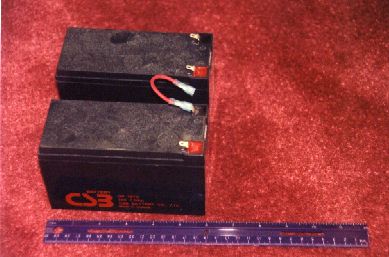
Back on track. Since DC voltage is DC voltage, only amperage is in the way of "More Power". You can't give 13 volts to a 9 volt motor. It will burn out in a short time. Same DC voltage to same DC voltage is fine. Smaller UPS batteries can only give out small amps. The larger batteries I used to replace the original rechargeable batteries had more amps to provide longer power, these are "wet cell" batteries. Something I will warn you about later. Most UPS have small, 3X6X10" lead acid sealed batteries.
| They give out about 7 amp hour and give that out at a constant rate, then die quickly. Just like a cell phone. The cell phone batteries will seem to last a long time up to that last 1/3 of the battery level. Then they die in 5 min. After finding this tossed out UPS I took it home I did some looking inside. I found the lead acid batteries. Oh lord, they are heavy. I mean heavy, don't ever try to carry a decent size unit any distance. This unit had two batteries that were 12 volts each. Another UPS I checked out had four larger 6 volt batteries. Wired a certain way, the four 6 volts still gave 24 volts to the circuit contacts. I asked my computer friends a simple question, what if I replace the two tiny 12 volt batteries with two 12 volt car batteries. None of my friends had heard of this, so off I went to build my "More Power" UPS. |
 |
DISCLAIMER:
As you can see from my other pages,
www.butkus.org, I do everything. Wiring, construction, auto repair.
So if you have no trust in yourself, or former experience, heed this
warning. This is how I did this. I am not saying you are capable
of this or won't short and explode these powerful lead acid batteries.
Just like car batteries they contain ACID, that can blind you or damage
your skin and surroundings. Charging lead acid batteries produce
hydrogen gas, very explosive! Do this to any battery under warranty and
bye-bye warranty!
 |
The initial idea.
I found a APC (American Power Conversion Corp) UPS model 900, about a foot and a half long by six inches high in the garbage heap. It 's supposed to handle 700 watts. That's seven 100 watt light bulbs for, I would guess, 10 min. Less drain (watts), longer time! These UPS are for computers. These units are to keep the computer running until they can shut down automatically should the power fail. That is done through software, formerly only server software but W2K or XP can be setup to auto shut down if the UPS has a USB or serial cable connected to the computer and the program is loaded. Hopefully the power would be restored before a system shutdown. This is great for the typical 2 to 15 second storm blackout or power loss when a large appliance is turn on in a standard home. The length of time to shutdown depends on how many hundreds of dollars you want to spend for a big UPS to run for hours rather then 10-15 minutes these small units provide. |
This APC unit has a two 5 LED lights. One
showing the power drain of the item you have plugged into the unit and
turned on. The other LCD, the power left in the batteries.
First I needed
replacement batteries. I checked out Walmart, auto stores and BJ
's Warehouse. BJ 's had these massive 12 volt deep cell batteries
for $49.00 each (1999 pricing). A "deep cell" is a battery used for current drain
for a long time without damaging the battery. Normal car batteries
get damaged every time you discharge them to almost nothing. They
are made for the car cranking the starter when it's 0 degrees outside,
high current drain for short times. A deep cell is for
boating lights and troller motors, long time drain, then full recharge.
So I purchased two of these "deep cells" as they were the cheapest I found
and had the longest "amp hour" time. Amp Hour is simple, how long
the battery can be drained at a certain "amp" in an hour. The batteries
I took out had a 7 amp hour, these new ones should have a bit more
"power".
The construction.
DIFFERENT UPS SYSTEMS HAVE DIFFERENT BATTERY SETUPS.. THIS IS A 24V SETUP..
TWO BIG BATTERIES WIRED FOR 24V.
After the UPS was opened, I saw the two large connections from the
battery to the circuit board. I used normal 12 gauge home wiring
to hook up the batteries and make the contact from the basement to the
UPS right above it. Don't even think of running this 20 or 30 feet.
I do not know if that will work or what could happen. DC voltage
is different from AC, short runs are good. These batteries must be used
and stored with the terminals pointed UP only.
The pictures
show the wiring connecting the one "Negative" terminals to the "Positive"
of another.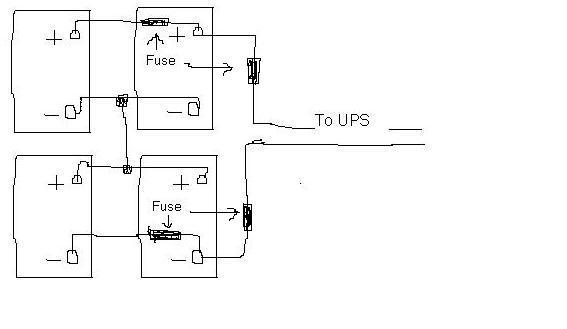 I purchased the round connectors at Radio Shack and a
powerful 50 amp fuse connector and a 50 amp fuse for this large unit.
EVERY battery is fused right at the connector. Shorting one of these will
melt the wire almost instantly. The female battery connectors to the male UPS connectors came from the
same store but had to be shaved a bit less wider with a file to fit correctly
inside.
In my UPS the white wire is used as a positive and black as ground.
However you want to hook the colors up, make sure you duplicate and mark
the Positive and Negative wires! As always, never hook up the battery
wires up until everything is finished. Any auto store would
have the large round connectors as these types of batteries have the thumb
screw connectors for boat use as well as the typical clamp type connectors.
I purchased the round connectors at Radio Shack and a
powerful 50 amp fuse connector and a 50 amp fuse for this large unit.
EVERY battery is fused right at the connector. Shorting one of these will
melt the wire almost instantly. The female battery connectors to the male UPS connectors came from the
same store but had to be shaved a bit less wider with a file to fit correctly
inside.
In my UPS the white wire is used as a positive and black as ground.
However you want to hook the colors up, make sure you duplicate and mark
the Positive and Negative wires! As always, never hook up the battery
wires up until everything is finished. Any auto store would
have the large round connectors as these types of batteries have the thumb
screw connectors for boat use as well as the typical clamp type connectors.
| You need to solder the connector to the wires, not just crimp them on. Rust and corrosion at these joints will stop the unit from working correctly or cause a fire as they overheat. Remember these are 12 gauge wires. Those tiny 10 watt soldering irons will not solder the ends correctly. The wire and connectors must get hot enough to melt the solder, not just having the tip of the soldering iron melting the solder. A quick test, if you can turn the eyelet on a long wire one full turn, and the wire turns, the solder job should be good. A cold solder join will break at the connection when that type of twist is place on the connector. The solder connection should also be smooth, not bumpy. I soldered the 50 amp fuse link to the 12 gauge wire going directly above it through a hold drilled in the floor, right next to a wall. I did drill down from the wall's edge and make sure the drill would not hit any live 120 volt house wiring directly beneath it. |
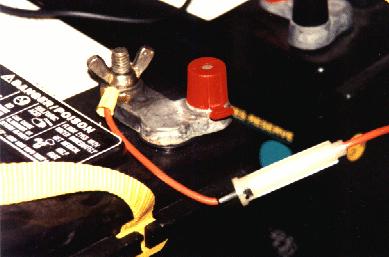 |
| It's a big double hole, so caulk it up afterwards. At the UPS end I again soldered the connectors for a tight fit. I used the house wiring "white" wire as positive and the "black" as negative. Touching 24 volts with your bare hands can't hurt you. Short 24 volts with that kind of amperage behind it and if you do not fuse that circuit, the wire will spark and melt on you! I'm talking about melting wire on your skin or in your eyes! Fuse it once or even twice, between the two 12 volt batteries. I chose a 50 amp fuse for this big UPS, a second smaller UPS I improved has a 30 amp fuse. This will keep the UPS from drawing too much power from the Deep Cell batteries or a dead short. Many internal circuits of the UPS will prevent overdraw of power at the AC outlets or overcharging of these batteries. That's if the UPS is working correctly. If you are getting a used or junk UPS, make sure it's not due to a bad UPS circuit. Find one that just needs batteries. A UPS that over or undercharges batteries will not help you. Overcharged batteries will create the explosive hydrogen gas and dry them out in a week. |
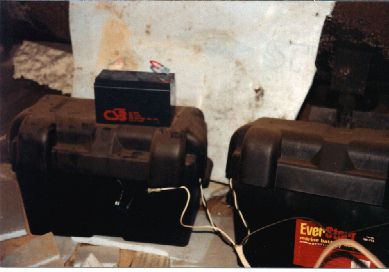 |
I first attached the wires to their respective connections inside the UPS (again match + and -), then in the basement I connected just the positive. Then I tested the system by quickly touching the negative wire to the negative contact. A tiny, tiny spark may be heard as it powers the UPS for a second. Again the 50 amp fuse would quickly melt if wires were shorted. I can only assume the UPS would not function if you reversed the white battery positive wire to the red positive wire in the UPS and the black battery to the black UPS wire. Don't know though, you might fry the internal circuit system if they are reversed! Again they are not "user replaceable" batteries and the UPS may not be setup for stupid "end user" errors.
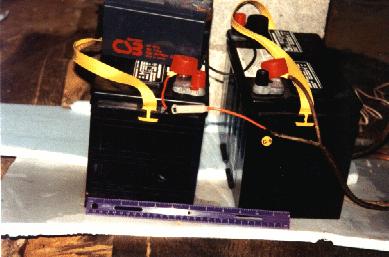
These oversized batteries will allow a longer RUN TIME. You cannot get a small UPS rated at 120 watts and plug in three seventy five watt bulbs. The transformers are what determines how many watts a specific UPS can handle. Don't go by the name. A RG-250 may only handle a peek 250w for a few seconds, but 175 watts of steady current. These specification are on each UPS.
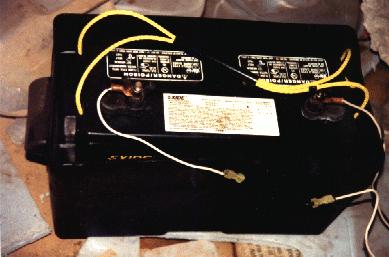
So the system is simple. Two deep cell batteries, one positive connected to one negative with a 50 amp fuse in the middle. (THIS IS FOR A 24 VOLT UPS) At the other two ends are two large copper eyelet soldered to 12 gauge (the thick stuff, 14 gauge is thinner) house wiring with a fuse between the connector and the 12 gauge wiring. (this shot and the above photo shows one of the 2 original batteries on top of the replacements marine batteries) The wire, about 10 feet long, is in my basement. The 12 gauge wire goes into a hole I drilled into the back or side of the UPS were it does not contact any metal or circuit parts. Inside the UPS I added a small "wire clamp" used in house wiring boxes to prevent the 12 gauge wire from being pulled out of the UPS. One clamp can be added to the outside to prevent the wire from being pushed in by accident. I also electrical taped the UPS connection ends to make sure those contacts don't touch each other or internal parts. I drilled though a plastic part of the UPS case so the 12 gauge wire will not be cut through by any metal. If you have to drill through metal, use a round rubber "short protector" found in auto stores to prevent the metal frame from cutting and shorting the 12 gauge wiring.
The test:
Summer time 1998, sitting one Saturday evening watching the TV.
This babe is 31" set, biggest I could fit in my wife's favorite TV cabinet.
I just had to take off the retracting doors! The kitchen light goes
out. Humm, TV still going. UPS gives a beep. A commercial
starts and I get up to check the kitchen light. I glance outside
and see darkness, no lights across the street. After 15 minutes the
TV show ends and I go outside to see my neighbors talking. Yep, power
out again. They notice my flickering TV and ask what's up.
I tell them about my UPS and batteries. Four and one half hours later
I'm still watching TV and the power is finally restored. My UPS which has
those "power lights" shows that out of 5 battery reserve lights only 2
were out in 4 1/2 hours. My drain, which is the 31" TV, VCR and stereo
(which was not on) shows only 1 light out of 5 for power drain. So
this 31" TV is only using 1/5 of the possible power drain. I can
only assume I could go 8 hours of TV watching before I start to worry.
Not bad for a $100 or so investment. I don't have to reset my VCR
or TV every time the lights blink for two seconds.
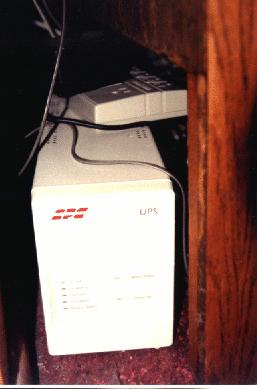 I had a smaller,
used, UPS that ran a small 150 watt fluorescent light, computer (not on
at that time) and electric powered phone. That light ran for 3 hours
before the old UPS batteries kicked it off. I then transferred the
living room light to the TV UPS for the last hour and a half during that
first power outage with my "beefed up" UPS. A year later the batteries
finally died on my smaller used UPS. After checking the connections
on the older UPS downstairs and finding no corrosion I decided to get the
same batteries and setup for this smaller UPS. The bigger batteries
cost about the same as the original batteries with shipping. It should
now be able run my computer, modem and phone during times of power outages
for many many hours longer then the original setup. I will test this
setup soon, just to see how long. (2-13-2000, power failure.) My large UPS
fails after 30 seconds. The next day I find those batteries had run
dry. The smaller UPS ran the TV for 45 min. then the pellet stove
for 9 hours - [10pm Sunday till 7:10am] It was
still going Monday morning when the power went on)
I had a smaller,
used, UPS that ran a small 150 watt fluorescent light, computer (not on
at that time) and electric powered phone. That light ran for 3 hours
before the old UPS batteries kicked it off. I then transferred the
living room light to the TV UPS for the last hour and a half during that
first power outage with my "beefed up" UPS. A year later the batteries
finally died on my smaller used UPS. After checking the connections
on the older UPS downstairs and finding no corrosion I decided to get the
same batteries and setup for this smaller UPS. The bigger batteries
cost about the same as the original batteries with shipping. It should
now be able run my computer, modem and phone during times of power outages
for many many hours longer then the original setup. I will test this
setup soon, just to see how long. (2-13-2000, power failure.) My large UPS
fails after 30 seconds. The next day I find those batteries had run
dry. The smaller UPS ran the TV for 45 min. then the pellet stove
for 9 hours - [10pm Sunday till 7:10am] It was
still going Monday morning when the power went on)
Items of interest: CAR BATTERY DANGERS
-
A UPS may not work plugged into a generator. There are
"pure sine wave" generators that are for "sensitive electronics". I'm
trying to find out more. From my early research there are "some" that will
run off generators if you make adjustments.
- should you accidentally blow a fuse, keep spares.
- WATER, WATER, WATER... these things need to be checked for water.
Wear eye protection when filling and always use distilled water from your
local food store. (update - newer "no water" car batteries have some
chemicals in the caps. They transform the gases back to water so those two
I have I rarely water.
- Pellet stoves draw very little power. They contain a small fan and
smaller motor to turn the feeder. I can only imagine many many hours,
maybe even a day, of just the Pellet Stove running off this beefed up UPS.
(10-14 hours)
- My UPS is just for annoying blinks of power outages to our typical 1-2
hours when the "deer" find another friend was hit by a car and cut our
power lines in protest. Should the power goes out for days,
no cheap UPS will keep your house warm or safe for that long. This
setup would keep me safe until I could make other arrangements.
- Never turn off a UPS (small switch in back) when the electrical power is
off. Only a few, very new units, will turn on without AC power.
This feature, to prevent you from plugging a UPS into a bad outlet.
Yes, if you have two UPSs and one is turned off, you can plug it into the
other to get it running, then unplug it.
- Power still out and your batteries are dead. I purchased a DC car power
converter that plugs into the car's DC outlet plug. For about $30 it gives
about 100 watts for those small emergencies, outdoor gathering, or other places
without AC power. You're car running in idle, can run for more then 10
hours. Some of these items will actually turn off the AC power when the
battery gets near 10 volts, the car's cranking ability. A few long
extension cords to reach a vital electrical device, get the idea. There
are more powerful DC converters available that clamp to your car's battery.
I assume you would need
to start the car to recharge the battery as one car battery will not last hours
on a good drain.
DO NOT RUN SENSITIVE ELECTRONICS (PELLET STOVES, FLASHLIGH BATTERIES) ON THESE UNLESS THEY ARE "PURE SINE WAVE" OUTPUT.
- I guess you can use car batteries. Since you rarely drain the batteries
a lot you shouldn't hurt them. Don't know, never tried them.
The deep cell are cheaper, bigger and are made for long drains, not like
car batteries that are for high short discharges
- Wet cell: The deep cell batteries are just like car batteries.
They have sulfuric acid in them. Oh yes, very nasty stuff!
I would never use these batteries near where people are breathing, living
or children would have contact. These aren't "sealed" batteries like
some of the newer car batteries. Want sealed ones, they make big
"gel cell " types for 4X4 trucks. These are sealed, can be mounted
in any fashion but are standard power car batteries. Maybe they make
them in deep cell type, but expect to pay $$$. Yes, very large UPS
setups use car size "gel cell" batteries. Sit down before you hear the prices
of these special batteries. ($125+)
- I don't know about longer cable runs. Ever wonder why those tiny
12 volt "walkway" lights have thick copper wires compared to a home extension
cord? It's due to the low voltage. Home Depot has a chart by
their outdoor wiring showing the wire length and wire size. That
chart is for just tiny lights.
- If the batteries are set outside, the cold will shorten the drain time
and UPS duration. My crawl space is usually 40-50 degrees in the
winter as my furnace and hot water pipes are located there. If your
crawl space is cold and unheated, don't expect the long run times you may
get in the summer.
- Need longer run time? You could purchase 4 - 12 volt batteries.
Two batteries would be hooked up (with fuses) positive to positive, negative
to negative. The other two the same way. One set of negatives
would be hooked to one of the Positives. The other negative would
go to the UPS negatives, the other positives to the UPS positive, with
a fuses between. The wire coming from the UPS would go to the other fused
positive and negative. This would give you the same 24 volts but
twice the "amp hour". If my setup gave me 8 hours, this setup should
give 16 hours of use.
- No matter how many batteries you hook up, the UPS is made for a certain
power output. A small UPS hooked up to a larger power draw will simply
set off the internal safety features and turn off the UPS. A UPS
with the correct amp ability may be hooked into many items such as a TV,
large stereo, VCR, Pellet Stove, light. It filters the power for
spikes, brownouts and protects from over loading that circuit. Should
the power go out, keep only the needed items on. The UPS will last
longer with fewer items running.
- These UPS have a built in battery chargers, depending on the make and model,
the time to full battery recharge can be listed in 4 hours to 10 hours. If
you find a recharge chart for your unit, the chart is for the original
smaller batteries. Lets say my power went out for 6 hours, then on
for one or two, then off again. There may be no way the UPS has charged
these larger batteries to full power so don't expect another 6 hours.
Most of the UPS have low battery lights. Usually this goes to warn
you a few minutes before the UPS goes dead. Check the water every
3 months!
- Any set of batteries for the UPS must be of the same type. Don't
try to hook up a used car battery and new deep cell and expect things to
work right. Remember the warning of mixing used and new batteries
in electronic devices, same thing here. One lower voltage battery
will try to charge the other.
- Just how long will yours last? Wait a day to fully charge your new
UPS batteries, assuming they are static charged when you purchased them.
The test is easy, see what is plugged into the UPS and turn on what you
want to run during this test. If things are plugged in but not turned
on, they do not delete from the battery supply. Unplug the UPS from
the wall outlet, it will beep at you warning the power is off. You
will also hear a low humming. Check the current time. Some UPS have
buttons to turn off the beep as the beeping is set to continue until the
power is restored. Some units will beep faster when the unit is about
to give up, then a continuous fast beeping giving notice it's only seconds
from shutting down. Some have lights that will glow showing the capacity
left in the batteries or lower than the recommended voltage. Keep
what you want running until the UPS automatically shuts off or until you
are satisfied. Check the time and see how many hours it lasted.
Plug it back in. It should charge the batteries. (check the water
level) If you have a DC voltage meter, you can check the voltage
after the test and see how long it takes to get back to 13 volts or so.
Don't be surprised if 15 or more hours pass. Need a faster charge.
Get a regular car battery charger, charging one at a time.
- WATER - check the water in these items if you ever used the UPS for any
extended time AND every 3 months. Distilled water is the only thing
you add! Wear safety glasses, wash your hands, be careful.