Film cameras
Alpa 9d User manual
User manual for Alpa 9d. 15 pages in English. Read the original PDF, download or print a copy without registration.
15 pagesEnglish2.0 MB PDF
Loading your manual…Open PDF directly
Document details
- Brand
- Alpa
- Model / document
- Alpa 9d
- Document type
- User manual
- Language
- English
- Pages
- 15
- File size
- 2.0 MB
- Category
- Film cameras
- Document date
- Not specified in catalog
Search available document text
Find a term, then jump to its page in the original PDF. Image-only pages may not be searchable; check the PDF for exact wording and diagrams.
Page 2 · Read text
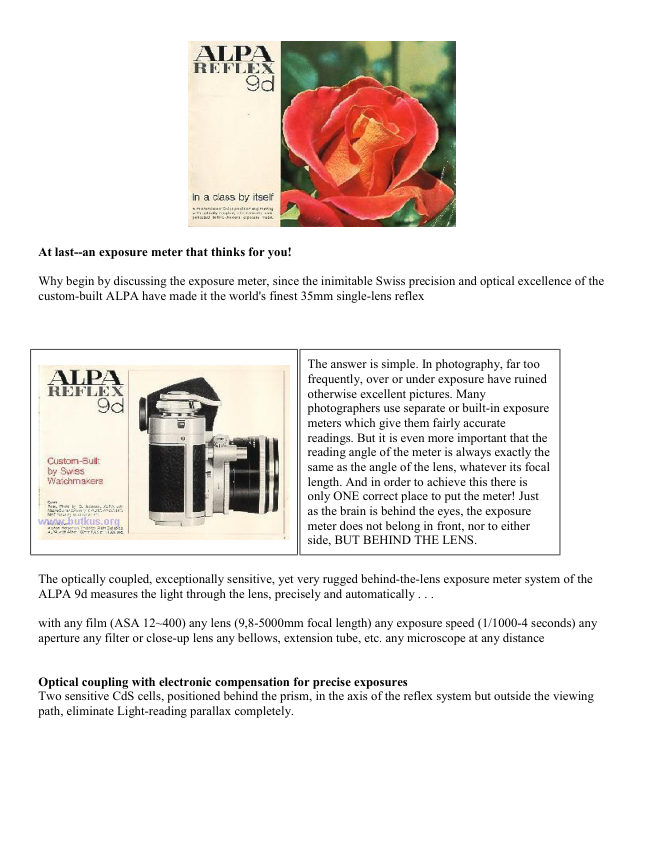
At last--an exposure meter that thinks for you!

Why begin by discussing the exposure meter, since the inimitable Swiss precision and optical excellence of the
custom-built ALPA have made it the world's finest 35mm single-lens reflex


                                         The answer is simple. In photography, far too
                                                     frequently, over or under exposure have ruined
                                                 otherwise excellent pictures. Many
                                                photographers use separate or built-in exposure
                                                meters which give them fairly accurate
                                                    readings. But it is even more important that the
                                                 reading angle of the meter is always exactly the
                                         same as the angle of the lens, whatever its focal
                                                      length. And in order to achieve this there is
                                               only ONE correct place to put the meter! Just
                                                   as the brain is behind the eyes, the exposure
                                              meter does not belong in front, nor to either
                                                         side, BUT BEHIND THE LENS.


The optically coupled, exceptionally sensitive, yet very rugged behind-the-lens exposure meter system of the
ALPA 9d measures the light through the lens, precisely and automatically . . .

with any film (ASA 12~400) any lens (9,8-5000mm focal length) any exposure speed (1/1000-4 seconds) any
aperture any filter or close-up lens any bellows, extension tube, etc. any microscope at any distance


Optical coupling with electronic compensation for precise exposures
Two sensitive CdS cells, positioned behind the prism, in the axis of the reflex system but outside the viewing
path, eliminate Light-reading parallax completely.
View original page 2Page 3 · Read text
What of the extraneous light that enters the eye-piece of every single-lens reflex?

ALPA's ingenious electronic feed-back compensation (patented) neatly solves this problem. A third CdS cell
facing the eyepiece measures any light which enters, and subtracts it, for absolutely precise exposures.

Thus, the ALPA 9d eliminates expensive film waste, which is especially important for all your color pictures as
well as critical scientific and industrial work. You always read the light BEHIND the lens, over the entire range
from wide-angle to telephoto as well as for close-ups and photomicrography.

Totally free from the need to calculate exposure factors, to consult charts or to interpret theoretical values, you
can now concentrate your entire attention on all the other unique features of the versatile ALPA 9d.


How to use the ALPA meter:
Whenever the needle seen on the ground-glass is centered in) the circle the meter indicates correct exposure
automatically:

1. Preset the most suitable shutter speed on both speed and meter dials. Then turn the lens diaphragm ring until
the needle is centered, which gives you the correct f/stop.

Or

2. Preset the most suitable f/stop, then turn the meter dial until the needle is centered. Read the correct shutter
speed and set it on the speed dial.

Contact with the standard 1.35 volt (or rechargeable) battery is only established, when the release is pressed.
The practical lock on the release button facilitates both exposure readings and depth-of-field control, preventing
accidental exposures.

Important:
ALPA's automatic readings do not necessarily mean automatic operation. Experienced amateurs as well as
industrial and scientific photographers will appreciate the versatility of the ALPA 9d which permits them to
change the f/stop manually to match the desired shutter speed or change the shutter speed manually to match the
desired f/stop, with a choice of 6a positive intermediate speed settings!
View original page 3
Page 4 · Read text
Focusing on the ground glass AND with the split-image Rangefinder


                                         The ALPA is equipped with the most advanced
                                                       reflex viewing system, for absolutely accurate
                                               framing and focusing of the 1:1 LIFESIZE
                                            image on your ultra-luminous ground glass.
                                            While viewing the picture, you see if it is
                                                            critically sharp.

                                    By aligning both halves of the diagonal (45°)
                                                    split-image you double check and pinpoint
                                               your focus instantly, automatically--with any
                                                          lens, at any distance, for any magnification I
                                                Thus, the boat will not be sharp until, by
                                                    turning the focusing ring, you "stick" its mast
                                                    together again.

                                                  Please note that the 45° diagonal split permits
                                           you to check sharpness both on vertical (mast)
                                                   or horizontal lines (balcony, motor car, etc.).

                                               Other exclusive features are the clear circle
                                              around the split-image, indispensable for
                                                   close-ups at higher magnification, the
                                                   millimeter scale (10mm cross) for exact
                                             measurements and the superfine grain of the
                                              ground glass for accurate depth-of-field
                                                        control.


ALPA 9dfront view: streamlined, ultra-modern design


                                                Typical of ALPA's modern concept are its
                                           smooth lines and attractive, well balanced
                                                    design. Made of a very strong, light-metal
                                                      injection molding, the ALPA 9d has the
                                                        sturdiest body of any camera, to withstand the
                                           most rugged use. Yet, it is exceptionally
                                               compact--only 5/ x 3/ x 2"--and unbelievably
                                                 kg-weight--a mere 21 ounces.  It usually comes
                                              equipped with the MacroSwitar, but can be
                                                            fitted with any of the interchangeable ALPA
                                                    lenses from 9.8mm up to 5000mm !


On the left is the self-timer, which ranges from 1-20 seconds, and the lock for the shutter release button. On the
right are the contacts for M and X flash synchronization.
View original page 4Page 5 · Read text
ALPA 9d top view: utmost ease and simplicity of operation


                                  On the right is the rapid-wind lever and the dial
                                                 of the electronically calibrated, Swiss precision
                                                       shutter, with speeds from 1/1000 to 1 sec. plus 60
                                                    positive intermediate settings

                                        The automatic exposure counter (behind the
                                             speed dial) returns to zero instantaneously when
                                                  the camera back is removed.

                                  On the left is the speed dial for the behind-the-
                                                   lens meter, with a center dial for ASA settings
                                           from ASA 12-6400


On the far left is the high speed rewind knob, featuring an ingenious parallelogram support that makes film
changing a matter of seconds.

The 2 eyelets for attaching the braided leather neck strap are recessed.
View original page 5Page 8 · Read text
180mm to 600 mm lenses


Complete ALPA lens system offers instant interchangeability

The wonderful photographs achieved with the ALPA and its amazing facility for resolving all photographic
problems are due in large measure to its complete range of 30 ALPA lenses--10 with Auto-diaphragm, 4
APOCHROMATS--from 9,8mm up to 5000mml The new reflex (behind-the-lens) meter makes their
interchangeability an even more valuable asset, spectacularly demonstrated by the 17 photographs in the
backfold of this brochure.
View original page 8
Page 9 · Read text
Each ALPA lens is individually film-tested and hand-picked for you. And each lens carries an unconditional
guarantee of optical excellence.

ALPA slip-in filters are made of the finest optical glass dyed in the mass, plane parallel and coated. They match
the outstanding optical qualities of the ALPA lenses and are subject to the same guarantee.

A separate lens brochure describes all ALPA lenses in detail.


The ALPA-Kinoptik Aprochomats
The Switar and Macro-Switar are perfectly color-matched by the KINOPTIK 100 mm f/2 and 150 mm f/2.8
Auto-Apochromats, unique high speed lenses of long focal length. Both produce the same incomparable
brilliance, high contrast, sharpness and true color fidelity (see pictures on page 8).

The ALPA-Switar Aprochomat


                                                         Precision ground by Kern,
                                                   world famous Swiss lens
                                                     makers, the Switar 50mm
                                                               f/1.8 with automatic
                                                  diaphragm is a magnificent
                                               Apochromat which gives an
                                                image of unique brilliance,
                                                     with razor-sharp definition
                                                 and high contrast, even at full
                                                            aperture. Its exclusive
                                                    apochromatic correction of all
                                               3 primary colors provides
                                                          precise color fidelity.


The Switar is calibrated for all distances from infinity to 3 1/4 ft. Red fractions indicate the reproduction ratios
of the image for all shorter distances, up to 1:9 (17").

The ALPA Macro-Switar Aprochomat
The Switar is surpassed only by its all-in one macro-version, the famous MacroSwitar 50mm f/1.8 Auto-
Apochromat, which effortlessly breaks through the near-distance barrier by focusing all the way down to 7
inches. In addition, the Macro-Switar features the KERN Visifocus depth-of-field scale. At its maximum
extension, the reproduction ratio is 1:3, i.e. a 3 times enlargement will give you a lifesize photograph of your
subject. The Macro Switar's exclusive facility for "point-blank" pictures enables the ALPA photographer to take
close-ups without accessories. . . anytime, anywhere.
View original page 9Page 11 · Read text
ALPA bellows - Placed
                                                             between camera and lens
                                                                                this invaluable accessory
                                                                       increases magnification,
                                                               opening up the fantastic
                                                              world of macro-
                                                               photography to the ALPA
                                                                    photographer. The ALPA
                                                  may be used either
                                                                        horizontally or vertically
                                                                   without changing the
                                                                        position of the bellows.
                                                               Coarse and fine adjustment
                                                                       are done by friction or rack
                                                            and pinion focusing.
                                                        The bellows are available in
                                                          two models: single track
                                                            and double track, the latter
                                                                      permitting focusing to a
                                                                   pre-determined scale. The
                                                                  range of the ALPA bellows
                                                                   provides a reproduction
                                                                                ratio of almost 3:1 with the
                                                                 Macro-Switar.


ALPA extension tubes
A normal set of tubes consists of two intermediate rings with a combined length of 6mm (screw/bayonet and
bayonet/screw) and four straight screw-in tubes of 6,12, 24 and 48mm length, for a total of 96mm. In
combination with the Macro-Switar, the complete set permits reproduction ratios up to 2~:1.
With the aid of the twin cable release (see picture) you retain the convenience of automatic diaphragm operation
when using either bellows or extension tubes.

Ultra close-ups
For even greater magnifications you can also combine ALPA bellows and extension tubes and/or add more
tubes.
A special close-up lens used in conjunction with bellows and/or tubes permits magnifications up to 10:1 or
more, completely bridging the gap between Macro-photography and Photomicrography.
View original page 11Page 12 · Read text
ALPA electric Motor 12
Volt DC - Already in
extensive use for scientific
and industrial photography
as well as action and sports
pictures, the ALPA now
becomes even more efficient
for such specialized
applications. The electric
motor can be operated with
a compact, lightweight 12
volt DC battery rod, which
stores sufficient power for
up to 500 exposures and can
be easily recharged from any
220 or 110 volt AC outlet.
Also available is a
transformer rectifier for
direct use from 220 or 110
volt AC outlets.
The ALPA electric motor
attaches to the ALPA
quickly and easily. When
ordering the motor, please
give exact ALPA model and
serial number. It provides
automatic film transport for
either single exposures or an
uninterrupted sequence of
one exposure per second.
The motor can be operated
by remote control, up to
distances of 300 feet.
View original page 12
Page 13 · Read text
ALPA 100 foot magazine - 100
                                                                          feet of film represent 800
                                                                standard 24x36mm or 1600
                                                                     single frame 18x24mm
                                                               exposures! The ALPA 100 foot
                                                         magazine easily interchanges
                                                             with the removable back. It
                                                                 accepts standard 100 feet rolls
                                                                      for daylight loading. A built-in
                                                                  knife lets you cut off the
                                                          exposed portion of film for
                                                          immediate processing. The
                                                         magazine features an exposure
                                                                counter which adds and
                                                                        subtracts, so that you can rewind
                                                          an exact number of exposures.


The dual addition of electric motor and 100 foot magazine brings the ALPA very close to a movie camera, but
under entirely different conditions of animation. The frequency of one exposure per second allows photographic
recording in numerous applications: scientific, industrial, police, identification, surveillance, armed forces,
aerial photography, etc. Sports and action photography take on a new dimension. The scope of both macro-
photography and photomicrography is widened. Copy work and microflming are automated and speedier. And,
with the special 18 x 24mm (17 x 22.5mm) models, the ALPA is also ideally suited for the production of
filmstrips for advertising, sales promotion and educational purposes.
View original page 13From the M. Butkus archive. Original publisher and archive notices are retained.
Check the model and edition against your equipment.
PDF verified 2026-10-10.