Film cameras
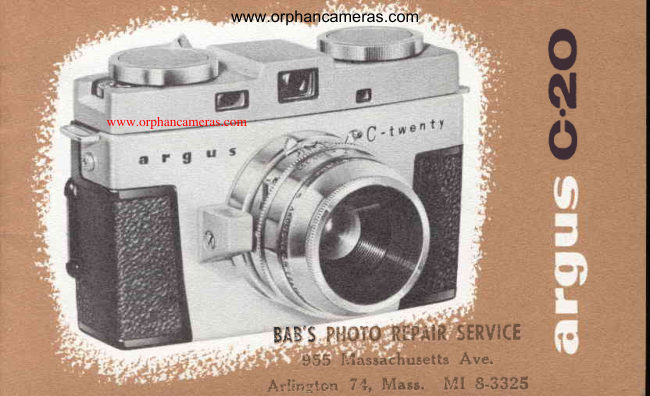
Argus C-20 User manual
User manual for Argus C-20. 21 pages in English. Read the original PDF, download or print a copy without registration.
21 pagesEnglish2.7 MB PDF
Loading your manual…Open PDF directly
Document details
- Brand
- Argus
- Model / document
- Argus C-20
- Document type
- User manual
- Language
- English
- Pages
- 21
- File size
- 2.7 MB
- Category
- Film cameras
- Document date
- Not specified in catalog
Search available document text
Find a term, then jump to its page in the original PDF. Image-only pages may not be searchable; check the PDF for exact wording and diagrams.
Page 2 · Read text
www.orphancameras.com    0


www.orphancameras.com                                 $l0


               BrlB'5PtjoTORIPAIRSERV|CI
                       955  l'.lassachusetts Ave.
                        .A.rlington 74, Mass.    F,lI 8'3325
View original page 2Page 3 · Read text
www.orphancameras.com


              Your new Argus C20 is a precision camera with
               outstanding ease of operation.  Its many  fine
                features  put   it  in an advanced  class, yet  the
              Argus system of Color-matic settings will  give
              you  beautiful  color  slides or  black-and-white
                 pictures your very  first  try.
                  This  book provides  detailed  information  on
               the features of the C2O and how  it  operates.
                 Familiarize  yourself  with  the lens, the shutter,
             and the rangefinder  before you Inad the fi,rst roll
                  of fiIm. This  will acquaint you with  the camera
             and prevent your missing an important  picture
               through  lack  of familiarity   with  its operation.
               Because Argus products are constantly  being
              improved, minor changes in the appearance of
                  this  product  may  not  be  included  in  this
                instruction book.
View original page 3Page 5 · Read text
www.orphancameras.com
%CzO

        The  shutter  speed setting  controls  the length  of time
          the shutter   is open when the  picture   is taken.  Num-
         bers on the scale are fractions  of a second and have
            "click   stops."  They   are  selected  by  turning   the
          knurled  ring  to bring  the index mark  directly   in  line
          with  the desired number.  Always  set th.e indet  mark
        on th.e nurnber.
         When the index mark  is set on "8",  the shutter  will
         remain  open as long  as the  shutter  release  is held
        down.  This  is for time  exposures. A tripod  and cable
           release   are  recommended      to  prevent
        ment when making  these longer
          To work  the shutter  without
           to  intentionally   double expose
           into  the "R"   position  (indicated
         camera), then release.
View original page 5Page 6 · Read text
www.orphancameras.com  DISTATICESCATEANDI}IDEX
             lf you focuswith the rangefinder,
        this scalegivesyou the distance
      from the camerato the subject.        7Zoe&O/a/rd
 SHUTTERSPEED
       Controlsopeningandclosingof        The 44mm  f/3.5  Cintar   lens  is coated  and  fully   color-
       the shutteraccordingto exposure      corrected  for  brilliant   pictures. The lens is automatically
      necessaryor type of subject.          focused by the rangefinder.
                                     The amount  of light passing through  the lens when the
  SHUTTERCOCKINGTEVER             picture  is taken  is controlled  by the aperture  (f/stop).  In
       This levercocksthe shutterfor          the C2O, you have a wide range of aperture  settings from
      eachexposure.                      the smallest opening,  f /22,  to the largest,  t/3.5. You ean
                                               set the aperture  on each number  or on any  intermediate
  CABLERETEASESOCKET             position. The  setting  clicks into  position  at each number
: ...'   YourC20shutteracceptsa           and  at the Color-matic   setting  between  f/5.6   alnd, f/8.      st#ard ASAtaperedthread         'release-recommended              If  the aperture   is too large  for  the  lighting   conditions,        caffi
       fortimeexposures.                 pictures   will  be  light  and  washed-out.    If  the  aperture
                                         opening  is too emall,  pictures   will be dark and lacking  in
                            'l'+                                     detail.  You can use the Color-matic   aperture  settinge  on  APERTURESETTING                                      page 7 for outdoor  pictures  in  bright  sunlight.  For  other
       Thisadjustmentcontrolsthe              lighting   conditions,  see the  outdoor  exposure  guide ou
      amountof light that passes          page t2 and the flash erposure  guide on page 14.      throughthe lenswhilethe
       shutteris open.
                               .::l:               ,

                                                                                      ,rii
View original page 6Page 8 · Read text
www.orphancameras.com
tu'gdotu

The  CzO lens  is  automatically   focused  when  the  rangefinder
images are lined up as shown on the opposite page.
  T.he left  eyepiece on the back  of the camera  is the rangefinder
window.  To use the  rangefinder,  hold  the camera as illustrated
and  turn  the focusing  ring  with  the thumb  and  forefinger   until
the images are lined up. Then look through  the viewfinder window
to take the picture.
  The camera can be held horizontally   or vertically.   f[ustrations
at  right  show how  to hold   it  comfortably.  As you become ac-
quainted  with  the camera, you may develop your own techniques
for holding  and focusing.
    It  is usually  best to focus on the main subject  in your  picture.
Ffowever, more  than  the main  subject  will  be  in  focus  in  the
picture due to what  is called a range of sharp focus. This range of
sharpness  increases  with  smaller  aperture  settings  and  greater
camera-to-subject   distances.   It  decreases with  larger  aperture
settings and as you move closer to the subject.
View original page 8Page 9 · Read text
www.orphancameras.com

                                                               'A         -        Zy
The Argue czocamera has a furl range of adjust-
ments,  but can be trsed like  the simplest  camera.
   Color-matic  settings on the aperture,  distance,
and shutter  speed scales provide  correct exposures
for average subjects  in bright  sunlight.   If  desired,
Color-matic   settings  can be used  for  the  shutter
speed and aperture  only, and each picture  can be
focused ueing the rangefinder.
  For  outdoor  sndpshots,  use  the  Color-matic
settings  for  your   film,  then  wind  film  and snap
each  picture   without   any  further   adjustments.
  Yellow markingsare used with  Kodachro
light  Color Film  (ASA  10).
  Red markingsare used with  Ek
Anscochrome   Daylight    Color   Films
Plus-X,  Supreme,  and  similar
films (ASA 32-80).

     When using  all the
     Wh.en your  subject
View original page 9Page 10 · Read text
www.orphancameras.com


     F U N D A M E N T A L S     O F  G O O D   E X P O S U R E
      On your  C20, the aperture,  shutter  speed, and distance  scales work  together  to
         properly  expose the flm  and provide a sharp, clear picture. The right  combination
          of  shutter  speed and  aperture  opening  always  provideo  correct  exposure  for  the
          picture  you are lqldng.
            Color-matic    settings   provide   best  erposure   in  bright   sunlight   with  average
          slrbjects;  however,  other  settings  are necessary for other  light  conditions.  Faster
          shutter  speeds with  larger  aperture  openings  can be used when you  wish  to  stop
          action. Smaller  aperture  openings may be used for a greater range of sharp  focus.
"ffi,,       For  example,  an average  exposure  in  bright  sunlight  might   call  for   l/1fi)    of a
 W"co:rd'         at  f/8.  A  faster  shutter  speed can be used  if some compensation    is made
          in t&e aperture  setting.   If you change the shutter  speed from  1/100  to L/2OO of a
       second for erample,  the shutter  is open only  half ae long- To compensate  for  this,
       move the aperture  setting  ftonf   /8 to  f /5.6 (one stop) and this provides an opening
         twice as large.  In  this way you compensate  for  the  faster speed of the  shutter.
             In the same way, a shutter  speed decreased from 1/1OO of a second to l/5O  of a
        second would  require  the aperture  opening  to be changed  from  f/8  to the  smaller
        opening qf f/LL  (one stop). Any  of thcse combinqtions  will providc the same erposure.
View original page 10Page 12 · Read text
www.orphancameras.com


Your   fi.lm  has  been  completely   exposed      as the  film  leaves the  take-up  spindle.
when   the  exposure   counter   reads  "O".
BEFORE   BACK    IS  OPENED,      film        Turn  rewind knob several extra turns
must  be rewound   into  film  cartridge.  To       to make  certain  film   is completely   in
rewind,   hold  wind  lever  in  "R"   position       cartridge. Back can then be opened and
(F)  to disengage  the winding  mechanism,       rewind  knob  pulled  up  to remove  film                              (3                           R"  position  stop      cartridge.Do not force leuer against
as this  uill  cause fiIm  to bind. Then  turn       Have film processed as soon as possible
rewind  knob   in  direction   of arrow   until        after exposing. All types of film may be
you  feel a change  of tension  (a slight  tog)      taken  to your Argus dealer.

                                                                10
View original page 12Page 13 · Read text
www.orphancameras.com


                                                                                  Shoothead-onto stop action.
     Beautiful  outdoor  pictures and color transparencies are easy with
     the  CzO. Check  the  picture  composition  through  the camera
     viewfinder  before snapping  the  shutter.  This  will  always  result
     in pictures  with more interest, and you  will be certain  that  you
    are not cutting  off an important   part  of the subject. Try  framing
     the scene with some nearby object  in the foreground, and include
    people when you  can  to add human  interest.  Watch   for  that
    unusual angle from  which  to take  the  picture,  or  try  a close-up
    using a neutral  background   to  place emphasis on the  subject.
      The outdoor  exposure guide on page 12 will help you to select          Scenesmakefine colorslides.
    the  correct  aperture  and  shutter   settings   for  different   light
    conditions  with  auerage outdoor  picture  subjects such as nearby
    people, gardens, houses, or light and dark objects  in about equal
     proportions.  Close aperture one stop from  chart  setting  for  light
    subjects (distant  scenery, marine,  beach, and snow scenes, light
    colored subjects  dominating).  Open aperture  one stop more  for
    dark subjects (dark  foliage, flowers, animals, and buildings).

l l
                                                                                Your C20takesexcellentportraits.
View original page 13Page 14 · Read text
SHUTTER  BRIGHT      HAZY    CLOUDY  CLOUDY GOLOR  FILMTS                      www.orphancameras.comSPETD    SUN      SUN     BRIGHT    DULL
 EktachromeDaylight                          50                  t /Il            t/8                t /5.6          ttq AnscochromeDaylisl
 KodachromeDaylight(or indoor                between     between                    ll25 at
  typewithfilter*l                    5{t             f /s.s &f t8      t/4 & f/5.6          t /3.5               t /3.5
 EktachromeTypeF*                                        between     between    between Anscochrome           FlashType*              5{t     t18&t/n    t15.6&tts    t/4 &t/5.6         t tl.s   (*withfilter)
 SuperAnscochromeDaylight      100                f /16                   t /ll            t/8                  t /5.6
O U T D O C l R     E X P O S   U R E   G U I D E        f o r a v e r a g e s u b j e c t s
 BLAGK.AND-\A'HITE         SIIUTTEN    BRIGHT     HAZY     CLOUDY    CLOUDY                          SPIED     SUN     SUN       BRIGHT    DULL
 KodakPlus-X
 AnscoUltra-SpeedPan           r00                 t /16                 t /II            t/8                t /5.6
 AnscoSupreme               r00                 t /LI           t/8             t/s.o         t/4
 KodakPanatomic-X            50              t /rl           t/8             tts.a          t/4
 KodakTri-X                   r00               t /22              t tto              t /rI           t/8
    *Filtersmustbeusedwithindoor-typecolorfilmsexposedin daylight.Consultmanufacturer'sinskuctions. 12
View original page 14Page 15 · Read text
www.orphancameras.com
 Mu    A2O    O
    IJnscrew bottom cap of flashgun and install two size C PHOTO-
   FLASH  batteries or a BC  unit. To attach the flashgun, plug  it
     into  side of camera.  fnsert  flashbulb  by pushing   it  in as far as
        it  will go. Do not twist flashbulb after   it  is in.
       Since the  intensity   of  light  changes with  the distance from
     the  subject,   it  is necessary to change aperture  settings when
    camera-to-subject  distances change. The guide number system
    on page 14 will  help you  to determine  correct  flash exposures.
      Guide numbers are given  in  the  table  for combinations  of
    popular  films and Sylvania  flashbulbs. With  other make flash-
    bulbs consult the flashbulb carton. Divide the appropriate guide
    number by the number  of feet between your camera and the
     picture  subject  to  obtain  the  correct  aperture  setting.
      Your  C2O is  automatically   synchronized   for  bayonet-base                                         (6X"     bulbs and for electronic  flash with       delay.
           To eject used flashbulb, push red button on top of flashgun.
l3
View original page 15Page 16 · Read text
www.orphancameras.comF L A B H   E X P O S U R E    G U I T ' E
          For EktachromeEXAMPLE:                                                                      Sylvania                                                             Sylvania                                                                               Sylvania
Type    F andSytvania                                                                            258                                                                  8              Bantam8        F I L M V   B U L B       SylvaniaSF Bantam                                                                    Press25  Press
flashbulbs,the guidenumber
is 80.With a subjectat l0 feet,       EktachromeTypeF           55*     80      130                          AnscochromeFlashTypedivide80 by 10, whicheguals
L Setthe apertureat f/8.          KodachromeTypeF           45*      65      100
Use a shutterspeedat l/25       KodachromeTypeA          55       60**     80**
secondwith wire-fifled(8, 25,       EktachromeDaylight                                                                   95258) flashbulbs.Use either        AnscochromeDaylight       Useblueflashbulbswith
l/25 or 1/50 secondwith gas-                        KodachromeDaylight             DaylightColorFilm         52filled(SF)flashbulbs.
  With electronicflash units,       SuperAnscochromeDaylight                           170
any shutter speed between       KodakTri- X                1 6 0     205     320
 | /25 and I /240 rnay be used.      AnscoUltra-SpeedPan                                                r15     135     230M2-typeflashbulbsrequire a        KodakPlus-X
specialreflector.Guide num-       AnscoSupreme          80      95       1 6 0
bers are suppliedby film and                        KodakPanatomic-X        65       75       r25bulbmanufacturers.
                                              *828-Upaflltcrrequlred. **8lC'typoflltcrroqulrtd.Guidenumbersfor electronic
flashunitsarefurnishedhy the   Flashbutbsoccasionallyshatter,and to avoid any possibledamage,a shield of translucent
unit'smanufacturer.         materialmaybe usedoverthe faceof the reflector.Neveruseflashin an explosiveatmosphere
                                                                    14
View original page 16Page 17 · Read text
www.orphancameras.com


                                                        Yotrr Argns CzO is a precision  optical  instrument.
                                                To keep your CzO in perfect  working  order,
                                                                protect   it from  dust, moisture, and heat.
                                           Do not store the camera in your  car's glove
                                                       compartment  or any other place where
                                                          temperature  tends  to rise. The  fine lens of
                                                          your CzO is ground,  polished, and coated
                                                                      with extreme precision.  If   it needs
                                                                   cleaning, blow  off dust  first, then use
                                                       a soft brush  with  a light  touch  or clean
                                                                                                                            it with  lens tissue. Use lens cleaning
                                                                       fluid only   if  it becomes absolutely  necessary.
                                                Working  parts  of your CzO contain  fine threads,
                                                                          tiny  screws, and sensitive adjustments.
                                      Never  force any parts  of the camera  to work   if they  resist.

      For sruice  or replrcement
         porb  contrct your  local   PRODUCTSERVICEDEPARTMENT,ARGUSCAMERAS,ANN ARBOR,MICHIGAN,
      Argw   Deol,er or write  to:     or ARGUSCAMERAS0t CANADA,LTD.,T0R0NT0,0NTAR|0.
l5
View original page 17Page 20 · Read text
www.orphancameras.com


 because  of bulb   failure.   Sylvania   "Blue   Dot"
           flashbulbs   are  especially   designed   for
consistent,   dependable    performance-provide
         split-second    lighting  when  you  need   it.
                                                       tr
                                H X F G S U F R H M H T H R


                   A  lifetime   of "good  picture   insurance."   A  perfect  companion
                             to any  camera.  Just  one touch  of the  dial  relates
                         apertures  from   t/L.4   to   f /22  with  a selection   of shutter
                      speeds from  120 seconds  to  1/1000  second-perfect
                        exposures   every  time  without   guesswork   or  calculations.
                           fncident    tight  adapter  and  leather  case included.   Booster
                           CelI  for  low-light   readings   available   as accessory.

                                                                                               l8
View original page 20Page 21 · Read text
www.orphancameras.com

                                  Your Argus C20 Carnera was manufactured,
                                       inspected, and tested by skilled craftsrnen.
                                                                 It  is guaranteed to be free of defects in
                                workmanship or material during  its lifetime.
                                                                If any seruicing is necessary becauseof
                                         irnperfections in materials or workmanship,
                                    your carnera will be factory seruiced
                                         witlwut clwrge.
                                  Argus equipment which lws been damaged,
                                    mislwndled or worn from extensiue use
                                                   will be faatory seruiced q,t established
                                         rates. Used or rebuilt equipment is not
                                  coueredby this gua,rantee.
                      TRGlJSCAMERAS,A]I]IARBOR,iIICl|IGAIIJunrnnteeDiuision  of Sytuania Electric Products  fnc.
                              tR0usGriltnts0t Gllll0l, [I0., I0R0]1T0,0llTARl0


                                                         PART   NO.  I1329-J77                                       L I T H O    I N U . S . A .
View original page 21From the M. Butkus archive. Original publisher and archive notices are retained.
Check the model and edition against your equipment.
PDF verified 2026-10-10.