Film cameras
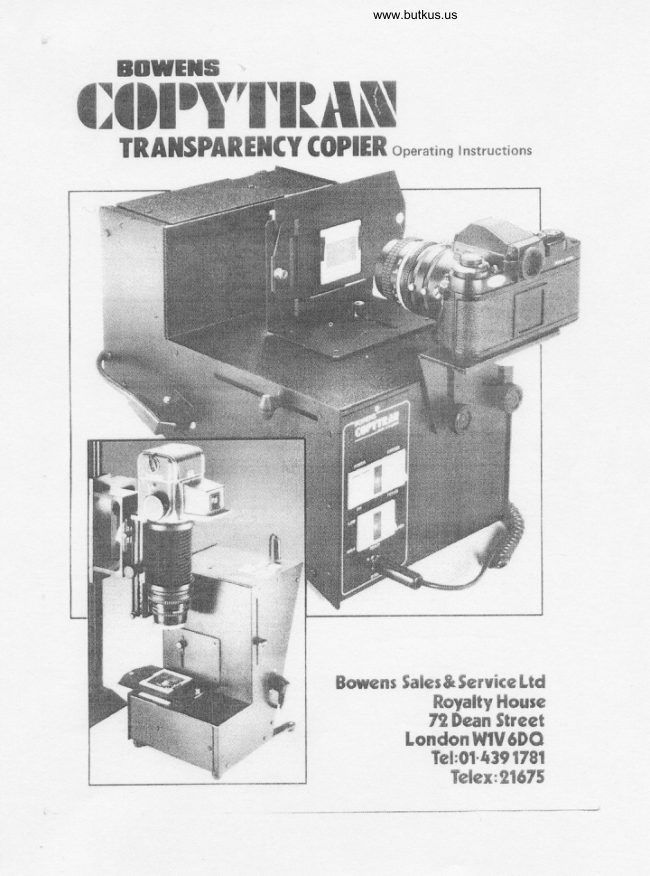
BOWENS COPYTRAN User manual
User manual for BOWENS COPYTRAN. 9 pages in English. Read the original PDF, download or print a copy without registration.
9 pagesEnglish7.3 MB PDF
Loading your manual…Open PDF directly
Document details
- Brand
- Bowens
- Model / document
- BOWENS COPYTRAN
- Document type
- User manual
- Language
- English
- Pages
- 9
- File size
- 7.3 MB
- Category
- Film cameras
- Document date
- Not specified in catalog
Search available document text
Find a term, then jump to its page in the original PDF. Image-only pages may not be searchable; check the PDF for exact wording and diagrams.
Page 3 · Read text
BOWETNS COPYTNIil HSTNUCTIOFuS
    | Gcnerol
                                                                                                   "* neutral,    Fit a 3pin plug to the mains lead as follows:- Brown wire * live, Blue wire
   Yellow/Green wire * earth (ground). Always connect to a 3fin socket.
   Assemble the Copytran as shown in the illustration.
    Plug in mains lead and switch ON {A}. With switch {B) set to'Focus', the opal djffusing scree.n
                                                           go out and 'Readv' neon {D)    {C} witf be illuminated. Switch to 'Expose' * focusing light should
    will light+. Test  f lash by pressing 'Flash' button {E).
   The low and high switch {F) changres th€ flash by one stop.
     *lt is normal for the'Ready'neon  to'tick'. This indicates that theflash is beingconstantly
    'topped up' an<J en$ures that the  f lash is exafily the same strength for each exposure.
   2 Iittlng lhc Ctrnero
     Fit the SLR camera body {with or without motor drive)* using the appropriate slot on the
   cameramountingbracket{Gitopositionthe|ensaxis{horizonta||y)withinj|luminatedarea.
   When fittinE the-camera to the bracket, en$ure the camera is square by locating the baseplate of
"e'* the @mera hard against the lip on the rear of the bracket.
    Adjust the height of the bracket to position lens axis {vertically}.
                                                                                            .- the final alignment is   NOTE: Only approxlmate positioning of the lens axis is necessary
    obtained by movement of the transparency frame (see section 3).
    *With sorne rfiotor drives, it may be necessary to repface tha normal carnera mounting
    bracket with one specially designed to take account o{ the additional depth and length                                                                      Code z05r''    requirements.
   3 $efiing up wirh Tc$ Jlidt
    The test slide has 2 main uses:-
     1 . lt provides a focusing and aligning targ@t-
    2. lt has a density which equals a correctly exposed average transparency.
     place slide in 3bmm frame holcjer, slacken knob {H)on focusing carrier, and position frame
    holder on carrier so that, viewing thrnugh camera,  it is central to viewiilg screen. Tighten knob
     {H}.
                                                  1 :1.      Initial te$ting should be carried out at
     a. lf a Macrs lens {50 or 55mm} is used, fit the 1:1 extension tube{s}.
     b. When using the standard lens, either fit the necessary exrension tube(s) for 1:1 copying
                                                                                                    a    or use **tunrlon bellovw {don't forget to set the iris from auto to manual}. lf preferred,
    standard enlarging lens {50/55mm} can be used in place of the camera lens. This has the benafir                                                                                    1 :1'    of having Ueen Cesigned for 'flat  f isld' to  'f lat {ield'. Adiust focus to give
    Move focusing lever {l} on Copytran to approximatety mid position. Slacken knob {J} and slide
     focusing carrilr until image in vieMinder is approximately sharp" Tighten knob {J}.'     Focus sharply by moving lever {l}.
     gecarrse most slicle maunts iboth careJboard ancJ plastic) have aperttrres smaller than the
   24x36mm lorrnat, a true 1:1 copV may show some o{ the stirJe mount at the very eclge of the
                                                                                                                         a    copy transparency. This. however, will usuallV be hidden when the duplicate is rnounted in
      slide.
     Additionally, some 35mm $LFl cameras show rnarEinallv less in the viewfinder than appears at
     the film aperture. To assist the Copytran user to take these two factors into account, the test
     transparency has different coloured lines around its periphery. The use of these is explained in
     section 5.
     | (hoito of filn
     Daylight Film
     Virtually any 'dayliglht' film is suitable for use with the Copytran when using  f lash as the
    exposure sourc€.
    The  f lash has a colour temperature of 5600 K, and under mc)st conclitions   f iltration will not be
    found necessary.
View original page 3Page 4 · Read text
www.butkus.us

Artifisial {Lightl Film
The C*ptitran hfi$ a Qu*rta Hal*gen focusing lisht {3,20O K}, which is suitable for direct use
*n 'artificial'   f ilrn  "
Kodak film No. 5O71 has a relatively low A$A rating and require$ an expCIsure time of at least
1 *ec. Determine ap€rtur* by a test film tsection 5),
Kodak film No. 50-3S6 requires a short expo$urs and is intended for use with the flash. A
basic filter pack of Wratten ?B+CC 6OY+0C t0C ir recommended to conv€rt the colpur af the
flash to balance with this particular artificiat film. {NOTH; Filtration requirernen$ may vsry from
sne film batch to another. Kodak give guldance with eech filml. The exposurs level usually falls
hetween f4 and f8.
5ilI*ing rlnrc* filn
Always make a resr film when using a different tilm for the first time. This is tCI determine both
cxpo$ure settinE and whetl"rer any filtratisn ir required.
 't. Use test slide provided.
2. Centralise and focus as explained in section 3 at 1:1 magnification.
3. lf using flash, connect sync. lead and $et fl6$h to fult. $witch from focus to flash.
4. Make a ssries od oxposures frorn maximum to minimum ap€rture {Freferably at ]/c stop
   increments), keeping a record.
5. Procers film and examine bath film and test slide agoinst a neutral light sourc€ to esteblish
   corr8ct expo$urs.
6" lt a colnur shift is requlred and filters are added, taks these intc aceount on your
   'estsbl ish€d exposure'.
7. The lines around the edge of the transpsr€ncy aro speced at one millimetre intervals and
   wilf assist in overcorning viewfindor/slidsmoufit  discrepancies.
t tluhing iopy frunrporcn*l+r
Th* exposure for your camera/fens/film cornbination at 1:1 has tleen establishecJ in sectian S
for copying a nCIrmally exposed transparency. Allortrance rflu$t b* made if ;-
a. The exposure on your original is not correct, or, the sutriect content is not average" By
   looking at the overall dsnsity cf yt:ur slide cornpared to the test $lids provlded, ths netd for
   a change in exposure can quickly be seen. NOTE:  lf the subject content is not average, but
   an exact copy is required, use the 'eetablished exposure'setting.
b. lf you are making a cspy which ls not 1:1, i.e. enlarging icropping) or reducing, then
   allowance must also be rnade in the exposure level"
When enlarging, the original transparsncy csn be moved out Bf squar*/centre by slackening
                                                                                                                                                      isknob {Hi. ftre magnetic frame holder wllt be held in any given pnsition whilst the pi*ture
cornp**ed in the viewfinder. Re-tighton knob before exposing. When filter* artr used, the clips
 {K} immediateiy in front cf the opal screen will hold 3'"x3" gelatin*s.
     L
   M
    K


                                                                                                                       Digitally signed by Mike Butkus
                                                                                         DN: cn=Mike Butkus, o=Butkus camera manuals,
                                                                                                    ou=butkus.org, email=mike@butkus.org, c=US            Mike Butkus  Date: 2020.10.12 23:02:58 -04'00'
View original page 4Page 5 · Read text
J

7 Through rhe lcns melering
wherr usingan sLH with T'TL nreteringandsn automatic  iris, in many ca$es it will bepossible
tr: r"rtilise these features when nraking rjuplicates on the Copytran.
The fof lowing is a guide to this automatic exposure.

                                                                                                          asAfter making your test film and establishing your exposure, with youl cameral-lens s€t
before for l:1 copying and viewing the test slide with the focusing light on,, adjust the ASA
setting on your cameri untilthe automatic  iris setting equals your'established exposurg':
For I6o asn  f ilm, your carnera will probably need to be set around l600-3200 ASA. {The
difference in settingcompensate$ for the difference of viewing with the focusing light and
exposing with the fiash.l Once the correct ASA setting for your camerallens has been
establishecl, any other slide to be copied will be corr€ctly exposed using TTL metering.
NoT[: This wili autonratically csrrrpensate for enlarging, reducing or adding filter.
lMpofi-rANT: The above system cannot be used with non{utomatic extension rings or
bellsws.
I Copying 6rt slidcr
By crranging the 35rnm sf ide carrier {L} to the 6x6 carrier, any 6x6 can be copied on tCI 35mm-
io            slides with a 6xG camera, an independent camera stand rnust be used-   "opy-6xb      the Copyrran on end tsee inset on front pagei and swing out the two feet. Position theTurn
Copytran beneath the camera, fccus the camera approximately and th*n utilise the fine
focusing movement o{ the Copytran.
A test filrn of an average tJensity transparency should be made to establish an exposure for
a 1:1 copy.
 I taintensnce
 Changing the focusing lamp:
 1. Unplug the unit from the power supply'
 2. Flemove the 2 scre\^rs {M} on the top of the lamphouse and r€move cover'
 3. Remove mirror box cover.
 4. Replace the focusing lamp with a Ouartz Halogen lamp Ref .No.M35 (1?v2Ow). (Do not
                                                                                   f ingers.)   touch lannp glass with your bare
 5. Feplat:e covers and screws.
 Changing the fuse:
 This may become necessary when the Copyffan  is switched on but fails to work'
 The fuse {N} is located adjacent to the power socket and should be replaced with a 5 amp
 20 mm glass cartridge fuse.
 lf the equipment still fails to work, consult your nearest Bowens dealer or Bowens of London
 direct.
 DANGER HIGH VOLTAGE
 Only a qualified engineer should effect an internal repair'


 Accessories                                   $pare Parts
 Bellows unit                    Code ?053  Sync lead (coiled)              Code 1831
 Bracket for Motorised Camera    Code 2054   Target trarr$ParancY            Code 2110
                                         Frame carrier with 35mm and ZYe"sq-
                                                 transparency holders            Code 21 I 1
                                                Carnera bracket & screw         Cods 2113
                                            Mains lead                    Code 5012
                                            Halogen lamp M35              Code 21O5
View original page 5Page 6 · Read text
www.butkus.us


*-F*-g

     PHC}TOI' CORT:
        100SOUIHvAf,lBRUNTSf,POBOX448,ENCtEt,OOD,NJ07631    NJi20l)568-7771  NY(?121695'8166 TELEX'135344mPHf,fO

     INITIAL CAI,IBRATION PROCEDURE FOR BOT,IENS COPYTRAN:
         Tfre Copytran is  furnished with an Ektaehrome cal.ibration  transpsrency, which
     should be used for  initial   set*up and should be retained for reference.
       The calibr:ation  tranparency includes a focusing Iarger,  color patches and a
    grey scale, so ic  is designed to be useful  for determining color  filrracion
     packs and exposure, ss welt as for precise framing.  Tlrere are  radial  cenLering
     lines on the calibrating  transparency and red concentric frame lines marked for
     various s izes   .
        Calibrating  the Copyrran involves the following steps:
             t.   Ftahing a series of Eest exposure$ of the calibrating  transparency
     ar L:1 magnification.
         2.  Picking out the cl"osest match from your test  roLl  to the calibration
     Lransparency.
         3.  Recrearing the conditions under which the best duplicaLe was produced,
     aperture,   f i.1rer pack ancJ power setting and feeding this  informarion in
        t.r yoUr Camer"-8.
         lJe have nade some tests using various films as a duplicating medium
    which can serve as a $tarting  point.

                                                                             50mm     Please note:  These tescs were made roiLh a Canon camera arrd a Canon
       t"ta"ro*f eils*wirtt  life  size  (t:  t ) aclaprer in place.  The aperCures referred
     to below are those shown on the lens setting  ring and include a bellows
     facror correcfion  for the adapter.  Other llacro lenses may not include
      this  feature,  in which case a nominal aper[ure of f6.3  is  suggested.
    Kodachrome 25:   fl1 1A SkJlight. Filter   low Powel !S.!:!g
    Kodak 30366 (Short Exposure Dupticating  irilni),   f11.4$- + l5Y- + lq,  Higtr
     Power
    Kodak 5071 Dup Film {not recorunended ):  using rnodelling lamp for exposure:
        2p * 20Y + 35C I  sec.    lB,
      To set your cam€ra m€rer to duplicate the exposure setting do the
      fol lowing:
           Put yollr camera into qanual mode
                                                                                                      1 I be us ing  .               l.   Set your silutter  speed to  lire X synch speed you  r,ri
         2.  Set rrp for stopped-down metering.
         3.   Adjr.,st the film speed dial  (nor fhe shutler speeg) uncil the indicated
            aperlure matches Ehe setli"ng which produced Ehe correctly exposed
              dupl ic aLe  .
            I'rlhen making future   f ilter  changes do not change shutter speed, or film
     speed setti.tg.   Adjr:st aperture as indicated by the meter.
View original page 6Page 7 · Read text
Reprinted Frorn Popular Phctography._February 1984

          FI RST LOOK
                                     By Norman Rothschild


              BOWENS COPYTRAN
                       Slide duplicator is both versatile and easy to use
                               As in the Illumitran, the nrain fight  arriving at c{)rrect flash erxposure, using
                                      $Ource iS electfoniC t'lash. The "low"  yOur cantera's through-thc.-lens meter^
                                                  flush pcsitian gives enough light fcrr r"rse '['o proceeci. first establish the correct f-
                                                  rvjrh slow- to medium-speecl cnlor"rlide stop as ourlirred  ittrrtve. Set this l'-stop ort
                                            or negative films"                       your lens. No\r, writh the lbcusing light
                                  The "high" power is advised fr.rr use on and the slide tcl b* c,opied in place, ad-
                                   with such slow duplicafing films as  just the ISO {ilm-speed dial until you get
                                     Ektachrome 5071 or 5()366, or lirr copy- the same f-stop reading on your camera.
                                         ing very dense <lrigirrals. If you prefer,  trn general, this procedure compensal.es
                                  you can make expclsures ofr tungsten-  fr:r rlifferences in slide density, fihration,
                                      lype colr:r film, including duplicating andimagemagnification.
                                          stack, using the Copytran's 3,?00 K      Transparegnrcj$[rorn,J-5,-l$m uptoand
 ' Slrrlc dupiicator; 70x70-mm                                                       ri1i1l41;41:1rirr,.+i{i1$!11$i 'rn$yl&+Opied  witlr the| Qu#Yt2jngilwffitrffislfi€iT                                                                                                                !{'1u ar-    unit, Its magnettr:  slicler hnldcr may be            l''Daylight-balanced (5.600 K) flash lubre,    A fest slicle ir provided ro hclp  recycling time, lwo,s+c                       rive at correcl exposure.  }'r'ru catt l.tncl a    crentered lor nror,rrrfing off-cenler 1r) c0py          i
 I i:lead\ indicalor, high/lnw     f iasfr-iniensily    hasis lbr this by nraking flash cxposurcs    spcc:ific irrcss t.rf'alt urigirral.'I'he                 i
   $sttlngs                                   at  l.: I rnagnificaljon, rvith stops from tire    Clupytlan's filter holdrr:, wtric,h mount$      i
 ' Buill-in voltage stahrilization                      lrrrgest to the snallest, and comparing  re-   below the slic'le holder, accepls 3x-1-in.      I I SlicJe holders for 6x6-crn and 35-mm                                               sults rvith the tcst slide" Frorn then on,     gelrrtin, glass, crr the new acrylic ltiters of                  I  lransparencres . Permits eniarging, reducing, cropprng,  frl"    rnath or tables wili let you compensate   any make.                                                                                                                        i
  tering, exposure correction, lilting,   for other image magnifications or firr     Copytran may be usecl horizontally on                 I
  supenmpoErng                                      filters.                                     a desk or vertic.ally uncler a copystarrd, It                 I
. Can be used horizontallv  or verticallv            'fhe tcst slide also has markings 1o help   comes with a universal camerft-mount-     j
                                    you compensilte  f'or framing differences    ing bracket: nn optional bracket is avail-          I I | | i ou are lookr rtg fcrr a slide copier with   between the finder imagr arrd the slide-    able fcrr use with motor drive,                                                   i
ihe qu;rlitv of l}rwens Illumitran, but   rno$nt format. If yr:ur originals irre un-      Price of fhe cluplicator is $?69: the mo-           i
rvithout its plice, consider the Copytran.    der- or overexposed, you'll have to us;e    tor-drive bracket is $ 1 1.95. Ilogen Photo          I
Actuall.v, it has fleaturcs and a personal-   judgmen  t to con-lpensate,                 Corp., 100 So. Vrin Brunt St.. F)ngle-    I
ity quite tts or,r'n.                                              I prefer Bowens'  alte rnate mEthod 1br    rvood, N.J, 0761 1, rs the distributnr, O
                                                                                                                                                                                                                                                                                                                                                                                                                                                                                                              i
                                                                                                                                                               _i
View original page 7Page 8 · Read text
www.butkus.us
Rr;printecj frorn f ilf'J(:i] 1ilf'.lAl* PI"-1OI-CORAP|JY JanuaryI f:ebruary. 1$83
  Auality
  Duplicating Unit
     The new Bowens CoPYtr*n has a
      unique inclined design whlch allows use
     on a desk toP or coPYstand

      Son Garbera, Edilor
            T ec h n   i ca I P h ot og ra Ph 5t
         Bowens is well known for its various    using the universal thread attach-
        products that are designed for the    ment screw is that when thecamera is
        photographic indusiry, in particular    unmounted, the screw cannot be
       the lllumitran 9lide DuPlicating     reattached. This h0wever, can he        System. Bogen is now distributing    remediad by picking uP a rubber
         another duplicating unit for Bowens    washer that fits the screw,
        that is less exPensive, Yet still     Packed with the CoPYtran is an        produces quality. The new Bswens      Initial Calibration Procedure that is
                                                                                                  a        Copytran is aPProximatelY 14"x9"     quile impressive; it not only gives
       and has a unique inclined design
         whrch allows vou tCI use it 0n a desk
         top or turn tl're unit on its end for use
        0n a copystand (see Fig. #1)'
         The slide stage sf the CoPYtran is
         mcvable icr  f oc us adiustments' A line
         focus lever is al"so included on the left
         side of the unit. 6els attach via clips
                ii'5tiae stage. Slides fit into a holder
       on the stage and the h,Jidier can be
         adJUsted lor precise tramtng ol the
        image becar".ise  it is held in ptace by
         maqnetic cofitact
          The lrr;:ighl of the camera bodY rest
          is also adjustable 1o accommodate
         almost any lens and bodY combina-
           tion. The unit is extrernely simple to
          use, the sync cord connector is at the    step-by-step guide to the use o{ the
        bottom of the control panel located     unit, but also gives recommenda*
                                                                            Pack.        on the lef t side of the back of the unit,     tions for a starting filter
         facing the operator. lf you're right     What impressed me the most aho$t
        handed everythtng rs at tinger reach.     the lnitial Calibration Guide is that on
                                                                                                                                                                                                            f ilter recom-         The user can manipulate a camera     testing the unit with the
         with the right hand, and the controls    mendations lor S0-366,  I found  it to
          of the Copytran with the lelt. There is    be accurate to withrn a 5C shift. Thts
      an expose and focus switch also    shows that a lot r:f care went into the
         located cin the control panel which     writing of the technical data for the
         allows you to preview a slide, as well     instrument. By the way, the starting
        a$ an open ilash swltch.              pack recnmmendations fcr $CI-36$
                                                        + 5C with flash set on          There is also a high and low flash    are 2E | 55Y
                                                                                         F         setting {for that extra measure of    high power, The recommended         €xposure control required for certain    stop (which was also {ound to bs
         stides). The intensity difference     quite accurate) is F-'11.
        between the two settings is approxi-          I neglected to mentiorl sar{ier lhat
           rnately a stop and a half. Aiso incor-    the unit also comes with a test sitde
         porated intC) the contfol panel is a    that has color and black-and-whit*
                           f lash ready light The flash has a two*    gray scale bars along with ntimtrers
        second recycie tirni: at both high and    and a bull's eye {or focusing, an<i with
           lCIw settings.                               all attachmenls for 35mm arld ?l'i
         The unit comes with a heavY dutY    duping.
       AC cord a hieavy duly sYnc cord. and       In conclusron.  I louncJ the Copl-
        a universal tl9read attachment ior tha     tran unit to tre an extrernely versatlle
         samera that fits several slots for righU    toal that could be considered an
             left carnera posrtioning on the unit.    average maR's slide duPlicat0r
       One rninor inconvenience when    because 0f its iow Price.
View original page 8From the M. Butkus archive. Original publisher and archive notices are retained.
Check the model and edition against your equipment.
PDF verified 2026-10-10.