Camera accessories
Canon Bellows M User manual
User manual for Canon Bellows M. 32 pages in English. Read the original PDF, download or print a copy without registration.
32 pagesEnglish3.1 MB PDF
Loading your manual…Open PDF directly
Document details
- Brand
- Canon
- Model / document
- Canon Bellows M
- Document type
- User manual
- Language
- English
- Pages
- 32
- File size
- 3.1 MB
- Category
- Camera accessories
- Document date
- Not specified in catalog
Search available document text
Find a term, then jump to its page in the original PDF. Image-only pages may not be searchable; check the PDF for exact wording and diagrams.
Page 3 · Read text
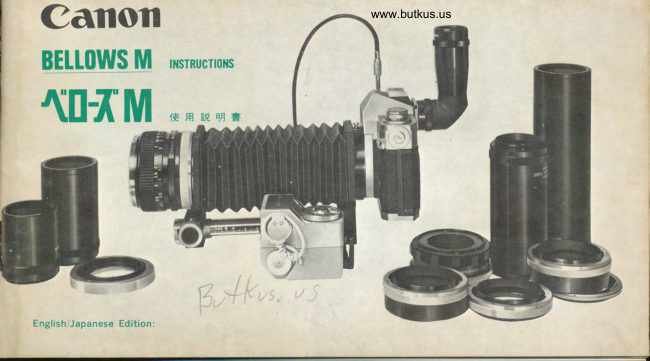
CANON BELLOWS M
Canon Bellows M is an apparatus for use on Canon F-1. FTb at
other Canon single-lens reflex cameras.  Photographic magnificati<
can be continuously obtained in close-up  photography and macroph
tography.
r Canon Bellows M can be attached to Canon 75 and Canon 7 wit
the use of Mirror Box 2.
Together with Canon Bellows M, we recommend the use of Macr
Canon Lens FL SOmm F 3.5, with its ultra-high resolving Powef,  drl,
Canon Bellows Lens FLM lOOmm F 4tor greater close'up photograph
and macrophotography  advantages.
rThe technical data of these lenses can be found on page 24.
*Itz.{tr-zM
J-o)/:tI'lJ, +f / >-iIr-X"M aAH'''ltJr,''/:/J'3, *:  t l:4
 0hrL. j :'Au,*f.  +rr / >-sr:-Z'M,J, +I/  >F-1, FTba
tJ D&b t t b + r / >-HR v 7 tt /,  a*)LUEEEFdHHF#ET, WE
+tfttft.F i:'ffH L < +ftfrti*+t E{ffi,L ( -$&) b .  t rr(" 3 * f   .
                                                                                 Y) {<                          2 z 2 HtttJHL(4X.                                                              ftttlfrE  +t / > 75, 7 ry.tr,J : 7 -,J-i'u
nr('3 *f     .
                                                                         >t*4  . +E*tftFtt*Ef.firlt:t  6ffiHffiv*fi v > A,                                                               -? 7 s + r /
v > A FL50mm F3.5 A t,Orl:, +t / >-sr:-X'v > A FLM 100mn
F4 a r{tH t r;t iD L * f   .
{,1'46gtnr, 24-25 H l:;1ry L< i> g * f   .
View original page 3Page 7 · Read text
2. Attaching Lens onto Bellows
The lens is attached onto the bellows in the same manner as when
 attaching it onto a camera. Set the red dot of the lens to the key
groove of the bellows and attach the lens onto the bellows. Turn the
 bayonet ring to the right and tighten the lens into position.
r For removing the bellows or the lens, just perform the attachment
procedures in reverse.


Man ipulation
1. Adjusting of Bellows
Turn the adjustment knob, extend the lens and focus. In order to
tighten, turn the tightening knob, on the opposite side, clockwise.
r Keep the tightening knob loose before turning the adjustment knob.


6t                                                                                                                                                                                                                t
View original page 7
Page 9 · Read text
2. Focusing
Please refer to the chart on page 12. The chart contains the photo-
graphic magnifications, shooting distances and bellows scales for the
various lenses. Therefore, it is convenient to first decide the photo-
graphic magnification you desire and then to obtain the shooting
distance from the chart.
r The shooting distance is measured from the film plane mark on the
ca mera.
3. Bellows Scale
The scale that indicates the extension volume of the bellows is scaled
in equiintervals and in millimeters. The minimum and maximum ex-
tension lengths are 33mm and 145mm respectively.
tThe scale readings are obtained at the white dot index mark in
f ront of the extending section.
4. Attaching on Tripod
Use a tripod or copying equipment when photographing. In either
case, the entire unit will be better balanced when the tripod or copy-
ing equipment is attached to the attachment socket on the bottom
side of the bellows instead of the tripod socket of the camera.


                                                                                                                                                                                                                                                                                                                                                                                                                                                                                                                                                                                           -:;:\\':          fi
View original page 9Page 11 · Read text
,     l,l.tr.i        :r,                              The proper exposure would be the f''number
1. Exposure Factor                            obtained with the exposure meter multiplied
The lens speed is decided with infinity as the    by four times. Therefore, in case the finum'
basis. When the distance between the lens     ber obtained with the exposure meter is f/11,
and the film plane increase, the amount of    the f,number is opened two stops' to fi5.6,
light reaching the film plane decreases. Thus,   and if the shutter speed is 1,160 sec. the
                                                                                    twothe actual speed of the lens becomes slower.     correct speed would be to slow it down
                                                                         1.,15 sec.With the exception of the through'the'lens     stages to
metering system,  f, numbers obtained with an    2. Effective Aperture
exposure meter cannot be used as they are.   The depth of field becomes very shallow in
The exposure must be increased according to     close-up photography and macrophotography
the increase in length of the bellows extens-     using the bellows. Use as small an aperture
ion. This percentage of increase is called   as possible with the limit of the biggest
exposure factor.                                 aperture being around f/5.6.
Calculation formula for exposure factor    :         r In the case of single-lens reflex cameras
                                                   /            n'\l                   with through,the-lens metering system, suchExposure factor B- (                 1+ +                                      t/  )               as Canon F-l and Canon FTb in which the                             \
             or B: (1-r- magnification)2          actual light volume coming into the lens is
     x' denotes extension length of lens        measured, the above calculation is  not
       f  denotes focal length of lens                     n ecessa ry.
Example:  lf the bellows is extended 5Omm
when using a 50mm lens.
      /    En \3 B=f l + *)    :(1  rI:l:-O      \    5U/
10
View original page 11Page 27 · Read text
r illl'ii  tl'r  [,r ::ir,,; .S: i-  ;a; f!t.i.:i'i]l  i.  i i+i:li;  t
Macrophoto Gouplers FL 48mm, FL55mm and FL 58mm
These macrophoto couplers used for attaching lenses in a reversed
direction when performing larger than life'size macrophotography.                                                               screw  $I Three types of couplers are available according to the
diameter of the lens.
Extension Tubes FL 15 and FL 25
High grade extension tubes with automatic diaphragm coupling
mechanism for use with FL lenses.
Extension Tube M
Extension tube for use with simple type FD and FL lenses. Available
in 5mm, lOmm and 2Omm sizes.
Lens Mount Converters A and B
Lens Mount Converter A is used when mounting an FD or FL mount
lens onto an accessory with a screw mount, and Lens Mount Con'
verter B is used for attaching a reversed mount.
r Various other types of extension tubes are available.                         ffffi

                                                                             ffi'
26
View original page 27Page 29 · Read text
Precautions
r When the magnification becomes large, the slightest movement will
blur the film. Always use a tripod and a cable release when shooting.
I Automatic aperture does not couple with R lenses for Canonflex'
In this case also, attach after pushing down the charge lever.
r In the case of macrophotography, set the distance ring of the lens
at infinity.
I In macrophotography,  cornering off partially appears in the viewfinder
but this will not affect the photographed image'
I In close.up photography and macrophotography, the use of incident
ray type exposure meter is recommended'


28
View original page 29
From the M. Butkus archive. Original publisher and archive notices are retained.
Check the model and edition against your equipment.
PDF verified 2026-10-10.