Camera accessories
Mercury battery replacement — PX13, PX625, MR9 and PX27 Reference guide
Reference guide for Mercury battery replacement — PX13, PX625, MR9 and PX27. 14 pages in English. Read the original PDF, download or print a copy without registration.
14 pagesEnglish0.5 MB PDF
Loading your manual…Open PDF directly
Document details
- Brand
- Various brands
- Model / document
- Mercury battery replacement — PX13, PX625, MR9 and PX27
- Document type
- Reference guide
- Language
- English
- Pages
- 14
- File size
- 0.5 MB
- Category
- Camera accessories
- Document date
- Not specified in catalog
Search available document text
Find a term, then jump to its page in the original PDF. Image-only pages may not be searchable; check the PDF for exact wording and diagrams.
Page 1 · Read text
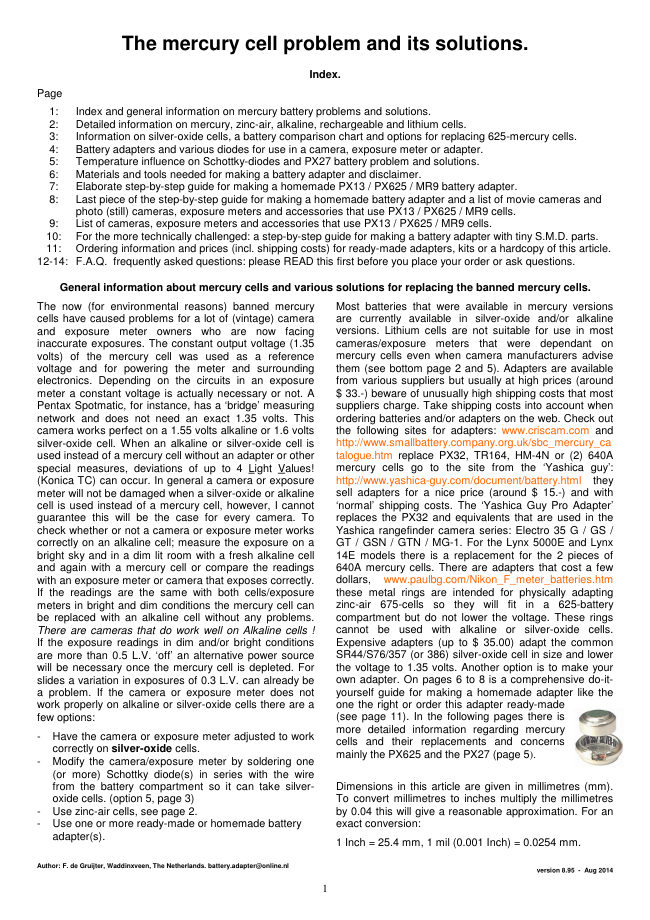
The mercury cell problem and its solutions.

                                                    Index.

Page

   1:   Index and general information on mercury battery problems and solutions.
   2:    Detailed information on mercury, zinc-air, alkaline, rechargeable and lithium cells.
   3:    Information on silver-oxide cells, a battery comparison chart and options for replacing 625-mercury cells.
   4:    Battery adapters and various diodes for use in a camera, exposure meter or adapter.
   5:   Temperature influence on Schottky-diodes and PX27 battery problem and solutions.
   6:    Materials and tools needed for making a battery adapter and disclaimer.
   7:   Elaborate step-by-step guide for making a homemade PX13 / PX625 / MR9 battery adapter.
   8:   Last piece of the step-by-step guide for making a homemade battery adapter and a list of movie cameras and
       photo (still) cameras, exposure meters and accessories that use PX13 / PX625 / MR9 cells.
   9:    List of cameras, exposure meters and accessories that use PX13 / PX625 / MR9 cells.
  10:   For the more technically challenged: a step-by-step guide for making a battery adapter with tiny S.M.D. parts.
  11:   Ordering information and prices (incl. shipping costs) for ready-made adapters, kits or a hardcopy of this article.
12-14: F.A.Q. frequently asked questions: please READ this first before you place your order or ask questions.

    General information about mercury cells and various solutions for replacing the banned mercury cells.

The now (for environmental reasons) banned mercury    Most batteries that were available in mercury versions
cells have caused problems for a lot of (vintage) camera    are  currently  available  in  silver-oxide  and/or  alkaline
and  exposure  meter  owners who  are now  facing    versions. Lithium cells are not suitable for use in most
inaccurate exposures. The constant output voltage (1.35    cameras/exposure  meters  that  were  dependant  on
volts)  of the mercury  cell was used as a reference    mercury cells even when camera manufacturers advise
voltage and  for powering the meter and surrounding    them (see bottom page 2 and 5). Adapters are available
electronics. Depending on the circuits in an exposure    from various suppliers but usually at high prices (around
meter a constant voltage is actually necessary or not. A    $ 33.-) beware of unusually high shipping costs that most
Pentax Spotmatic, for instance, has a ‘bridge’ measuring    suppliers charge. Take shipping costs into account when
network and does not need an exact 1.35 volts. This    ordering batteries and/or adapters on the web. Check out
camera works perfect on a 1.55 volts alkaline or 1.6 volts    the following sites for adapters: www.criscam.com and
silver-oxide cell. When an alkaline or silver-oxide cell is    http://www.smallbattery.company.org.uk/sbc_mercury_ca
used instead of a mercury cell without an adapter or other    talogue.htm replace PX32, TR164, HM-4N or (2) 640A
special measures, deviations of up to 4 Light Values!    mercury  cells go  to the  site from the ‘Yashica  guy’:
(Konica TC) can occur. In general a camera or exposure    http://www.yashica-guy.com/document/battery.html  they
meter will not be damaged when a silver-oxide or alkaline     sell adapters for a nice price (around $ 15.-) and with
cell is used instead of a mercury cell, however, I cannot     ‘normal’ shipping costs. The ‘Yashica Guy Pro Adapter’
guarantee this  will be the case for every camera. To    replaces the PX32 and equivalents that are used in the
check whether or not a camera or exposure meter works    Yashica rangefinder camera series: Electro 35 G / GS /
correctly on an alkaline cell; measure the exposure on a   GT / GSN / GTN / MG-1. For the Lynx 5000E and Lynx
bright sky and in a dim  lit room with a fresh alkaline cell   14E models there is a replacement for the 2 pieces of
and again with a mercury cell or compare the readings   640A mercury cells. There are adapters that cost a few
with an exposure meter or camera that exposes correctly.     dollars,  www.paulbg.com/Nikon_F_meter_batteries.htm
If the readings are the same with both cells/exposure    these metal rings are intended for physically adapting
meters in bright and dim conditions the mercury cell can     zinc-air  675-cells  so  they  will   fit  in  a  625-battery
be replaced with an alkaline cell without any problems.    compartment but do not lower the voltage. These rings
There are cameras that do work well on Alkaline cells !    cannot  be  used  with  alkaline  or  silver-oxide  cells.
If the exposure readings in dim and/or bright conditions    Expensive adapters (up to $ 35.00) adapt the common
are more than 0.5 L.V. ‘off’ an alternative power source    SR44/S76/357 (or 386) silver-oxide cell in size and lower
will be necessary once the mercury cell is depleted. For    the voltage to 1.35 volts. Another option is to make your
slides a variation in exposures of 0.3 L.V. can already be   own adapter. On pages 6 to 8 is a comprehensive do-it-
a problem.  If the camera or exposure meter does not     yourself guide for making a homemade adapter like the
work properly on alkaline or silver-oxide cells there are a    one the right or order this adapter ready-made
few options:                                             (see page 11). In the following pages there is
                                                more detailed information regarding mercury
-  Have the camera or exposure meter adjusted to work
                                                                     cells and  their replacements and concerns
   correctly on silver-oxide cells.                                                         mainly the PX625 and the PX27 (page 5).
-  Modify the camera/exposure meter by soldering one
   (or more) Schottky diode(s) in series with the wire
   from the battery compartment so  it can take silver-    Dimensions in this article are given in millimetres (mm).
   oxide cells. (option 5, page 3)                      To convert millimetres to inches multiply the millimetres
-  Use zinc-air cells, see page 2.                        by 0.04 this will give a reasonable approximation. For an
-  Use one or more ready-made or homemade battery       exact conversion:
   adapter(s).
                                                 1 Inch = 25.4 mm, 1 mil (0.001 Inch) = 0.0254 mm.


Author: F. de Gruijter, Waddinxveen, The Netherlands. battery.adapter@online.nl
                                                                                                                                                      version 8.95  - Aug 2014

                                                    1
View original page 1Page 2 · Read text
Mercury cells such as PX13, PX14, PX27, PX32, PX400,    Stack solution 2: Use a conductive spacer between the
PX625, PX640, PX675 and other types are (because of     cells with a small piece cut out of  it as shown
environmental reasons) no longer available, produced    on the right. Make this from copper or other
and imported in most countries all over the world. The    metal  foil. The example on the right is made
mercury in the cell is a highly toxic heavy metal and can    from a conductive self-adhesive  foil that can
do a lot of damage to the environment. There are many                  easily be applied to a zinc-air cell as shown
manufacturers that made the 625-cell under their own              on  the  left. The  glue on  this  sticker  is
part  number:  4370,  4371,  PX13,  V13PX,  EPX13,                 conductive. When this sticker is applied to a
V625PX, PX625, KX625, RPX625, EPX625, HD625,                    cell so that one air hole remains open the
PN625 RM625, 4625, 625, H1560, H-D, HS-D, M01,                  sticker  will  seal  off  the  other holes and
MR9, 1124MP, M20 and 8930. Many salesmen do not    therefore  will  last longer. The  air can reach the  cell
know the difference between mercury and alkaline cells    through the gap formed by the cut-out part of the sticker.
and  will try to sell you (in  all ignorance) alkaline cells   When 675-cells are used to replace PX625 cells you
stating these cells are the same as mercury cells and are    might need to  fill up the space (0.04" = 1 mm per cell)
interchangeable without any problems, sadly however,     with metal no. 10 flat washer(s) (hardware store). Centre
this is not true! There are rumours mercury cells are still    the cell with rubber O-rings or, even better, (needed for
produced and available in China, look for those on the     electrical contact) order the tightly fitting metal ring from
web. Make sure you are not sold ‘old stock’ that has been    www.paulbg.com/Nikon_F_meter_batteries.htm.
waiting on a shelf for 6 years or longer, these cells will                                                       For cameras like the Rollei 35’s these solutions are not a
certainly not last long! The main reason mercury cells                                                  good option because the (half full?) film must be taken
were used is the constant output voltage of these cells                                                           out of the camera to change the batteries.
during their lifespan. This constant output voltage makes
simple and effective exposure meter  circuits possible    There are  ‘replacements’  for  the PX625,  the  ‘Wein’
without the need of (expensive) reference components   MRB625 and ‘Rittz’ MX625. Regrettably these cells are
and a  lot of electronics. Their large capacity and low    expensive compared to 675-hearing aid cells. These cells
prices also made it popular.                                are 675-cell sized and come with metal adapter-rings to
                                                           centre them. Both of these cells have fewer holes than
Zinc-air cells are intended for use in hearing aids to
                                                               ‘normal’  675-cells  and,  therefore,   will  last  longer.
replace mercury cells. The cheap 675-hearing aid cells
                                                            Unfortunately these metal rings are quite loose around
are sold in blisters and can be used in most cameras/
                                                           the cell and not easy to apply (not so with the metal ring
exposure meters directly but their lifespan is limited to
                                                     mentioned  above). The  ‘Wein’ MRB625  also has a
only 2 to 4 months depending on make, humidity and
                                                somewhat lower output voltage (1.36 Volts). It has only 2
temperature whether current is drawn or not since they
                                                          holes instead of the usual 3 or more; this causes the cell
literally dry-out over time. These cells are smaller than
                                                                  to dry-out more slowly and will therefore last longer, up to
625-cells and need to be held in place with an adapter-
                                                 1 year according to the manufacturer.  If you don’t mind
ring. There are cheap adapter-rings (a few dollars) made
                                                      changing and buying these expensive 625-substitutes
from metal but anything to centre the cell will do also, like
                                                                 regularly you can have a very good substitute in these
a rubber O-ring, faucet washer or a rolled piece of paper.
                                                                        cells.
Some cameras, however, use the protruding rim of the
PX625 cell to make contact with the battery compartment    Alkaline  cells such as LR44 (60-80mAh) and 625-
and won’t work with a ring that is not made of metal. In     alkaline  ‘replacements’ such as  the V625U, KA625,
this case a metal ring is necessary to make contact with    R625, EP625G and LR9 (150-200mAh) are not suited for
the battery compartment. As long as the seal remains on    most (vintage) cameras and exposure meters. These
the battery it will have a shelf life of at least 6 years. After     cells are often sold (a piece or in blisters) on markets, in
the seal has been removed air gets in the cell through    warehouses, dump-stores and drugstores. They cannot
little holes, the cell is activated and after 1 to 5 minutes    be used because of their too high voltage and, more
the output voltage will be high enough and ready for use.    important, their sloping discharge properties (see  ‘dis-
This cell needs access to fresh air or it will not be able to    charge comparison’ chart on page 3). A fresh cell has a
deliver the right voltage so a hole or gap somewhere in    voltage of 1.55 Volts, then rapidly falls to 1.45 Volts and
the battery compartment or battery-cap  is necessary.      falls slowly down to 0.9 Volts. Alkaline cells are inexpen-
Zinc-air cells, however, can be stacked directly on top of     sive and only if there is no difference or if the differences
each other since the holes from one cell (or more, if 3 or     in readings  of the exposure meter are smaller than
4 cells are used) are not completely sealed off by the    0.5 L.V. in all light conditions compared to readings with
negative side of the other zinc-air cell(s) and will be able    the original mercury cell, these alkaline cells can be an
to deliver the proper voltage. The fitting problem can be     excellent replacement.
solved easily with the following 2 solutions.
                                                NiCad or NiMH rechargeable cells are also not an option
Stack solution 1: make an empty battery casing as                                                   because  of  its  limited  capacity (60-80mAh),  sloping
described on page 10 (the right half of the page). Make 3                                                         discharge curve and high self-discharge rate. When fully
small dents from the outside of the plus                                                     charged they have a voltage of 1.38 Volts but falls very
(+) side of the battery casing so that on                                                                  rapidly down to a much too low 1.2 Volts.
the  inside 3  small bumps appear as
shown on the  right. A 675-cell  that  is                 Lithium Manganese (Li-MnO2) cells are not suited as a
placed inside the battery casing will now                 replacement for mercury cells because of a much to high
be somewhat elevated so air can get into                   output voltage (3 Volts) small capacity, sizes and their
the air-holes. Zinc-air cell(s) will  fit perfectly in a battery    sloping discharge characteristics (see: chart on page 3
compartment when  this adapter  is used because the    and text (right bottom) page 5). Lithium-Iron-Disulphide
0.04" (1mm) height difference between the 675 cell and     batteries (1.5 Volts) are available in ‘AA’ penlight size
the PX625 cell is corrected too.                              only and recommended for usage in low temperatures.
                                                    2
View original page 2Page 3 · Read text
Silver-oxide cells, under certain conditions, can be good    Option 3: an adapter is a good solution if the camera or
alternatives. The voltage of these cells, 1.6 Volts, is too    exposure meter must remain in its original state or if the
high to be used directly without reducing the voltage.    wires from the battery compartment are not easy to reach
Silver-oxide cells, however, do have a constant output    as with the Rollei 35 series. Also  if the batteries last
voltage  like mercury  cells. An adapter with a build-in    1 year or more, or  if the camera/exposure meter is not
device to lower the voltage to (an average of) 1.35 Volts    used very often a battery adapter is a good solution. Use
is the solution. An SR44, S76, 11077SOP, SP76, EPX76,    the € 15.00 ($ 20.-) ready-made adapter (page 11) or the
SB-B9, RW42 or 357 silver-oxide cell (150-190 mAh) with    $ 32.99 MR9 adapter from C.R.I.S. Camera Service:
an adapter fits in the battery compartment of a camera/    www.criscam.com or the V206A adapter from Gossen:
exposure meter. There are also alkaline cells with the    http://www.gossen-photo.de/english/foto_s_batterie.php
same outline as the SR44 such as LR44, A76, S76A,     C.R.I.S. also has adapter solutions for other types of
V13GA, PX76A and RW82, do not mistake these for    mercury cells. For replacement of PX32 and other cells:
silver-oxide cells, they are not the same and certainly not    http://www.yashica-guy.com/document/battery.html  The
interchangeable.                             MR9 adapter from C.R.I.S. has two drawbacks; the first
                                                     problem  is  its inability to handle currents over 200 µA
An adapter has two functions.                                                       (microamperes) very well because of the applied diode
                                                           (probably 2 germanium diodes in series). Readings with a
 1.  Adaptation of the somewhat smaller SR44 cell to the
                                                     Nikon F can be ‘off’ –1 to +3 L.V. when the C.R.I.S. MR9
     larger and differently shaped 625-cell.
                                                         adapter is used! (See page 4.) Another problem is the
 2.  Lowering the output voltage of a silver-oxide  cell
                                                             height of this adapter with a S76/SR44/357 silver-oxide
    from 1.6 Volts to the desired 1.35 Volts.
                                                                         cell in it, which is 0.015 inch (0.38 mm) thicker than the
                                                                    original PX625 cell and won’t  fit well in some cameras/Below are the discharge characteristics of various equal
                                                     exposure meters. The MR-9 fitted with a 386 cell has toosized batteries under identical load conditions.
                                                                                              little height and an even smaller capacity than when it is
                         discharge comparison                  silver-oxide
         3                                                               alkaline              fitted with a 357 cell. An adapter with a 357 cell has half
                                                      NiMH             the capacity of a PX625 cell and, therefore, will last about
         2.5                                                         mercury
                                                                                    zinc-air              half as long too. The diode is placed in the bottom of the
         2                                                     Li-MnO2       MR9 adapter and not in the rim like in the homemade
                                                         adapter that does not suffer from these drawbacks.          (volts)
         1.5
         output   1                                              OptionThis can4:beadjustquite difficultthe camera/exposureand you can do moremeterharmyourself.than
         0.5                                                 good. There are no general guidelines on how to do this
                                                           since  every camera/exposure meter  is  different and
         0                                             needs another method or  specific order  of adjusting
           0      0.1      0.2      0.3      0.4      0.5      0.6      0.7      0.8      0.9     1
                 service life of equal sized cell with identical load              under controlled conditions. So do this ONLY if you have
                                                           expert knowledge and know exactly what you are doing!
Attention! The ‘battery check’ reading on a camera or    Option 5: solder one  (or more) Schottky diode(s)  in
exposure meter may give erroneous readings when a    series with the wire from the battery compartment and
battery adapter  is used because the ‘load’ of the test    use silver-oxide cells. A diode is a semiconductor that
circuit may be too high, this does not mean the adapter    passes current in one direction and blocks in the other
does not function properly. When a fresh silver-oxide cell     direction. Every diode has a certain voltage drop across it
is used with an adapter, mark or remember this ‘battery    as current flows through it depending on the material it is
check’ reading and use  it as a new ‘full battery’ reading   made of (germanium or silicon), its structure (Schottky)
when using an adapter.                               and the amount of current flowing through it. (see page 4)
                                                                                                   If the ‘+’ of the battery is connected to the chassis of theBe sure never to short-circuit the cell and adapter, this
                                                 camera or exposure meter, solder the diode(s) in seriesmay result into failure of the Schottky diode.
                                                              with the wire from the battery compartment
Alkaline cells cannot be used in an adapter because their    as in the upper example on the right. If the
output voltage is not constant enough during its lifetime.      ‘+’ of the battery (also) has a wire attached
Only Silver-oxide cells can be used because they have a     to the battery compartment you can solder
constant output voltage like mercury cells.                   the diode as shown in the lower example.
                                               The colour of the diode and ring may vary
Options for replacing the PX625.                       depending on make and type. The ring or
                                                         coloured band on the diode represents the cathode.
Option 1: have the camera/exposure meter adjusted to   Make sure you have enough room to place the diode and
work correctly on a (1.6 Volts) silver-oxide cell. This is a     insulate the diode and its wires properly.  If the camera
sometimes costly, but probably best, long-term solution.    takes 2 cells, solder 2 Schottky-diodes in series with the
An old camera or exposure meter is bound to be a little    wire or one (1) 1N4148 silicon-diode, 3 cells: solder one
inaccurate after more than 20 years of service and it can’t     (1) 1N4148 silicon diode and 1 Schottky diode in series.
do any harm to have  it serviced anyway. The cost of    4 cells: solder two (2) 1N4148 silicon diodes in series.
servicing and or adjusting or calibration is dependent on
make, model and  service department  that does the    Option 6: a homemade adapter can be a good solution
calibration. An adapter is not necessary in this case.         (see option 3). A homemade adapter  is cheaper and
                                                       performs better than the C.R.I.S. Camera Service MR9
Option 2: zinc-air cells can be a good solution in some    adapter. You do need some manual  skills  for  the
cases but only if battery compartment is accessible from    assembly of an adapter. Comprehensive descriptions for
the outside of the camera. Info on zinc-air is on page 2.      making homemade adapters are on pages 6 to 8 and 10.
                                                    3
View original page 3Page 4 · Read text
Choosing the optimal Schottky diode.                 Research done on various voltage lowering diodes.

Cameras and exposure meters that last a year or longer   A multimeter with current measurement ranges was used
with their batteries, such as Rollei 35’s, have a maximum     to measure the minimum and maximum drawn current
drawn current between 0 - 200 µA (micro-amperes). For    from the battery when  it is connected in series with the
all those cameras/exposure meters the C.R.I.S. MR9     battery and the camera/exposure meter. The current is
adapter can be an excellent solution as long as the    measured in low light level conditions (indoors in a not
battery compartment allows the 0.015 inch (0.38 mm)    too bright room) and in bright conditions (on a bright sky,
extra height. For cameras/exposure meters with a current    not  directly into the sun  in case of an SLR!).  If the
between 2 - 1,000 µA, a homemade adapter fitted with a   maximum current remains below 700µA the BAT81S,
BAT43 Schottky diode is an even better solution and is    (DO-35),  or BAT83S  (DO-35),  BAT41,  1N5711  or
suited for all cameras and exposure meters.  If the   1N6263 (DO-35), or BAS70J (S.M.D.) can be used. If the
0.015 inch (0.38 mm) extra height of the MR9 adapter    current range  is between 5µA and 2mA the BAT43,
with a silver-oxide cell poses a problem, the homemade   BAT46 (DO-35) or BAT54J (S.M.D.) will do fine.  If the
adapter is the only solution since  it has the exact height    current range  is between 50µA and 5mA the BAT47
of the original PX625 mercury cell. Below is a comparison    (DO-35) will do. Above 5mA a Schottky diode is not an
chart  for an adapter  fitted with a BAT83 and BAT43    option  anymore.  Schottky  diodes come  in  different
Schottky  diode, The  C.R.I.S. MR9  adapter, PX625    packages, the DO-34 (Diode Outline) measures (max.) 3
mercury and V625U alkaline cells are also shown in the  mm long (without the wires) and 1.6 mm across. The DO-
chart. All measurements are made at room temperature    35 measures (max.) 4.3 mm long and 1.9 mm across.
with a silver-oxide cell as a power source.                  Very small S.M.D. (Surface Mount Device) Schottky
The X-axis from the chart is neither logarithmic nor linear    diodes such as BAT54J and BAS70J also can be used.
for the following reasons:                            The ‘J’ suffix is very important in this case, it stands for a
                                 output comparison                     SOD-323 (Special Outline Diode) casing which measures
    1,6                                                         only 2 x 1.5 x 1 mm (L x W x H) and has two pads for
    1,5                                                          soldering  it directly onto a P.C.B. (Printed Circuit Board)
                                                             without the need of any wires. If little pieces of wire are
    1,4                                                      soldered onto these solder pads this diode can be used
    1,3                                                              also. Below is a comparison chart for various Schottky    (volts)
                                                            diodes, C.R.I.S. MR9 adapter, PX625 and V625U cells,
    1,2
                                               1N4148 silicon diode, AA119 germanium diode(s) and a   output
                           PX625 mercury
    1,1                    V625U alkaline                                  2 kΩ (kilo-Ohms) resistor. All measurements were made
                       MR9 C.R.I.S.
                          BAT43                                                at room temperature with a silver-oxide cell.
     1                    BAT83
                                                                                          Comparison of diodes, batteries and MR9 adapter
    0,9
       1      5      9      15     25     42     75     130    230    330    500    700    1000   1500              1.6
                                           current  (micro-amps)                                                                                                      PX625 mercury
                                                                                                                 1.5                                                           SR44 silver cell
1. Every increase in Light Value means doubling of the                                                                        V625U alkaline
                                                                                                                 1.4    light-level of the previous Light Value resulting in the                                                               MR9 C.R.I.S.                                                                                                                                                                2 X AA119 Ge
                                                                                                                                                    AA119                                                                                                                                         Ge   following light-level scale: 1, 2, 4, 8, 16, 32, etc.                                                                                                                 1.3                                                                                                                                                         1N4148                                                                                                                                                                                                              Si                                                                                                                                                                                                                                                                                                                                     (volts)
                                                                                                                                                 BAT43
2. In most vintage cameras/exposure meters a CdS-cell             1.2                                                            BAT83                                                                                                                                                                                                                                                                                       output                                                                BAS70J
  (Cadmium Sulphide cell, a Light Dependant Resistor)             1.1                                                                      2k resistor
  was used as a light sensitive device. The variation in                                                                        BAT47
   resistance is not linear to the amount of light falling on            1                                                              BAT54J
    this  resistor,  therefore,  the  current  through  the             0.9
    resistor,  if a constant voltage is applied, also will not              1    5    9   15   25   42   75  130  230  330  500  700 1000 1500
   be linear to the light level.                                                                                current (micro-amps)

The steps on the X-axis are analogue to Light Values    Schottky diodes, other than the ones mentioned in the
                                                              chart above, also have been measured but are notfrom (this case) a Nikon camera. (L.V.1 = 1 µA to L.V.15
                                                           included since they have identical characteristics to other= 1,500 µA). Ideally the output voltage of an adapter,
                                                        diodes already shown in the chart. The BAT81, BAT82under varying current loads, should be equal to the output
                                                  and BAT41 have similar characteristics as the BAT83.voltage  of a  mercury  cell. The  voltage  drop  of a
                                               The 1N5711 and 1N6263 are positioned exactly between(Schottky) diode is dependant of the current through  it.
                                                           the BAS70J and BAT83. Do not use diodes other thanAs the current increases the voltage across the diode
                                                           the ones mentioned above. Germanium diodes (AA119also increases (a  little), because the output of a silver-
                                                              or OA  types)  haven’t  got  the  right  characteristics.oxide cell remains the same under varying current loads,
View original page 4Page 5 · Read text
Note: The output voltage of an adapter with a silver-oxide    stack will fit in most battery compartments (provided the
cell cannot be measured with a multimeter without an     battery compartment contacts allow 1.5 mm extra height).
additional ‘load’. The internal resistance of a multimeter is    Most cameras and exposure meters will not have any
very high, as a result hardly any current will flow through    problems with a voltage of 6.2 Volts instead of 5.6 Volts
the diode and the voltage across the diode also will be    from the original PX27 mercury cell. Minox 35EL, GL, GT
negligible. The output voltage that is measured will be    cameras for instance work perfectly on this somewhat
around 1.5 to 1.6 Volts and not around 1.35 Volts. If the    higher voltage and do not need to have the voltage
adapter with a silver-oxide cell is loaded with a resistor of    lowered to 5.6 Volts. If this stack won’t  fit in the battery
around 10kΩ (kilo-Ohms) the average output voltage,    compartment (Rollei 35TE  / SE / LED), 386-silver-oxide
when used  in a camera or exposure meter,  will be     cells can be used. A 386-cell (120-140mAh) is 1.2 mm
measured.                                                   shorter compared to the 357 (SR44) cell (150-190mAh)
                                                  and  if 4 of these cells are stacked they will be 3.7 mm
Temperature influence on Schottky diodes.                                                                  short. Fill this gap with metal ring(s) to obtain the correct
As with all semiconductors, Schottky diodes also react to     height. There are adapters on the market that use 4 of
changes  in  their temperature. When the temperature    these SR43/386-cells to replace the PX27, such as the
increases the voltage drop across the diode decreases,    ‘Minox battery conversion kit’ for ordering these look at:
as a result, the output voltage of the silver-oxide cell/    www.smallbattery.company.org.uk/sbc_v27px_adapter.htm  or
diode combination will increase. When the temperature    the V27PX adapter from C.R.I.S. This adapter does have
decreases the voltage drop across the diode increases,    a voltage lowering  circuit and delivers 5.6 Volts. The
therefore, the output voltage of the silver-oxide cell/diode    adapter  is suited  for the Rollei 35SE, 35TE, 35LED,
combination will decrease. For Schottky diodes the tem-    Minox 35’s and a  lot of other cameras and exposure
perature influence on the voltage drop  is somewhere    meters. Look at page 1 for more adapter selling websites
between -1.2mV/oC to -1.6 mV/oC depending on type and     for replacing various types of mercury cells.  If you  still
current. Most cameras/exposure meters will be used at   own a PX27  cell you can easily check  if a stack of
room  temperature  or somewhere  around   it.  Below    4 alkaline or silver-oxide cells are the answer to the
freezing point a lot of cameras will also have even more    problem by measuring exposure on a bright sky and in a
problems than just with their batteries. A camera with a    dim lit room with the PX27 and with 4 LR44 alkaline cells.
temperature of over 104oF (40oC) feels very hot  if you       If the readings of the camera/exposure meter are the
keep  it in your hands. Mostly, cameras/exposure meters   same with both types of cells the PX27 can be replaced
will be used within a temperature range of 32oF (0oC) to     with a stack of 4 alkaline or 4 silver-oxide cells without
104oF (40oC). The measured output voltage of a battery    any problems. Do not use alkaline and silver-oxide cells
adapter fitted with a BAT83 Schottky diode at tempera-     together! Stacking 4 zinc-air 675-cells is not an option
tures of 32oF (0oC), 68oF (20oC) and 104oF (40oC)  is    because the air holes from 3 of the 4 cells will be closed
shown in the chart below.                                           off by the other cells and will not be able to deliver the
                                                      necessary current.
                    temperature influence on BAT83 Scottky diode
                                                                                                   If the readings of the exposure meter are not the same
     1.6
                                                              with both kinds of batteries only silver-oxide cells can be
     1.5                                               used and a 1N4148 silicon diode with BAT43 Schottky
                                                        diode must be soldered in series with the wire from the
      (volts) 1.4                                                          battery compartment. This  will give
     1.3                                                       the proper voltage drop and will bring

            PX625                    mercury                                                           the output voltage down to around     output 1.2            BAT83           @ +40oC                                                           5.6  Volts.  Solder these diodes  in
            BAT83 @ +20oC
                                                              series as shown on the right. If only     1.1      BAT83 @  0oC
                                                           the  ‘-‘ side of the battery compart-
      1                                             ment has a wire attached to it; solder
       1    5    9   15   25   42   75  130  230  330  500  700  1000 1500     the 2 diodes in series with this wire,
                                   current  (micro-amps)                       the cathode of the diodes (the stripe
The PX27 mercury cell and its replacement.      or ring) must point towards the ‘-‘ of the battery stack.

Cameras and exposure meters that take PX27 mercury   CR1/3N or DL1/3N cells Lithium-Manganese cells are
cells (150-180mAh) also will need a replacement. If PX27   NOT a good replacement for the PX27 mercury cell even
mercury cells can be found keep a few of them in stock.   when camera manufacturers recommend them. These
There are plenty alternatives  for replacing the PX27     cells have a nominal voltage of 3 Volts (when fresh) and
batteries  such  as SPX27BP  or PX27S  silver-oxide    a height of 2 SR44 silver-oxide cells. These lithium cells,
batteries or the PX27A alkaline battery, these batteries              however, have an extremely sloping output
are the best alternatives as a replacement. Also battery               voltage (see ‘discharge comparison’ chart on
          adapters  that take 386  cells can be used.            page 3). From the moment these cells are
          Another alternative for this battery is a stack of             used their voltage will drop steadily. When it is
         4 alkaline LR44 or 4 silver-oxide SR44 cells.              halfway  its capacity the output voltage has
          Stack 4 of these cells atop of each other and               already dropped down  to 2  Volts and  will
         wrap a thin sheet of plastic or paper around it              continue to drop further to 1.2 Volts before
         as shown on the left. Use cello-tape to keep              ending  its  useful  life. Most cameras using
          the roll together, make sure the cells do not    these  cells have  electronic  shutters. A  Lithium  cell
stick to this roll. The plastic roll must be somewhat loose    nearing  depletion may  give a  ‘normal’  battery  test
around the cells and keeps the cells together and isolates     indication but cannot deliver the current bursts that are
the individual cells to prevent them from being shorted by    needed for proper shutter operation resulting in wrong
the metallic wall of some battery compartments. This    exposures and/or ‘strange behaviour’ in some cameras.
                                                    5
View original page 5Page 6 · Read text
Required materials and tools for making a PX625/MR9 battery adapter.


               Be sure to read the entire manual before starting to make the adapter.

Important liability notice: Modifying a camera/exposure meter and/or making a homemade adapter are at your own
risk. The author of this article is not liable for any personal injuries or any damage caused as a result of any actions
taken because of this article. The contents of this article may be used, copied and distributed freely as long as the
contents are not changed in any way.

Materials required:                                    Tools required:

          An alkaline cell of the type 625; never use     A drill and a vise with 3 and 10 mm drill bits. Or, a stand
           a Mercury cell! (see page 2).  If there is            drill with a vise and the necessary drill bits. A center
           any doubt about the kind  of  cell,   it  is       punch can prove to be very handy.
              better not to use that cell at all because of                                                       Combination pliers or long-nose pliers for pulling out the
the hazardous nature of the materials that can escape                                                         metal and plastic rings.
when opening a Mercury cell.
                                          A 40-60 Watts soldering iron with a small  tip or a
A Schottky diode as mentioned on page 4. One or more        soldering station for use with electronics. A soldering
of the mentioned types should be available at your         iron with less power than 40 Watts will not be able to
electronic parts shop. The BAT43  is included in the       heat the battery casing enough to make the solder flow.
625-kit*.  If you need another diode please ask when     A soldering iron with a power of over 60 watts is likely to
ordering the kit.                                   damage  the  Schottky-diode  or  the  isolator when
                                                               soldering the diode onto the solder-able foil.
Glue. Preferably, a 2-component glue; however, any                                          A breakaway utility knife or scalpel.
filling glue that can bond metal and plastic (or paper,
                                                            TIP: This knife can also be used to keep the heat away
when a paper isolator is used) together will do.
                                                        from the isolator when soldering the diode onto the
                                                               solder-able  foil by  holding   it between  the  foil and
Solder of the type used for soldering electronics. This is
                                                                         isolator.
called 60/40  rosin core  solder,  with a diameter  of
0,7-1 mm;  it is sold on a reel, a piece of cardboard or                                                            Scissors for clipping the sticker, foil and strip. When the
as a coil in a plastic container. A piece (±15 cm) is                                                                   625-kit* is used the scissors are not necessary.
included in the 625-kit*. Do NOT use plumbing solder
and/or solder that needs external flux.                 A flat or square file, maximum 5 mm wide.

                                          A small screwdriver or pick for cleaning out the alkaline
A 100 Ω (Ohms) resistor (0.25 Watts). This resistor is                                                                 battery once it is opened.
used to drain the cell and is included in the 625-kit*.
                                          A side cutter for cutting the wires of the Schottky diode
A paper sticker cut in the shape, shown below. This is      down to the proper size.  If you do not own a side cutter
used as isolator and therefore may not be made from        scissors can be (mis)used for this purpose.
conductive material. This pre-cut sticker is included in
                                          A clothespin is used for clamping the resistor on to thethe 625-kit*.
                                                                           cell to drain it.

                  A conductive and solderable                                                             Contents of a 625-kit* :
                          self-adhesive tinned copper
                           shielding  foil, made by 3M,
                          type 1345, cut in the shape
                       as shown on the  left. This
                                     foil is intended for shielding
                             of  components  from  R.F.
                      and  E.M.C.  signals.   It  is
                        expensive   material   and
                           often hard to get. Look for
well stocked electronics shops that should have these
or comparable foils in stock. Aluminum  foil is not an
option because   it cannot be soldered  with normal
solder. A pre-cut foil is included in the 625-kit*.            A  *625-kit comes  with  a BAT43  Schottky  diode
                                                          (DO-35), a 100Ω (Ohms)  resistor  (for  draining the
A flexible plastic or paper strip (32 X 4.5 mm). Almost        alkaline  cell), a paper pre-cut isolating self-adhesive
any plastic or paper may be used, as long as  it is as         sticker and a (metal) pre-cut solder-able conductive
thick as normal paper and non-conductive. A preprinted        self-adhesive sticker, 2 pre-printed paper isolators with
paper strip with a plastic coating (shows how to place         cell type and battery placement instructions on it and a
the silver-oxide cell and 3 of the most common cell-type       piece of solder. Ordering information can be found on
numbers that can be used) is included in the 625-kit*.        page 11.


                                                    6
View original page 6Page 7 · Read text
Instructions for making a PX625/MR9 battery adapter.


The adapter is made from an electrically empty (dead)   The insides of the cell can now be removed. Do this in a
625-type alkaline cell. The used cell must be an alkaline     well-ventilated room or outdoors making sure that you
cell, for example: V625U, GP625A, KA625, EPX625G or    use household or surgical gloves. Scoop out the insides
LR9. An alkaline cell has a nominal voltage of 1.5 Volt.     with a small screwdriver or a pick. The insides of the cell
Mercury cells (see page 2) are NOT to be used because    should be treated as chemical waste. After the rings are
hazardous materials are used in these types of cells,    removed from the battery casing, the inside
among those the extremely toxic mercury, which is why     of the battery casing can be cleaned with
                     the mercury cell is now banned in    water and soap.
                  most countries. To drain the cell, a    Dry the battery casing well to avoid rust.
                100Ω (Ohms)  resistor   is  placed                                              To be able to solder the Schottky diode in the rim of the
                    over the contacts of the  cell, as                                                               battery casing, the inside of the rim must be tinned with
                 shown on the left. Make sure that                                                             solder at the spot where the Schottky diode  is to be
the leads of the resistor do not short the battery contacts,                                                            soldered. In order to let the solder flow and adhere to the
if it does; the cell will get very hot and might even rupture.                                                               inside of the rim, the rim has to be scratched at the spot
Discharging takes ± 2 days.                                                   where the diode is to be soldered. Use a soldering iron of
After the  cell has been discharged the  cell can be                 40 to 60 Watts or a soldering station.
emptied. Because of health risks  it is advisable to take                  Heat the rim of the battery casing for
some precautions. Drilling and removing the insides of                   about 10 seconds and then  let some
the cell is best done in a very well-ventilated area or                     solder flow into the rim. It can take over
outdoors. Make sure to use household or surgical gloves.                 30 seconds for the solder to flow and
Avoid any contact with the insides of the cell with your    adhere to the rim. The battery casing will become VERY
skin or other body parts. This way health risks are kept to     hot! The solder should adhere firmly if done correctly. For
a minimum.                                          easy soldering put the battery casing in a vise (not in the
                                                                             drilling tool !) or hold it with pliers. Cut the cathode (near
To remove the insides from the cell,  first  it has to be                                                           the black stripe) of the Schottky diode so there is 5 mm
opened. Puncture the battery FIRST using a nail or sharp                                                                  of lead left, as in the illustration on the left. Tin the 5 mm
screw as sometimes the battery is under slight pressure.                                                          long cathode of the Schottky diode and solder the diode
Then drill a hole of about 3 mm exactly in the middle of                                                                       in the rim. To prevent damage to the Schottky diode; do
the cathode (-) of the cell. A center punch can prove to                                                           not heat  it for longer than 2 seconds. Let the Schottky
be very handy for centering the drill.                                                        diode cool down for some time after soldering.
To hold the battery securely in a
vise it might be handy to construct a                           After the battery casing  is cooled down the Schottky
holder that goes into the vise as                        diode can be placed. Heat the tinned rim on the inside of
shown on the right. Take a square                         the battery casing until the solder begins to
piece  of  material  (in  this  case                            flow. When the solder flows the diode must
Plexiglas but it can be made from a                     be soldered in place as shown on the right.
number of materials) and drill a hole                        Maintain a clearance of 0.5 mm between the
of around 13 mm in the middle. Make a saw cut in one    end of the Schottky diode and the rim of the battery
side so the hole can expand and shrink a bit. The battery    casing. To prevent damage to the Schottky diode, do not
should be held firmly in this tool when  it is inserted in a    heat it for longer than 2 seconds. Hold the Schottky diode
vise. When drilling, use surgical or household gloves and    motionless in place, until the solder has solidified. After
safety glasses. Do not  drill too far into the cell so the                                   soldering make sure the
bottom of the cell won’t be  hit. Some cells might leak                                   solder does not stick out
some fluid when drilling! Use a low speed when drilling so                              as shown on the left.
that the insides of the cell won’t fly around and also to
make sure that the  cell does not get too hot due to    Now, the isolator has to be placed on the bottom of the
friction.                                                        battery casing. This isolator is made of a paper sticker
                                                              with a diameter of 12 mm and a “flap”. This sticker is
Next, the 3 mm hole must be                                                           included in the 625-kit*. The "flap" is to be placed in the
made larger. You can proceed                                                               battery casing as shown on the right. Let
using the 10 mm drill.                                                           the "flap" overlay about 0.5 mm into the
Now, only the rim of the metal electrode and the isolator    hole in the rim. Cut away the piece of "flap"
ring remain. To remove these, the empty cell needs to be    which  is  sticking out above the  battery
placed in the vise (use the drilling tool) again. Safety first:    casing with a knife or a scalpel.
use surgical or household gloves. An approx. 6 mm wide
                                                           Tin the area where the diode is to be soldered onto the
            gap must be made in the rim of the cell
                                                                        “flap” of the conductive selfadhesive foil with a very tiny
              casing, as shown on the left. The BAT43
                                                 amount  of  solder. Place  the  precut conducting  self-
             diode supplied with the 625*kit is DO-35
                                                       adhesive  foil (included  in the  625-kit*) on the paper
                size. When a DO-34 (page 4.) diode  is
                                                                       isolator. The conductive foil must be placed in the middle
used, a 5 mm gap is required. The Schottky diode will
                                                                  of the paper  isolator so  that everywhere around the
later be placed in this opening. Once the gap has been
                                                                       conductive  foil there  is 1 mm of paper
filed out the electrode ring and the isolator ring will have
                                                                                     isolator visible as shown on the left. The
been cut and can be removed
                                                                                                          foil may NOT make  contact  with  the
by pulling them out with pliers
                                                                              battery casing.
as shown on the right.

                                                    7
View original page 7Page 8 · Read text
The anode of the Schottky diode must now be shortened.    Cameras/exposure meters that use PX625/MR9 cells.
Leave about 3 to 4 mm of lead remaining on the Schottky
                                                   Over 700 different photo (still) cameras, movie cameras,
diode. Tin the anode of the Schottky diode. Loosen the
                                                     exposure meters and accessories need one or more
"flap" of the conductive foil from the rim of the battery
                                                  PX13, PX625 or MR9 mercury cells. Most of these will
             casing. Solder the anode of the Schottky
                                                  need to have an exact 1.35 Volts to operate correctly. A
            diode  onto  the  loosened  "flap"  of  the
                                                           too high voltage can result in wrong exposures. Only a
             conductive foil at the spot where the "flap"
                                                     few of the below mentioned photographic equipment will
                 falls  in the rim of the battery casing, as
                                                         operate correctly on silver-oxide or alkaline cells without
shown on the left. Try to do this in less than 2 seconds. If
                                                           the need of an adapter, modification and/or adjustments.
soldering takes more than 2 seconds, the Schottky diode
                                         How to check  if your equipment works correctly on the
and/or the paper isolator may be damaged
                                                            higher voltage silver-oxide cells is described on page 1.
(see: TIP Utility knife on page 6)
                                                   Most cameras with manual shutter speed and aperture
After soldering the Schottky diode let  it cool
                                                               controls are completely mechanical and do not need
down and bend the diode as far as possible
                                                                 batteries to operate; in this case only the exposure meter
into the rim as shown on the right.
                                                                                will not function. (Semi) automatic cameras (aperture
The anode of the Schottky diode and the "flap" of the    and/or  shutter speed  is determined by the camera)
conductive foil should not be in contact with the battery    cannot operate without (one or more) batteries. Shutter
casing.  If you own a multimeter you can check this by    speed-, aperture- or L.V.- scale with an indication needle
measuring the resistance between the anode  of the    being visible in the viewfinder or the ability to only set
Schottky diode and the casing. In case short-circuit is     shutter speed  or  aperture  (or  neither) manually can
measured,  bend  the  Schottky  diode  inwards  and     identify most of these cameras. Below and on the next
investigate where  it was making contact with the battery    page is a list of photographic equipment that uses one (or
casing and solve the problem. A Schottky diode conducts    more) PX13/625/MR9 cells sorted in alphabetical order.
only  in one  direction and  therefore   it needs  to be
                                                                                                   If you can add to (or correct) this  list of cameras and
measured in both directions.
                                                     exposure meters that use PX625/MR9 cells please e-mail
Now, only the paper insulation strip needs to be glued in     this info to: battery.adapter@online.nl
place to finish the adapter. Preferably you should use a
                                                   Brand:    Type
fast hardening 2-component glue, however, any  filling
glue that can bond metal and paper will do. Superglue is    Accura:    CdS clip-on.
not advisable because  it is not filling glue. Apply a very    Aetna:       (Capital / Capitol / Maxwell): L-1, D-1, D-3.
thin layer of glue onto the strip and  fill the rim of the    Agfa:      Optima sensor 500 / 5000 / 5008 / 6000 /
battery casing with glue. Glue the strip into the                         6008, Selectronic (S), Family Camera,
casing as shown on the right. Do not use too                          Agfamatic 300 / 4000 / 4008 / 5008 / 6008,
much glue, for  it will seep into the bottom of                       Optima microflex 100/200 sensor,
the casing preventing the, later to be placed                     movex automatic I, Movex automatic II,
cell, from making contact with the conductive foil. When             Movex reflex, Movexoom.
the strip is in place, the battery casing must be stuffed    Alpa:       9d, 9d SLR, SLRIIe, SLRIIeL, SLRIIsi.
with foam rubber or with compressible earplugs without    Argus:     270 Insta-Load, 616, 704, 706 zoom, 708,
          moving the strip. These materials swell in all                803, 804, 810, 811, 812, 814, 815, 816, 820,
            directions and  will therefore push the strip               820T, 822, 826, cinemax 85E (8 mm).
           onto the side of the battery casing. Turn the    Automex:    3.
           adapter  upside down  while  the  glue  is    Bell&Howell:FD 35, Auto Reflex, Dial 35, 308, 339,
           hardening, as shown on the left. The foam                Autoload 340 / 341.
           rubber/earplug must be removed just before    Beseler:    Topcon Auto 100, super D, Unirex.
the glue is hardened. Cut off the piece of strip              Bewi:       Super, Super L.
that sticks out above the rim with a knife.  If               Bolex:       7.5, 150, 155, 160, 233 and 250 Super-8
excessive glue seeps out from under the strip                       cameras and 86EE zoom lenses, exposure
this glue must be removed. Before the glue is                         meter for H8 / H16, FOGOS exp. meter.
hardened completely press the strip firmly onto the side    Braun:     S8E, S8L, S8T, S36.
of the rim by pushing the adapter down with a rod (metal    Bronica:    C-2, S-2.
             or other material) while rolling the adapter as    Canon:     F1, F1n, Ft, Ftb, Ftb-QL, FP, FX, TX, EF,
          shown on  the  left,  especially where  the                TL, TLb, EX EE , EX Auto, Canonet QL17 /
            diode is soldered onto the metal sticker and             QL19  / 19E / 28 / newQL17 / newQL17L /
              rim. Do NOT apply pressure to the diode.               newQL19 / new28 / QL17GIII / QL19GIII,
                                                              A35F, A 35 Date Lux, 7S, Dial 35-II,
Place a silver-oxide SR44, S76 or 357 cell in                                                                             Dial rapid, Pellix, Pellix QL, Demi 17,
the adapter, as shown on the right. This cell                                                        Demi EE 17, Demi Rapid, Finder Illuminator,
should lay somewhat loose in the adapter and                                                       FTb booster finder, Auto zoom 518 / 814 /
must fall out when kept upside down.  If the                                                         814XL / 1218, zoom 318 / 518.
cell is somewhat stuck in the adapter: either                                                      Carena:   SLR Zoomex S.
the Schottky diode is bent too far inwards and needs to                                                        Chinon:   CS and CX II.
be bent outwards  (carefully,  the glass diode breaks                                                         Cosina:     5X, 8X, 24.
easily) or the strip has too much glue and is bulging too                                                        Dacor:    DLM (= sekonic Marine Meter L164)
far inwards into the battery casing. If so: press the strip                                                       Dacora:     rapid D101 / D202 / 404.
           firmly onto the side of the rim where the cell                                                              Dejur:       Dejurette EF10 / DE50 / DE60 / DE70 /
         was stuck or remove the strip and old glue                                                   DEG55 / DEG65, Citation I, Citation II,
         and glue in a new strip with less glue.                                                                           Electra V, Electra VI, Electra VIB.
                                                    8
View original page 8Page 9 · Read text
Brand:    Type                                    Brand:    Type

Dot Line:   DL0016, DL0017.                             Nikon:     F Photomic S model 1 and model 2,
Edixa:      LTL, TL1000, Prismat, Amica Auto.                       Photomic illuminator, Photomic Finder: T,
Elmo:      8-CZ, zoom 8E / 8EE / 83, pocket auto,                     Tn, FT, FTn finder, Nikkormat (or Nikomat)
           super 104, super 106.                                   FT, Nikko(r)mat FTn, Nikko(r)mat FT2 (old),
Exakta:    TL1000, RTL1000, Examat (Harwix) and                   5X, 8X, R8 superzoom.
           Travemat (Schacht) exposure meters.           Nizo:       S36, S40, S48, S55, S56, S58, S58L, S58T,
Fuji(ca):    35FS, 35GP, V2, AX100, C100 (single 8).                  S80, S480, S560, S800, S801macro, Elec 4,
Fodor:    CdS exposure meter.                            ELEC 8, S8E, S8L, S8T, FA-3 electric.
GAF:       64, 65, XL110, 100A, 102A, S/83, S/272,       Olympus:   M1, OM1, OM1n, FTL, 35RC, 35UC,
           SC/92, SC/100, SC/102, ST/1000, ST/1002,               35DC(N), 35LC, 35SC, 35RD, 35SP,
             L-14, L-17, L-CM, L-CS, Anscomatic 62,                  35SPn, Pen FT / EED / FTL / meter.
            726, S/62, S/84, S/85, S/86, ST/84, ST/87,      Pathe:     Webo, Duolight.
            ST/88, ST/89, ST/90, ST/97, ST/99, ST/100,    Pentax:     Spotmatic SP-F / MD / DATA and clip-on.
           ST/101, ST/110, ST/111, Autoset CdS,            Petri:        Petriflex 7, FT, FTII, F1X, Petri Racer,
           Auto 35, model 503, Viceroy 200, 205, 206,                 Auto-Rapid 2.8, M35, V6 II, V6 CdS meter,
            214, 250, 281,311, 5000, PR7, PR65, Focal                  Kine, MP400, MP500, Cinemax 8H,
            500, 800, 900, MZV, MSP4, CRS V, CRS VI,               Saimic ES25, Saimic Super 8.
            Lentar 311.                                      Polaroid:    628, 850, 900.
Gossen:    Super Pilot CdS, C-Mate CdS, Lunasix,          Porst:      ES35.
            Lunasix 3, Luna Pro CdS, Super pilot SBC,      Praktica:    Praktica mat, TTL-prisms for Exakta
              Sixtar, Sixtar 2 SBC, Sixon 2, N100.                         (Harwix, Examat, RTL1000)
Hanimex:   35EE, 35SL, Compact A rangefinder,                                 all other types can use alkaline V625U cell
        MXL 131, XL300, Practica 66 (meter),            Prinz:       160, 117, DX1, Rexamat.
          PR135, PR140.                              Revere:     Reflex electric.
Hasselblad: CdS metered prism finder.                   Revue:      Autoreflex , Autoreflex TTL
Ifoco:    D I.                                           Ricoh:      Ricomatic 100X, Ricomatic 600M, Singlex,
Interphoto:  Sunset 65.                                                 Singlex II, Singlex meter, SLX-500, Auto
J.C. Penny: manual zoom 2-1, power zoom 2-1, SLR2/3.             TLS EE, TLS 400, TLS 40, 520M CdS,
Jonan Electric:Lumitax 412 / 413, Oray, Stitz, Stitz M-4D.                  super shot 2.4, Zoom Star meter,
Kalimar:     Zenit 2000 CTL, K-431, K-432, K-433,                     super 8 100F, super 8 400Z, super 8 420Z.
            K-437, K-438, K-610, K-611, K-650, K-683,       Rollei:      35, 35T, 35S, 35 Classic, SL35, SL35M,
            K-686, K-688.                                         SL350, SL706, SL26, XF35, A26,
Kern:       Vario-Switar 86 EE 18-86mm Zoom Lens.                   Rolleimat F
Keystone:  K609H, K610H, K614H, K615H, K616D,         Royal:     RTL 1000, Pentacon 6TL.
           K1010.                                       Sears:     35RF, 7320, 7232, 7324, 7325, 7347, 7360,
Kinox:     C-1                                                    7365, 7823, 7870, 9110, 9121, 9128 to
Kobena:    121, 221, 321, 421.                                      9134, 9180, 9190.
Kodak:     Retina II F, Electric 8 zoom reflex,              Sekonic:    L-98, L-138, L-164A, L-164B, L-164C,
            Instamatic M-4 / M-5 / M-6 / M-7 / M-9.                      L-218, L-228, L-248, Dualmatic 50, micro-
Konica:     Auto S, Auto S1, Auto S1.6, Auto S2, Auto                    leader, micro-clip-on, marine meter II,
         S2 EL, Auto S261, Acom 1, Autorex (P/SP),                 Autorange, Apex, Zoom meter, Multi Lumi.
             Autoreflex (TC, T4) EE-Matic deluxe F,          Sinar:       SinarSix (Gossen)
           EE-Matic de Luxe FM, CdS meter for FP,        Soligor:     Selector CdS UF / UF II, Spot Sensor meter.
            Super-8, Compact-8.                           Spectra:     TriColor.
Kopil:       L-98, L-136, L-138, L-206, L-216, L-218.         Spiratone:   Spiraflex TTL.
Kowa:     SE, SER, SET, SET-R, SET-R2, SET-ER2,     Sunset:    CdS 35
           Super 66, TTL meter for Six and SixMM.       Topcon:    RE-2, RE super, Super DM, 135 EE, Uni,
Leica:      CL, M5, Leicaflex, Leicaflex SL, Leicaflex                    Unirex, Unirex EE, meter light.
          SL-MOT, Leicaflex SL2, Leicaflex SL2-MOT,    Uriu Seiki:  Cinemax Regular 8 85E
       MR meter, MR3, MR4, Metrastar,              Taron:     Auto EE, Auto EL, EL28, Rival.
             Leicina 8S, Leicina 8V, Leicina 8SV.               Vivitar:     XV-1, TL268, TL368, TL468, 35EE, 35EF,
Majamatic: EE Super Deluxe.                                35ES and 34 exposure meter.
Mamiya:   35SD 1.5, 35SD 1.7                             Voigtländer: VS-1, VSL-1, VF101, Bessamatic CS,
Minolta:    SR7, SR7v, SRT101, SRT100, SRT102,                         Ultramatic CS, Vitomatic 11 CS / 111 CS,
           SRT303, SRT Super, SRT202, SRT303b,                       Vitessa 500 AE, 500 SE, 500S, 1000 SR.
           SR505, SR505s, SRT200, SRT100b, SRT100x,     Weston:    Ranger 9
           SRT201, SRT101b, SR101, SR101s, SRTMC,       Yashica:   MAT124, MAT124G, Y12, Y24, Half 14,
            SRTMC-II, SRTSC, SRTSC-II, HiMatic 7,                     Lynx 14, Lynx 5000, MinisterD, Penta J3 / J4
             HiMatic 7s, HiMatic 9, HiMatic 11, AL-S, AL-E,                                / J5 / J7, Ministar 700D, Super 40K,
             AL-F, Autopak 700, 24 Rapid, 16 MG-S, CL,
                                                              Super 40N, Super 50N, YEM-35.
             Flashmeter, Colormeter, SR Meter-2, SR Meter-
                                                             Zeiss-Ikon:  Contarex Super / Super Electronic / Super             V, SR Meter-S, View Meter 9.
                                                            BC, Contaflex 126, Contaflex 126SLF,Minox:     110S.
                                                                         Icarex 35S, Icarex 35CS, Icarex SL706,Miranda:   Automex II, Automex III, Sensorex, Cadius,
                                                               Contessa S310, Contessa S312, Ikophot         F coupled meter, FM 1 / G / TTP, Clip-on
                                                          CD, Ikophot CdS meter.         CdS meter, TTL Penta Prism CdS meter.
                                                                  Zenit:     FS 12s

                                                    9
View original page 9Page 10 · Read text
Instructions for making a PX625/MR9 battery adapter with an S.M.D. BAS70J or BAT54J.

The adapter is made from an electrically empty (dead)   To be able to solder the Schottky diode in the rim of the
625-type alkaline  cell. Mercury cells (see page 2) are     battery casing, the inside of the rim must be tinned with a
NOT to be used because hazardous materials are used    blob of solder at the spot where the cut in
in these types of cells, among those the extremely toxic    the battery casing was made, as shown on
mercury, which is why the mercury cell is now banned in    the right. In order to let the solder flow and
most countries. To drain the cell, a 100Ω (Ohms) resistor    adhere to the inside of the rim  it has to be
                          is placed over the contacts of the    thoroughly cleaned and/or scratched.
                          cell, as shown on the  left. Make                                                    Heat the solder in the rim of the battery casing until  it
                   sure that the leads of the resistor do                                                                 flows. Place the Schottky diode in the rim of the battery
                    not  short  the  battery  contacts.                                                                          casing as shown on the left. Let the
                    Discharging takes around 2 days.                                                                               solder  solidify  without  moving  the
After the  cell has been discharged the  cell can be                      Schottky   diode.  Make  sure   the
emptied. Because of health risks  it is advisable to take    cathode does not make contact with the battery casing.
some precautions. Drilling and removing the insides of   Do not heat the Schottky diode too long ! Scrape or cut
the cell is best done in a very well-ventilated area or     off the part of solder and Schottky diode that sticks out
outdoors. Make sure to use household or surgical gloves.    from under the protruding rim when you look at it from the
Avoid any contact with the insides of the cell with your     top, otherwise the SR44 cell won’t fit.
skin or other body parts. This way health risks are kept to                                                                 After the battery casing is cooled down the isolator has to
a minimum. These precautions apply until the battery                                                  be placed on the bottom  of the battery casing. This
casing has been washed and dried.                                                                  sticker is included in the 625-kit*. The "flap"
Drill a hole of about 3 mm exactly in                              is to be placed  in the battery casing as
the middle of the cathode  (-) of the                  shown on the right. Cut away the piece of
cell. A center punch can prove to be                           "flap" which is sticking out above the battery
very handy for centering your drill. To                      casing with a knife or a scalpel. When the
hold the battery securely  in a vise                          isolator is in place, the precut conducting selfadhesive foil
construct a holder that goes into the                   must be placed in the middle of the plastic isolator so that
vise as shown on the right. How to                     everywhere around the conductive foil there is 1 mm of
make this tool is described on page 7. Do not drill too far     plastic  isolator  visible as shown above.  This  precut
into the cell, so you won’t hit the bottom of the cell. Some    conductive foil is also included in the 625-kit*.
cells might leak some fluid when drilling! Use a low speed                                                  Loosen the "flap" of the conductive foil from the rim of the
when  drilling so that the insides of the  cell won’t  fly                                                               battery casing. Solder the wire from the anode of the
around and also to make sure that the cell does not get                                                         Schottky diode onto the loosened "flap" of the conductive
too hot due to friction.                                                                                                           foil at the spot where the "flap" falls in the
Next, the 3 mm hole must be                                           rim of the battery casing, as shown on the
made larger. Use a 6 or 7 mm                                                              left. Try to do this in less than 0.5 seconds
drill. After this, you can proceed                                      so the wire won’t come off the Scottky
to the 10 mm drill.                                        diode while soldering. (see: TIP Utility knife on page 6).

            Now, only the rim of the metal electrode    Now, only the insulation strip needs to be glued in place
            and the isolator ring remain. A cut must be     to finish the adapter. Preferably you should use a fast
          made with an iron-saw in the rim of the    hardening 2-component glue, however, any  filling glue
               battery casing, as shown on the left.            that can bond metal and paper will do. Apply a very thin
                                                                 layer of glue onto the strip and fill the rim of
Scoop out the insides of the battery with a               the battery casing with glue. Glue the strip
small pick or screwdriver as much as possible                 into the casing as shown on the right. Do
and bend  the (now  cut)  ring  inwards, as               not use too much glue, for  it will seep into
shown on the right, so it can be pulled out with pliers as    the bottom of the casing preventing the,
shown below. For an aesthetically refined version you     later to be placed  cell, from making contact with the
can grind the rings out with a small handheld grinder.    conductive  foil. When the strip is in place, the battery
                          With this, time consuming                 casing must be stuffed with foam rubber or
                          way, the cut with the iron                   with compressible earplugs without moving
                      saw is not necessary and                  the  strip. Turn the adapter upside-down
                             the casing remains whole.                    while the glue is hardening. When the glue
                                                                                              is  almost hardened  the  piece  of foamAfter the rings are removed from the battery casing, the
                                                                      rubber must be removed and  if excessiveinside of the battery casing must be cleaned
                                                                        glue is seeping out from under the strip thisout further and washed with water and soap
                                                                        glue must be removed. Cut off the piece ofto  neutralize  the  acid  remains. Dry  the
                                                                         strip that sticks out above the rim with abattery casing well to avoid rust.
                                                                knife as shown on the right. Before the glue
Determine the cathode  of the Schottky diode with a      is  hardened  completely  press  the  strip
multimeter. Tin the cathode and solder a short piece of                   firmly onto the side of the
                  wire onto the anode of the Schottky                  rim with a rod (metal or other material),
                 diode as shown on the left.                                especially where  the diode  is soldered
Do not bend the solder-pads of the diode too far or too                  onto the metal sticker and the rim.
often for they break off easily!

                                                    10
View original page 10Page 11 · Read text
Ordering information and delivery terms (2014):

Adapters and 625-kits will be delivered after a payment is    Shipping policy and delivery terms:
received. NO large quantities intended for wholesale or
                                                                           All items can be shipped  to any country (worldwide)
distribution. For information e-mail to:
                                                         through regular priority airmail in a normal letter.
battery.adapter@online.nl or use the address below.
                                                     Not arriving Items sent through regular priority airmail
Frans de Gruijter                                                   (this is unregistered mail) is at YOUR own risk and will
Zuidkade 161                              NOT be refunded or re-sent without a new payment
NL-2741 JJ Waddinxveen                              Things can and have gotten lost in the mail. Shown below
The Netherlands                                         are prices for 1 and 2 adapters and 1 to 10 kits and
                                                             include  shipping  costs  (worldwide  shipping  to  any
These are the ONLY Payment options:
                                                                country).  Note: ± 0.3 % of all shipments have been lost
                                                                       in the past. This means 99.7% of the shipments arrive
Pay securely and fast with online bank                                                             without problems. Some countries have a higher risk of
PayPal®. The account name is:                           shipments not arriving.
battery.adapter@online.nl
Join  PayPal®:  https://www.paypal.com   for  a FREE     * Pricing in (US)$: The pricing for adapters and kits
account and pay in Euros (€) no other currencies are    mentioned below is based on an exchange rate of:
accepted.                                                      €1.- ≈ $1.40. When the exchange rate changes, the price
PayPal® can convert all currencies to Euros.                     in (US)$ changes too. (pricing in € remains the same)
NOTE: If you intend to pay using PayPal® please use the    Please ask for current prices in (US)$ before ordering.
PayPal pricing as a fee is added.                   When paying with PayPal® please read the NOTE in the
This is to cover the costs I have to make to receive the    PayPal® section on the left and use the PayPal® pricing.
funds.
                                                       Prices for BAT43 adapters include shipping costs:
Cash, only U.S. dollars ($) or Euros (€)
                                                                      Q’ty price incl. P&P + PP  PayPal®are accepted. Send cash in registered
or unregistered  letters, whichever you                       1   *(US)$ 22.- or € 15.-    € 16.-
prefer. Divide amounts above $ (€) 15.-                       2   *(US)$ 44.- or € 30.-    € 32.-
into more envelopes or send it registered. Make sure you
cannot see through, or feel, that there is money inside the    Adapters are often not available from stock. The order
letter; stick the cash between 2 pieces of card. (US)$     q’ty is limited to max. 2 adapters. Adapters will not be
may ONLY be send in banknotes, Euros (€) in banknotes    sold to vendors and resellers. In case the adapters are
and coins. Sending cash in unregistered letters  is at    not in stock delivery times may take up to 2 weeks before
YOUR own risk! (Letters, even registered, can get lost in    they become available. The adapter is handmade and
the mail). Send the letter(s) to the address above.         comes with an instruction manual/data sheet and a 5-
                                                      year warranty on construction faults. The adapter takes
International money transfer directly from                  the very common SR44, 357 or S76 silver-oxide cells.
bank to bank (in Euros (€) only) using IBAN.              These batteries are NOT included.
                                         When  ordering ready-made  adapters  please  always
For listed countries only:   Austria, Belgium, Bulgaria,                                                    check  for  availability  before  sending money. Each
Cyprus  (Greek  part), Denmark,  Estland,  Finland,  France,
                                                         adapter is sent separately on following days in order to
Germany, Greece, Hungary, Iceland, Ireland,  Italy, Kroatia,
                                                      reduce the possibility of adapters getting lost in the mail.Letland, Liechtenstein, Lithuania, Luxembourg, Malta, Norway,
Poland,  Portugal,  Romania,  Slovenia,  Slowakia,  Spain,    Therefore  all ordered adapters might not arrive on the
Sweden, Tsjechia, United Kingdom.                     same day.

This money transfer is without costs for both parties if the                                                       Prices for D.I.Y. 625-kits include shipping costs:
‘shared costs’ option and BIC and IBAN codes are used
to make payments within the E.E.R. to bank account:           Q’ty    price incl. P&P     PayPal®
                                                                  1    *(US)$ 6.- or € 4.-     € 4.50
IBAN: NL07INGB0001574689                                   2    *(US)$ 9.- or € 6.-     € 6.50
BIC: INGBNL2A                                                3    *(US)$ 12.- or € 8.-     € 8.60
Account holder: F.P. de Gruijter, Zuidkade 161,               4   *(US)$ 14.- or € 10.-    € 10.70
2741 JJ Waddinxveen, The Netherlands.                       5   *(US)$ 17.- or € 12.-    € 12.80
Bank: ING bank Amsterdam, The Netherlands.                 6   *(US)$ 20.- or € 14.-    € 14.90   A 625-kit  contains
                                                                  7   *(US)$ 22.- or € 16.-    € 17.00    the following items:
How to order:                                                   8   *(US)$ 24.- or € 18.-    € 19.20
                                                                  9   *(US)$ 26.- or € 19.-    € 20.40   1  BAT43   Schottky
Items can be ordered by supplying me with the following
                                                                   10   *(US)$ 28.- or € 20.-    € 21.50    diode,   a   100  Ωinformation, (e)-mail this information to:
                                                                     resistor,  1  piece  of  solder,  self-adhesive  isolator,battery.adapter@online.nl
                                                          conductive  self-adhesive and 2  pre-printed  isolating
1: name and address where the items are to be send to.      strips. Each shipment comes with a (full color) English
  (only personal addresses, no office address please)         description on how to make an adapter. Kits are available
2: Which Item you want to order. (adapter and/or kit)        from stock and will usually ship the same day as payment
3: The quantity. (max. 2 adapters, kits = unlimited)             is received or within (maximum) 2 days.
4: How you would like to pay. (see options on the left)       Please always check availability before sending money
5: A statement that you understand my delivery terms.

                                                    11
View original page 11Page 12 · Read text
F.A.Q. (Frequently Asked Questions)


Questions & Answers about delivery and payment:

Q: How do I order ?
        A: Contact me at battery.adapter@online.nl or write me a letter (see page 11)

Q: How can I pay ?
        A: With PayPal®, sending cash or using a bank-to-bank transfer (within the E.E.R.).

Q: Can I pay with a credit card ?
        A: You can pay with a credit card through PayPal®, pricing of items is higher (see: page 11)
Q: Why is the price higher for a PayPal® payment ?
        A: Paypal charges costs for a transaction. These costs are for the buyer.
Q: If I pay from a personal PayPal® account is the price of an adapter in this case € 16.- instead of € 15.-?
        A: Please contact me for an alternative PayPal account address where you can pay without a credit card.

Q: Can I pay in other currencies than US$ or Euros(€) ?
        A: No only US$ and Euros(€) are accepted when sending cash in a letter. (see: page 11)
           PayPal®, Western Union® money transfer and bank-to-bank transfer using IBAN and BIC in Euros (€) only !

Q: How much does the item cost in US dollars ($) ?
        A: Because the exchange rates change daily it’s best to ask for the US$ before placing an order.

Q: Do you ship to .. (your country) ?
        A: Yes, The shipping costs are the same for every country.

Q: I received only 1 adapter but I paid for/ordered 2 adapters, why is that ?
        A: The second adapter is probably still on its way. Each adapter is sent separate on following days.

Q: Can you send the items to my office address ?
        A: I’d rather not, Adapters sometimes seem to get lost inside offices somehow. Please have it sent to your home address.

Q: Can you send the items to my P.O. box ?
        A: Yes, the shipments fit through a normal letterbox opening and do not have to be signed for on receipt.

Q: How often does a shipment get lost in the mail ?
        A: In less than 0.5% of all shipments. If it happens it’s mostly in December, that’s why I do not ship in December.

Q: Are the items send in a box ?
        A: No, they are sent in a normal envelope nor do you have to sign for it, so you don’t have to be home to receive it.

Q: Can the items be sent insured/registered ?
        A: Yes, if you want it but the price will be higher. Experience has proven normal shipping to be far more reliable.

Q: I paid … days ago but have not received anything yet.
        A: Sometimes it takes 2 weeks for the items to arrive. If it has not arrived by then please contact me again.

Q: How long does it take for a shipment to arrive ?
        A: For Europe (as a rule) around 2 to 4 days, U.S.A. & Canada 3 to 7 days, Australia 7 to 10 days.

Q: I am not satisfied can I get a refund ?
        A: Yes, regardless of the reason, minus € 1.- shipping costs when the adapter has been returned to me within 3 months.

Q: What is the total amount for the following items… ?
        A: Just add the prices mentioned on page 11, When paying with PayPal the prices are higher.

Q: How much does shipping to (your country) cost ?
        A: Shipping costs are already calculated in the prices mentioned on page 11, no hidden fees !

Q: Are there any hidden costs such as taxes ?
        A: No extra costs or taxes, there is no mention of the contents or value on the letter it is sent in.

Q: What do I make an international bank to bank transfer ?.
        A: The IBAN and BIC code mentioned on page 11 and do not forget to check the ‘shared costs’ tick box !!

Q: Can I pay with international money transfer outside the E.E.R. ?
        A: No. only within the E.E.R. (see page 11 for the listing of countries)

Q: I need 3 or 4 adapters can I order more than 2 adapters ?
        A: Contact me if for any reason you need more than 2 adapters, as a rule the maximum is 2 adapters.

Q: Can you tell me where I can buy the adapter in a local shop near me ?
        A: No, You can only buy them from me directly, there are no distributors or importers.

Q: Can I buy 10 or … adapters for (this and this) person ?
        A: No, I do not sell adapters so they can be sold to third persons with or without profits, no wholesale.

Q: I need 6 adapters for my photography club, can I buy them so they don’t have to contact you ?
        A: No everybody can contact me individually, the warranty is made out in person so I need their personal info.

Q: Do you also supply the batteries that go into the adapter ?
        A: The batteries are readily available almost everywhere. I can supply them if you want but they will be more
           expensive then if you were to buy them in a shop near you or in an on-line shop.

                                                    12
View original page 12Page 13 · Read text
Questions & Answers regarding general issues:

Q: Can I contact you in my own language (parles vous Francais, sprechen Sie Deutsch) ?
        A: You can contact me in English, French (Francais), German (Deutsch) and Dutch (Nederlands)

Q: Is the adapter suited for my (your brand) Camera ?
        A: I haven’t encountered a single camera or exposure-meter yet where the adapter doesn’t perform well.

Q: I need an PX675 adapter can I use the PX625 adapter ?
        A: No the PX675 has different dimensions as the PX625 battery. For a 675 there is a reasonable easy solution: use the
         ZA675 hearing aid Zinc-air cell. Or use SR44=S76=V357 silver-oxide cell and build the diode in the camera itself.
         You can also buy adapters online, see the url’s for suppliers on page 1.

Q: Do you have other adapters than the PX625/MR9 adaptor ?
        A: No, I only make PX625 adapters. Search the web for other adapters or see the url’s for suppliers on page 1.

Q: I am looking for a replacement for a PX-1 / PX640 battery can you supply these too ?
        A: You can use the PX625 adapter and fill the missing space with aluminum foil or other (metal) conductive ‘stuffing’.

Q: Does the adapter lower the voltage to 1.35 Volts ?
        A: Yes, the adapter lowers the silver-oxide battery voltage from 1.55 Volts to 1.35 Volts using a Schottky diode.

Q: Can I use 1.5 Volts (alkaline/silver-oxide) cells without an adapter in my (your brand) camera ?
        A: In some cameras (like Pentax Spotmatic) this is no problem. In most cameras your exposure will most likely be ‘off’.

Q: Do I really need an adapter for my (your brand) camera ?
        A: Yes, if your camera doesn’t expose correctly with an Alkaline cell and you do not want to use zinc-air cells.

Q: Can I damage my camera when an Alkaline cell is inserted.
        A: Highly unlikely the difference in voltage is so small, the exposure might be ‘off’. NO guarantees though !

Q: What are the advantages of an adapter over adjustments or zinc-air cells ?
        A: You do not have to modify your camera (expensive) or do not have to change batteries every 6-12 months (zinc-air)

Q: What are the options for replacing a PX625/MR9 Mercury cell.
        A: Have you camera adjusted to work properly on 1.5 Volts silver-oxide cells, use zinc-air cells, modify the camera using
           diodes (page 3 ) or use a (home- or ready-made) battery adapter.

Q: What type of battery can I use ?
        A: an S76, S44 or 357 type battery. These are all the same type silver-oxide cell with the same dimensions, the only
            difference is the manufacturer. There is no preference for any type or brand. Just make sure it is silver-oxide.

Q: Is the battery that goes into the adapter easy to obtain ?
        A: It should be available in online stores, electronics stores, stores where they sell watches, cameras, even drugstores.
             Silver-oxide cells can be hard to get in Singapore I am told.

Q: Will the silver-oxide batteries be banned in the (near) future just like mercury cells ?
        A: No, even though silver-oxide cells also contain traces of mercury.

Q: Can I use alkaline cells in the adapter ?
        A: Only if they are ‘fresh’ (when you cannot obtain a silver-oxide cell or just want to test proper operation) the adapter
            and/or camera will work fine but due to the discharge characteristics (see page 3) this is not recommended.

Q: I have 2 batteries in my camera, do I need 1 or 2 adapters ?
        A: 1 adapter replaces 1 battery, so if the camera takes 2 batteries you will need 2 adapters.

Q: Does the adapter with a battery in it fit properly in the battery compartment ?
        A: Yes, the adapter with a battery in it has exactly the same dimensions, it’s an exact fit unlike the C.R.I.S. adapter
           which is either slightly too thick or too thin depending on which battery is used in it.

Q: The battery check says the battery is not O.K.; The battery-check light on my Canonet QL17GIII doesn’t light up.
        A: This happens if the battery check-current is much higher than the actual currents during normal operation. This doesn’t
         mean the exposure will be ‘off’. Replace the battery every few years in this case or when the exposures aren’t spot-on
           anymore.

Q: I use slides.. my exposure is ‘off’ by 1/3 E.V.
        A: Due to temperature changes / lighting circumstances the exposure might be ‘off’ +/- 0.5 LV (also dependent on camera
           model/make). For negative film this is no problem. In this case, for slides, you might be better of with zinc-air cells.

Q: Can I use the adapter in hot / cold / damp conditions
        A: Yes, but in extreme temperatures the exposure might be ‘off’ a little. (see graph on page 5)

Q: Is there a warranty on the adapter ?
        A: Yes, 5 years warranty and a 3 month return/refund policy in case you are not satisfied for any reason.

Q: In which factory is the adapter made ?
        A: It is not made in a factory, it is handmade by me (the author of this article) in my spare time.

Q: What happens if the battery is inserted upside down/the wrong way in the adapter ?
        A: Nothing, the adapter will simply produce no output voltage and can cause no damage.

Q: What happens when I have inserted the adapter with a battery in it upside down / the wrong way in my camera ?
        A: This will very likely short the battery, draining and perhaps overheating it. The adapter will most likely be defective after
              this has happened. Always make SURE you put it in the right way.

Q: What happens when I short the adapter with a battery in it ?
        A: You have a big chance of damaging the diode and the battery in it will get warm/hot and might even explode.


                                                    13
View original page 13Page 14 · Read text
Questions & Answers regarding technical issues:


Q: I measured the output voltage but it reads about 1.5V instead of 1.35 V.
        A: This is because the adapter needs a certain load to work properly (the exposure meter of a camera is such a load).
          The internal resistance of a voltmeter is far too high to represent a proper load. You can measure the output voltage
          when the adapter is ‘loaded’ with an extra resistor across the contacts with a value around 1 kOhm or in a working
          camera / exposure meter if this is possible.

Q: How can I check if the adapter is O.K. ?
        A: You can use the ‘diode’ position of a multimeter. It should conduct in one direction only and have a certain voltage
            drop. In the other direction there should be no conductance and the meter should read ´OL´ or open circuit.

Q: My camera’s exposure is ‘off ‘ … e.v. when the adapter is used.
        A: This can happen with old cameras / exposure meters using CdS cells. Please first check the battery contacts for
            corrosion and/or proper operation using an PX625 alkaline cell or zinc-air cell before blaming the adapter.
          The adapter is either functioning (O.K.) or not functioning at all if defective. It is always tested before it is sent.

Q: When I measure the battery adapter in diode position it measures 0.30 Volts instead of 0.20 Volts is the wrong diode used ?
        A: This is caused by the measuring current of the meter which is higher than the current drawn in the camera, therefore
            the voltage reading will also be higher. The current in a camera / exposure meter is much lower than the test current
           so therefore the measured voltage drop will be higher than the actual voltage drop under working conditions.

Q: Why use a Schottky diode and not a regular Silicon or Germanium diode ?
        A: The characteristics of a germanium- or silicon-diode are not suited (see page 4)

Q: What is the maximum current of the diode used in the adapter ?
        A: 200 mA continuously, you can also Google ‘BAT43’ and pull-up the datasheet on this diode.

Q: Why don’t you use a resistor as a voltage lowering device ?
        A: The voltage drop across a diode is almost independent of the current going through it. So when the current increases
          (more light on the detector) the voltage across the diode (i.e. the voltage drop) remains almost the same. In case a
             resistor is used the voltage drop is linear to the drawn current so the voltage drop will vary equally. In low and high light
            conditions the output voltage would be drastically different but SHOULD remain constant. (see page 4)

Q: why don’t you use a voltage regulator, there are lots of tiny regulators that can do the job.
        A: There are miniature voltage regulators BUT they require a higher input voltage (drop-out voltage) meaning more
           expensive and small (read small capacity) lithium cells, these are also hard to find. In addition a regulator also draws a
            (minute) idle-current draining the battery even when the camera is not in use. Furthermore it requires a + and – input to
            function i.e. a difficult construction where both the + and - of the inserted battery need contacts and a separate output
            contact leaving little room for a battery in an adapter. You can, however, build a voltage regulator in the camera.

Q: CRIS states there is microcircuitry inside their adapter why do you use only a diode ?
        A: The ´microcircuitry´ they talk about is a diode. There is no IC or any other components in there.

Q: You mention 1.6 Volts for a silver-oxide cell but it states 1.5 V on the package ?
        A: The 1.5 (or 1.55) Volts is a nominal (average) value under ‘load’ conditions. Because a camera load is very small and
          when the battery is ‘fresh’ the output voltage will be somewhere between 1.55 and 1.6 Volts.

Q: On a hearing-aid zinc-air cell package it states 1.4 Volts but I need 1.35 Volts, can I use this cell or do I need a Wein cell ?
        A: The output voltage of a zinc-air cell is somewhere between 1.36 and 1.4 Volts. The difference is so small that there will
              practically be no difference in exposure.

Q: Does the 625-kit come with a battery-casing or PX625A alkaline battery ?
        A: No, the contents are described on page 6.

Q: I just need a diode to solder into my camera. Can I order a single diode or do I need to order the whole kit ?
        A: If you only need the diode you can order just one diode. If your camera needs 2 batteries you can also replace 2
         BAT43 diodes by 1 diode type1N4148, 1N4001 or equivalent. This will give the proper voltage drop for 2 batteries.

Q: I will probably need some assistance/tips for the assembly. Can you assist me when I have questions ?
        A: Of course, I will help in any way I can. Please feel free to ask me any question even if you feel it’s a stupid question.

Q: Can I order empty battery casings from you ?
        A: No, I only sell the kits or whole adapters.

Q: In the kit / adapter is a BAT43 diode, should there not be a BAT83(S) ?
        A: The BAT83(S) is replaced by BAT43 because the BAT43 performs marginally better on batteries that are not brand
        new.

Q: What are the specifications of the battery adapter ?
        A: Technical Data:

         BAT43 @ room temperature with V357 silver-oxide battery:

            Intended for current range:……………………. 2 - 1000 µA
         Maximum allowable current:…………………... 200 mA
            Output voltage @ 100 µA:……………………...1.36 V (± 3%)
             Variation in output voltage (5 - 500 µA):………± 6%
           Temperature coefficient:………………………..-1.5 mV/ºC
           Dimensions (incl. SR44) H x W:……………….0.224 x 0.606 Inch (5.7 x 15.4 mm)


                                                                                                                                                      version 8.95  - Aug 2014


                                                    14
View original page 14Related documents and language editions
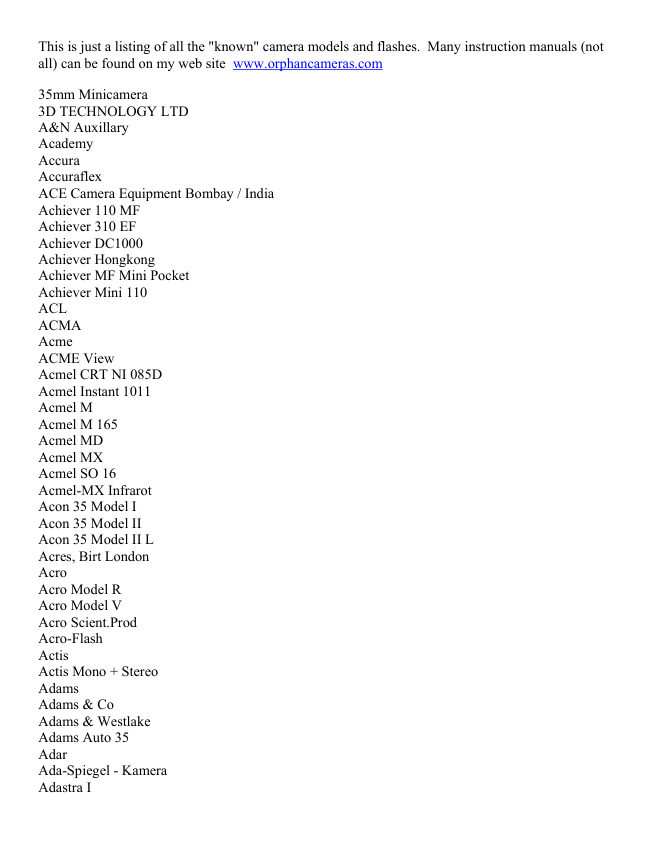
From the M. Butkus archive. Original publisher and archive notices are retained.
Check the model and edition against your equipment.
PDF verified 2026-10-10.