Film cameras
Compur Shutter User manual
User manual for Compur Shutter. 3 pages in English. Read the original PDF, download or print a copy without registration.
3 pagesEnglish1.4 MB PDF
Loading your manual…Open PDF directly
Document details
- Brand
- Compur
- Model / document
- Compur Shutter
- Document type
- User manual
- Language
- English
- Pages
- 3
- File size
- 1.4 MB
- Category
- Film cameras
- Document date
- Not specified in catalog
Search available document text
Find a term, then jump to its page in the original PDF. Image-only pages may not be searchable; check the PDF for exact wording and diagrams.
Page 1 · Read text
www.butkus.us


                  Compur Shutter

            Instructions for use for the Camper lock


                                                                                                                                                                                 Digitally signed by Mike Butkus                         Mike             DN: cn=Mike Butkus, o,
                                                                                                                                                    ou=Butkus.org,
                                                                                                                                               email=mike@butkus.org, c=US
                                                                                                                                                           Date: 2025.11.17 21:14:12 -05'00'                          Butkus


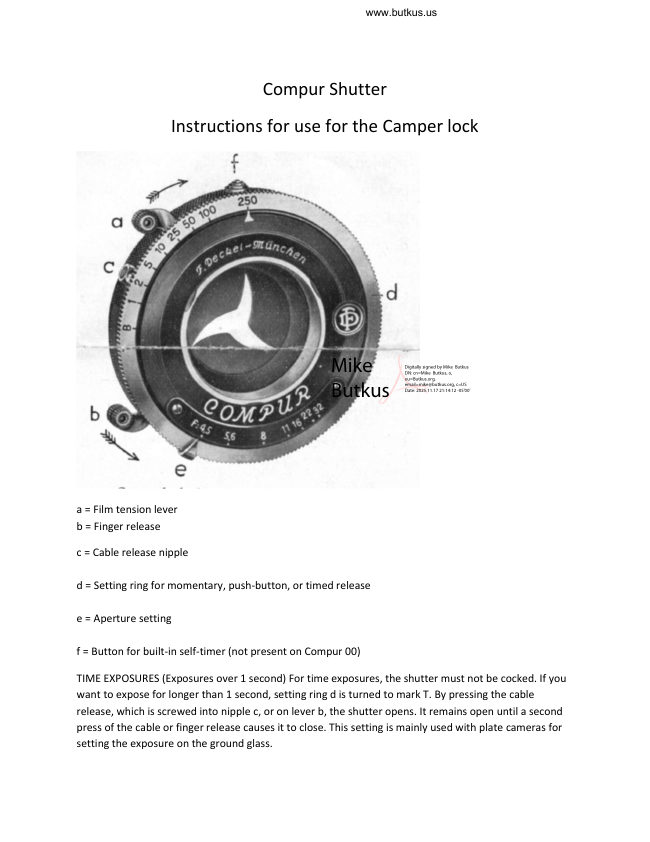
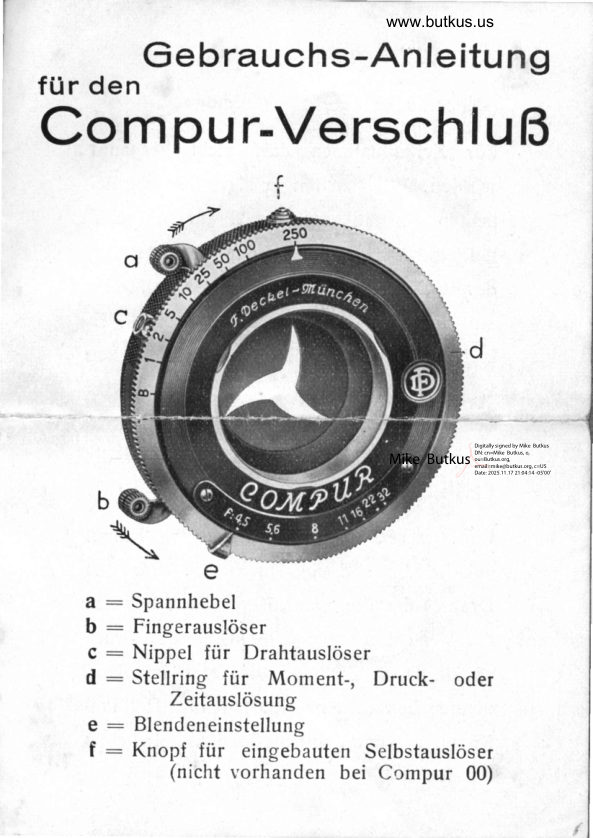
a = Film tension lever
b = Finger release

c = Cable release nipple

d = Setting ring for momentary, push-button, or timed release

e = Aperture setting

f = Button for built-in self-timer (not present on Compur 00)

TIME EXPOSURES (Exposures over 1 second) For time exposures, the shutter must not be cocked. If you
want to expose for longer than 1 second, setting ring d is turned to mark T. By pressing the cable
release, which is screwed into nipple c, or on lever b, the shutter opens. It remains open until a second
press of the cable or finger release causes it to close. This setting is mainly used with plate cameras for
setting the exposure on the ground glass.
View original page 1Page 2 · Read text
For shorter time exposures, ring d is set to mark B. By pressing the cable or finger release c or b, the
shutter remains open as long as the pressure is maintained. This setting is generally used with plate and
roll film cameras when exposures longer than 1 second are required.

SNAPSHOTS For snapshots, Compur shutters are cocked with lever a in the direction of the arrow. It is
advisable to first set the ring d to the desired time, then cock the shutter. In addition to the marked
speeds, intermediate positions can also be used between 1 second and 1/10 of a second and between
1/25 of a second and 1/100 of a second; between 1/10 of a second and 1/25 of a second and beyond
1/100 of a second, however, not. The triggering for instantaneous exposures is the same as for time-
lapse photography, by pressing the cable or finger release.

When using the maximum speed, you must always set the ring d first, then cock the shutter. However,
even in this position, it is still possible to change the speed afterward. It should also be noted that when
using the maximum speed, the setting ring and the winding lever are harder to operate than at longer
speeds.

TIME EXPOSURES
(Exposures over 1 second) For time exposures, the shutter must not be cocked. If you want to expose for
longer than 1 second, setting ring d is turned to mark T. By pressing the cable release, which is screwed
into nipple c, or on lever b, the shutter opens. It remains open until a second press of the cable or finger
release causes it to close. This setting is mainly used with plate cameras for setting the exposure on the
ground glass. For shorter time exposures, ring d is set to mark B. By pressing the cable or finger release c
or b, the shutter remains open as long as the pressure is maintained. This setting is generally used with
plate and roll film cameras when exposures longer than 1 second are required.

DIMENSIONS


Size                Largest aperture     Largest shutter     Number of sectors  Maximum speed
                   diameter of the     diameter
                     shutters
Cr. 00           17              44              3                1/300
Cr. 0            23              57              3                1/250
Cr. 1            29              68              3                1/200
View original page 2Related documents and language editions
From the M. Butkus archive. Original publisher and archive notices are retained.
Check the model and edition against your equipment.
PDF verified 2026-10-10.