Film cameras
Exakta-Camera User manual
User manual for Exakta-Camera. 34 pages in English. Read the original PDF, download or print a copy without registration.
34 pagesEnglish3.3 MB PDF
Loading your manual…Open PDF directly
Document details
- Brand
- Exakta
- Model / document
- Exakta-Camera
- Document type
- User manual
- Language
- English
- Pages
- 34
- File size
- 3.3 MB
- Category
- Film cameras
- Document date
- Not specified in catalog
Search available document text
Find a term, then jump to its page in the original PDF. Image-only pages may not be searchable; check the PDF for exact wording and diagrams.
Page 1 · Read text
www.butkus.us
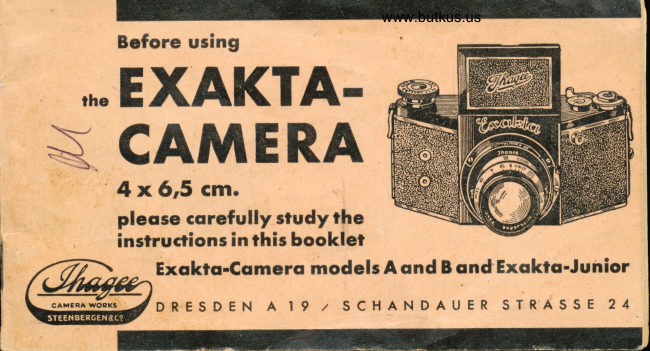
       Before using
 ThEEXAKTA-
N" CAMERA
     4x6r1 cm.
       pleose corefully study the
         instructions in rhis bookler
           Exokto.Gqmercr models A qnd B ondExokto-Juhior
       J  7V7t       1l VV
-7        DRESDEN A l9   / SCHANDAUER  STRASSE 24
View original page 1Page 4 · Read text
www.butkus.us                                                                                                          tA personol Appeol to oll owners of on Exokto  !
We are very glad that you have bought an Exakta. Before describing the use of
this model we personally appeal to you:

                                                                                                                                                                                                   "         Treat your camera carefully! Never use force!
        Above all: read the instructions for use with the greatest care. Wrong
          manipulation rnay soon become a habit, and we cannot accept liability
           for def ects due to faulty handling.
The Exakta camera is a precision instrument, and its operation requires your full             I
attention, particul arly at first ! If anything should not be perfectly clear to you our
Service Departments will be glad to help you.
With best wishes for successful work with your Exakta we are,
                                               always at your service
                        IHAGEE CAMhRA WORKS
                                                         Steenbergen & Co.
                                          DRESDEN-A. I9.
View original page 4Page 5 · Read text
EXAKTA- INSTRUCTIONS FOR USING
fnserting fhe film. The loading of a film into the camera is done in the ordinary way as in
any other roll film camera. Holding the camera in the left hand, as shown in figure,2, press with
the right forefinger knob B in the direction of the arrow, pulling the camera back away from the
main body with the thumb and middle finger. The roll film is then inserted with the printed side
up in the lower empty spool compartement until its two ends slip into the slots provided for
them and the film is held in position by the bent spring which must first be turned back. With
the right hand, pull the backing paper straight up to the upper empty spool (fig. 3). The pointed
end of the paper is pushed as far as possible into the broader slot of the upper empty spool
which is then turned once by means of the film winding lever c to prevent the paper from slipping
out, afterwards close the camera. During insertion of the film be sure that is runs straight, parti-
cularly when putting in the pointed end of the paper. Then move the film windlng lever c until
the figure I appears in the red window on the back of the camera. The light hood (important
for panchromatic film) is pressed aside with the thumb in the meantime to expose the window.
The lever c is moved in the direction of the arrow up to the stop und returns automatically.
This is repeated until the figure I is seen in'the film window.                \
The winding of the film automatically sets the shutter. After a few turns of the lever a braking
device begins to act and renders the movement of the film more difficult. Do not pay attention
to this, but continue to wind until the number appears in the window.
The braking device is very important and prevents overwinding the shutter.

                                                                                                                     . r.,,$..'i''                                                                                                                                                           ,i.
View original page 5Page 7 · Read text
I
                                                                                                                                                                                                                                                   I
Loading of the film (Roll Film V. P. 2r,12><lnlg" 4x.6.5 cm.) must be done very carefully. Hasty           II
and inaccurate insertion of the backing paper in the film guide and the uneven placing in the slot                Iof the upper empty spool often causes troubles which can be avoided with necessary care.
As soon as the number  I appears in the red window a on the camera back the first picture is
ready to be taken. Set the lens to "infinity" by turning the focussing mount up to the stop.
Something highly important must now be mentioned: If the focussing mount is in a                                  {It
position of rest, that is, turned into the cam eta, the shutter can not be released even          'l$by force. Unless the focussing mount is screwed out to infinity, do not try to release the shutter.
This locking mechanism prevents faulty exposures by thoughtless release or accidentally touching                    i
the release knob
The Mirror Reflex Attqchmenl.  A superior feature of the "Exakta" camera is the possi-                                     -  before exposurebility afforded by it to check the image
Image Control I: A slight depression of the lever / autornatically erects the light hood and the
ground glass screen is exposed, on which the image can be observed up the moment of exposure.
When the light is poor or very exact focussing in critical cases is required, it is advisable to use
the magnifier which springs forward from the back of the hood after the knob m has been
slightly depressed (fig.    ).
Image Control Il: When the magnifying lens springs into position it brings with it the back
portion o of the frame finder. By now pressing down the mirror n until it catches, the front
portion of the frame finder is opened, as shown in figure 5, which is very useful for taking
                                                                                                                                                                                                                                    Ipictures at eye level. However,  it is necessary to focns accurately either by the focussing scale                       {i                                                                                                                                                                                                                                                                                                                                                                                                                                                                                                                                                                                                                                                                                                           ilf
                                                                                               3         ,r,  . -llI                                                                                                                                                                                                                                                                                                         nljjil
View original page 7Page 8 · Read text
www.butkus.us

                                         r
                                                                                                                                                                :,,rr))\))]P


                            Iig. 4                                                       fig. 5
or by looking first on the ground glass screen. The field covered by the camera is accurately
seen it the eye is brought as near as possible to the rear frame of the finder. The frame of the
front of the finder will then show the amount covered by the camera.
6
View original page 8Page 9 · Read text
fig. 6                                                   fig. 7
Image Control III:  It is also possibl.'to see the ground glass screen while using the camera
rt eye le.vel. This is easily done by allc'wing the mirror n to come back to its orifinal position)y pressing the small lever p. The malinlfying lens together with the rear part o-of the frame

                                                                                              J
View original page 9Page 10 · Read text
www.butkus.us
finder must then be pressed down inside the hood until it catches in position (see figure 6). The
mirror is now pressed downwards and backwards once more but only until the first catch (figure 7).
The ground gtass screen may now be easily seen through the mirror n.
   :nffi,ffi@,5"%fig. 8

Closing the light hood cannot be done until the mirror n has been allowed to spring back into
its upright position by pressing the small lever p. The magnifying lens and the rear frame o of
the frame finder must then be folded back, as shown in figure 6, until it snaps into position. The
walls of the finder hood can now be folded down in the order Q, r, s, and finally, the coveringframe holding the mirror n is closed on top of them. These movements are shown in the five
srnall pictures of fig-ure 8, in _which position I shows the lowering of the magnifying lens andthe rear part of the frame finder
The Focol-Plqne Shulter. As has been said, the shutte,r has been already wound up by winding
on the film. When the shutter has been released, no pi';ture can be seen in the light hood, be-
cause the mirror in the camera has risen upwards in order to slop any light reaching the filrr
8
View original page 10
Page 11 · Read text
that has not co.me through the lens. When the film is wound on once more, the mirror sinks into
    the correct position for focussing. Tf e camera is then ready for the next picture, inO tttiJ;irii;    mechanism makes it impossible to give two exposures on one section of itre filfi.
    Ther  If e uerrr_ngsetti.n-g orqf rnethe sh-uttersnuller spe€qsp.eedisJS arrangedaffangeo by.liftingDy.llttlng tnetheknobknob k,k,andturningit"inand turning  it in thethe directidirection of the
     arrow.(while.in the lifted position) until thE reqlrired sfeed is opposite the red"dot on ttre innerr knopknop ki'kf     (see figure 9). The outer knob k is then lowered uniil ftush with kt. The numberJ ;;thi; [noU-{ive     fractions of a second. Short "time".exposure of any r.equired length may be made Uy turning tndU f    so that the red dot on ki is opposite "8". The stiuttei will norairemaiir open as loig iJlfte shutter                                                                                                     n,tifre"    release d is pressed, and closes as soon as- pr.essure_ is released. Foi'.long                        Z" on the knob k should be placed against the r-ed dot on Lxpo_sures,ki. In thid
                                  Position one pressure on the shutter reldase d opens the shutter, wtrictr
                            then remains open- until the release d is presied a second time. For
                           the convenience of camera users the shdtter release d is provided                              with a socket into which a wire release may be screwed.
                         only the wire releose suppligd.by-us                                                                                                       is suitoble. when making                                                                                              -of                              exposures that are longer th-an tlzsth   a second, the camera should
                         be screwed on tg u tripod. A bush for the tripod screw will be found
                         on the bottorn of the camera body.
                      The shutter can only be released when the lens is focussed at                                                or_ a neafer distance and the focussing mount has                              "infinity"
                          been screwedoutJar enough-. Prior to this the shutterTs Iocked, ind                   fig. 9          no attempt should he made to force the release knob into the camera.
,__-rzs/                  -                                                                                                          I
View original page 11Page 12 · Read text
www.butkus.us
The lens ond focuss.ing.. The lens, aslhe eye of the camera, is_extremely sensitive and fragile, and
                                                                care- must be taken ihat ttre fingers ddnof soilTult always be handled wilh great ctr9. In -particular,                always b-e cleaned by wiping with a soft dry washleather, but tooTrequent use ofi1..fnq_glass. ,m?y
this w.ill spoil the polish of the glasses.- On this account, thcj lens should always be coirereO ty iticap when the camera is not in use, and should never be touched with the fingers when focusding.
                         The lens is mounted in a ring whigh, when,turned to the
                                             left (hol-{ the ring ft when turning) screws forward the lens
                            on a helical thread. other short or long focui lenses can be
                    b   substituted for the standard lens.
                                  -  Before the lens can be focussed, it is necessary to turn the                    d                                       Iing.rTll a stop is felt. The lens is urougtttl"io frtis position                          by                                                                                             figur.e 10, rizittr the                                      lol{ing thg outer ring e (shown in                           word "lhagee" on it) and turning it in in anti-clockwise
                                      direction up to the stop. In this position the lens is focussed
                                    at infinity, and at the same time the lock on the shutter is
                                the lg,t is in the proper poiition. For all obiects bevond                    fig. l0             65 fee*t the lens wilt be cbrrectly focusseo *tt'.n th;;;i;                                  reads infinity o. (The infinity zone begins for Exakta (mean
aperture about F/3.5) at approxim,ately 20 metres. Rt a'smaller afierture this distance is reducedand at a larger aperture increased according to deptir of focus.)-In order         to                     nearer           focus at                             distances,                                                    the,.r.{n3ll                                                             prissed                                                        down                                                                                                            is ther:                                                                                               lighily, and it                                                     .ltop ff:.uer/ispossible          screw        to                 out                     the helical                           mount                                                        still further.                                               may                                                                                                                                                orr                                                                     then be-focussed                                                                                                    either                                                                          i,'he iicture
l0
View original page 12Page 14 · Read text
www.butkus.us
What one should know airoqt expos'lures' besides the_ purely teehnical operation of t'recame_ra, will_ be found in the "Exakta-"-bpok. by.Gerhard Isert (published by'Gerhard  Isert.Magdebugg-Sudenberg).-  It is of course impllssible to offer here a hlndbook on photography; rlut
aa lewfew nlntshints maymay beDe welcome:welcome:            \1* .-*-^-6i-*-^-ftThe main feature of the Exakta camera is its mirror ,*flex
focussing. The image on the focussing screen is ahvayl; de-
cisive as to focussing. If the object has been sharply focfuqsed,
you may be sure, that the picture taken will always have
the same qualities as the image on the screen. To be alulaYs
ready for working it is advisable to carry the camera civer
the shoulder by means of a sling furnished for that purptrse.
The reflex equipment ulill chiefly be used at breast level.
Any subject, even a racing car, can be easily followed, but
for qapidly moving subjects press photographers in parti-
culai.- prery{ th. rpor{ finder (see iig. S1. Att image- observation pos.sibilities mentioned apptyequally well to vertical work. The image on the focu5s,ing screen indicates when the camera ilheld not exactly level. For vertical wi'^.: it is advisable to focus sharply first with the reflex
equipment and then to employ the frag,*eindeq,lfug                            is resorted to invertica1work,oneIcrokstowardsthe#:t"-'1eleftor.rigtrt.In1hiswayoneI;:l-le,1.focuss.inqmayoftensucceedintakingpicturesi5;''{ircrowd,one.holdsthecameraabdveone'Sheadand-Iooki'atggt':$:.i:!fro.m.uitow.tlerticii-pi;il;;;':Y/:
with a tripod require ,u" Er:,-:ii:..t/;:                i.;,!:f:*'tE |";_frjip;;;ftEi.:*i;pffi+rnedbelow.

r2
View original page 14Page 15 · Read text
Exqktcr model B (risure u)
By means of the special shutter supplied lvith the
 Exakta, exposures between 1/1sth and l2 secorrds can be
given. If this mechanism is used (the range is tilsth to
12 seconds normally, or l/roth to 6 seconds if the"delayed action mechanism" is used) the shuttercontrol fr must be set either to B or Z. Before setting
the Time Control,the film must be brought into its proper
position by means of the film moving lever c whereupon
the knob f must be wound up to the end stop.
Important: The shutter works accurately onlyif the knob / is wound up to the end stop. When
looking at the camera from the front, winding is
effected by turning the knob f to the right. Sometimes
only little turning is required if a shorter exposure
time has been previously used.                                                                                              fig. 1 I
 Notice: The gradual winding of the spring towards the end stop makes the winding of the knob
  difficult. Do not be confused thereby. Shortly before the end orre has a feeling that the knob is
  fully wound, but a little additional winding is actually necessary to complete the operation.
 This should not be overlooked, and the user should always make certain to wind up fully.
                                                                                                         l3
View original page 15Page 16 · Read text
www.butkus.us                                                                                                                                                                             i
                                                         as follows:Th" desired time exposure is adjusted only after windingThe knob I must then be wound up to its fullest extent, and the necesshry time of exposure adjusted.   IThe- outer_ring of the knob / is lifted up and turned until the desired exposure time is against the          'it
mark on the central part of the knob. The outer ring is then allowed-to drop back into place.            'l
Black figures- show the times of exposure for normal work, and red figures sliow those po^ssible      Jt
when the "delayed action mechanism" is being used. Irr the latter case the various times of exposure
will be given approximately 12 seconds after the shutter release is pressed. If the'instantineous
exposures engraved on the knob k 1tl25th to l/lessth) are to be used with the "delayed action mechanism"
the shutter is set to the desired exposure (for example to l/2seth of a secohO; while the knob f is
placed with the mark opposite any of the red numbers on the ring. It should be noted that it is
always necessary to adjust knob k whether the knob f is being used or not. Longer exposures
than 12 seconds may be given by the normal method of setting the shutter to B or Z, but the timeshould be noted with a watch. lt is difficult to count seconds accurately without much practice.
 The order is therefore as follows
       1. Move the film to the next number.
      2. Set the shutter:                                                      #
        1/roth 12 sec. without delayed action and t/1sth-6 sec. with delayed action, tension                 *"f       knob f and adjust time.                                                                                                                                                                                                                              I          '   tlruth-t/tooo th with detayed action  : set small knob k, tension knob f and set to any red number.
      3.       Release                (the shutter cannot be relesaed until the focussing mount has been turned      l     .        out           to "infinity").
l4
View original page 16Page 17 · Read text
lf you wish to familiarize yourself with the operation of an "Exakta" not loaded with film' move the film lever c after each release at least three times up to the stop as only then will
 the shutter be wound up and the mirror in proper position. Later on during actual work one
 should always be guided by the number in the small red window.

The Exokro Junior
Looding the film: see pages 3-5.
Mirror Reflex Equipmenl: see pages 5-8.
Shutter3seepages8-9(highestshutterspeedofExaktaJunior1/roothsecond).
Ghonge of film: see page ll.
Focussing rhe lens: The lens of Exakta Junior and its -operation differ in many.respects fromthat of th; *oOei A-. ttte Exakti lunior h"as a lens which focusses by means of movement of
the front lens. First, the lens tube is pulled out and turned lightly in a-clockwise direction until
if;topa. fo-oo thi; the lens shoutd'be held by the-ring with ttie apertu(es marked oq it,.}nd               ,'pulled"                     out position it is focussed on infiriity. As beftirg all objects further thanwhen'in this                                                                              always assuming65 feet from the camera witt be found to be in focus oh the ground glas!,
that the focussing mark on the front lens is opposite the infinitf mark. on the rigg. Focussing   'for nearer distan6es is arranged by turning the iiont lens until thd mark is against the appropriate
                                                                                                     r5
View original page 17Page 18 · Read text
www.butkus.usfigure on the scale of distanc,es. It is also                                                .possiblg, ol course, to do the focussing by examining        tthe.picture on,the, grou.nd..glass screen. When ttre lens is do p";hed--uact< agaii iito  tt e iear       Iposition, a gentle turn to th-e teft will allow it to slide nack intb the camera,-Again'firei'ttite iftis iro;Gof the lens will also lock the shutter to avoid accidentat exposuie.            feni shoutd behandled by the ring marking the lens apertures.                                                           L
The iris diaphragm is worked as in modet A by turning the ring.
For enlqrging negqtives token wirh rhe Exqkro  it is r€Gorrr-
mended to use rhe Exokro-Lumimox enlorger.
The lens of eyefl                 fxakta camera. may. be screwed out and removed. Byturning to the left (anti-clockwise) and, in the case of ttrJ J;;i;;-modet,pulling out tle lens tube from the camera body, the lens dnd its mount
comes. away.from the body.and can be used in-the Lumimax enlarger as                                                                                           4   enlarger lens. The Lumimax enlarger is very Jeasonable in prici, and3n                                                                                                                                                                                                                                                                                           l'is_ q- necessary accessory for every owner of an Exakta camera. Wd will                                                                                                                                                                                               tiIgladly send you particulars.
                                                                                                                                                                                                                                              Il
                                                                                                                                                                                                                                                                                                           )


r6
View original page 18Page 19 · Read text
{  The Exskro Csmerq
   with the Plcrre Bock
 I
     Everybody owning this special Exakta make should
    remember the following:
          Plate exposures cannot be focussed by
        the screen in the light hood, but on
         the second ground glass screen at the
        back of the camera.
    To permit the use of the distance scale a metal ring
     is interposed between the lens and the focussin[
    mount. When roll film is used, the ring remains    where it is. However, as the focussing plane for
     plates lies somewhat behind the roll film plane, the
     lens must recede this distance to make focussing
     scale and infinity stop harmonize aqain, which i5
    done by removing the metal ring. By turning the diaphragm ring to the left the lens is screwed
l     out, and the ring can then be easily removed. You see for yourself that after removal of the
     ring the lens is closer to the camera so as to maintain the same distance up to the plate. If one
    wishes to focus by the screen on the back of the camera, the shutter is first iet to Z and opened.
                                                                                                                       t7
View original page 19Page 20 · Read text
www.butkus.us
The image can now be checked. Before exposure close the shutter and wind it uo asain bv     r pressing          _the film winding lever c at leagt 3 times against the stop in the direction ofthe-arrori.Then pull out the focussing screen at the back of the camera and the dark slide loaded with a
plate can then be inserted. For roll film exposures remove the focussing screen and in lieu of    .+ it insert the slide provided with the film preisure plate.
              Briefly, remember:
                                Ring remains between the lens and the focussing mounr.          $ofl film.exposures:               l'o..usslng     scale and screen in the light hood. Film pressure plate slide-inserted                     -by          on back. Move the film always according to the number in thb red film window.
          Plate exposures: Remove ring, Focussing by scale or screen on back of camera.
Exqkto Accessories;
are quite comprehensive and witl be briefly described below.
Protective Cose
Preserve your Exakta if you value ii. This case completely surrounds the camera without inter-   Ifering with its instantaneous use. The camera is inserted in the case so that the laterallv
attached hangers are suspended close to the side walt of the camera. The bush is screwed throupfi    |
!lt9 gpening in the bottom of the                                case into the tripodbush of the camera. As the bush is alio    )titted with thread, the Exakta may be screwed to the stand with its case. Before exposure unbutton
the flap covering the lens and turn it down. (This case can be used also for'Exakta Junior)
18
View original page 20Page 21 · Read text
t
 +    Speciol Lenses of Exokro
     These lenses are intended for two separate fields:
I'i,   The Tele-Lenses for distance work, the Wide-angle lens for wide angle exposures.
    The lenses are fitted on in our works, i. e. the infinity stop is put together with that of the
     standard lens. We further attach a focussing scale. The red figures apply for the Tele lens, the
     white ones for the standard lens. The prices of special lenses include the cost of fitting, so that
     the camera must be sent to our factory. If you do not want fitting, you can always focus without
      scale and infinity stop by the focussing screen. The standard lens is screwed out by turning the
     diaphragm ring to the left, and the same mount holds the long focus and the wide ang-le lens.         -case-of      In          fitted lenses one may depend, also on the focussing screen in the light hood, or on
     the red scale. For the Tele-lenses (lhagee-Anastigmat Fla:5110.5-ll cm., Tele-Tessar F/6.3112 cm.,
     Tele-Megor F/5.5/15 cm., Tele-Tessar F/6.3/18 cm. and Tele-Tesqar F16.3125 cm. focal length) the
     frame finder of the Exakta is provided with a mask which indicates the limits of the picture
      attainable with the Tele-lens. The mask, with the engraved lettering to the rear, is first placed
     with the two supports in the front frame to the right and left and then pressed on top into the
     frame until it snaps into position.


                                                                                                                r9
View original page 21Page 22 · Read text
www.butkus.us
Exqkto tighr Filrers
They serve for producing proper tone values when orthochromatic or panchromatic material is
used by increasing or reducing the action of certain light rays.
The Yellow Screen for orthochromatic material that is lightly sensitive to blue, retains the blue
                                                          yellow                                        So                                                       called     increases              the                                              rays.                    effect of the yellow                                            lightand
                                              case                              emulsions                                 and                 orthochromatic                                                      panchromatic- greenfilmsscreenshavinghave increasedthe sameeffects                                                in      upon the                                                  of
green and reduced red sensitivity ensure a reproduction in correct tone values.


                                                                                                                                                                                                                                                                                                                                                                                                                                                                                                                                                                                                                                                                       |The Oreen Screen serves for reproducing the green tints correctly if panchromatic films parti-
cularly sensitive to red are used
The Blue Sgreen in case of exposures made by artifical light or panchromatic malerial highly   tsensitive to red light rays. Retards the red light rays present in large numbers in most artiticial  Llight sources and prevents a too light reproduction of red tints.                                        t
The Red Screen for panchromatic or lnfra-red material increades the effect of the red light    irays to an enormous degree. Particularly suited for distant exposures (also                                                                                 night effects by     1                                                                                     -fordaylight, as the blue appears much too dark in the picture).                                                                         I
For the various diameters of the lenses light lilters with corresponding attachable mounts are
available. When ordering please state the name and the aperture of the optical system concerned.    ,The filters absorb a portion of the light passing through them, so that the time of exposure must        I
20
View original page 22Page 23 · Read text
be somewhat increased. This depends of course on the transparency  o.f the filter and the colour
                                                                                                                                                                                                                                                                                                                                        :     sensitiveness of the material used fbr exposures. Approximately, fhe extra time required is as follows


 II                         Yellow screen, light       double exposure time
                         Yellow screen, medium    4-fold exposure time
                         Yellow screen, dark       6-fold exposure time
                         Yellow-green screen      3-fold exposure time
                       Green screen             4-fold exposure time
                         Blue screen              double exposure time
                     Red screen               8-fold exposure time for panchromatic film                                                     30-fold eiposure time for infra-red film

                         Lighr hood Extensions
                                 These two accessories are intended to keep extraneous side-light
                                away from the image on the focussing screen and thus increase
                                   the brightness of the finder image. Both extensions, on bqing
                                 taken dut of their cases, automatically spring into operating
                                      position and are placed over Jhe- gPg{red_light hood of the                                         i,Exakta".                                       They cah be closed by folding. These practical aids
                                                                                                  o^pen. air exposures                                  to photography can be used not only for                                                                 exposures to facilitate focussing              Plain      Light hood Extension   in 6right"suhtigtrt but for all              type          with magnifier     and to obtain a better screen image.
                                                                                                               2l
View original page 23Page 24 · Read text
www.butkus.us
The Sun Shqde
is also supplied for all lenses. When ordering please state !ame and apertureof the len-s. The sun Shade serves the important purpose of keeping trouble-
some front or side-light (not only sunlight but also artifical light) away from
the lens. The sun Shade is indispensible for charnring exposures by contrasting
lights. It is easily attached to the front of the lens mount, or upon the mount
of a light filter if one of these is interposed.

Attqchment Lenses
Our attachment lenses serve for two kinds of exposures. One group is intended for giving larger
pictures of distant objects (Tele-lenses) and the other shortens the focal length, so that it be-bomes possible to approach the object more closely, which is particularly useful if exposures of
insects,- coins, stamps, flowers etc. are to be made. The lens is simply attached with its mount
to the front lens of the Exakta objective, and the screen image is decisive for focussing.
The Tele-lens increases the focal length. Greater focal lengths require a longer exposure. The
Exakta Tele-lens requires the double of the ascertained exposure time. When an attachment lens
is added to the optical lens system,-      a corresponding stopping down is necessary to obtain sharplydefined pictures (at least to F/8 or F/l t) and consequently another increase of the time of
exposure must be.considered. The standard focussing mount of Exakta does not suffice, however,
22
View original page 24
From the M. Butkus archive. Original publisher and archive notices are retained.
Check the model and edition against your equipment.
PDF verified 2026-10-10.