Film cameras
Expert Agfa Ansco camera operation Product booklet
Product booklet for Expert Agfa Ansco camera operation. 17 pages in English. Read the original PDF, download or print a copy without registration.
17 pagesEnglish1.4 MB PDF
Loading your manual…Open PDF directly
Document details
- Brand
- Agfa
- Model / document
- Expert Agfa Ansco camera operation
- Document type
- Product booklet
- Language
- English
- Pages
- 17
- File size
- 1.4 MB
- Category
- Film cameras
- Document date
- Not specified in catalog
Search available document text
Find a term, then jump to its page in the original PDF. Image-only pages may not be searchable; check the PDF for exact wording and diagrams.
Page 2 · Read text
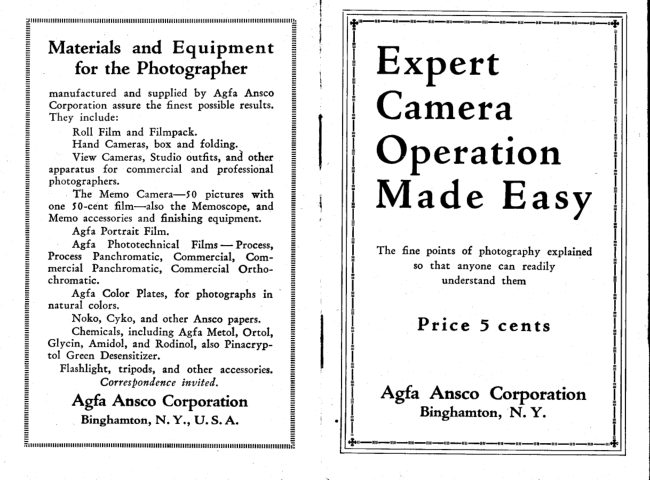
for the Photographer                 Expert                            =
manufactured   and  supplied  by  Agfa  Ansco    =
Corporation  assure the  finest  possible results.    =
They include:                Carn eta
     Roll Film and Filmpack.
    Hand Cameras, box and folding.
     View  Cameras, Studio  outfits,       other    =                                      "od       Operation
photographers.
     The  Memo  Camera-tO     pictures   with    =
one  i0-cehtf0-ceht   film-alsofilm-also    thethe Memoscope.Memoscope,  andand    =             Made EasyMemo  accessories and  finishing  equipment.
     Agfa  Portrait   Film.
      Agf.a  Phototechnical    Films  -   Process,   =               The   fine  points   of  photography    explainedProcess  Panchromatic,   Commercial,   Com-    =
mercial   Panchromatic,   Commercial   Ortho-     =                        so  that  anyone  can  readily
chromatic.                                               =                              understand  them
     Agfa  Color  Plates,  for  photographs   in          j
natural  colors.                                 =
            Cyko,     Noko,                                      papers.                  and other                           Ansco                                               =
     Chemicals,                  including                          Agfa                                    Metol,                                                Ortol,                                               =             Price  5 cents
Glycin,  Amidol,  and Rodinol,  also Pinacryp-                                               =
tol  Green  Desensitizer.                         =
   Flashlight,   tripods,  and  other  accessories.   =
          Correspondence inuit ed.
                                             Agf.  Ansco  Corporation   Agfr Ansco Corporation
      Binghamton,  N. Y., U. S. A.
View original page 2Page 3 · Read text
Some  of  the Things  Expl,ained                   Photography  Explained
              in This Book
                                              A  TECHNICAT,   knowledge  of photography
                                                       L  r    is not  necessary to  the making  of good
                                                                  pictures,  any more than a technical  knowledge
What  happens  when  you  take  a  picture.                    of  electricity    is needed  to use  it  for  lighting
IIow   to know  what  exposure   to  give.                   one's home or running an electric cleaner. Nev-
                                                                ertheless, at least a sl<etchy idea of the process
IIow   to  get  sharpness   and   tletail.                                 is  desirable,  for  the avoidance  of  errors  that
How   to  focus  correctly.                                   are  \\'asteful  of  film.
What   the  shutter   does.                                  Photography  may  be  thought   of  as  partly
IIow   to know  what  shutter  speed  to  use.               physics and  partly   chemistry,  physics  supply-
                                                                ing  the lens, chemistry  the  film.  The  functionIIow   to know  what   "stolr"   to  use.                                                                     of  the  lens  is  to  focus an image  of  the scene
What   the  stop  numbers   mean.                           before   it on the  flat plane occupied by the  film.
                                                  The  function   of  the  film   is  to  take  a perma-IIow   to use  your  folding  camera   lilce a  fixed-
     focus  box  camera.                                    nent  record  of  this  focused. image.
How.  to understand   your  lens.                                                    The  secret  of  the process  lies  in the  discov-
What    is meant  by  the  "speed"   of  a  lens.                  ery, many  years  ago,  that  certain  substances
                                                           are  chemically  altered  by  the  action  of  light.How   to  take  pictures   indoors  by  lamplight.
                                              One  of  these  substances   is   silver   bromide,
 \tr/hen   to  use  a  tripod.                                    which,  after  being exposed to the light  and then
Differences   between   large  cameras  and  small           "developed"   in  certain  chemicals,  blackens  to
     cameras.                                                    metailic  silver.  By  coating  film  with  an emul-
                                                              sion containing  minute  paiticles   of  silver  bro-Depth-of-focus    tables  ancl how  to use them.                                                          mide, there  is obtained  a light-sensitive  surface.
 Practical   p,ointers  for  assuring  success.              When   the  view   is  focused  and  the  picture
And  many   other  things  worth   l<nowing.                  taken,  what  happens  is that  the  light  tones  of
                                                                 -the view,  such as the  sky,-dark,make  a strong  im-
                                                                lression  on the  film,  the       such as foliage,  -
     Read  the  book   right  through                   a weak  impression,  and when  the  film   is  de-
                     2
                           www.orphancameras.com
View original page 3Page 5 · Read text
This  method  does not  utilize   all  the advan-          exposed long enough, he would  replace  the cap
tages you bought when you bought -your cam-          on the lens, replace the slide in the plateholder,
era, no"  is   it  the best rvay  to use the camera'           and,  withdrawlng    this,  take   it  into  the  dark-
but   it has several  points  in  its  favor.    In  the          room  for  development  of the  plate.
first  place,   it  enables you  to  begin  with  your
folding  camera where you  left  off-with   your              This  method,  still  used  in some studios, was
box  camera.  When  you  have made  the  set-            too crude  for  amateur  cameras, especially  with
tings  called  for  in the "rulesr"  you-can  go-right            the  introduction    of  fast  plates  and  fllms.     It
ane-aa as you have been  in the habit  of  doing'         was necessary to devise something which would
In  the second place,  this method  of using  your                          ' work  faster and be automatic   in  its  action.  So
camera  providis   an  excellent  standard   - from          an automatic   blind  or  shutter   to go over  the
which  td  work  as you become more  familiar             lens  or window   of  the camera  wis  invented,
with  the camera  ancl how  to  utilize  the advan-           y-earsand thisuntilmechanismwe havehasthebeenmarvelouslyimproved accuratewith  the
tages which   it has to  offer.    If  you forget-how             shutters  supplied  on Ansco  camera!,  some  of
to-set  the shutter  or  rvhere to place  the focus          which  permit   automatically    controlled   expo-
under  this  or that  condition  of light  or subject'           sures ranging  from  one second down  to  f/800
you  can  always  go back  to   the   flxed-focus             of a second.
inapshot  standard,  as set forth  in the five rules
abo-ve, and then modify  the settings  as circum-          When  we  consider  that  most  snapshots  are
                                 'fhis   will  be  clearer  to        made  with   an  exposure   of   l/25   second,   itstances may  require.
you when you have read what  follows'                seems at  first  impossible  that  the early  photog-                                                           raphers  could  have made  outdoor  pictures   at
                                                                                       all,  as  it  would  appear  impossible   for human
   Interesting  History   of  the  Shutter            hands  to uncap and cap a lens  in so short  a
                                                                  time.   But   the  early  photographers   did  not
T-ffn    term  "shutter"  comes down  to us from          ihave  plates anywhere  near  as  fast  as Ansco
  I    the early days  of photography.   Originally,             Film,  and   exposures  had   therefore   to  be
cameras were  not  provided  with  shutters'  but           longer.  Moreover,  photographers  were able  to
the photographer  used a lens-cap.  - When  ev-           control  the exposure  in another  way.  By  hav-
erytfring  was-ready,  he would  cap- -the lens,  in-           ing a set of  ciircular  discs with  hol6s of  hiff"r-
sei't triJptateholder,  remove the slide lrom   this'           ent sizes in the middle,  they  could, by using  in
and  then  uncap  the  lens  to make  the  "expo-             front  of the Iens a disc with  a larEe hole or a
.sure."  When  he  thought  the  plate  had been           disc  with  a small  hole,  control  the" amount  of                                                                            light  admitted   into  the  camera   in  a  given

                            www.orphancameras.com
View original page 5Page 10 · Read text
For  instance,   if  you  are taking  a picture   of            Stopping Down  for  Sharpness
a person, and  this  person  is standing  ten  feet
awalr  you operate  the  front  to bring  the focus         O TAKE   the first  point.  "isiust rememberpointer  to the  l0-foot  mark  on the scale.    If  on                that  the smaller the- sto!     the greater
the  other  hand,  you  are  taking  a  picture    of           the  depth  of  focus.   This  is-the  reason whv
something  far away, you may place the pointer           people-are  advised  to  "stop  down"   for  shart'-
on the 100-foot mark.                                   ness as much as the  light  will  allow.     It  is also
                                                       what  makes   possible  the   "flxed-focus,,   box
  Some people using a focusing camera  for  the          camera.  With  this type  the lens  is focused  for
first  time,  regard  focusing  as a nuisance, and           objects  at an average picture  distance, and the
want  to know why  fixed-focus  cameras  cannot           regula_r stop,  F 14,  is  small  enough  to make
be supplied  with  fast  lenses.                               everything   else sharp.
  This  brings  us  to  the  question  of  depth  of                   J      Small Cameras  Easier  to Focusfteld,  or  depth  of  focus,  as   it   is more  com-
monly  called.                                                  tT.tO  TAKE   the second point,  just  remember
                                                                                                                  I      that  the  shorter  the  focal  length  of  the  Suppose we  take  the  case of  a camera  fo-
cused on a  figure  10  feet  away.   This  figure            lens, the  greater   is the depth  of  focus  at any
will,  of  course, be rendered  absolutely  sharp,           stop  selected.   For  example,  a No.   I  Folding
but,   in  addition,   objects  nearer   or   farther           Ansco,  which  takes  pictures  2t/a x 9Ya, has a
away-say   8 feet from  the camera and 12 feet           Iens  with  a  focal  length   of  3t/2 inches,  while
from   the  camera-will    be  reasonably  sharp          a No. 3A  Folding  Ansco, which  takes  pictures
also.    If  anything  nearer than 8 feet or farthel            3/a x 5t/2, has a lens with  a focal Iength  of 6Yz
away  than  L2  f.eet  is  noticeably  unsharp   or           inches.    If  we  focus  both  cameras  at  10 feet,'out-       of  fg.c-us," then we say  that  the "depth   of         and use stop  U.  S. 4  (F 8)  in each case, we
fieldt'  or "depth  of  focus"  is  in  this case from             find  that  with  the  No.    I  Folding  Ansco  the
8 feet  to 12 feet.                                         depth  of  focus  is from  7.6  feet  to  14.5 feet,
                                                               while  with   the  No.  3A  Folding  Ansco   the
  This  thing   called  depth   of  focus  varies  a          depth  of focus  is from  g.l  feet to 11 feet.  (See
good  deal, but  always  in accordance  with  op-           tables on pages 28 and 29.)
tical  laws  that   affect    all  lenses.   In  otherwords,  the depth  of  focus depends on:           II     What   this  rather   striking   difference  means
                                                                                 is  that  large  cameras  must  be  focused  more
   (1)  The stop used.                                      accurately  than  small  ones.
   (2)   The  focal  length  of  the  lens.                                       It  also explains  the  greatly  increased  popu-
   (8)   The  distance  for  which  the  focus  is  set.              larity   of  small  cameras,  especially  where  pic-
                         l6                                                    t7
View original page 10Page 11 · Read text
tures must be taken  in a hurry.   With  the No.              For  those who wish  to go into  this matter  of
I  Folding  Ansco, when   it  locks  automatically              depth-of-focus  more  fully, we give on pages 28
at  the  2|-foot  focus  distance, we  get a depth            an-d 29  three  depth-of-focus    tables  covering
of focus even at F8 of from  14 feet  to  infinity,           Ansco  cameras.  These tables,  which  were  in-
or  the  limit   of  vision.   That   is, with  the  lens            troduced  by Ansco, have been of  great  service
wide open and nothing  nearer  the camera than              to  amateurs.   Similar  tables  are amxed  to the
14  feet,  everything   will  be  in  focus.   At  the            lens cap of the No.  I Expert  Ansco, and to the
next smaller  stop, everything  from  t2  feet  to          bed  of- the  No.   I  Ansco Speedex and  No.   I
infinity_ is sharp,^and at-F lO-(U.  S. 16), every-          Ansco  Super  Speedex.
thing  from  9.7 feet  to  infinity   is sharp.   Th'isalso applies  to  other  No.   I Ansco  cameras.                         Simplified  Focusing
                                                                                                                  \   f,  /  ltu     the  foregoing   explanations   as  a
                                                V y   background,   the  following   instructions
    Focus Near Objects  Carefully                          will  simplify   the  matter   of  focusing  so as  to
                                                                  sharp  pictures.                                                                insure     TAKE                the  third                              point,                                    the  depth                                                      offO                                                                    Instrwctions                                                                                               for   all' No. 7 Ansco  carnaras-of  r   focus               is greater                        with                             the camera                                      focused
for  far  distances than  with  the camera focused             focusi,ng  type  (pictures  Zt/a x  a!a).-(L)     For                                                             general  views,  such  as houses,  street   scenestfor  near  distances;
                                                                    lroups,   etc., set  focus  for  25  feet and  avoid
  For example, although  with  the No. 3A  FoId-             [aving   any   important    or   noticeable   object
ing Ansco focused at 10 feet the depth  of focus             nearei  thah 15 feet.   This  applies  for  stops up
at F 8 (U. S. 4)  is from  9.1 feet to 11 feet when              to F 8 (U.  S. 4).  For  larger  stops focus more
we focus the camera  at 50 feet rve find  that  the              exactlyr' as the'depth   of  focus  decreases with
depth  of focus  is from  34.3 feet to 91.6 feet.               increase  in  size of  stop.
                                                                                 (2).  For  close-upsr- and  single  figures,  set
                                                                                                                                                                                                                                                                                                                                                                     I  This point about the depth  of focus increas-              focui  at 6 or  l0  feel, and pace off the distance
                                                                                                                                                                                                                                                                                                                                                                                                                                                                                                                                      '  I       from  the object. Two  long paces make approxi-ing as you set the focus pointer  nearer  the 100-       ;1.
foot  or  infinity  mark  on the scale can be fixed        I      mately  6 feet, 312 long  paces 10 feet,  the  nor-
in mind by examining  the scale.  Note  the gap       ,l     mal  pace beinE about 30 inches.
between  the  6-foot  and  the  l0-foot   mark  as           ?             (3i.   For  distant  views such as views  from
compared with  the gap between the 25-foot and            a iefght   or  over  water,  set focus  at 100 feet.
the 100-foot marl<.  The  latter  gap  is smaller,                 Instructi,ons  for   al'\, No. 7A and, No. 3 Ansco
although  the difference  in indicated  distances  is             cd,nrerd,s of  fodusi,ng typa  (pictures   2t/z x 4Y+
greater, and  of course the smaller  the gap  the            and.3!a  x'41/E).-(f    ) For  iverage  views, such
greater  the depth  of  focus.                               as  street  scenes,  road  views,  large   groups'
                  r8                                            L9
                             www.orphancameras.com
View original page 11Page 12 · Read text
houses as seen from  sidewalk,   ete.,  set  focus                  If  you  get the exposure anywhere  near  correct
 for 25 feet and avoid having  any imDortant   or          you are reasonably  sure of a negative  that  will
noticeable  object  nearer   ti'an ?O  fbet.   This             print  very  nicely.
ppplies  .to  stops  up  to  U.  S. 4  (F 8).   For           The  "correct"   exposure  depends  on  several
Iarg-er stops, focus more  exactly.                             factors:   the  time   of  year,   for   light   is more
    (2).   For  views  in which  the-emphasis   is on           intense and days are longer  in summer  than  in
the middle  distance,  such as more bpen  street            winter;   the  latitude   of  the  locality,  whether
scenes  or  road   views,  houses  photographed           near  or  far  from  the tropics;  the time  of day;
from  the middle   of  the  street,  etc.,  selt fbcus      {    whether  the sun is shinins,  or the skv  is dull  br
for 50 feet.                                                  cloudy,   etc.,  and  whethdi   ttre  subject   to  be
   (3).   For  distant  landscapes,  views  from  a             l    photographed    is  bright,  such  as  a  sriow   or
height,  etc., set focus  for  100 feet.                      b_each scene, or  to take  the  other  extreme,  very
   (4).   tr'or the largest  class of snapshots,  pic-            dark,  such as a view  in the woods.
ture,s_ of  standing   fi.gures,  children   at   play,         We  will  not attempt  to cover  all these points,
small  groups,   etc.,  set  focus  at   l5   feet- and          as the  efrect would  be onlv  to  confuse.-  For-
pace  ofr the  distance.                                          tunately,  because  of  the  lbtitude   of  the  film,
 ^ (5).   For  near- portraits   and  close-ups,  set                    it  is possible  to  strike  an average  which   will
focus at  l0  or 6 feet and pace  off the distance.           hold  for  .most  amateur  photography,  summer
   Instructi,ons   for   al,l, No, 3A  Ansco  canxera,s.        and winter.
-Proceed   as  for  No.  lA  and  No. 3 cameras,                                                              Disregarding   difrerences  in  subiect,  time  ofbut  estimate  the  distance  more  carefully,   es-                                                                year,  etc., the  following   table can be taken  aspecially  the  near  distances,  as  the  deplh   of                                                        a guide:focus  is less.
   Finally,  bear  in mind  that  the use of a small
stop increases the  depth  of  foeus, thus  ofset-                                       4     8   16   32   64                                             sroP                                                                                                                        |                                                                                           "'t'ting      errors                 in  judgment                                 of                                 distances.                                                    Until                                                                          6.3   8   11.3  16   22   32                                                                                                                                             l                                                    Fyou become                             your            accustomed                              to                              camera   it                                                              is a
good p_lan to  use  the  smailest  stop  that   will               Dull,   cloudy      1/25 L/L0   r/5  L/2    1    2
give- adequate  exposure  at  a shutter  speed  of
1/25_ second.  For  bright   sunlight   this- means,            Cloudy-bright      t/50  1/25 1/Lo  L/5    t/2    1
on the average, stop  16.                                             X'aint  Sunshine    /n0 7/50  L/26 t/Lo   L/5   t/2
      What  Exposure  to Give                      ntense  Sunshi     /200  /t00  L/50 r/25 L/L0  7/6
   NSCO and Agfa  Film  have very  wide  lati-                         ,  This  table  allows   for  fairly   g:enerous  exposure.     tude,  protecting  against  error  in exposure.               In  many   cases,  less  will  be  sufficient.
                  20                                                              2l
View original page 12Page 13 · Read text
Remember  that  the  light   is strongest   in  the          A Chapter  of Useful Pointersmiddle  hours  of  the  day.
  Cut  the  above exposures  in  half   for  unob-                   A Snapshot  Method
structed  open views, such as views on beach or
water,  where  the  lighting    is  flat,  and  double         .Q OUn  amateurs, in taking  pictures  of people,
the exposure  for views with heavy dark masses,         v   have  a tendency  to make  their  subjects
such as wood roads, pictures  in narrow  streets,           fldgety  or  nervous,  thereby  inducing  an unat-
ete.                                                                tractive   or  strained  expression.   This   is  due
  Work  towards   full  exposure  in  winter,  and           to  fussing  around  too much  after  the subject
towards   shorter  exposure   in  May,  June  and         has been posed.  Do your  fussing  first.   That
July.                                                                             is, before  posing  the subject,  decide on shutter
  For  accurate  euposura  und,er  all, cond,itions         speed, stop, and even the focus distance   if pos-
tha pwrchase of an Ansco  Light  Metor  wil,l, be           sible,  setting  the  camera  accordingly.   Then
found, a good i,naestment.  It  is easy to wnd,er-          state  your  purpose,  pose the  subject,  pace  off
stand and, tsery easy to use.  Tel,ls the correct          the  distance,  and  take  the  picture   promptly
enposure  f or  each stoTt und,er  all  cond,itions.        and  with  assurance.   In many  cases  it  is  still
Pri,ca $1.50.                                                    better  to make no announcement  whatever,  but
                                                                      to get the subject  occupied  with  something,  teII         Exposures Indoors                                                      him  or her  to pay no attention  to you, as you
NT O RELIABLE  guide to indoor exposures       are only  getting  ready, and then  take  the  pic-
r   \   can be  given  without   going  into  minute           ture  u.'hen the pose and expression  suit  you.
details.   The  simplest  method   is  to  make  a
test exposure and see what  kind  of  negative
you  get.   This  can then  be taken  as a guide                      High  Shutter  Speeds
to  future  indoor  pictures  under  the same light
conditions.   For  the  test,  place   the  subject       FOR   nine out  of ten snapshots, high shutter                                                                           L'  speeds are unnecessary.  An  exposure  ofabout ten feet from  the window  and  try  5 sec-                                                                      l/26  second is generally  short enough.  Use theonds with  the lens open to F 8  (U.  S. 4).                                                           highest   shutter   speeds-1/100,   l/200,   l/300
  Very   interesting   pictures   of   rooms,  even         second-only    for  rapidly  moving   objects,   in
portraits,  can be made indoors  at night  by the           bright   sunlight  and  rvith  a  large   stop.  Use
usual   artificial   illumination.    The  exposures            l/50  second sometimes  in  photographing    chil-
will  naturally  be long,  averaging  from  one to          dren whom    it   is hard  to  keep   still,  also  for
three minutes  with  stop F 8  (U.  S. 4).                    street  scenes with  automoblies  moving  slowly
                   22                                                      %l
                            www.orphancameras.com
View original page 13Page 14 · Read text
in the middle  distance.  Avoid  taking  such ve-            When  to Use a Portrait  Attachment
 hjcles  broadside,  as  they  are  more   likely   to
show  blur  this way  than   if  taken  head on  or                    f  T SE  a  portrait   attachment  when    it   is  de-
moving  out  of  the  picture.                                         \J   sired  io  get a head  or head-and-shoulders
                                                               view  larger  than  is possible  with  the lens
                                                          racked  forward  as far  as  it  will  go.           HoId  the Camera  Level
   LWAYS   hold the camera  level-that     is, so               When to lJse a Tripod
       that  the plane  of the film  is at  right  angles
with  level  ground.      If  the camera  is  pointed        A  TRIPOD  or some equivalent rest for the
upr  the  vertical   lines  of  buildings   in  the  pic-          -aL samgva is necessary in  taking  time and
ture   will  converge  towards  the  top.     If    it  is          bulb exposures. Such exposures are desirable
pointed  down,  they  will  converge  towards  the          under  c-ertain conditions  and  absolutely  neces-
bottom.                                                      sary  under  others.   They  are  desirable  when                                                                       yori wish  to  obtain  greaf  detail  and sharpness
         Close-ups  and  Near  Portraits                         in  all parts  of the picture  and when  to get  this
                                                       you must use smaller  stops than  will  permit  a
E1OR   these,  always  measure  the  distance,           snanshot  or hand  exDosure.  Thev  are  neces-
 l'    either  by  pacing    it  off  or  using  a pocket             sarf  when  the  light    ii  too  dull  foi  a snapshot
tape  measure.   Also,  arrange  the  subject  so            with  the lens at  its  largest  stop.
that  all  parts  are approximately   the same  dis-
tance from  the camera.   This  is to avoid  exag-               Sunlight  Compared   with  Diffused   Light
geration  in size of nearer  parts.   For  instance,
suppose you  are  taking  a picture   of someone                l\7f  OST  snapshots  are made when  the sun  is                                                                           rvr    shining,  but  with  a  fast  lens  sunshinein a chair  at a distance  of 6 feet.    If  the sub-
ject   is  facing  the camera  with  knees crossed,         may  not be necessary  for  snapshots  (see expo-                                                            sure  table, page 21.)    If  you want  softness andthis  will  bring  one foot so near the eamera that                                                      even  lighting   avoid  sunshine.   With   portraits,
in the  picture  the  foot may be bigger  than  the               for  example,    it  is often  better  to take  the  pic-
head.   lt   ttre subject   is turned  sidewise, much             ture  on the shady  side of  the house where  the
of  this  exaggeration    will  be  avoided,  and    if           subJect  does  not  have  to  stand   in  &  harsh
the subject   is taken  standing  there  will  be no            glare  that  may  cause the eyes to  squint.  On
exagger-ation,  as  all  parts   will  be  at  nearly  an            the other  hand, most views  look more  cheerful
equal  distance  from  the  camera.                       and  inviting   in sunshine,  with   its  play  of  light
                  24                                               25
View original page 14From the M. Butkus archive. Original publisher and archive notices are retained.
Check the model and edition against your equipment.
PDF verified 2026-10-10.