Film cameras
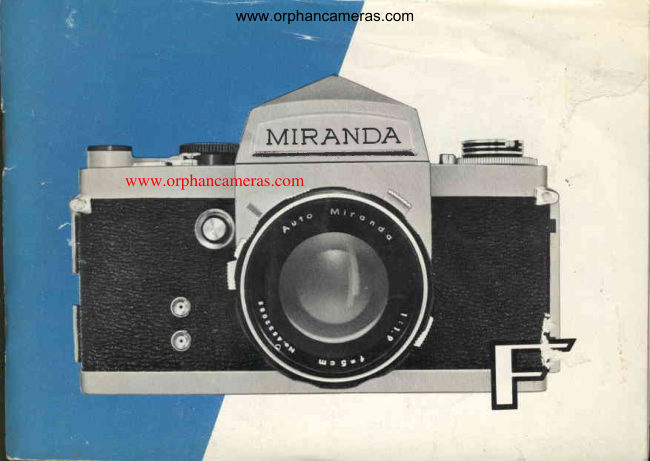
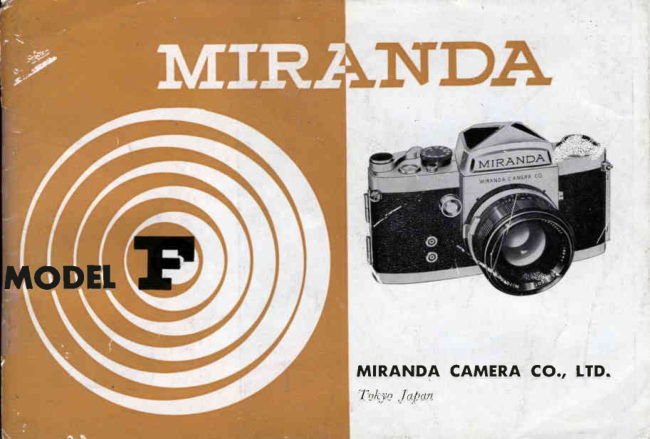
Miranda F — part 1 User manual
User manual for Miranda F — part 1. 58 pages in English. Read the original PDF, download or print a copy without registration.
58 pagesEnglish7.5 MB PDF
Loading your manual…Open PDF directly
Document details
- Brand
- Miranda
- Model / document
- Miranda F — part 1
- Document type
- User manual
- Language
- English
- Pages
- 58
- File size
- 7.5 MB
- Category
- Film cameras
- Document date
- Not specified in catalog
Search available document text
Find a term, then jump to its page in the original PDF. Image-only pages may not be searchable; check the PDF for exact wording and diagrams.
Page 4 · Read text
NAME  OF PARTS

 Filrrr Rewind Knob (with collapsiblecrank)
 ASA Speed Indicator Window
 Viewfinder Lock Button
 Pentaprism Viewfinder
 Film Advance  Leve
 Shutter Speed Dial
 Film Counter
 Cable Release Socket with Ca
 (also for  attachirg  Exposure  Meter)
 Preview Burton   (for checking  depth-of-field
 Lens Positioning Mark
 Shutter Release Button
 Diaphragm  Lever
Lens Locking  Button                                                  www.orphancameras.com
FP and X synchro terminals
Aperture  Reading
Focusing Ring
Standard Lens


                                                                                                                                                                                                                                                                                                                                                                                                            t\
View original page 4Page 6 · Read text
SPECIAL FEATURES OF MIRANDA  F


 l.  The  superb  Auto  MIRANDA   Lens            2.  Bright,    Easy-to-View    and   Accurate
                                                          Viewfinder


for color pictures.


                                               mlcroscope .
View original page 6Page 7 · Read text
www.orphancameras.com


                       4.  LJnique  TyP"   of Lens  Mount
                  The  lins  rnoittt  of Miranda F  has on  its
                   outside a  4-claw bayonet mount and on  its
                    inside a screw mount of 44mm inner diameter
                       (Att  Miranda   carneras and  lenses have the
               same standard lens mount).
                  The  bayonet mount   is' for  attaching  th.'
                  Auto lenses (having-.t..,automatic  diaPhragms),
                   extension beliows,       quickly and e.asilyby
                   merely  twisting  them    | IB  of  a  circle  after
                        -o.r.tting.  Th;  inner screw mount  is used for
                   Preset leises and most of the other accessories.
                  As the Miranda mount has a wide diameter
                 and a short flange back (distance between lens
                                                                                                        it per3t$                                                 surface)                                 and  fiim                    attaching                               plane"^most                                "of                                              SLR                                                           for  other                                 made                                   lenses                    the  ,rt.
                  cameras  by  means  of   available  Miranda
                   adapters.
View original page 7Page 8 · Read text
5.  Vibration   Free  Operation
   Since the introduction  of  Model  T  more
than  ten  years zgo,  the  Miranda  camera
became known for  its almost noiselessshutter
and vibration  free operation. For this reason,
 it is very much  liked by stage cameramen and
by technicians mainly engaged in close-up and
copying work.
  MIRANDA  F  has also inherited this superb
quality enabling  it  to  fully compete for a top
place among the SLR  cameras of the world.
Its  prevention  device  against mirror  shock
is so perfect, that no carnera shake can occur
even in such delicate work as close-ups, copy-
irg and micrography.
View original page 8
Page 10 · Read text
Venmo @mike-butkus-camera  Ph. 2083
PayPal Name  Lynn@butkus.org      www.PayPal.me/lynnbutkus
View original page 10
Page 14 · Read text
www.orphancameras.com


4.  Position  Take-uP  SPool       5.  Insert   Tip   of  Filrn  Into        6. Turn     Fikn    Advance
Slit                                  Spool's  Fikn    Slit                 Lever   Until   Perforations
  Turn  the  bottom  knurled        Insert end of. film, but see     on  Both  Sides  of  Fikn  are
flange  of take-up spool with      that  one  perforation  hole is     Caught  by  the  SProcket
the finger.                      caught by  the  claw  at  the             If one winding fails to make
                                entrance of film  slit. Also see     sprocket  catch  the  Perfora-
                                      that  the  sprocket engages in       tions on  both  sides of  film,
                                   the perforation.                   press shutter button and wind
                                                                         agarn.


                                                                                                                                                                                                                                                   l l
View original page 14Page 17 · Read text
HO\il TO USE FILM ADVANCE LEVER


      Turn  film advance lever  until    it  goes no     One  Full  lfinding    of Film  Advance  Lever:
     further. One  full  turn  of  lB0" is necJssary ro               l.  Advances one frame  of  film.
    advance one frame.  Insufficient winding  rrray         2. Makes film counter advance one number.
    make the shutter button  unrvorkable, or even         3. Changes color of film counter's indicator
         if   it  does work    it  rcray not  permit  proper           from  white  to red.
    opening of shutter curtain. This point requires         4. Cocks the shutter.
     careful attention.                                          5. Sets the automatic diaphragm of lens and
     One  full  winding,  which  also cocks the            mirror mechanism ready for  action.     shutter, makes the  film  counter's indicator
    change its color from  white  to red.  It  returns
     to white  again when the shutter is released.
t 4
View original page 17Page 26 · Read text
www.orphancameras.com


            #

5.  Obtaining   the ProPer  ExPosure
A.  When seiting the shutter speed first:       Ov    If the shutter dial does not click into posi-
  Match  the shulter speed to the red shutter           tion,  set  it  to  the nearest number and
speed index in the center of the meter scale         adjust the lens aPerture.
and use the aperture value indicated by the    O  Tike   care  to  prevent  car-:'eramovement
meter needle to set the lens aperture.             when using shutter shutter speedsof slower
B.  When setting the lens aperture  first:             than  tlto second.
  When  the  apirture   is  first  set,  turn  the    Ov  Generaliy, when  depth  of  field  is more
meter dial untif the needle indicates the same         important,  set the  iperture   first' When
aperture number, then  !lt.  shutter- speed will          shooting subjects of quick movements, set
be  automatically  set. (The'shutternumber  which          the shutter speed first.
comes against the  red          index  is the    Ov  The meter couples to the shutter dial from
shutter speed.)                                                                               I -500 speed readings but not at B (bulb)'

                                                                                    23
View original page 26Page 32 · Read text
www.orphancameras.com

        Critical   focuser,  Typ"  VFg        Critical'   focuser,  TyP"  VF3        Critical   focuser,  Typ"  VF4
                               ( x 5 )                                                  ( x 1 5 )

I
J

       I

          The viewfinder on MIRANDA  Fv is inter-
        changeable and  can be changed  with  the
        most  convenient  type'tb  according to the pur:
          oor.   of  the  shot    as to make best use of
             ih;  camera's  capacity. The viewfinders avail-
                                                waist-level1      able are the p.ntuprir-   type and
          finders Types   l,  3 and 4.
       Ov  For  oiiittuty   shooting  tf  is convenient to
            use the Pentaprism viewfinder which showsI:         the  image  right  side up  and right way
            round.
       Ov  For  low-angle  or   trigl  position sho-oting
           and for candid shots, ttre waistlevel finder
             VF-I  becomes useful.

                                                                                        29
View original page 32Page 34 · Read text
www.orphancameras.com
SHOOTING AT SLOW SPEEDS        DETACHABLE
                                CABLE RELEASE SOCKET'S SCREW-CAP


                                   M I R A N D A F h a s a c a b l e r e l e a s e s o c k e t f o r
                                                       attaching   its  specially-designed top. Release'
                                        When  this  is aitached,  the  camera's  shutter
                                                  can be operated from  two  places' which   will
                                                        give  great  convenience  in  a  variety  of ap-
                                                            plications.
 body.
   When  the meter  is mounted  on the came-
 ra, use a leica-type  cable release by unscrew-
 ing  the  shutter  ielease  protection   ring  and
 replacing  it by the cable release'                                                                                    3l
View original page 34Page 41 · Read text
www.orphancameras.com
    SHOOTING  WITH  FLASH


                                                  For snapshots at night,  in dark  places and  in  in-
                                                door  shooting,  flashbulbs  or  electronic  flash  can be
                                            used as auxiliary  light  for taking pictures  of against-
                                                         the-light subjects.
                                  O  For flash shooting, an  exclusive Flash b"acket  is
                                             mounted on the bottom  of the camera.
                                  O  The  flash unit  is inserted from the rear of the flash
                                                    bracket and secured by tightening  its mount.
38
View original page 41Page 43 · Read text
www.orphancameras.com
   LENS INTERCHANGING

       MIRANDA   F  has a  bayonet type  lens
      mount  which  permits quick-of   lens interchange
      and  accurate coupling    the automatic  dii-
      phragm mechanism.
     O  Lens _ can  be  interchanged  regardless to
         whether  the  film   is advanced  or   not.
         Moreover,    it  makes no  difference  what
          aperture  value  the lenses rnay have been
          set at the time of changing.
    O  fol   Miranda   interchang.iUt.   lenses, not
         belonging to the exclusive Auto  Miranda
           S-eries,!y.h  as Soligor, or other preset lenses
          the inside screw mount can be^used. Also,
          various  adapters and  accessories can b;
         attached by  using  either the bayonet or
          the screw mounts.


40
View original page 43Page 45 · Read text
www.orphancameras.com

     MIRANDA   INTERCHANGEABLE    LENSES

      MIRANDA  F  has a number  of extremely
      high  resolution interchangeable lenses which
     e_mpodythe latest optical theories and original
      designing. The  Auto  Miranda  lenses aie of
        {ully  automatic diaphragm  type  available  in
       five  focal  lengths fAom 28mm  to  l35mm,
      (more  in  preparation) while preset diaphragm
      lenses are available  in 13 types  from- 28mm
     uq  to B00mm. This permit  selecting-sharpthe most
       suitable lens for  any purpose. The          re-
      solving power and beautiful  blurring   effects,
      as well as the perfect color balance, combined
      with  light weight  and  easy use have made
      the Miranda  lenses the desired in the wortd.       Auto  MIRANDA   28rnm   fl2.B
                                                A                                                                                            -                                                                                        ligfr  speed, full-fledged  ultra  wide-angle
                                                              lens, having great depth of neta and no con-
                                                             spicllous  distortion.   Its  brightness of   f 12.B
                                                               exhibits  its fullest power in outdoor snapshots
                                                   and architectural pictures, as well as in indoor
                                                  and  -night scene shooting.   It  is made in a
                                                            retrofocus formula
                                                     Coverage  angle 75" , lens  construction  6
                                                        groups B elements, smallest aperture   f l16,
                                                               closest focus at 25 centimeteis, uses fiiters
                                                                      of 46mm screw-in type, dimensions 57 .5
                                                X 60mm, weight  is 230 grams.

42
View original page 45Page 48 · Read text
www.orphancameras.com
    WIDEN  YOUR  PHOTOGRAPHIC   SCOPE WITH  MIRANDA'S  LARGE
   RANGE  OF ACCESSORIES

     A.  Viewfinders
      As already explained  briefly  in  connection
     with.picture  gomp.ojition and.'viewfinder, ttre
     waistlevel finder  differs from  the  pentaprism
    viewfinder, which is used. at eye-revel, in b.i"g
    useful in taking pictures at  waist-level. onE
     of the sp_eciaifeltures  of the Mirand a- ca,,'era
     is  viewfinder-.interchangeability.   ffr.   inter_
    changeable Miranda  viJvfina.i   ,vrt.-    is  far
    superior to the angle finder attacirment used
   FV other S.L.R. c-meras, as it  p.r-it,  view_
     irg  of a bright and  life  ,ir.  image.

    e  Thq waistlevel finder  is not  only  useful
        in  low  angle shooting but also uLry con-
       venient in                   -cloje-ups, iopying  and  micro-
       scopic work.  Moreover,-  it  iun be used. in
      sideway shooting.                             ".u.,  O  Th.  vi'ewfind.,      be removed for  inter-
      changing            _UVmaking   it  slide towards  the
       rear, while  pushin$  the  viewfinder  lock
       button   in  the  direction  of  the  rewind
      knob.  To  attach, match  the viewfinder,s
      base to the  camera,s groove and slide  it
      forward  until   it  clicks irrto position.


46
View original page 48Page 50 · Read text
www.orphancameras.com

     B.  Focabell
      This  is an extension bellows unit  which  is
    used between lens and  carnera bodv  for  tak-
     ing ultra close-up shots and magnified pictures
     of small objects. It  is available in two types.
   O   It  is attached to the carnera in the same
       way as the l.g! by using the outside bayo-
        net mount and riratching to thTred  point-
          er.  But   if  the camera  is  to be used ver-
          tically,  this position can be shifted 90o to
       match the green pointer on the camera's
         front  plate.
     e  The  tripod  socket  of  Focabell  can  be
        suitably shifted to obtain proper balance.
     e  When  combined  with   the  short-barrel
        Soligor  I 35mm  f 13.5 lens, it becomes usa-
         ble over a wide range of conditions from
          infinity  to ultra close-ups.
   O As  the  field  of  coverage  car. be  easily
        varied  it  is extremely convenient in taking
        pictures of animal life and scientific works.


48
View original page 50Page 52 · Read text
www.orphancameras.com

    C. Extension  Tubes
     The          standard                    lens                             of                         Miranda                                         sharp                                      gives-21                                    r)        up               to 45cm                           (t7                              (roughl y                                 X  I                                          4 cm     lg:"r
    nlls up  the  entire  viewfinder  field). But  to
   shoot at closer distances, the p*t.nuion  tubes
   become necessarv.
   o  Extension  tubes  are  available   in   four
       length, one AU  Adapter  and  3  inter_
      mediate Rings. The eli  eaapter  is equip-
      p.ed with  a screw and bayonet -orr.rtl  th.
    _  rlngs use inside screw mount.
  O The AU  . Adapter  has the same length      as tube No.  I.-
   e  The tubes are of lengths Bmm, l6mm and
      32rnm, and  can  b;  used separately or
     combined to give close-ups of' 0.15 -   | .22
      times magnification.
   o  Magnificalio.r ratios and exposure factors
      are shown on the next  page  (for 50mm
      Iens at infinitv.
  O These are handy  to use in copying^ '    photo-
      grap.hs or   taking   pictures   of"  insect
     specimens.


50
View original page 52Page 54 · Read text
www.orphancameras.com

          D. Lens  Adapters        MIRANDA  has a lens mount  of large diameter and a thin body
                                which enables it to accept various types of  lenses with  the aid o?
                                   lens mount adapters.


     PM  Adapter    :          XM  Adapter  :       AXM  Adapter  :         LF  Adapter    :
         For  lenses of Asahi          For  mounting          For  automatic           For  Leica  and
      Pentax  ,       Yushica        Exakta and Top-        Exakta lenses.         Canon        scre\^'
      Penta,    Petri   Penta       con mount lenses.                               mount  lenses.
      and  others having  the
       Praktica  Mount.


       CSF Adapter  : ,          CTF- Adapter  :                         AU  Adapter  :
          For   standard           For wide-angle                                For    making
        lenses of Contax         and     telephoro                              close-ups up-   to
       and Nikon S.             lenses of  Contax                                        l0   inches   r.r'ith
                                and  i.rlikon S.                                Miranda  lenses.
s2
View original page 54Page 55 · Read text
www.orphancameras.com


E. MicroscoPe   AdaPter

                        When mounted between carrrera body and microscoPe,
                                   this  adapter makes microscopic picture taking extremely
                             easy.
                             e  The  carnera lens is taken  off.
                             e  The  viewfinder  can be  interchang.ed with   critical
                                 focuser VF3  or VF4  for easier focusing.


                   (HOW TO ATTACH)
                                           (tl  Attach this adapter to carr'erabody.  (?) T!.  con-
                              nection piece at the end  is turned counter-clockwise and
                             detached.  (3) Take  off microscope's eyepiece and attach
                                                       it  to the inside of the connection piece by means  of  its
                            bayonet mount.  (Picture at  left).   (4)  Insert into micro-
                             scope's eyepiece as before, match the red spots on tube
                          and bayonet mount  of connection piece, set to th.  pcsi-
                                 tion to be used and tighten the connection piece's screw.
                                (Picture at right).                                  53
View original page 55Page 58 · Read text
www.orphancameras.com
   CARE AND STORAGE  OF CAMERA

     When used on  the  beach,  in  a  strong wind  or  other
    unfavourable  conditions, damage may  be caused  if   left                                                                                                                                                                              't
    unattended, so please observe the following  precautions :
   CARE AFTER  USE                                                                  l
   @Clean the lens of dust and  dirt  by  using a  soft brush
     lightly,  but do not clean too often.
   QUse chamois or other soft material  to clean the chrome-
    plated parts.
   QAlways use a blower to clean the mirror, which must never
   be touched with  fineers.

   PRECAUTIONS   IN STORING
   QAvoid  places of high temperature  or high  humiditl'.
   QBe  careful to avoid shocks as they may cause damage.
   @Keep the shutter uncocked.
   @Set the lens to  infinity  before closing the camera case.
   @If  not using for some time, pack  it  in a  plastic bag to-
    gether  with  a  drying  chemical and enclose within  a  car:
    or other strong container to preveylt damage.
  @Be very careful not be drop the carnera into  salt water
   as repair may be impossible.
                                            t&
56
             i,{ri{p\dSL,                                               ,g*r:r-a,t*                    n.     rr;*ilis{  .   ..,;}8l&,,       ff&-
View original page 58Related documents and language editions
From the M. Butkus archive. Original publisher and archive notices are retained.
Check the model and edition against your equipment.
PDF verified 2026-10-10.