Film cameras
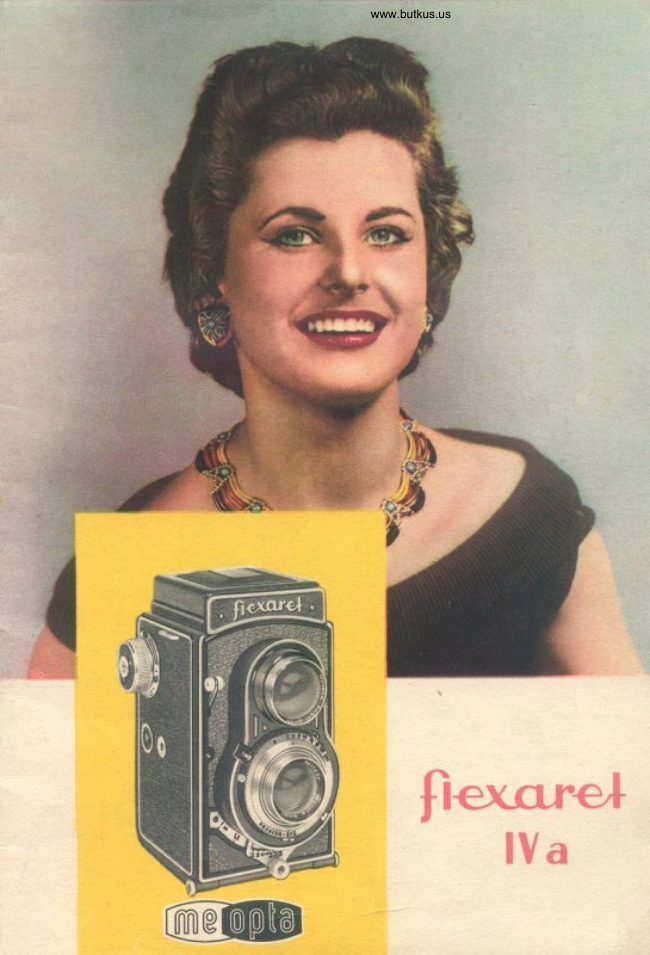
Flexaret IVa User manual
User manual for Flexaret IVa. 53 pages in English. Read the original PDF, download or print a copy without registration.
53 pagesEnglish4.8 MB PDF

Loading your manual…Open PDF directly
Document details
- Brand
- Flexaret
- Model / document
- Flexaret IVa
- Document type
- User manual
- Language
- English
- Pages
- 53
- File size
- 4.8 MB
- Category
- Film cameras
- Document date
- Not specified in catalog
Search available document text
Find a term, then jump to its page in the original PDF. Image-only pages may not be searchable; check the PDF for exact wording and diagrams.
Page 3 · Read text
Description:
The FLDGRET lVo  is o twin-lens reffex comero for twelve 6Y-6 cm exposureson
120 films or for thirty-six24Y.36 mm exposureson 35-mm cine film.
The focusing  is effected by o simultoneous movement of the two objectives (mounted
on o common ponel) by meons of the focusing lever within o ronge of obout 1100.
The viewing lens is o   f g.O, F:80  mm three-gloss coqted onostigmot; hnce  its defi'
nition  is ro-ther low, os o  result of which the focusing is more occurote, A full-screen
mognifier which con be tilted over the ground-gloss screen focilitotes focusing' On
the-ground-gloss screen on upright, non-reversed, bright ond qhorp. imoge  is seen.
 It is-possibl6 olso to toki: snopshots from the e-ye-level, providing thot the viewfinder
hos been odjusted  to on open frome  finder. This proves to  be very odvontogeous,
porticulorly when tcking quick, sports shots.
The toking lens is o four-gloss BELAR cooted onostigmot,  f  3.5, F:80   mm, with o
focusing ronge from infinity up to 3  ft.
The comero is equipped with o five-lominoe centrol-type shutter fitted with synchro'
nizotion for  vorious' kinds  of  floshlight ond  with deloyed  oction.   lt  is usuolly o
PRONTOR SVS-type sh,utter. The meihonisms  octuotinq  the cocking  of the  shutter,
the setting of  tl.re exposure time ond  thot  of the diophrogm, ore. mounted on the
 shutter;  tEe releose  iever ond  the  th,reod-nipple  for  the  wire  releose ore  locoted
on  the comero body, these mechonisms being blocked by the rewind mechonism,
thus preventing repeot"d .*posures from being mode on the some frome' In speciol
        (e. g. w6en moking  trick shots), two or more exposures con be effected directly
 "orlr'on the shutter.


                          www.orphancameras.com
View original page 3Page 4 · Read text
t
                                                                                                                                 'g
                                                                                                                                                                                                               ,i
                                                                                                            {
The odvoncing of the fim is corried out by meons of o rewind knob locoted ot the            ti
 right hond side of the comero.When rewindingthe beginningof fiim up to the first
exposure ond towords the end of film ofter ihe twelfth e*fiosure the film con be
odvonced continuouslyby                      .mgonsof the rewind knob. From ihe first exposure up to
the twelfth one the rewind knob is blocked qutomoticollyolwoys olt"r'in"  film hos
been moved o disto.ncecorrespondingto the width of one frome. Siruttoneorsly, if"1"
releose lever is  releo:ed.; by p.ressingdown the  releose lever when  rnotint  on
exposure the rewind knob is releosed once more ond con be rototed ogoinl A"
exposure connot be effected, however, unless the film hos been rewoundl Hence,
the film cqnnot be rewound without exposing,os o result of which the some frome
cqnnot be exposed twice.
The number of the exposuresfrom 1 up..to 12 is indicoted outomoticollyby meons of
o film counter which is set outomoticollyin the zero-positionwhen the bock of the
comero is opened' For countingthe exposuresmode on o 35-mm cine film the comero
is fitted with on odditionol counter lototed by the side of tne piincipo't--fitrcounter
window, this ouxiliory counter indicoting the exposuresin tens.
The.ouxiliory counter. m.ust olwoys be set by hond to the respectiveten, the totol
number of exposuresbeing reod-off on both of. the two counters.
             it b_erequired to work with o 35-mm cine film, the comero con be odjustedllt:Jlfor this purpose very eosily. The 35-mm film guide hos only to be inserted inio the
cornero, ond then the extension p.ivotsset up on the upper spool piuott. The film
con be wound up either on o stondo-rd35-mm spool or upon o spool'insertedinto q
stondord m.ogo.zine.ln both coEes the film  is no longer rewound into the
mogozine. In the first cqse the exposed film sh,ould6"  r.rou"d  together with"ri;inJthe


                                                                                                                                                              F

                                                                                                                                          ,:
                                                                                                                                                                                        iAa
View original page 4Page 5 · Read text
spool in the dork room; in the second cose the film wound up into the mogozine
con be removed in doylight.
Also when using o 35-mm cine filrn both the rewind knob ond the releose lever ore
blockedogoinst o double exposureond ogoinst odvoncingthe film without exposure.
The releose lever is locoted ot the right hond side of the viewing lens so thot  it con
be octuoted by meons of the right hond thumb. This is very convenient since  it
enobles the ccmero to be held firmly with both honds while exposing.Simultone-
ously, the focusing lever con be octuoted with the forefinger of the left hond.
The forefinger of the right hond con be used for cocking the shutter, Thus oll the
operotions preceding the exposure con be effected very eosily ond quickly without
crossingthe honds.
The depth of the focus icole is engroved on the focusing lever.
After tilting the cover lid of the viewfinder folding hood, the remoining three lids
qre set outomoticolly into working position; on closing the viewfinder foldinE hood
it is sufficientonly to press down the cover lid, os o result of which the folding hood
is closed outomoticolly.
With the lotest model of the FLEXARETlVo the rewind knob hos been designed to
registerthe kind ond sensitivenessof the film used, The design of this device elimi-                                                 'hqsnotes the possibilityof ony hondling ofter the film    been looded ond the comero
closed,thus ensuring thot the figures shown by the indicotorsore correct.


                         www.orphancameras.com
View original page 5Page 6 · Read text
DIRECTIONS FOR USE.
1. SensitiveMoteriol:
Stondord1.20(6\9  cm) roll film should be used on which twelve 6X6  cm expo-
sures con be mode.
 lf  it is required to work with 35-mm perforoted cine film, use stondord pocking-mmin
mogozinescontoining up to 1.6 m  (i. e. 63 in.), ond moke thirty-six24 \  36
exposures.
It is possible, however, to use olso other types of mogozineswith cine film, e. g,
mogozineswithout o spool (e. g, AGFA-KARAT-FiIm)for twelve 24)(36 mm expo-
sures. lt  is obvious thot in oll coses vqrious types of sensitive moteriol, block-ond-
white or colour, con be employed.
2. Opening the Comero:
At the left hond side of the cqmero there is o milled knob (see Fig. l-1) which con
be unscrewed by rototing  it to the  left. lt con then be presseddown, os o result
of which the bock of the comero is opened.
3. Preporing the Comero for Looding the Film:
o ) 6 X 9  c m
   Inside th,e comero there is on empty spool (see Fig. lll-3) which should be locoted
    in- tf9  upper spool chomber (see Fig. lV-4). lf this is not the cose, the inserting
    of this empty spool is effected in the following woy:

                                 6


                                                              T
                                                                                                                                                                . .;ri+fii.r..,-.: ..,,''r4l                                                           Iri
View original page 6Page 7 · Read text
Pull out the rewind knob (see Fig. ll-2) in the direction of its oxis ond turn ir
    slightly to the left (i. e, onti-clockwisedirection). The knob remoins in the with-
   drown position.Insert the empty spool into the upper spool chomber so thot the
   longitudinolslot ot one side of the spool foces the rewind knob. Then slightly
   press the spool with the left hond thumb in the direction of the spool crxii so
   thot.the.firm spool pivot (see Fig. lV-6) snops into the circulor operringon the
    left hond side of the spool,
   While holding the left hond side of the spool with the left hond thumb, turn the
   rewind knob by meons of your right hond first to the left, until the knob snops in,
   whereupon,by turning the knob to the  right, the key of the tronsporting pivot
   snops into the longitudinolslot in the right hond spool side. Thus the spool is
   inserted correctly into the upper spool chomber" This con be checked by turning-
   the rewind knob, The spool must rotote sinrultoneouslywith the rototing knob.
  The rewind knob con be turned only to the right (i. e. in clockwisedirection),
   providing thot the spool hos been inserted correctly.

b) 35-mm Cine-film:
   Set up the smoll extension pivot (see Fig. V-8i',upon the firm spool pivot (see
   Fig. V-6) in the upper spool chomber, inserting the spring-fooded inner port of
   the smoll extension pivot into the opening in the firm pivot.
   Next set up the lorge extensionpivot (see Fig. Vl-9) upon the tronsporting pivot
   of the rewind knob so thqt the key of the tronsportingpivot (see Fig. Vl-7) snops
   into the groove (see fig, Vl-l0) of the lorge extensionpivot.


                          www.orphancameras.com
View original page 7Page 8 · Read text
lf  it is desired to lood the film on o spool only, insert the spool between the two
    extensionpivots in the following woy:
   Toke the side of the spool with the left hond occordingto Fig. Vll-11 ,ond put the
   opening on its other end upon the lorge extensionpivot (see Fig. Vll-9) so thot
    the tronsporting insert of the spool snops into the spoce between the projecting
   pins of the pivot, pressingthe spool simultoneouslyin the direction of its oxis
   towords the rewind knob so thot  it con olso be put upon the smoll extension    pivot.
   Supposingit is desired to work with o mogozine,the insertingof the mogozine
   with the spool must be corried out simultoneouslywith the lJoding of thl  film
   (see porogroph 4b).
    lnsert the 35-mm film guide (see Fig. Vlll-l2) into the comero,toking care thot
   the guide seoting surfocesore seoted properly on the recess in the comero body
   (see Fig. Vlll-13).Simultoneously,the roller (see Fig. Vlll-15)is turned towords the
 ,  lower spool chomber,
4. loodinE the Filmi                                              a   ,
Bgfore looding the film first moke certoin whether the ouxiliory counter'(see Fig.
fx-l6) indicotes the correct position. The window of this counter must show zero.
Should it not do so, the milled knob (see Fig, lX-l7) must be rototed in the clockwise
direction until the zero oppeors in the window.


                                                                                                                                                             ,r
                                     8 ; :
View original page 8Page 9 · Read text
o) 120 roll film t6 X 9 cmt:
  The film roll con be inserted into the comero in doylight.
  Swing off the left.hond.hinged, pivot (see Fig, X-18j o"fthe lower spool chomber,
  ond put on the pivot the spool with the filrn The other end of the spool p"i"d
   towords the firm pivot (see Fig. X).
   Next tilt down the hinged pivot into the spool chornber,toking core thot the firm
   pivot (see Fig. X) snops into the opening in the side of the  i  ool.
  The..bocking_poperis olwoys seoled by meons of o poper strip which con be
   eosily torn off, whereupon                             piece of bocking poper obout 15 cm (i. e. 6 in.) in                                .o
   le.ngthshould be wound off. The top side oithe'bocking  poper, which is fiited
   with printed inscrip,tions.ond.fig.ures,must olwoys foce t-he direction owoy from
   the comero, providing the film hos been looded correctly(see rig. xl1.
   lnsert the cut-off end of the bocking poper into the longer longitudinol slot of
   the empty spool.(see Fig..Xl). Bv turning the rewind knob io the ri-ghtthe bocking
  pqper is wound.on to.the upper spool until the triongle-shopedmorks ({F)
   printe4 ot the side of the bocking poper ore set oppositl the circulor white'dots
   (see Fig. Xll'l9)                  .919t9to the  filni juiie.  Simultoneously,tne- Uocking poper con
  be broked very slightly by meons of-the left hond thumb: (see Fig. Xllj. tore must
  be token, however,thot the bocking poper does not slide ov6r the meosuring
   roller (see.Fig. X-2O).Under no circumstoncesshould the bocking poper Uu nrot.j
  so violently thot the lever (see Fig. X-21') determining the bos'ic'position of the
   blocking mechcnism could be swung off. This would Tesuft in the forming of on
  undue spoce before the  first exposure.


                        www.orphancameras.com
View original page 9Page 10 · Read text
Furthermore,core should be token thot the bocking poper is wound correctlyon
   to the upper spool.
  The bock of the comero (see Fiq, Xlll-22) con be closed by pressing it down with
   both tlrumbs (see Fig. Xlll) until it snops in, whereuponthe milled knob (see Fig.
   Xlll-1) is secured by being screwed so thot  it connot be pressed down. As o
   result,the comero ccnnot be opene.dby occidentolpressingof the knob.

b) 35-mm Cine filrn:
   After hoving inserted the empty spool between the extension pivots in the upper
   spool chomber, insert the mogozine with the film into the lower spool chomber
  ond wind off o piece of film obout 10 cm (i. e. 4 in.) in length. Insert the film
    first under the  left hqnd guide sprocket (see Fig. XIV-23),then under the right
   hond one, set the sprocket holes on the teeth of the meosuring sprocket (see
   Fig. XIV-20); next insert the film under the swing-off pressure plote (see Fig.
   XIV-25)of the 35-mm film guide, ond tilt down the pressureplote upon the film,
   fixing its end to the empty spool os usuol.
   Next turn the rewind knob slightly to the right, just to stretch the film. With the
  comero bock opened it is not permissibleto continue rototing the rewind knob
    in order to ovoid domoge of the film perforotion.
   Afterwords close the comero bock immediotely.
   In cose it  is required to wind the film into o mogozine,the following procedure
   shsuld be observed:

                                       lo        ;-'
View original page 10Page 11 · Read text
From o looded mogozine wind off o piece of film obout i0 cm  (i. e. 4  in.) in
    length, ottoch its end to the spool os usuol ond insert the spooi'iooaea-irogozineioqether with the
   ottqched film into.the.mogozineoccordingto.Fig.XV. Put tfre                   into
   the lowe.rspool chomber, insert the fi.lm.undeithe guide rolleis (r""  FigI X), under
   the guide pressure.plote (see Fig, XV) in the  rlru  woy os'described in the
   foregoing pcrrogroph.Put the emfty mogozineinto the          ,;;J'  chomber in
   the some woy os the spool only (iee por-ogroph3b).    "pp;;  '
   Stretch the film slightly.by meons of the rewind knob, holding the empty-occid"ntJrv.mogo-
   zine with the left hond thumb so thqt the mogozine .onnoi turn
   Afterwordsclose the" bock of the comero,

5. Setting the film for the first exposure:
Turn the rewind knob (see Fig. XVI-2) until it is blocked outomoticolly.Sirnultone-
ously,the figure "1" oppeors in the counter window (see Fig. XVI-42),indicoting thotthe film is preporedfor the first exposure.

6. Preporingfor exposure:
o) Focusing:
   Upon pressing                    {"ry.n the knob (see Fig. XVll) the viewfinder fofdinq hood is   opened           outomoticollv..                       swins                                the                                    mognifie.r                                           (see rig. xvii-2ti                                                                    sround-   gloss screen,              opprooch                        the-eye                                 closJto                                          the'mogniiier                                               ond fbcus";;;;i""the imcge                                                                  on
   the screen by moving the focusing lever (see Fig. ivr[-ze)  wiih lr,L i"rt hond

                         www.orphancameras.comI I                ;
View original page 11Page 12 · Read text
forefinger,lf the imoge on the ground-glossscreen is properlyfocused,the imoge
   on the film will be perfectly shorp os well,
    In cose moving objects ore to be photogrophed which conhot be focused before
   exposure,determinethe distonceof the object by estimotionond set the estimoted
   volue on the distonce scole (see Fig. XIX-29) below the focusing lever. (Fig.
  xrx-28.)
   This scole is fitted with figures indicoting distonces either in metres or in feet.
  The object ot on infinite distonce is morked by the sign " o "  (infinity),or "lNF".
     lf, for instonce, the reference mork of the focusing lever (see Fig. XIX-30) is set
   opposite the number "2", the imoge of the photogrophed object locoted ot o
   distonce of 2 m  (i. e. opprox. 7 ft) from the objective front lensesis focused.
b) Stopping down thd lens:
  The omount of light which is ollowed to poss through the objectivecon be mode
   vorioble by stopping down the lens. The diophrogm scole (see Fig. XIX-31) is
   fitted with stop numbers3,5, 4, 5.6,8, 11, 16, 22, oppositewhich the point of the
  diophrogm lever (see Fig, XIX-32)con be set. lf the stop number "3,5" hos been
   set, the objective is fully open, whereos,on the other hqnd, with the lens stopped
   ot "22" only o smoll omount of light is ollowed to poss.Thesestop numbershove
  been chosen so thot stopping down to the next higher number entoils doubling
   the exposure.
   Exomple:
  When stopping down to  "5.6" o  certoin omount of  light  is ollowed to pcrss
   through the lens. When stopping down to the next higher stop number "8", the

                                                                 t 2


                                                                                                                                                                                                                                           -   r ' : i      :
View original page 12Page 13 · Read text
gT.ou.ntof light is holved; on the.other hond, however,when stopping down to
    "4"  the omount of light  is doubled. Every ooJ!.iiu" prouia"i if-," L!!t  results with   o      certoin              s.to-p                           usuolly                                   wjthin                                      o                                             S up io  ii,  ,""uring the                .number,                                            ."r.o.ngqof from   moximum              definition                        or depth                                   of                                focus                                       within-these                                                            limits.
 c) Setting the exposure time:
   The shutter is equipped with figures indicoting the shutter speed, i. e. the time of   exposure,
   There ore the following..figu.reson the pRoNToR SVS shutters: l, z, s, 10,25, s0,
   100,300. The figure "l"  indicotes1._l9g.onq,.the.figure  ,;z';- .oii"ib."al"'g--*.,tli--'-
   1/2 second, "5" with 1/5 second, ,,100,, wiin lp05 second, etc.
    ln oddition, the,sh.ufter.is equipoed with the leiter B f;; i#"-"*posures.
     It is recommendedthot beginnersuse o shutter rp""J.r   illoiliJr-'rnopshots to
   ovoid rocking the expo-sure.Only experiencedphoiogropheri    1op" snopshots
   with o shutter speed of 1l2S sec., or even lower.           "on
   By turning the externol milled shutter ring                                           (see Fig, XIX-33) the chosen speed                                                                                     .   number is set opposite the reference mirk'on  th,6 shutter. The shutter speed
   should be chosen with regord to the stop used, oi, vice verso, the suitobl;;;;
   number should be chosen in occordonce with the shutter ;;;;A   uitn"r, o".orJinil
                   or occording to the EXPOSURETABLE, or with tl.,* fr"ip of on exl   lo^:1p^:r,"nce,posrmeter.

d) Cocking the shutter:
  The shutter is cocked by pressingdown the cocking lever (see Fig. xlx-35).

                                 13           ,r'l 4  '
                         www.orphancameras.comf
View original page 13Page 14 · Read text
7. Exposurei
After hoving focused, set the stop ond the shutter speed, ond, ofter hoving cocked
the shutter, the exposure con be mode, Before exposing, the mognifier should be
swung bock into its originol position.
Hold the comero firmly with both honds, th,e best woy being shown in Fig. XX, ond
ot o suitoble moment, press down the releose lever (see Fig. XXI-36) lightly ond
without rockingwith the right hond thumb. When exposing,the imoge con be obser-
ved on the ground-glossscreen.When using o 35-mm cine film, the imoge of the
photogrophed object must be positioned within o  rectongle drown on the screen
for this purpose.      ,

8. Exposuresfrom eye level:
tn some coses, e. g'. *hen  toking ropid sports snopshots,or when using o 35-mm
cine film for longitudinol pictures,it  is convenientto use the open frome finder.
Pressdown the flop of the viewfinder lid (see Fig. XXll) into the horizontol position
over the ground'glossscreen,swing off the mognifier (see Fig. XXll-27) into the ver-
ticol position, opprooch the eye close to the squore-shopedopening in the view-
finder bock (see Fig. XXll-27) ond observethe ph,otogrophedobject.
When using o 35-mm cine film, only the inner hinged portion of the viewfinder
front port should be tilted down (see Fig. XXI-39).


                                                                                                                                                   l L         F

                                                                                                                                                                                                                                        ,  :  t

                                                                                                                                                                                                                                                                        I
                                                                                                                                                                                                                                   -,"i!f,*',..,        -.,i*i..r.-           ,    !.,:                                    -r*;,J
View original page 14Page 16 · Read text
The milled shutter_rin9--.(s-ee.Fig..XIX-33) is set with the letter "8" opposite the refe-
rence^mork (se-g                       fig.. XIX-34). Then the shutter is cocked by meons of the cocking
lever (see Fig. XIX-35).Upon pressingdown the releoselever'or the wire releose,th6
shutter is opened ond remoins open os long os the releose lever is presseddown.

12. Further exposures:
After                           first      -octuoting }!e                        .exposure-by pressing.down the releose tever (see Fig.XXI-36),the. blocking                 .mechonismof the rewind knob is releosed outomotiiolly on"d
the rewind knob con be turned ogcin until it is blocked outomoticolly.Thus thl tilm
is prepored for the next exposure,the film counter indicoting outomoticollythe next
number.                     !
lf o 35'mm cine film is used,_it is necessorybefore or qfter every eteventh exposure
to turn the milled knob (see Fig. lX-17) of the ouxiliory film counier by 900 in'clock-
wise direction,
Simultoneo.usly,the milled knob snops in slightlyond in the window (see Fig. lX-16)
gf tlq ouxilioryfilm counterthere.oppeorsth-efigure 1,2, or 3, occordingto-whether
the 11th,21st,or 31st exposureis being mode.ln cosetheknob of theou*iTiorycounter
(see Fig'.lX-17, is turned by more thon 900,th,e.'milledknob must be rototed in the                                       4originol direction until the correct figure oppeors in the respectivewindow.
lf number "l" does not oppeor in the mqin counter window when the milled knob
of the odditionol counter is turned s I o w I y, we must turn tlre milled knob further
on in the direction of the orrow by 3600 in order to obtoin the required setting of
both counters.

                                1 6     1
                                                                                                                                                                                                                                                                                                   l ';*
                                 i4\,^-,             .,   i-  .- ..           . #ii'                                                                                                             ,"      g,
View original page 16Page 17 · Read text
ii
          fo ovoid covering the window in the milled knob with our finger when hondling the
         odditionol counter,we hod better turn  it lightly by grosping it with two fingers from
        the side by the milled edge of the knob.
      When turning the ouxiliory counter, the principol counter (see Fig, lX-421 olwoys
       springsfrom the number"11" to the number"1",  showing on  further exposures
        furthernumbers,i. e.2,3,  etc. up to "1'l".
       Thus the ouxiliory counter (see Fig. lX-16) counts the tens, the principle counter (see
         Flg. 1X-a2lthe ones.
        For instonce, the window of the ouxiliory counter shows "2", the principol counter
       window showing "7"; hence the "2Tth exposure is being mode.
      When using t20 roll film (6 X 9 cml the quxiliory countei must not be hondled.

       13. Closing the viewfinder:
       By tilting down the cover lid of the viewfinder(see Fig. XXlll-a3)the viewfinderfold-
        ing hood is closedoutomoticolly- ond the lid snops in.

       14. Removingthe eiposed film from the cumerq:
         o) 120 roll fitm (6 X 9 cml:
            After                .hoving exposed the tweifth shot, turn the rewind knob (see Fig. lt-z) without
           stopping,os o resultof which o red mork oppeors in the window of the principol
           counter indicoting thot the whole film hos been exposed.

                                       1 7 {                     t r  'w i  i                               www.orphancameras.com. a
View original page 17Page 18 · Read text
Turn the rewind knob obout 5 times ond only then open the comero bock. Pull out
   the rewind knob in the direction of its oxis (see Fig. ll), os o result of .which the    film roll is roise.dby the pressure exercisedby meons of the pressurespring so F                                                                                                                                   \    thot the film roll con eosily be removedfrom the comero.
   Core shoufdbe token thot the film does not uncoil. Seol the end of the bockinq
   pope.rby          -meonsof o poste strip ottoched to the end of every film. This procedur6   con be effected in dcryligh,t,

b) 35-mm cine film:
   After ho.vingexposedthe lost shot distinct resistoncewill be felt when turning the
   rewind knob. lt occurs if the end of film is ottoched to the lower spool,"Stop
   turning the rewind knob in order to ovoid domoging the film.
  To ovoid losing the lost exposed shot, it is necessory- even in cose the film is
  rewound into o mogozine -  to remove the mogozine from the comero in o dork
   room.
     lf  it is desired to remove the film from the comero in doylight, it must be token
   into occount thot one or two of the .lost exposures(occordlng to the length of   film, to the woy of looding, etc.) will be il[urninotedwhen tiken out froil  the
  comero, i. e' deprecicted. lt  is recommended,therefore, when looding the film
   into.the mogozitreby oneself,not to fosten the end of film to the siool; os o
   result,it  is possibleto rewind the whole film into the upper mogozine.
  Removol of the.spool or mogozine from the comero is eosy ond need not be
   especiollydescribed.

                                     tg        ,1.t:,                                                                                                                                                                                     I                   &F
View original page 18Page 19 · Read text
15. Depth of focus:
Everyobjective reproducesshorply not only the objects locoted in the focusing plone,
but olso objects lying before ond behind this plone. This phenomenonis colled
"depth of focus" which is the lorger the more the lens is stopped down,
The comero is equipped with o depth of focus scole locoted directly on the focusing
lever (see Fig. XIX-aa). This is very convenient since  it  is possible -  ofter hoving
focused -  immediotelyto reod off the two distonceswithin which the photogrophed
objects will be reproducedshorply. The scole is computed for o moximum unshorp-
ness (the so-colled dispersionring) of 0.05 mm,

Exomple:
The focusing lever is set with its reference mork opposite the number "3" on the
metric distonce scole (see Fig. XIX-29). Supposingthe objective is stopped down to
"8", reod off on the distonce scole the distonceslying opposite to th,e two numbers
"8" which ore locoted on the focusing lever on either side of the centrol reference
mork. They ore distoncesobout 2.5 m ond 3.8 m. lf the lens is stopped down to "16",
the distoncesreod off will be opproximotely2,1 m ond 5.5 m.
In cose it  is desired to determine the depth of focus more occurotely,the enclosed
"Depth of Focus Toble" con be used which hos been computed for o moximum
unshorpnessof 0.05 mm.

                                                                                    t o               r
                         www.orphancameras.comi i
View original page 19Page 23 · Read text
riliiL ; l                                                                                                                                                                                                                               iii
16. Floshlightexposures:
The PRONTORSVS-type shutter is equipped with o floshlight synchronizer.When
effecting        exposures                                       plug                     of                         this kind insert                                    the
                              (see            flqshlight                                                   of the floshlight coble into the termi-            itr inol of the                   synchronizer                                        Fig.                                        XIX-45).
Any kind of floshlight moy be used, providing, however,the chonge-overlever is set
occordinglyond o suitoble shutter speed chosen,
ln the enclosed "Floshlight Exposures"toble con be found the respectivepositions
of the chonge-over lever together with the suitoble shutter speed for vorious kinds
of floshlightilluminotors.
17. Mointenonce:
The plrotogrophic comero is o precision instrument which should be hondl'ed with
proper core.
Before looding o new film  it  is recommendedto brush the interior of the comero
thoroughly with o  hoir brush. The objectives con be cleoned (not too often!) by
meons of o cleon, soft linen cloth. The lens surfocesshould be cleoned from dust by
meons of o soft hoir brush. The comero should be protected ogoinst shocks,domp-
ness ond chemicol evoporotions.
18. Developingof film:
lf you wish to develop the film by yourself, sufficient core must be devoted to this
work in order to secure q fine groin developmentond to ovoid scrotchingthe film,

                            2S                                                                               Jr!
                          www.orphancameras.com
View original page 23Page 24 · Read text
It is recommendedto develop the film in o tonk ond to use developersof well-knu'wn
trode morks, e. g. AGFA-ATOMAL, llford-P. A; Universol, Kodok D-76, etc.
For those who wish to prepore the developer by themselves,the following opproved
prescriptionsboth for cine film ond  roll film ore recommended:

o) KODAK Developer D-76:
                             Metol                                  2 9
                           Hydroquinone                           5 g
                             Civitiili"*-'3oaiu*'Srrpnrt",           200 g
                            Borqx                                 2 a g
                                   to be supplementedwith woter up to 1000 cu.r. cm.

  The some os obove with D-76 R regenerotionsolution:
                             Metol                                 3 9
                           Hydroquinone                            7.5 g
                          Civit.iii"e-SoOiurSulpnit",.    :      200 g
                               Borqx                                2 o g
                                       to be supplemented  with woter up  to 1000 cu. cm.

   Preporing the developer;
   Dissolve metol in 200 cu. cm of woter of o temperoture of 500 C; in onother
  200 cu. cm of woter of 700 C, dissolveobout one fourth of sodium sulphite,odding
   hydroquinoneto this solution. This solution should be poured slowly ond under

                              24        ,.'
View original page 24Page 25 · Read text
constont stirring into the metol solution olreody prepored. Next dissolvethe rest                  iFi
of the sodium sulphite in o  further 200 cu. cm  of  woter, 700 C wormr ond
qdd borox. After totol dissolution hos token ploce, pour the solutions together
ond odd cold woter till 1000 cu. cm of liquid ore obtoined.
The developer with regenerotionsolution is prepored in o similor woy.
For preporing the developer use on principle distilled, or ot leost boiled woter
with on odmixture of 1 g  of secondory sodium phosphote to 1 litre (:61.027
cubic inches)woter.
A developer prepored in the woy described obove mointoins its originol proper-
ties for o long time  if preservedin well seoled bottle of brown-glossot room
temperoture,ond  if refilled ofter every developing of o film with the regenerotion
solution,The omount of odded regenerotionsolutionis indicoted by the omount
of developer removed by the film, ond the number of films worked-up in the
developer,depending on the degree of cleonlinessmointoined during the work
(up to 24 pieces).
For mointoining the some negotive controst the following toble of relotion bet-
ween the time of developing ond temperotureshould be observed:                                                             i
                   Temperoture     I Developing Time
                        o C               I     m i n .
                         1 2              36
                         1 5               26
                         1 8               20
                      21                1 5                                                                                                            il                       24                1 2

                            25
                       www.orphancameras.comT
View original page 25Page 26 · Read text
lf the developingtimes quoted obove ore obserued,the D-76 developer provides
   soft negotives, o very good compensotion ond mqximum reproduction in the
  shodow oreos. As for the mognitude of groin, it very closely resemblesthot of
   genuine fine-groin developers,ond since it does not reduce the sensitivenessof
   the moteriol developed, it con quite sotisfoctorilybe used for developing normol
   exposures.

b) AGFA-!4 Devetoper:
                            Metol                                       4.5 g
                          4nhydroussodium sulphite ,               85.0 g
                                        ,         nhydrous sodo                            1.0 a
                           Potossium bromide                          0.5 g
                                  to be suppfementedwith woter up to 1000 cu. cm.
   Preporing the developer:
  The chemicols ore dissolved in the sequence quoted obove in 750 cu. cm of
   distilled or boiled woter, 500 C worm, ond supplementedwith cold distilled or
   boiled woter up to 1000 cu. cm,
   After developing5 cine films or 3 roll films in one litre of developer,odd 5 cu.
  cm of 200/esodq solution ond, besides this, refill with fresh developer to the
   originol volume. This kind of regenerotioncon be repeoted twice.
   At o temperotureof 180 C ond o developing time of 16 up to 20 minutesthe
  AGFA-I4 developer provides soft negotives of opproximotelythe some groin os
View original page 26Related documents and language editions
From the M. Butkus archive. Original publisher and archive notices are retained.
Check the model and edition against your equipment.
PDF verified 2026-10-10.