Light meters
GE Exposure Meters instructions User manual
User manual for GE Exposure Meters instructions. 17 pages in English. Read the original PDF, download or print a copy without registration.
17 pagesEnglish1.3 MB PDF
Loading your manual…Open PDF directly
Document details
- Brand
- Various brands
- Model / document
- GE Exposure Meters instructions
- Document type
- User manual
- Language
- English
- Pages
- 17
- File size
- 1.3 MB
- Category
- Light meters
- Document date
- Not specified in catalog
Search available document text
Find a term, then jump to its page in the original PDF. Image-only pages may not be searchable; check the PDF for exact wording and diagrams.
Page 2 · Read text
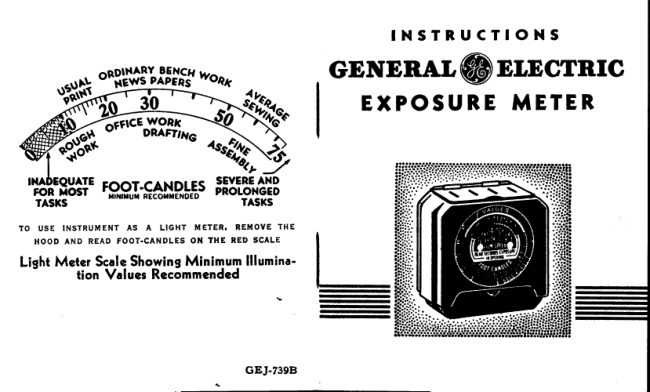
I N S T R U C T I O N S
               GENDnAL@ r,DCTRrC
           30           EXPOSURE METER
            6tt,"'JllAil,ru       ek           ,*'q.a:t  K"*
         rE  FOR UOST FOOT.CANDtESilINtrui' RECOTilENO€O
  TASTS

TO USE INSTRUMENTAS A  LIGHT METER' REMOYE THE
  HOOD AND READ FOOT.CANDLESON THE RED SCALE
Light Meter &.lq ShowingMinimum lllumina-
          tion Values Recommendcd


                                  GEJ-zsgs
View original page 2Page 3 · Read text
DETAILED INSTRUCTIONS
                                                     The General Electric exposure meter is a precision
                                                            instrument designed for use not only as an exposure
     TABLE OF CONTENTS                meter to be used in correctly setting camera aperture
                                                     and shutter time, but also for use as a densitometer,
                                       Page                                                          a light meter, and as a guide in portrait and dark- Simplified  fnstructions.                                                                                                 I                                                    room work.
Detailed  fnstructions                                     The  degree of  satisfaction  received  from  the
   fmportant  Factors  in Proper  Exposur€.   . . . .   1         device depends upon   its  correct  use. For  that
   IVlethods of Determining   Ligfrt  Value Read-             reason, the user should read this complete book of
    r n g s . . . .  .                                  T         general instructions  carefully. Some of the material
  E x a m p l e s o f  I I o w t o T a k e R e a t l i n g s . . . . . . . .   1 4         iontained  in the simplified instructions  is amplified
  Using the  Calculator                        15        and supplemented with  other information  which  is
  F o r M o t i o n P i c t u r e s . . . . . . .                   1 5            .,...siry    for obtaining  the best possible results.
  Use in the Dark Room.                            lT
    Method  A                 for                  Street                     Scenes                                     at                                   Night                                             Zz
  M i     s c e l l a n e              o u s                                         l f s e s . .                                              . . .  . .  . .                                                             . .                                                2    IMPORTANTFACTORSIN                                                                             . . .  . .  . .  2
  Hints  for Satisfactory Operation.  . . . ..  ..  . ..  2T    PROPEREXPOSURE
R e p a i r I n s t r u c t i o n s . . . . . . .                     . , . . . . . .   Z g          The proper exposure of negatives for best results
                                                     depends on using the correct value of film emulsion
                                                            spied  (obtained from the film-speed rating sheet),
                                                               the illumination  available (exposure meter pointer
                                                                    indication), and the lens aperture and shutter speecl
                                                             (obtained from the exposure meter calculator).

                            www.orphancameras.com
View original page 3Page 4 · Read text
FILM SPEED                                    2.O
  Figure  I shows a curve of the relative responseof                   ;  1 6
various         films                                                                          it                to  light.                   From  this                                 curve                                       can be                                                                      C 1-2seen                                                    light                                                                 is        3      that           a certain                   rninimum                           amount                                               of
required                                            value                                         1           to             affect the                              filrn                               at  all.                            Above                                               this                                                                        ! o a         respondsthe  film                 more                          more                                                        light                                             I                       and                                   as                                          the                                  2increases until  a point  is reached beyond which       S o.a                                              z-,2'
the film will no longer respond-this  illustrates the                           ctz o
term "6lm  latitude."  After this last point has been                       1 0    1 0 0   1 0 0 0 1 0 0 0 0
reached, further  exposure does not  increase the                         Re.lative a,xposufe
density of the  film.                                                            Fig. 1
                                                                   Imaginary emulsion curves  Film speeds are values which give a measure of
the relative responsiveness to  light  of the many                                                                                is small, the exposure can be increased or decreased
different film emulsions. The C-E exposure meter is                                                                materially  without  harmful  results. No  hard and
calibrated so that  the  film  is always exposed to a                                                                      fast rule can be given, however, since this latitude
definite  point  on  the  curve  section bracketed  in                                                                                is entirely dependent upon the range of the particu-
Fig.  l. This point on the curve has been determined                                                                            lar film emulsion. In spite of this range, where  it  is
to give the density of negative usually desired. If                                                            desired to emphasize some particular  part  of the
more dense or less dense negatives are desired, the                                                               object  to  be  photographed,  the  meter  reading
user should adopt by  experiment  a factor  which                                                          should be taken close to that  part.
gives this result.                                                                               All  of the above applies to black and white  film.
  From  this curve  it can be seen that  the relative         Without  exception when using color  film,  the ex-
exposure in black and white  films may be varied         posure meter should be followed absolutely and the
over wide limits. Where the contrast over the scene         reading taken  close to the subject whenever pos-
                                                                       sible.
                                                                                  3
View original page 4Page 5 · Read text
^ No  special instructions  are necessary with  the         sheetgiving up-to-date ratings determined especially
G-E  exposure meter  for use with  coloi  film. The           for your General Electric exposure meter.
same principles apply  to both color and black and
white photography.  The only  difference  is that  a    EXPOSURETIME
more accurate measure of illumination,  either on or         The time during which the image is cast on the
coming from the scene, is necessary to obtain good          film is regulated by the shutter speed and is known
color pictures. The General Electric exposure meter         as the exposure time.
reads the illumination  with  sufficient accuracy  to          The time values used on the G-E exposure meter
prodr,rcegood results with  color film using the film         are  for  shutters  in  correct  operating  condition.
speeds given.   It  is of great importance  to get as        Since  there may  be some  variation   in  camera
close as practical  to  the  part  of  the scene to be        equipment,    it may  occasionally be necessary to
most truly  represented. Good results, however, are        modify  actual  settings  for  individual  cameras.  It
usually obtained  by  pointing  the exposure meter         should  be  understood,  however,  that  any  such
from  the camera  position   if  impractical   to  get         corrections  should  be made  only  after  a  large
close.                                              number  of pictures have been taken under a wide
  To encourage standardization, and in recognition          variety of conditions.
of    the       widespread                   acceptance                                      of                                      the  film-speed
rating      system               established                         by the                             Weston                                                Electric     THE (f) VALUE
Instrument  Corporation,  the  General  Electric          The   (/)  value  of a lens  is defined as  its focal
Company has adopted this system of rating  films         length  divided  by  the  diameter  of  its  effective
for the G-E exposure meter. Films are tested in the         opening. The focal length  of a lens is the distance
sensitometric laboratory  at the General Electric  in-         from   its  effective  center  to  the  film  when  the
strument  factcry   in West  Lynn,  Massachusetts.        camera is focused for infinity. The eflective opening
_Film-speed rating  sheets are issued periodically.          varies as the square of its diameter and governs the
You can obtain from your dealer a G-E flm-speed        amount of light which the lens allows to pass to the

                            www.orphancameras.com
View original page 5Page 6 · Read text
film. Usually  the lens mount  permits easy adjust-   METHODSOF DETERMININGment       of         the  (/)                 value.
        other              things  With                   remaining constant, the smaller    LIGHTVALUE READINGS
numbered   (f)  values  permit  more  light  to pass          There are two recognized methods of determining
through the lens to the film.  It  is customary  to say           light  values. One  is based on measuring the- light
that the lens has a speed rating  of the smallest  (/)          refected from  the object  to be photographed;  the
value (largest opening).                                        other, the  light  falling on the subject. The  latter
  The  table below gives the  relative  illumination         method  is extremely accurate and especially useful
necessary for  correct exposure when  the  shutter            in very low light intensities.
speed is kept constant and  (/) values are changed.
                             REFLECTEDLIGHT METHOD
                                                Relative              To use the G-E exposure meter by the reflected    (f)                                        Illumination
 Value                                    Required                light  method,  the  readings  are taken  with  the
                                                                                                                                                                                                               't               protective hood extended in the operating position.
   1                                                   The hood  restricts  the  light  falling  on the  light-      t . 4                                      2
   2                                                                                                                  A+               sensitive cell to a definite area as shown diagram-
   2 . 8                                      8               matically  in Fig. 2. The angle of light entering the
               'i.4                                       1 6            exposure meter is narrower in a vertical direction so
   5.6                                 32               that unwanted  sky  light and strong ground  glare
   8                                    61              are excluded. The foot-candles indicated represent
  1 1 . 3                                      r28                illumination  available  for producing  an image on
  1 6                                256
  22                                    484              the  film.
  32                                  r024              To extend the directional hood to the operating
  4+                               1936               position, hold the body of the instrument  with one
  64                                4096            hand and  with  the other  slide the hood  until    it
                        6                www.orphancameras.com
View original page 6Page 7 · Read text
-=----_\---


: n ; r [ ) i u l t o p o s i t i o r ra s s h o r t n i r r I . ' i e .] . S t r r c ] r ' 1 . ' qI .,
. i r n l r l i f i , ' ,i in s t r r r t ' t i o r ) si t n c ll c a r n t h c n a r n c s o I  t h c
u ] ) p t ) r t a r r tJ r i r r t so I  t ] r ( . c x p ( ) . s r l r cr r r c L e r I o r   f L r t r r r c
r t ' l r r c t ) r ' t ' .                                         U i

                            www.orphancameras.com
View original page 7Page 8 · Read text
To Take Readings
  When taking readings rvith the G-E exposure
rneter it is pointed tou'ard the object to be photo-
graphed as is the canlera.ln most casesthe read-
ing can be taken from canrera position. Hor.t'el'er.
rvhereanv sineleobject is of more importanceit is
 r''ell to approachas closeas possibleto this object
before taking the reaclings.Taking the reading is
the most important step in determiningcorrect ex,
posure.Any exposuremeter is a tool. and judgment
and experiencert'ill add to its usefulness.
  For averagelight conditions the hinged cover is
openedand readingsare taken on the red.0- 75 foot-
candle. scale. When the light becomesso bright
that the needledeflectsofT scale.the hinged cover
shouldbe closedand the readingtaken on the black.
0 7i0 foot-candle.scale.The hinged cover acts as a                                             I)ir-r. I
ten-to-one multiplier and should be used either                                                                  \ l r . l t ' i ' 1   i l  | 1 r , 1 1 !J 1 r - r o 1 l
closed or open as light conditions and pointer
position indicate.
                                                             lorv light intensities where reflected light values
INCIDENTLIGHT METHOD                     are too low to give readableindications.Renrove                                                         the hood as shown in Fig. 4. Foot-candlesare rcad
  One of the features of the General Electric ex-       on the 0 75 foot-candlescale.Thc light fallinq orr
posuremeter is its use as a light meter at extremely        the subject should be measured.This rnethod is
                                                  I ( )                                                                                                                                                                       l l
View original page 8Page 9 · Read text
particularly   useful  for  pictures  taken  inside  in
poor illumination  where  it  is possible to measure
the light around the subject accurately.
  For  example,   if  a  subject  is  lighted  with  an
intensity   of  l0  foot-candles,  the  reflected  light
reading will be very small. When the instrument  is
used as a  light  meter  to measure incident  light,
however, l0 foot-candles is a readable and accurate
indication.
  A  bright  object  reflects more  light  than a dark
one,  is brighter  to  the  eye, and  should appear
lighter in the 6nished picture.  If the same amount of
light  falls on a dark object and a light  object, the
same setting  of the camera  will  give them  their
correct relative appearances on the negative. A trial
by the most skeptical will prove that  the incident                       u." if'5ioi,,*ntlight method  gives correct camera  settings  since
                                                                         falling on the object should be used. Readings arethe reflection coeffrcient of the object  will cause it
                                               made on the red, 0-75 foot-candle, scale. The ex-to appear properly  in the photograph.
                                                        posure is obtained from the calculator in the usual
                                                         way, but the camera should be set for l0 limes thisTo Take Readings
                                                          exposure.
  When used in  this manner,  the exposure meter            For example, assume the situation shown in Fig.
should be held at the object so that   it points half            5. The  reading  should be taken when  the  foot-
way  between  the main  source of  light  and  the          candle meter is placed at the object and pointed in a
camera. In  all cases the average value of the light           direction  half way  between  the camera and  the
                    L2                                                  13
                           www.orphancameras.com
View original page 9Page 10 · Read text
main source of illumination. Assume a reading of l0          object. The correct way to make this reading is from
foot-candles and a film speed of 16. If the shutter         a position near enough  to the object so that  the
speed for an (f)  stop, say (f)4.5,  is desired, set l0          white background is a negligible portion of the total
foot-candles opposite (f)4.5 and read  lll0  second           field taken in by the exposure meter.
opposite a film speed of 16. Multiply   lZl0 second           Another  example  is found  frequently  in indoor
by  l0 and the result, one second, is the shutter         photography where the artificial illumination  covers
speed to be used. Or,  if  it is decided to use one sec-         intensely only a small area. From the camera posi-
ond with a film speed of 16, set the film speed of l6           tion  the exposure meter would  include  this  well-
opposite lilO  of one second and read the  (f) stop          Iighted  area  plus  a  large  percentage  of  poorly
opposite the indicated  foot-candle  value.  In  this          illuminated  background. Thus, the exposure meter
case, the  (f ,1stop opposite l0 foot-candles is (f )4.5.         would indicate a low average illumination and over-
  This  method  can be used  for  either   still  or         exposure of the negative might result. In this case, as
motion-picture  work.                                                 in the above example, the reading should be made
                                                          from a position near the main object.
EXAMPLESOF HO\T TO TAKE
READINGS                USINGTHE CALCULATOR
  Assume that a picture  is to be made of a small        See simplified instructions.
gray  object which  is directly  in  front  of a large
white                 and                       approximately                                      twenty      background                                                     feet    FOR MOTION PICTURES                    reading                           taken from         camera. A                                         the camerafrom the
position would result in a badly underexposed image              In  this case the shutter speed is a set value for
of the main object. The influence of the large white          the particular make of camera. The speeds vary for
background makes the average light intensity over           different makes of cameras as shown in the table on
the scene much greater than  that  over the main          the next page.
                     L4                                                        1 5
View original page 10Page 12 · Read text
Put  the exposure meter  with  hood  off  in  the              (u.)  For a given table setting (distance from lens
 position  previously  taken  by  the  printing  frame,           to printing  paper) determine the proper enlarging
and place this standard negative over  it so that the         time for a negative by experiment. Then, hold the
meter  will read the actual foot-candles that reach        meter at the lens of the enlarger as shown in Fig. 6
the paper. Another  film giving a reading of twice the        and read the  light coming through  the negative.
foot-candles will require half the printing  time.            For the same table setting the enlarging time  for
     If the greatest accuracy  is desired,  it  is advan-        any other negative can be determined by comparing
tageous to  block  off a section  of  the meter  cell         the readings at the lens. Remember the rule: The
opening and explore the negative to get the reading        more light, the less time. Fifteen foot-candles needs
on the section that  is of greatest interest. A master                 I 13 the time  that  five foot-candles does, and so
negative may well be filed with a record of the foot-           forth.
candles and time  to produce satisfactory prints on              (b.)  Another  way  is  to  take  a reading on a
various papers. With  this information    it  is easy to         negative as shown in Fig. 7 after having determined
reproduce any given set of conditions  at a later         the proper time for a given table setting. When  it is
date.                                                            desired  to  print  another  negative  in  the same
  AS A GUIDEFOR ENLARGING            enlarger  with  the  same  setting,  read  the  new                                                           negative as in  Fig. 7 and determine the enlarging
  Use as for  contact  printing  except  insert  the         time  in the enlarger by the ratio  of the readings.
ne-gative in the enlarger and read at  the  printing         Always  remember  that  more  light  requires  less
table.                                                    exposure.
  Inasmuch  as enlarging  papers are much more                   If the table is moved, this also affects the printing
sensitive than  printing  papers the  light  from  the          time, since the image is brighter when small than
enlarger is likely  to be too low  to give good read-       when large.  lf a 2X enlargement takes 30 seconds,
ings on the meter. Here are two ways to overcome        a 4X enlargement  will take 4 times as long or two
this  difficulty.                                            minutes.
                       1 8                                                       1 9
View original page 12Page 14 · Read text
is a tableA METHODFOR STREETSCENES    the home, office, and factory.  Following
AT NIGHT                                           tasks.showing the amount  of light necessary for various
  Assume that the meter, even with hood removed,
gives      no          reading               when                          the                               only                                      illumination                                                         at     RECOMMENDEDMINIMUM FOOT.night         is        a            street Iight.                              get                    Then                               as close                                       as possible
 to the light,  for example  l0  feet, point  the meter             CANDLES
toward the light, and read the value. Suppose the       Under    l0   foot-candles-corridors,     auditoriums,
reading  is two  foot-candles.  This  is the lncident         railway platforms, bulk  storage, coal and ash han-
light  l0  feet away. To obtain the correct exposure         dling, foundry  charging and casting floors.
with       this           incident                        light use                              the                                    calculator                                                       in                                                 the                                                                                                    rough                                                                                                       receiving,                                                                              and                                                                            l0  foot-candles-shippingregular       way           and multiply                           the                              time                                       setting by                                                          l0                                                                                                       welding,                                                                                      assembly,                                                                 work, machine work and                                               as       bench
described on page l3 for the incident lighl method.        glass blowing, paint manufacturing,  leather tanning
For other distances, such as 100 feet, the light  will                                                    and stretching.
be reduced in proportion  to the square of fh.  dir-
tance. For  ."i-pI.,    two  foot-candles at  l0  feet       20 foot-candles-knitting   machines, printing  presses,
will be 0.5 foot-candles  at 20 feet and 0.02 foot-         electrotyping,   light   colored  leather  and  cloth
candles at 100 feet.                                            fabrication,   rubber  products   fabrication,   retail
                                                                stores.
MISCELLANEOUSUSES                  50assemblyfoot-candles-drafting,and  inspection,  handfine  machinesewing,  jewelrywork,
  Since with  the hood removed the G-E exposure-useful         repalrlng.
meter becomes a light  meter,   it has many              100 foot-candles-proofreading,  automobile  body
lnRlications   outside  the   field  of  photography.         inspecting,  dark   leather  cutting  and  grading,
One interesting use is for checking illuminalion   in        tobacco grading, hospital operating  tables.
                    22                                           23
                            www.orphancameras.com
View original page 14Page 15 · Read text
meter held about five inches away from the surface.
                                              remove the blotting paper. take another reading in
                                                        the same position and obtain the reflection factor
                                                   by direct ratio.
                                                       For example.aisume that the white blotting
                                                  paper has a reflection factor of 77 per cent (fairly
                                                     representativeof standard white blotting paper)
                                               and that the reading taken with the blotting paper
                                                                      is l0 foot-candlesand without 5 foot-candles.The
                                                            reflectionfactor of the surfacewould be the ratio of
                                                     5 l0 of 77 per cent or about 38 per cent. It must
                                                 be remembered.hor+'ever,that this method is an
                                                  approximationand can be used for measuringsur-
                                                     laces that almost entirely diffuse the light that is
                                                          reflectedfrom them. The measurementof reflection
                                                          coefficientsof bright objects such as mirrors re-
                                                    qurresmore apparatus.
                     \ l t ; , -   ' ' ,   , , r - , t ' i ,,t),, , ' , , , r l r l r r r r 'l '         TRANSMISSIONFACTORS
                                                To check the transmissionfactor of any trans-
REFLECTIONCOEFFICIENTS                 parent object  it  is necessarvonly  to place the  -l-o
     cletcrnrincreflectioncoefficicntsplacea sqLrare      instrurnentwithout the hood in a reasonablycon-
foot of clean rt'hiteblotting paper of knorvn reflec-       stant source of  light and take a reading. Then
tion lactor against the surfaceto be nreasuredas       place the transparent material so that   it com-
.ir,rrtnin Fig.8. Take a reading rt'ith the exposure       pletely covers the cell opening ancl takc another

                                                                                                                                                 '  l                                                                                                                                       ! . ,
                           www.orphancameras.com
View original page 15Page 17 · Read text
the  full open position  to prevent  part  of the light
from being cut off.                   REPAIRINSTRUCTIONS
   6.  Care should be taken  not  to  obstruct  the
light  falling on the  cell surface. Be sure that your                 If  repairs or adjustments become necessary,
hands or clothing do not cover part  of the opening       your exposure meter will be repaired promptly,  if
in  the hood which  allows the  light  to  strike  the       forwarded directly to the Geniral  Elictrii  iom-
cell.                                                pany, 40 Federal Street, West Lynn, Massachu-
   7.  When  not  using the meter, the hood and         setts, pQstag-eprepaid. Or,  if you prefer, it may be
multiplier  should be closed to give maximum  pro-        returned to the dealerfrom whom il was purchised,
tection.                                         and he will return  it to the factory. Repalrs and
                                                    adjustments will be made promptly, and the  in-
   8.    If the hood becomes difficult to open or close,      strument will be returned to the iender, charges
it can be made to work  easily again by marking         collect on delivery. A suitable tag with the sende-r's
with a soft lead pencil or  graphite  on  the guides     name and address should be tied to the metal ring
inside  the hood  and  the  spring  balls on  either        that is provided for the.purpo.se of carrying  th;
side of the instrument.                              exposuremeter on a neck band.
   9.    If repairs become necessary, see the  inside           - Be sure to _print name and address plainly on
back cover of this publication.                          the tag and alio on the outside of the iackage.
                                                                                   - Exposure meters should be carefully-damagedpaiked
                                           when being returneJ since they may be
                                               beyond repair,  if  roughly handled, when ina-de-
                                                        guately packed. The instrument should be "floated"
                                                              !n crumpled paper (do not use excelsior)r)  inin aa boxbox
                                                    havinghaving dimensionsdimensions 88 bvbv 88 by 8 in., andd thethe  tbox
                                                              plainly marked "FragilrHandle    with Care."

                           www.orphancameras.com
View original page 17From the M. Butkus archive. Original publisher and archive notices are retained.
Check the model and edition against your equipment.
PDF verified 2026-10-10.