Camera accessories
Graphic Graflex Photo Accessories / Supplement User manual
User manual for Graphic Graflex Photo Accessories / Supplement. 16 pages in English. Read the original PDF, download or print a copy without registration.
16 pagesEnglish6.5 MB PDF
Loading your manual…Open PDF directly
Document details
- Brand
- Graflex
- Model / document
- Graphic Graflex Photo Accessories / Supplement
- Document type
- User manual
- Language
- English
- Pages
- 16
- File size
- 6.5 MB
- Category
- Camera accessories
- Document date
- Not specified in catalog
Search available document text
Find a term, then jump to its page in the original PDF. Image-only pages may not be searchable; check the PDF for exact wording and diagrams.
Page 1 · Read text
www.butkus.us
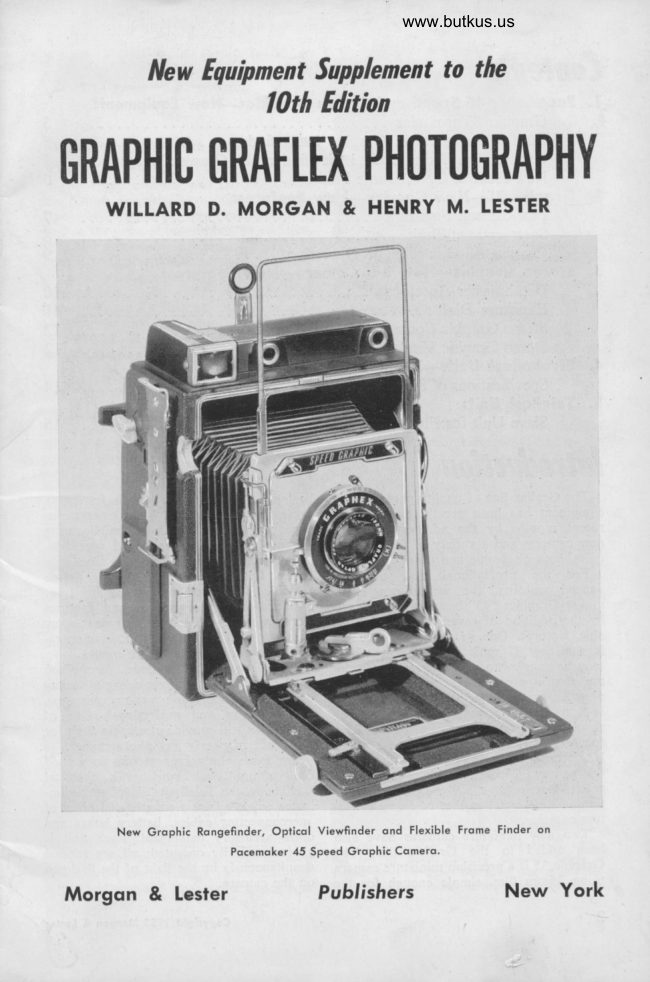
       lhw Equipnent Supplenent to the
                  lOth Edition

ORAP]|IC GRAFLEX PI|OTOGRAP]|Y
   WILLARD D. MORGAN & HENRY M. LESTER


       New Grophic Rongefinder, Opticol Viewfinder ond Flexible Frome Finder on
                           Pocemoker 45 Speed Grophic Comero.

                                              YorkMorgon & Lester    Publishers   New
View original page 1Page 2 · Read text
Contents
 l. Pocemqker 45 Speed qnd Crown Grophics-New Equipment:
       Graphic Rangefinder .  .                                                                                                         aJ
        Built-in Rangelite in Graphic Rangefinder                         5
        Parallax-Correcting Optical Viewfinder with Graphic Rangefinder     5
     New Flexible Open-Frame Finder . .  .                           6
2. Grcphic 35-New Cqmerq-New Feqlures:
       Push-Button Focusing  .  .                                      7
       Spectramatic Flash                                                     8
       Graphic 35 Controls and Operation                                 9
3. Stereo Grophic-New 3-D Cqmerq-New Feqlures:
       Depthmaster Autofocus  .  .                                      10
       Exposure Dial   .                                                10
        Stereo Graphic Controls and Operation   .                        t2
        Stereo Graphic Viewer                                          t2
4. Sfrobofqsh Units-Porfqble Elecfronic Flash:
         Specifications of Stroboflash Units                                14
5. Telefqsh Unit:
     '    Slave Unit for Flashlamps  . . .                                  15
lntroduction
  The Graflex line of quality photographic   beginner, yet versatile enough for many
equipment has been greatly expanded in   professional purposes. This camera in-
recent months by the addition of three    corporates the new "Fush-Bul'on" Focusing
new cameras and a variety of flashlighting   system for ease and speed of operation,
units, both electronic and chemical.       and Spectramatic scale setting for easy
  For the professional and the ad-   eolor flash photograptry. The Stereo
vanced amateur, the well-known Pace-   3raphic is a 35mm camera designed for
maker Graphics "45" have been improved   3-dimensional photography and features
by the addition of several new and valu-   Depthmaster Autofocus, which does away
able features. One of the most valuable    with any need for the usual focusing opera-
is the new Graphic Rangefinder, which   tion before the picture can be made.
may be coupled to nine different lenses by    Three new Graflex-made Strahoflash
the simple process of changing a small   units are now offered, providing a variety
cam. This rangefinder also features a built-   of power outputs for various purposes,
in Rangelite for focusing in dark places or   both amateur and professional. One of
at night, a magnifying eyepiece for easy   these units will provide electronic flash for
focusing under all conditions, and a p,aral-   the needs of nearly any photographer.
Iax-correcting optical viewfinder. With    For those photographers who do a good
this new rangefinder, the larger press cam-   deal of multiflash work witla chenrrical
era takes on a versatility and ease of opera-    flashlamps, the Teleflash "slave" u,nit elim-
tion at least equal to that of many minia-   inates any need for a complicated array of
ture cameras.                                 nterconnecting cables, battery boxes and
 Two new miniature cameras have also   other accessory equipment. Each unit is
been added to the Graflex line. The    photoelectrically  operated; all are tripped
Graphic 35 is a precision miniature camera   simultaneously by the light of the flashgun
using 35mm film, slmple enough for the  on the camera.
2\                                                        Copyrighr 1955 Morgon & tertcr.-
View original page 2Page 3 · Read text
www.butkus.us


PACEMAKER 45 SPEED AND CROWN
 GRAPHTC CAMERAS - NEW EOUIPMENT
  The Speed Graphic and its companion,
the Crown Graphic, have come to be the
recognized badge of the professional as
 well as the press photographer. In addition,
they are standard equipment with the
armed forces, where ruggedness and de-
pendability are essential. The advanced    l.  Bock view of Grophic Rongefinder showing:amateur, naturally, has long recognized    (right) Opticol Viewfinder; (cenler) Rongescope
that the features which make these cameras    mognifier;  (lefi) Rongelite switch.
valuable to the professional mean long,trouble-free service and convenience for   of balls through the tube. At the upper
his own purposes as well.                end of the tube, the last ball pushes an-
                                              other plunger, activating the cam, which in
 GRAPHIC RANGEFINDER                        turn operates the rangefinder mirror. Thus
 To the basic camera has now been   the tube filled with small steel balls takes
added the new Graphic Rangefinder, de-   the place of a complicated mechanical
signed especially for the Graphics and in-   linkage which has always been thought
cluding features found most desirable by   necessary previously; the simplicity of the
users of these cameras. The external hous-  new system, containing no levers or con-
ing of the new rangefinder is made of   nections to get out of order, adds a new
nylon, which is resistant to impact and   degree of reliability to the rangefinder.
temperature variations; its internal parts    Cams can be changed quickly and easily,
are ruggedly made, and the whole unit  is   without any tools, as shown in the ac-
designed for hard usage. It is mounted into   companying photographs (Figs. 2 to 6).
and on top of the camera for greater    To install a cam, first rack out the lens
convenience in use.                         track about I inch past the front of the
  The principal feature of the new range-   camera bed. Next, pull down the hinged
finder is that it is instantly adaptable to   cover under the top of the camera body
any of 9 standard lenses of difterent focal   and hold it down with the left hand. Note
lengths. This is accomplished simply by   the slot in the tube under the hinged door;
changing a small cam at the time the lens
is being changed.
  Each interchangeable cam is matched
at the factory to the lens with which it
will be used, and is designed to operate the
rangefinder throughout the range of work-
ing distances for which the lens is intended.
The cams are small, odd-shaped metal
plates that fit in a receptacle at the top of
the camera; they serve to operate the
rangefinder mirror by means of an arm
which extends through the top of the
camera. The motion of the lens track of
the camera is transmitted to the cam    2. Hinged cover of Grophic Rongefinder, under
through a row of small steel balls encased   the top of Speed Grophic Comero. Cover  is
in a tube; a small plunger enters the tube    pulled down lo insert lhe coms thot couple lhe
at the bed end and pushes the entire row    inlerchongcoblc  lenrcr to the rongefindcr.
View original page 3Page 4 · Read text
each cam. lens and viewfinder mask  is
                                    coded with colored dots so that all ac-
                                               cessories for any one lens can easily be
                                               located. In any case, it is wise to put the
                                 cam on the back of the lens board, under
                                                       its clip. as soon as the board and its as-
                                            sociated lens are removed from the cam-
                                             era. It is also well to make a record of
                                          the numbers on each cam so that replace-
                                      ments can be ordered if one should ac-
                                                  cidentally be lost.
     www.butkus.us                   Cams are available for lenses of  the
3. Hinged cover is held open os rongefinder   following focal lengths: 90mm, l00mm,
com is held reody lo be ploced in the slotted   l27mm, l35mm, 152mm, l62mm, 203mm,
tube. Eoch lens hos ils own com.               2-50mm, and 380mm. However, since there
                                         are minor variations in focal length even
if this slot is not clear, hold the camera  among lenses of the same nominal focus,
with the handle down and tap the body
lightly, until the plunger drops into the
tube, clearing a space for the cam.
  The cam is a small, irregularly shaped
piece of metal with numbers engraved on
one side. and a hole toward the large end.
Take the cam between the thumb and
forefinger. hold it with the numbered side
trp trnd insert the smaller end into the slot
and under the engaging lever to the left.
Push the cam all the way to the left and
drop the larger end into the slot. This is
all done in one motion. in a matter of a
second or so.                                               5. Smoller end of com is pushed to ihe left ond
                                               under the engoging lever on the left.

                                         each cam mLrst be individually fitted to the
                                                 lens with whrch it will be used. This fitting
                                    must be done at a Graflex Service Sales
                                          Department, and the lens must be sent in
                                               for matching. However, as previously men-


 4. Smoller end of com is dropped into slotled
tube first. Com is inserled wirh the numbered
 side up, locing top of comero.
   'Ihe cam for each lens is stored. when
not in use, under a clip at the back of the
lens board; thus each lens has its associ-    6. Pencil points to com inserled in slol ond in
ated cam instantly available. To aid in    posilion lo couple the lens to the rongefinder.
rapid identification of the various cams.    Finol step is lo releose hinged cover.

4
View original page 4Page 6 · Read text
r+rw[wl


                                                      www.butkus.us


 '#.+                                                                                                               '"r; ffii;.                                                                                                                                                                                                             i
  9. GRAPHIC 35 Comero uses stqndord 35mm film corlridges. The comero hos lwo new qnd
  unusuol feolures: Push-Bullon Focusing, o simple melhod of focusing by finger pressure; ond
  Speclromolic Flosh Serlings, on €osy system for correcl color flosh exPosure by motching color
  bonds. Also o coupled rongefinder, double-exposure prevenfion, oulomotic exposure counler.
rangefinder housing, and coupled to the    sliding aperture with click-stops for paral-
rangefinder mechanism, in such a way   lax correction. Thus as the subject moves
that as focusing is carried out a parallax   to or from the camera, correction may be
correction is automatically made.         made by sliding the sight up or down a
  The fields of the various lenses are out-   notch at a time.
lined by slip-in masks which are available    When not in use, the front frame tele-
for all lenses except the wide-angle. For    scopes into the camera front standard. The
the wide-angle lens, an attachment lens   rear peepsight folds into a small niche in
element is supplied for the front of the   the back of the camera; it is important to
viewfinder, and no mask is required.        be sure that the adjustable aperture slide
                                                   is pushed all the way down before fold-
FTEXIBTE OPEN.FRAME FINDER                 ing the rear sight into storage position. A new type of open-frame finder on the
Pacemaker 45 Graphics is now being fea-
tured. This is made of flexible stainless
steel and is designed to yield under impact,
without being permanently deformed;  it
springs back into shape upon release, and   GRAPHIC 35 CAMERA
maintains its assigned position under nearly    The Graphic 35 is a new miniature
any condition of rough use. The rear peep-   camera using all standard 35mm cartridges
sight used with this finder frame is also   of both black-and-white and color films.
rnade of chromed spring steel; it has a    It has two unusual features, not previously

6
View original page 6Page 7 · Read text
www.butkus.us

found in any other camera regardless of
size.
  The fust of these features is Push-Button
Focusing, by rneans of which the lens is
moved in or out in its mount through
fingertip pressure on one of two small
push-buttons conveniently placed on the
front of the camera. The secsnd feature is
Spectramatic Flash, which provides cor-
rect color flash exposure settings sirnply
by matching two color bands, without cal-
culation or mathematics of any kind. Other
important features are:
    l. Coupled split-image rangefinder.
  2. Visi-Ready Footage Scale.
  3. Double-exposure Prevention.                ll. The Grophic 35 Comero is focused by finger'
  4. 50rnm Graflar f/3.5 or f/2.8 lens.      lip pressure on eilher of the two smoll push'
                                                                                                second  5. Depth of field scale.                      buttons under lhe index fingers. The                                                                                        on                                                                              stoys                                                                                      convenienlly                                                                     right hond                                                      finger                                                  of the                               l/lOO,             speeds                                    l/50,                   of l/300,  6. Shutter                                                                                              exposure.                                                           reody                                                               releose,                                                              to moke                                                      shuller                                          the                 V2 and                                       I  second,                   l/5,      l/25, l/10,
     as well as "Bulb." The shutter also
     has a built-in self-timer.                  easily grasped, and all controls are grouped
  7. Bui,lt-in contacts for electronic flash   for quick, simple operation.     and Class M flashlamps.                All standard 20 or 36-exPosure film
  8. Accessory clip with contacts for   loads can be used in the camera, producing
     mounting flash unit without connect-   the standard sized lxlVz-inch pictures;
      ing wires. This connection operates   color transparencies made with the Graphic
       either the Graflash P-L or B-C units.   35 can be mounted for projection in stand-
     Other flash units, and all electronic    ard 35mm slide mounts or 2x2 inch glasses.
      flash outfits, can be used with con-    The automatic film counter is preset
      necting cords.                       manually for the number of exposures on
                                                             indicates how many pictures  The Graphic 35 has a die-cast metal   the roll; itbody with corrosion-proof satin chrome   are left on the roll at any time.
finish, and an attractive, scuff-proof gray   GRAPHIC 35 PUSH.BUITON FOCUSING
covering. The engine-turned knobs are    For maximum speed of operation, the
                              35mm camera has always been preferred.
                                                                                   Digitally signed by Mike Butkus          The Graphic 35, with the new Push-Button
                                                               DN:                                                                 cn=Mike                                                                                       Butkus,                                                                                                            o, ou=Butkus.org,                                                                                                       email=mike@butkus.org,                                          Focusing system, increases the "top speed"                                                           c=US Mike Butkus                                                                         Date:                                                                            2025.01.06                                                                                          16:01:32                                                                                                              -05'00'                                        of operation  still further-in fact, after a
                                         few shots, it will be found that the camera
                                 can be operated almost as fast as the
                                             operator can think.
                                            Focusing is done by a light pressure of
                                        the fingertip on one of two push-buttons
                                             that flank the lens barrel just under the
                                                 rangefinder windows. With the camera held
                                          comfortably for shooting, the index fingers
                                                           fall comfortably on the push-buttons, while
                                           the third finger of the right hand finds it-
                                                   self directly over the shutter release lever,
                                   ready to shoot as soon as focus  is 10. All conlrols on lhe Grophic 35 Comero ore                                                                  necessary to look for conveniently grouped for eosy operotion with   achieved.  It is never
 the comero ot eye level, or they con oll be seen   the controls; they are always undgr the
 ol o glonce, from the top of fhe comero.          fingers when the camera is correctly held.
View original page 7Page 9 · Read text
www.butkus.us

                                                    the shutter snaps. "X"-type flash synchroni-
                                                  zation is produced at this setting. When
                                                                                        should                 Spqlro6otia                                                                  the camera                                                           self-timer                                                                   is used                                              the
                         slfintr                              Oiophcoeo                   , Bslr                                                                         preferably                                                               a tripod,                                           be on                                           a firm support,
                Stnako                                                       Viiiin.odt      such as the Graphic Jr. TriPod.
                                                           Fodoe.  ko{.      The Graphic 35 has red-dot settings for
                                                                                  Koda-
              Itdd                 Dontttkchd                                outdoor color photography with                                        chrome Film Daylight Type and Ansco
                                               Color film. ln bright sunlight, no exposure
                                     meter is  necessary-the  photographer
T                                              simply sets the diaphragm lever to the red                                                 dot between f./5.6 and f/8, and the shutter

                                                    tlolh)                        R.rindi.r!                               to the red l/50-second setting. This is the                                                        Unil                     correct sunlight exposure for the films                                                             (lip                       (ob                                                 mentioned. With the new, fast color films
        12. Externql working porls of the Grophic 35  such as Anscochrome and Ektachrome
       Comero. Note thst oll conlrols ore conveniently   E-135, leave the shutter on the red l/50
       grouped so thol settings con be seen in o single   and move the diaphragm pointer to f"/ll.
        glonce, ond exposures mode eosily.        A depth ol field scale along the outer
                                      edge of the Visi-Ready Footage Scale     Then note which color band the Visi-      Ready footage indicator points to, and set   shows, for any lens aperture and distance                                                    focused on, the distance before and beyond      the lens diaphragm pointer to the same
       color. Thus if your subject happens to be   the point of focus within which the image                                                          will still be acceptably sharp.      5 feet away, the Visi-Ready Indicator will
       point to a yellow band. Then you simply    The camera can be used in a vertical        set the lens diaphragm pointer on the yel-   position just as easily as the horizontal                                                                                 and     low marker; this is equal to f/8, which   one. All hand positions for focusing
      would be the proper setting for an average    tripping the shutter remain the same. For
                                                                                           range-       picture in an average room. Very dark    vertical pictures the image in the      rooms will require somewhat more expo-   finder will be split vertically, and it will
      sure-very light ones, somewhat less. The   be found easier to focus when some hori-
                                                                                                 a       color bands allow some tolerance for cor-   zontal line in the subject is used as
        rection for such subject variations; simply   reference point.
       use the edge of the band, rather than the     Accessories for the Graphic 35 include
        center, when setting the diaphragm pointer   a carrying case, the Graphic Speed Tripod,
       under such circumstances.                    Filter Kit, a Lens-shade Filter Holder,                                                Graflash or Graflite Jr. flash units, and
      GRAPHIC 35 CONTROTS AND OPERAflON      the Stroboflash Electronic Flash Units.
          Instructions for loading and unloading    The Graphic 35 carrying case is made of
       che camera, and making ordinary types of   top grain cowhide and has a removable
        pictures, are found in the instruction book   front and adjustable neck strap. The
       supplied with each camera. Certain inter-   camera can be both carried and used con-
       esting features deserve further discussion   veniently in the case, which affords it a
        here.                                        constant protection. With the front of the
        For those who like to get into their own   case either dropped or removed, a Graflash
        shots, the Graphic 35 has a built-in self-   unit can be attached to the accessory clip
        timer. The self-timer setting will be found  on top of the camera. Thus flash pictures
       next to the flash settings on the side of   can be made while the camera is carried in
       the lens barrel; it consists of a "V" and a   the ever-ready case.
       green dot. This setting causes a delay of,    The camera is removed from the carry-
        t0 seconds between the time the shutter re-    ing case when used with any of the Strobo-
        lease is pressed and the time the exposure    ffash electronic flash units. Figure l4 shows
        is actually made, thus giving the photog-   the Graphic 35 used with the smallest of
       rapher time to get into the picture before   the Stroboflash outfits-the Stroboflash L
View original page 9Page 10 · Read text
13. STEREO GRAPHIC Comero ossures excellenl slereo resulls without focusing or chonging
  shuller speeds. A single conlrol, the Exposure Diol, is set to give correct exposure for locol
  lighting condilions; Deplhmosler Autofocus gives rhorpness lhroughoul piclure.
The camera and lightweight lamp head are   DEPTHMASTER AUTOFOCUS
mounted conveniently together on a mount-    The lens system in the Stereo Graphic
ing bracket, and the power pack is carried    is called Depthmaster Autofocus, and con-
over the shoulder on its own built-in    sists of a unique setting of the two lenses
shoulder strap.                              that provides sharp focus throughout the
  The Craflex Speed Tripod is well suited    entire scene without any adjustment on the
for use with the Graphic 35. It weighs only   part of the operator. The lenses are so
472 pounds, complete with Pan-Tilt Elead,   positioned that one lens produces sharpest
and has a lateral adjustment for leveling    detail through the entire foreground range
the camera. It opens to 67 inches, closes to   in one picture, while the other lens pro-
28 inches, and has a double extension cen-   duces equally sharp detail in the middle
ter post for quick height adjustment.         distance and background of the other pic-
                                             ture of the stereo pair. Thus when the pic-
                                            tures are viewed in a stereo viewer, the
                                       scene appears sharp from foreground to
                                                  infinity. Matched 35mm Graflar lenses
                                              are used; they are, of course, anti-reflection-
STEREO GRAPHIC CAMERA                      coated.
  The new Stereo Graphic camera has
raised 3-dimensional picture taking to a   STEREO GRAPHIC EXPOSURE DIAI
new level of simplicity.  lt has only a single    The exposure dial of the camera is set
adjustment to be set by the photographer    between the two lenses and is operated by
    simple choice of aperture for the cor-  a knob directly belor,r,. There is a series of-arect exposure is all that is required. No   click-stops marked with both f-stops and
focusing or change of  shutter speed is    light conditions,  thr-rs: Brilliant  I l, Bright
needed at all-for  any picture taking, in-   8, Hazy -5.6, Cloudy 4. An additional f/16
doors or out. Thus the veriest tyro can   stop is provided, but not marked with a
secure excellent stereo pictures from the    light value. When using Kodachrome Film,
very first roll of color film.                   Daylight Type, or Ansco Color Film, Day-
l0
View original page 10Page 11 · Read text
www.butkus.us
               Dlvucnr ExposunB  T.l,sr,B non SrnnEo Gnepnrc
                     For Stereo Graphic Shutter Set at I
                                        Daylight Color Film       Kodachrome TyPe A
                                                                       with No. 85 Filter
                             Kodachrome    Ektachrome   Kodachrome TyPe F
                               Ansco Color   Anscochrome    with No. 85C Filter
 Beach, water and snow scenes       Brilliant                                   Brilliant
 in bright sun                                     t/ r1,                     f./ 16                 t/Lt
 Nearby subjects of average           Bright           Brilliant               Bright
  color, sunny, clear sky                t/8                             t /Lr                  f/R
 Hazy, light clouds, transparent      Hazy            Bright             HazY
 stradows, with no sharply de-        t/s.6            f/8                       f./s.6
 fined edges
 Cloudy sky, overcast, no           Cloudy         Hazy             Cloudy
 shadow**                             f/4                 f./s.6                f/4
 Open shade.** Subject in open      Cloudy        Hazy             Cloudy
 with ample light from sky over-         t/4                  t/ s.6                  f/4
 head, but not in direct sunlight.
    **Note that pictures taken under these conditions may have an excessive bluish cast. Picture
     taking is notiecommended under these conditions because of difficulty of-judgin-g light values.
    Try one exposure at indicated setting, and if possible, one with the next larger lens openlng.

light Type, it is simply necessary to set     Synchronization is correct for all Type
the dial to the prevailing light condition M flashlamps, which includes the No. 5,
and take the picture. With other films, the   25, 59 and 25B.
                          used            numbers                                             in     aperturelens                  can be                                                                                       with                                                             exposure                                                            correct                                             secure                                               the                           To                                          the                remembering    normal           way,                              thatthe                                                                            measure                                                                  simply                                                             lamps,                                               the above                                  any                                          ofshutter speed of the camera is fixed at                                   or estimate the distance from flashlampapproximately 1/50 second. An exposure                                          to subject, and consult the table below. Inmeter may be used if desired, or the expo-                                             this table, find the number for the filmsure table below can be referred to for                                        being used and the approximate distancethere are no connecting cords or plugs re-                                                    settings for average subjects with the filmsquired. Ilowever, a connecting cord  is                                                            listed.available for off-camera, sidelight efiects.
In addition, a Graflite Extension Flash        It is important to remember in this con-
can be used for two-flash shots, with either   nection, never to set the lens aperture
the Graflite Jr. or Graflash B-C unit.        between lens stops.

                     Fresn ExposunB Tesle FoR,STEREo Gnepnrc
                                                                  7 -ro ft.   10-14 ft.   t5-22 ft.
 Kodachrome (daylight with blue bulbs)                        5.6         4
 Kodachrome (indoor type A or type F with clear bulbs)       It          8          5.6
                                                                      8          5.6        4
 Ektachrome (indoor type F with cle3r bulbs)                 r6          11
                                                                      5.6            A
 Ansco Color Film (indoor with clear bulbs)                                           5.6
 Anscochrome (daylight with blue bulbs)                        8         5.6        4
 Anscochrome (indoor with clear bulbs)                      t6
  *The correct diaphragm  setting for flash pictures depends upon the distance'between  the flash bulb  and the subiect. These flash settings are for No. 5 or No. 25 flash bulbs (clear or blue as indicated)
  used with the Stereo Graphic and with the shutrer selector set at "I."
  Notq: Do not set the exposure dial between stops.


                                                                           11
View original page 11Page 12 · Read text
r.rt::'*-:)-


  14. GRAPHIC 35 Comero with STROBOFLASH I elecironic flosh outfit. The Grophic 35 ond the
  lomp heod ore mounfed together on one brocket. A Koiled Kord connecls power pock to lomp
 heod qnd the entire unit is synchronized wilh fhe shutler through lhe comero occessory  clip.
STEREO GRAPHIC CONTROTS                  the camera and is ready for use at once;
AND OPERATION                         from lamp to subject. This number is the
  The shutter of the Stereo Graphic is   exposure dial setting. For example, if you
coupled to the film-winding mechanism    are using Ektachrome Film, Daylight Type,
and is automatically cocked as the film is   with a No. 258 flashlamp, and the subject
advanced. Thus double exposures are pre-    is l0 feet from the flash, the table gives
vented, and the only thing necessary after   the exposure dial setting as 8; just set the
taking a picture is to wind the film for the    dial to 8 and take the picture.
next one. The shutter also has contacts     Standard color film cartridges can be
built in for flash synchronization.            used in the Stereo Graphic. Regular 36-
  Any of the three Graflash units can be   exposure cartridges will make 29 stereo
mounted in the accessory clip on top of    pairs, and 20-exposure cartridges will make
                                             l6 stereo pairs. The finished transparencies
                                can be mounted in double mounts for
                                       viewing by the user. or they will  be
                                   mounted by the processing laboratory  if
                                       so reqr.rested when the film is sent for de-
                                                   vcloping.

                                         STEREO GRAPHIC VIEWER
                                    The viewer made as a companion piece
                                          of equipment to the Stereo Graphic is a
                                        convenient hand-held unit with  built-in
                                                     light source and battery case. It has ground
                                          glass diffusion screens for uniform illu-
                                         mination over both pictures of the stereo I5. Stereo Grophic Viewer hos built-in  light,                                               pair. Dual focusing knobs are provided so focusing odiustment ond lens seporotion  odiust-
 meni for individuql eyesight. A detochoble  bot-   that thc viewer can be focuscd with cithcr
 tery cose con be removed ond the unit used with   hand, and the separation between lenses
 ovoiloble  light.                            can also he adjrrsted for the user's comfort.

 t2
View original page 12Page 13 · Read text
www.butkus.us

Slides are dropped into a slot on top of   tively Stroboflash  I,  Stroboflastr II, and
the viewer, and a pushbutton underneath    Stroboflash  III. The lightest and most com-
the viewer lights the lamp.                 pact is the 50-watt-second Stroboflash  I.
   If batteries are temporarily unavailable,   Next in size is the Stroboflash  II, a general-
the viewer can be used with any light   purpose unit of 100 watt-seconds rating.
source. It is simply necessary to remove  And the most powerful, but still easily
the battery case and point the viewer   portable, unit is the Stroboflash III, which
toward a light; the ground glass screens   has a power output of 200 watt-seconds.
will diffuse most external lights sufficiently    While no single one of these units can
for comfortable viewing.                be claimed to serve every possible need,
                                     the flexibility of the Stroboflash system
                                          permits a great variety of combinations
                                          of the three units, since the lamps, power
                                     packs and accessories are readily inter-
                                             changeable. Thus the various components
                                    can be used in a variety of combinations
                                      for multiple flash shots, either directly
STROBOFTASH                                                                                     "slave"                                                    or by photoelectric              UNITS - PORTABTE               interconnected,EIECTRONIC FTASH                                                                                                      units,                                               operation. In selecting                                                         one or more
  The well-known Stroboflash series of   therefore, the photographer should be
electronic flashlighting units is now made   guided by his specific needs, either for
by Graflex; from this group of units, al-   portability and low-cost operation, or for
most any photographer will find one that   high light output, or a combination of both
will serve his needs. All are adaptable to    factors.
any Graphic or Graffex camera.              All  Stroboflash units utilize identical
  Three different units are supplied for   lamp heads, and all have the flexible Koiled
various light output requirements. All are   Kord connection from lamp head to power
battery-operated and are labeled respec-   pack. The lamp head and power units
                                           are carried in flexible-but tough-Royal-
                                                    ite cases that are resistant to temperature,
                                      moisture and shock, thus enabling the
                                                 units to stand rugged use and hard knocks.
                             The Stroboflash units use electronic
                                            (triggertube) tripping, and can be con-
                                       nected to any type of camera shutter
                                         without danger of burning the contacts.
                                       In addition, there is no possibility of for-
                                             getting to turn off the unit after use; the
                                    power packs become inoperative as soon
                                       as the lamp heads are disconnected. Cur-
                                           rent drain when idling is negligible;  total
                                             leakage current in an hour is no more than
                                               that consumed in a single flash.
                                       Because of these features battery life
                                           is considerably prolonged, and cost per
           www.butkus.us                   flash is correspondingly low. A  further
                                    economy can be achieved by the use of
                                  the AC line-operated Battery Booster.
                                            available as an accessory;  if this is used
                                                 consistently, the life of a set of batteries
                                    can be nearly doubled. The Stroboflash I
                                  power pack uses 240-volt batteries; the
16. Slroboflosh !1, lomp heod mounled on Grof-   Stroboflash II and III units use 225-volt
lite bottery cose, Speed Grophic Comero.            batteries.

                                                                           13
View original page 13Page 14 · Read text
which lamp heads can be mounted either
                               on the camera or any convenbnt obioct.
                                   There is also available a phototube for
                                             converting the units to "slave" operation;
                                 a battery analyzer; "snoots" for light con-
                                                    trol; and extra lamp heads and other con-
                                             venient items.
                               As a starting point for estimating the
                                    exposure required, the guide number
                                          table below is offered for use with the
                                                Stroboflash  units. It must be kept in mind'
                                            however, that some variation may be neces-
                                         sary to suit individual needs, methods of
                                     working and density of negative desired.
                                  The numbers should be used as a starting
                                        point from which the photographer can
                                          determine guide numbers, either higher or
                                         lower. which best suit his needs. These
                                     numbers are based on the latest informa-
                                             tion from the manufacturer at the date of
                                                 publication.
17. STROBOFIASH  ll, o generol-purpose,  port-   SPECIFICATIONS OF SIROBOFTASH UNIIS
oble electronic flosh outfit of 100 wotl-seconds.    To assist in choosing the unit most de-Flosh durotion opproximofely  I / 1000 second.                                              sirable for a given photographer's needs
  Accessories for use with any of the   and methods of working, the following in-
units include a  variety of  brackets,   formation gives the pertinent data on the
adapters, clamps and extension cords by   three units:

             Tlnre or GuDe NurasEns ron SrnonoFLAsH MooBrs I, II lNo III

                            STROBOFLASH
                                                                          IIIilI

 Coron Fnus
   Kodachrome Film, Daylight Type                    28-30   35-40  56-70
   Ansco Color Film, Daylight Type                    28-30   35-40  s6-70
    Ektachrome E-135 and new fast roll film, daylight     45-55   70-80 100-115
    Anscochrome, Daylight Type                         45-55   70-80 100-115
 Bucx AND WHrrE
    Fast Pan Films*                                      140-200   220-320 350-450

  .Guide numbers vary with film type and processing techniques. To get negatives of normal contrast,
  about 50 per cent longer development than usual is recommended. This is not force-developed, but
   is necessitated by the fact that films exposed to electronrc ffash usually have a lower than normal
   contrast. Strob-X Developer gives excellent results with 7 to 10 minutes development time.

 l4
View original page 14From the M. Butkus archive. Original publisher and archive notices are retained.
Check the model and edition against your equipment.
PDF verified 2026-10-10.