Film cameras
Harrison Light Corrector User manual
User manual for Harrison Light Corrector. 21 pages in English. Read the original PDF, download or print a copy without registration.
21 pagesEnglish5.5 MB PDF
Loading your manual…Open PDF directly
Document details
- Brand
- Harrison
- Model / document
- Harrison Light Corrector
- Document type
- User manual
- Language
- English
- Pages
- 21
- File size
- 5.5 MB
- Category
- Film cameras
- Document date
- Not specified in catalog
Search available document text
Find a term, then jump to its page in the original PDF. Image-only pages may not be searchable; check the PDF for exact wording and diagrams.
Page 1 · Read text
www.butkus.us

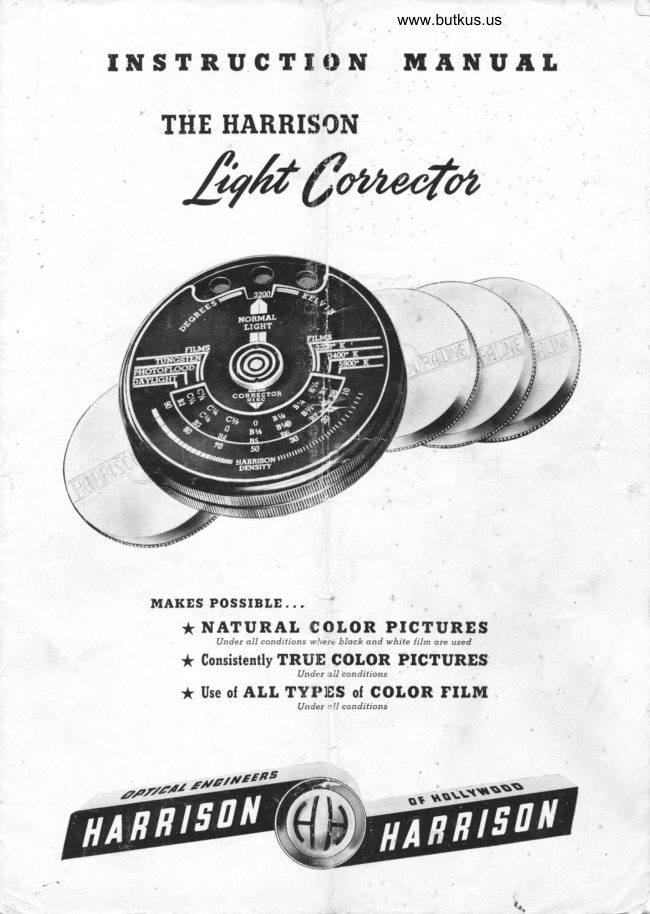
INSTRUCTION MANUAL

THE HARRISON

MAKES POSSIBLE.
* NAT

L COLOR PICTURES

4 Consistently TRUE COLOR PICTURES

& Use of ALL TY! OLOR FILM

as.
ua sMEe =
eerie, oF WETS

HARRISON apy HARRISON
View original page 1
Page 2 · Read text
tT

HARRISON

HARRISON

‘The Optical Engincering firm of Harrison &
Harrison was organized in the year 1925 in
Los Angeles, California,

‘The first assignment of this new company
was to develop a beamsplitter for a color
camera. The purpose of this beamsplitter
‘was to split light into three separate beams.

This optical device was successfully
completed by Harrison & Harrison after two
years of experiment and research.

Harrison & Harrison then contracted to
produce an optical system for a 35mm natural
color motion picture camera whereby the
‘cameraman could see the picture on a ground
lass viewfinder in full natural color.

This new optical system also permitted the
cameraman, while viewing the picture in its
full natural colors, to control the color
content of the light passing through the
optical system, This control was regulated
by means of two dials, one marked red-orange
and the other blue-green.

‘This was the first 35mm movie eamera to
be used in natural color photography,
designed and built on the principle of control
of the color content of light. This eamera
produced a matched series of negatives
which assured true natural colors in motion
pictures,

Using this new camera, a film, "California,
Highways,” was produced, bringing to the
screen a graphic account of the beatiful
seenery of California, This successful natural
color motion picture proved that natural
color photography based on the principle of
control of the color content of light, could

Page?

assure consistent and true natural color

pictures,

With this in mind, Harrison & Harrison
continued with their research, confident that
it would be possible to find some easy means
whereby any camera might be used for
natural color photography—based on the
principle of control of the color content of
light—without the necessity of rebuilding
the entire optical system,

About this time natural color film was
introduced to the public and natural color
photography was thus simplified so that it
Decame unnecessary to make three separate
negatives to secure color pictures,

By 1937, Harrison & Harrison had
developed a color meter which was placed
on the market for use by commercial
photographers. This first unit was called the
Harrison Color Meter Commercial Set and
‘was an instrument that gave natural color
photographers a means whereby they had
control of the color of light, using

‘This color meter set, which was based on
the principle of control of the color content
of light, proved successful and adaptable to
any standard optical system for use with
either still oF movie photography.

‘The Harrison Color Meter Commercial Set
‘was madefor commercial colorphotographers’
tuge. The reason for this was that the user
bad to have considerable experience in color
photography to be able to handle the meter
accurately for true results

‘This color meter set gave a very important
View original page 2
Page 5 · Read text
Venmo @mike-butkus-camera  Ph. 2083
PayPal Name  Lynn@butkus.org      www.PayPal.me/lynnbutkus
View original page 5
From the M. Butkus archive. Original publisher and archive notices are retained.
Check the model and edition against your equipment.
PDF verified 2026-10-10.