Film cameras
Hulcher 70, model 102 User manual
User manual for Hulcher 70, model 102. 19 pages in English. Read the original PDF, download or print a copy without registration.
19 pagesEnglish6.7 MB PDF
Loading your manual…Open PDF directly
Document details
- Brand
- Hulcher
- Model / document
- Hulcher 70, model 102
- Document type
- User manual
- Language
- English
- Pages
- 19
- File size
- 6.7 MB
- Category
- Film cameras
- Document date
- Not specified in catalog
Search available document text
Find a term, then jump to its page in the original PDF. Image-only pages may not be searchable; check the PDF for exact wording and diagrams.
Page 3 · Read text
ott
              ABOUT  THE
           P      t{*ts,70

                              Movie Fqst Sequence
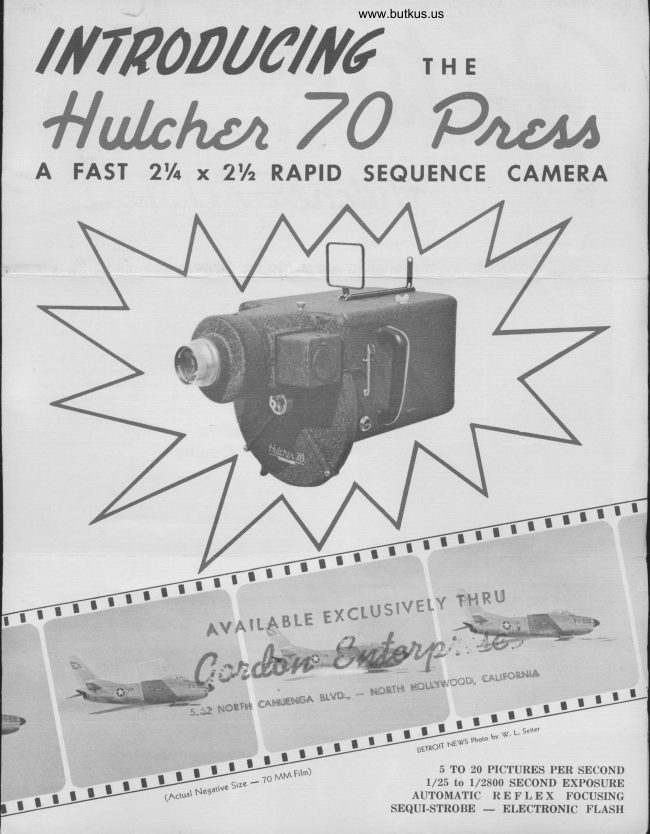
                                                     Here is a press camera that can take BIG pictures
                                                         as fast as a movie carnera ! Aim it-squeeze off
                                           a volley of shots, and you may end up with a
                                                               prize winner ! The "pictures you took too soon"
                                                 and "the one's you took too late"-they're there,
                                                         bracketing the fabulous shot that gets printed
                                                from coast to coast ! Here is a press carnera to
                                                              get the shots that tell a fast changing story from
                                                                   start to finish, a seqllence of BIG action pictures
                                                               that no amount of rvords could duplicate.

                                    Studio Quolity
                                          The Hulcher's larger negative size (2r/ax2r/2)
                                                             provides big enlargements rich with clear detail.
                                          For every shot, whether taken at l/2ltli' or
                                                          1/28801h, the film is absolutely motionless, and
                                                           exactly flat. This unique system for transport-
                                                      ing the film takes maximum advantage of the
                                                                           c4rtieal intlustry's {inest lenses.

                                 Proven Performonce
                                             The Hulcher 70 has already proven its worth to
                  "New York News" Photo by Fronk Hurley           the Associated Press, Detroit News, Daily NewsHulcher 70 sequence of the famous 1954 World Series                                                           (N.Y.), Life, Minneapolis Star & Tribune, Nash-catch by Willie Mays. The camera was equipped with                                                                   ville Tennessean, Salt Lake Tribune, Cleveland10-inch lens and the sequence was shot at eight frames
per second, with a shutter speed of 1/540 of a second,           Plain Dealer, Des Moines Register & Tribune
at an aperture of f.11.                                 and many others.
View original page 3Page 4 · Read text
www.butkus.us

 SEQUENCE RATES                      FILM
 Immediately variable from 5 to 20 per second          The camera utilizes 70m,m perforated film avail-  .    speed controlled accurately by means of           able on standard 100 foot spools. Each loading centrifugal e-lectric governor . .  camera speed            provides 470 pictures. A film footage indicatoi 1nay be_ quickly changed simply by turning bali-        on the side of the camera indicates the film brated knob on side of camera   .                          available on the supply spool.
 EXPOSURE                                     CONSTRUCTION Equipped with a highly eflicient variable open-                                                                             handles with steel rein- ing rotary disc shutter operating close to the          Except for the plastic fbcal plane, this new instrument provides an            forcing bar, the entire camera is constructed of unusually wide range of exposures . .  ranging           metal. There are no cloth bellows or fabric from l/25 of a second at 5 frames per second to            shutters to wear. All bearings are perrnanently
                                                                                        been madl l/2880 of a second at 20 frames per second.             lubricated. Although every efTort hai Shutter openings may be quickly changed by          to keep this unit light, it is nevertheless ex-
 an adjusting knob on the front of  the camera.           tremely rugged.
 A table of exposures for various sequence speeds
 and shutter openings is conventiently mounted      UNIQUE OPERATING MECHANISM
 on the rear of the carnera.                           Only four basic moving parts are involved                                                                                                           --                                                                  All of which rotate at a constant pre-set speed. LXNSES-                                                            Ifre-motoilliives a sha-fT on rvhlch is moiinted Standard camera comes equipped with a 63/s           the shutter and two gears, one of which drives inch, F4.5 Wollensak Series iI Riptar lens. paybl           the sprocket and the other the rotating film net type lens adaptor provides for instant lens           advance rollers. There are no small or intricate c_han_ge. Alryost any lens capable of covering             parts. Every moving part revolves and there is the 2t/+" x 2r/2" format may be adapted to thii        no reciprocating action to cause vibration or camera. The sturdy ,machined aluminum alloy           mechanical failure. The film is held in a flat housing provides sufficient strength and rigidity          plane between spring loaded stainless steel, for very long focal length lenses.                          guides and is not in motion while the exposure
                                                                         is made. FOCUSING
 Full size reflex focusing on a finely ground                                     TRIPOD MOUNT screen provides fbr precise and rapid focusing. The first surface mirior set by a knbb on top oi        The camera is equipped with a r/+" standard the camera is automaticallv returned when- the            tripod mount base and will fit regular press or
 camera is started.                                   movie camera tripods.
 VIEW FINDER
 In addition to the reflex focusing system, the
 cSmela is equipped with a folding sports t5,pe
 view finder. This feature enables the operatoi to
 accurately track fast moving action.
WEIGHT
 Constructed almost entirely of aluminum alloy,
 the camera weighs only l2r/2 pounds. Perfedt
 balance about its two spade type handles enables
 th'e operator to obtain on fhe spot action se-
 quences easily.
POWER
The camera is powered by a small high torque
 electric motor, operated by means of a small, portable 12 volt battery. It may also be operate,J
from the standard 115 volt AC line bv means of
                                                                    Speciai Lenses and Lens Mounts    Lenses equippeda 12 volt transformer. Electric poiver supply
                                                                             special focusing mounts from                                                                                                                  -80-mm to g0 incheseleminates the problem of preinature "iun-            with
                                                              more focal length can be supplied or your own lensesdown" regularly experienced with the spring              or
wound motors.                                    may be adapted to the Hulcher 20.
View original page 4Page 5 · Read text
STRAILMAN SEQUI.STROBE
                            A fast repeating electronic flash designed especially for use
                                             with the Hulcher 70 Press Camera. Operates on 115 volts AC.
                                               Portable    weighs only 36 lbs. Flashes up to twenty times
                                             per second.-  Synchronized with the camera it provides ample
                                                   light for sports and special assignrnents. Exposure of the
                                             order of fifteen microseconds stops any action. Two or more
                                       lamps may be flashed from the sarne trigger circuit. This
                                        rare combination can produce pictures never before at-
                                                         tainable.


CAMERA CARRYING CASE
Streamlined alutninurn carrying case weighs only 6./+ pounds. Holds
camera, standard lens and three 100 ft. rolls of 70-mm film. Cornpletely
weatherproof.


                         BATTERY
                                                12-volt plastic non-spill lead acid batter5'. Weighs only 4r/2 pounds.
                                    Long lasting nickel cadimun battcry also available.

                        BATTERY CASE
                                      Sturdy plywood carrying case weighs only one pound. Provide.s
                                       easy rneans of safely carrying battery.
BATTERY CHARGER-Specially developed to charge battery safely. Operatcs on 115-volt AC. Just plug in
battery with same cable used to operate carnera. Balanced to battery. Output, 75 arnpsl May be left overnight
to fully charge battery.

Single Frame and Pulse Operation-Orr special order the Hulcher 70 may be equipped to produce one picture
each time the trigger is pulled. The camera will recycle as fast as the trigger is operated by hand or may be
switched to operate at the standard sequence rates. The camera can also be supplied to operate remotely by
pushbutton or programmed pulse.


                              FOR FURTHER INFORMATION WRITE
             CHARLES A. HUTCHER CO., lnc.
                                      40 MANTEO AVENUE  HAMPTON, VIRGINIA
                                           Telephones: Newport News, Va. - 2-6190     Hampton, Ya. - 3'6427
View original page 5Page 7 · Read text
I}XIRODUCTION
          The Hul.ehen 70n Modcll- 102n is a ?Crnm ro11 flLm caaera
      whlch has been d.eve.i-oped speclally for press phobo€;rap,iry'. It
      has, also, proven useful j-n other flelds  of  lnd.u'srri. al. ae:rialr/)
                                                                                            clln.s i'A f .i.i-l-s the      research and d evelopment phctographyr Thls
      long exL st lng gap between the st 1l--l- camera trrth  it s  l arge f ilm
                                                                                               sma],]'       slze and the movle camera wlth lts  fast frane rate, but
      negatlver Eveny effort  has been extended. to keep this  lnstru-
       rnent as slmplez llght  and troutrle free as possible   The                                                                      "      camora
                                                                                  s .  All noving        |s unlque ln that  it uses no reclpr:o catlng part
       parts notate at a constant presei speed and. only the filrn  loop

                                                                                                                                    e                                                                              s s d.rrrln6 tir.e expo sllrs            lt s eIf stops and remains f Lat and mot lonLe
       In splte of the camerar s relarive  si:i:p1-iclty,  lt  neverthel-ess
                                                                         Press      provldes all  of the versatll-e and desj.nable features of the
       camera plus the rapld scqucnce f eature,  Thls manual is  intend.ed.
                                                                       new       to acclualnt thc operator i^,rith the mechanical behavior of this
       instrurnent and rnrith the slmple maint enanc e regulred. to kee'p lt  ln
      good operating condltion.  The Cha:e1es A" Ilulehcn Co., Inc. e al-
                                                                    may      ways stands ready to ald you with any speeific problems wirlch
                                                                                                Outl       arlse or to help out wlth speclal or unusual applications.
                                                    m.echanlsm ls always       consldenable experlence with thls type of
       avatlable, at no cost or obl-igation,

        GE}IERAL
                                                                                                         Z$tt                                      1:O2r provlde s negatlves 2-&" high by          The llulchen 70, Model
                                                                         second.      wtde on ?0mm fllm a! varying frame ratcs of from 5 to 20 per
                                                           L/25 of a second     A wj-de range of shutt or speeds is available from
View original page 7Page 8 · Read text
www.butkus.us

                                -2-
                                       minirnum of L/2880 of anaxlrmr.m at 5 fnarnes per second to a
sect:nd. at 20 fnames per second. The standard camera ls eLect-
rically  drlven from a smalL LZ volt batteryo  l\r11 reflox focus-
lng ls provldcd wlth a ground glass scroen on the sld,e of the
lens mounting. Automatlc mJ-nror neturn Ls provLded to Pr€-
vent openatlon of the camera ruith the minror tn the focuslng
                                                                                                          f oldtngpo s lt lon.  The camera ls  equ.lpped wlth a spont s type
vlew flnden, spade handles for hand heLd operatlon and Is Pt3o-
vld ed r,rlth a f ltt 1ng f or tr:i-pod. mountingo Bayonet type lens
                                                    Amounts pnovlde quick changes for a wlde variety of lensese
fii..ra footagc gage on ttre rlght hand side of the canera lndlcates
                                                              C&$Ierra.rthc amount of unexposed f ilm  -l. ft  in thc
     Camcra spoerd. J.n frames per second. ls controLled by a cal-
                                                                                        cafte; r8rlbrat ed knob on the lower right hand sid.e of tho
    On special'ord.en thesc carncras may be supplled to oporate
                            pu-1-se c&It1era,c Whcn so egulpped. the canenaas a s ingle frame or
r^rJ-.1-1 proclueo one pl-cture each tlme tho tnlggen ls pulledr r€-
gardless of hornr qul-ck the trigger  ls puIled or how long lt  ls
hcl-d orrr  It  r^rilI tre-cycle f ast cr than the openator can pull
anC. reLeasc the tniggen'  By slrrply th:rowlng a switch the

                                                            CBI11c13B.rcamora agair: oporatcs aS a Sequenoe
                                                             aLso       S cqui-,Strobe, a f ast rcpeating elcctronlc  f lash may
                                         z ed. r^rith thc  cB.ITICTB.rbc provld.cd. ancj. synchroni
II.HI
    The stanclard canera uscs 70mm double perforatod  f ilmt
                                                                        trlastmanwound on 100 ft.  spocls   This f itm ls available from                             "
View original page 8Page 9 · Read text
-3-

Kodak Company, Rochcster, New Yonk, ln scvcral crmrlsLons ln-
cludlng colon, provided. a sufflclent  quantlty is orderedr To
lnsure proeurement of the comect fllm,  thc nrlrnbcn -1177 should
be mentioned. For exanrple, Plus X should be orrJ cre C P-f--11.77 or
Llnignaph Pan, LP-l+?7" If  these numbcrs are no 5 used., the f l1n
should be ordered as ?Ornm filn  on #iO spool.s with lCrnm perfona-
tions"  Insofar as possible, the fj.l-m shou-l-d be load.ed. l-:: the
camera ln subduecl ilght  to reducc  f llm r,raste. On special orden
the camera may be equl-pped wlth a f1-1-m sprocket whlch fits  the
?Ornr mllltary  speclflcatJ-on fitn  perforations  o
POWER SUPPLY
    The standard camera ls powered by means of a series wound
moton which has been souped. up to provi-de th.e requS-red. powera
wlth a mLn{mum of welght.   It  is,  therefore, of the intermittent
duty type and should not be operated for prolonged perlods, slnce
thls w111 nesult ln overheating and posslble d.amage to the elec-
tnlcal  syst elrr  Norma1 operation of the camera will  not eause
overheating. Twelve (l.Z) volt s DC are nequirod. Approxlmately
7 amps at 12 volt s at3e needed to operat e the camera at maxirmrm
speed.. Any LZ volt batteny having at least a 7 amp hou:r nating
w111 openat e the canora.   f he opera.tor should always make cental-n
that the batteny is  fully  eharged. before attemptlng to photo-
gnaph an asslgnment    Speclal battenl-cs of both the lead-aeld. or                                            '
the nickel-cadmlum type are avaiLable from the Charles A. Hulchen
Co', Inc.z as well as a special battery chargen. Care should al-
ways be exerclsed to sce that  all  connections are tight  and that
at least #tZ wlre ls used. for sonneetlons. $peed. of the motor
View original page 9Page 10 · Read text
www.butkus.us


                                         -11-
ls controLled by means of a centnlfirgaL eLectnl o Sovernor adJust-
                                                              goV-ed by the knob on the ntght hand siCe of the cflYlcr'ar Thls
                                                               fnaneernon operates a relay whtch ln turn rnaj-ntains the rl.esirod
speeds.
FOCUSING
      Fo cusing is  aecomplished. by mean,s of a f irst   surf ace mj.nror
                                                                onwhlch ls rotated lnto the light  path by a snal.l kni;:'-LeC knob
                                                                   imagethe top of the Lens houstng" Thls mj-rror nefleets the true
                                                                                        le ftonto the gnound gLass sereen unden the vlewlng heod on the
                                                     at e the small knob gIOCf*sld e of the lens mount .  To f o eus , rot
1fIsEunt1Ithem1rron1ocks1ntheopenposJt1ool!'9-}I-W
TO RETTIRN TIII1 MTRROR I^IITH T}IIS KNOB. The rllrror  1S rEtUrNEd
automatlcally when the swltch lever adjacent hb the left  hand
handle is d.epressedo Thls swit ch leven neleases the mlmor be-
f ore stantlng the moto!3 o The stand.and lens pnovided r,rith the
carnera ls focused by rotating the rear knurled. portlon of th.e Lens.
Tkrls screws the lens in and out to obtain accurate foeustng.  Fon
very shanp focus the cover on the hood shoul,d. be c losed and. the
small cLnculan dise rotated. so that the ground glass may be view-
ed th:rough the magnlfying Lens" Camera lenses may be qulckly
changed by notatlng the l-ens mount counter: clockrnrise. The refLex
focustng system requtnes no changes for longer focaL length lens-
€so Howeven, speelaL alterations are rcqulred fon the sports
finder when lenses of cilffe:r:ent focal lengths are used. Almost
any lens capable of covenlng the 2+" x 2*" negatlve slze can be
adapt ed to the carnera by the manuf aeturer.
View original page 10Page 11 · Read text
-2a

VIEW FIIVDIR
    The standard camera ls equlpped wlbh a foldtng type sports
vlew flnder.  Thls conslsts of a rectangular fr,ame mounted on
                                                                    athe top of the carrrer&a This ls enected by pul}ing  it up in
                                              same il&rrler;vertical  posltion.  The rear si-ght rnrorks in the
The gnound glass screen should be used fon composltlon whenever

                                                                                              ?                                                              Theposslble since there is no parallex involved iir  it  s llser
ground glass should also be used" to chcck the sports finden if
                                                                 used. s  Loij.gerlt  should become d.amaged or  lf  other lenses a?e
                                                           spcn ts  f indens.or shorten focal length lenses ::eo,uirc diff erent
The sponts finder should be e-l.osecL whcn transportj-ng the cilnera
to prevent damage to them"
I#L1Eg
                                                              each    A Wo1lensak 6-3,/8" f\.5  Raptan lens ls supplied r^rith
standard camer:a. This lens j-s morrnted ln a casting. machined to
fit  the front of the ca.iller"ar Longen foeal length lenses are mount-
ed ln the  s atnc manner o When the  l ens ls very long and heavyr lt
                                                      and. Ict the canerals necessany to mount the lens on the tnlpod
                                                         madehang from the rear of the lcns.  The front casting is
                                                        lnJhen very short lensesstrong enough to hold. the earnera safely"
are used the reflex mirror can no longer be used for focusingt
because the rear element of the lens interferes  r^rith the mirror.
In these casos, the mirron ls kept closed. and special mounts are
                                                              Thesemachined to hold. the ]ens'lnside the camena nose castingr
                                                         Al-enses are then callbnated l-n f eet, to allow  f or focusing.
leven extending out through the slde of the lens ls equlpped with
                                 Many types of longer focala polnten to allow qulck focusing.
View original page 11Page 12 · Read text
www.butkus.us

                                         -.6-
                                          e&mera ab the factory.Iength lenses may be neadl}y adapted to the
EXPoSURE SETTIi\Jqq
    The camera [s equlpped with a rotany disc type shutten
operatlng elose to the focal planen The openlng in thls disc
                                    means of a ccntrol knob,shutten may be varled from 3 to 70o by
                                                       A"d justment is accomplished bydlrectly unden the lens srrppont                                   "
loosenlng the srnall thumb screw just sufflclently to allow fot'
                                               engraved. nu::ibers a Thethe rotatlon fon the knurled knob urlth the
numbeFrq from one to nine lndicate the shutter openings as follows I
                       L-30                                                   ;    (o
                                   1-)3-io?                            IF20:
                         5E30:                                              ti9;                      g "                                                                i  - 2u^
                      3:?g;
The exposure tabLe raounted on the backstde of the camera lndicates
                                                               Fonexposure pnovlded fon eaeh number" settlng and frame speed.
exampLe, lf  a fname rate of 15 per seeond. ls desired and an €x-
posure of t/Slt+O of a second. ls requlre d, the shutter setting
                                                             e t c.  Always bear ln mlndshould be ad just ed to #3 posltion,
that any change 1n canera speed. (frames per  second) or shutter
                                                                           noted.settlng dlrectly  affects the exposure obtaj-ned.. It  will be
                                                                 ,nrhi                                 ch c an b e f e lt  as the knob                                         s errat ionsthat the knob has small
ls rotated., These serrations fit   lnto mated. grooves spaced. €x-
actly 2H"r6  apant.  It  ls possible therefore t o set the shutten
openlng ln 2*o lncrementg between the nrrr,"rbers shown on the ex-
                                                                    beposure chart.  The speed" contnol or frames per second may also
View original page 12Page 13 · Read text
-7-

                                                      soccnC.   Jilwa.ys nake cer-         set ln lnflnite steps from 5 to 20 per
                                                                         be-         tain that tho small- kno?r on the shutter c.ontrol  is tightencd
         fore openating the cBrlter&r
I        SPFED COI\MROL
            The canera speed or frames per socond ls controlled by the
         black plastic knob on the lower rlght hand. sl,Ce of the coiltor&r
                                                                                  second.r             It  h.as been caltbnated ln steps'fnom 5 to 20 fnames per
        Thts knob openates a cam wht ch eontrols a centrlfugal electrlc
         governor attached to thc drlvo motorr The posltlon of tho con-
         tnol knob therefore dctenmlnes the spoed at whlch the motoii wtLl
        operate, Slnce the knob ls conneeted to a cam the speed may be
          vanled, between setttngs shown on the dtal'  The dlal may be
                  f of at ed baclnrards on f orward.
         LOADING T}IE CAMERA
              Insofan as posslble, fllm  should be loaded ln subdued llght
          to prevent film waste. Approxlmately 2E feet of leaden of film
         should be unwound. The supply spool ls then placed. on   spindlo
           n6rr,               Flgu:re 1, wlth the square hole ln the spool f aclng down-
        wand' The supply spool rmst be rotated to align the hole wtth
                                                                rt4rr.         the squaro sharrk on the bottom of splnd.Le      The footage ln-
          dlcator trBtr must be held open to allow the spool to slide ln posl-
           tlon.  The fllm  ls then r^rrapped around. the sprocket as llLustrated
          ln Flguro L, wlth rollers   rr6rf and. nprr holding the fllm  agalnst the
                                            ftgil         sprockct and nol-l-er      frofafrrg the fllm out of the path of tho
                      tlpft.                                                             rtgtt        beaten      The flLm ls then slipped. behind roller      and the
         pressure pLate tt11tf ls hcld open to allow the fllm  to pass by the
                                                tr1il         apentune around noller     and thence anound the sprocket betweon
View original page 13Page 14 · Read text
www.butkus.us


                                      -8-
       spool rotates ln a clockwlse dJ-rectlon r:hen'riewed. from the top'
                                                    nprr                                                 shculd bc trrrncd to the     To obtaLn the propcr lcop.n the beatela
       position shown 1n Flgure l and the loop adju;terl. as shown ln thls
                                                                       bej      plrotograph. iif tcr the catnera ls loaded, thc bcater shouLd
       roiated. by hand several times to make ccriain that the ioop ls
        cot3lsect and that the fl}m  d.oes not pull  tight  or contgct the
       camera caslng during each cycle.  Special care should also be ox-
                                                                          and       ercised to ascertain that the pressure plate l-s floating  free
                                                                                          al-so       that the spring ls hcldlng  it  ag4ainst the film'   Caro should
     be exereised to see that the lld  is closed tightly  to prevent
        fllm  fogging.

       MAI1STENANCE
                                                                      keep           With nonmal care, little   servlclng should be nequlred to
                                                                         course t        this  cax,tera opcratlng satisf actorlly"    OLeanllness ls,  of
                                                                               no       quite lmportant,  The extremely slmple mechanical deslgn, wlth
                                                               gad.get s, result s tn a       reciprocating part s and no small lntrlca-te
      minimum of mal nt €ogrn.c€ e A f ew drops of light   oill  placed on the
      two sets of gears after eaeh twc or three thousand feet of film
       shculd be all  of the }ubricating required.  All bearings are of
      the self-lubrleatlng  type.  Cane should be exercised. to kccp the
      gears cl-ean and should it  beccme nccessary to readjust any pant of
      the openatlng mechanlsm, Lt ls strongly reeolmlended that the unit
     be returned. to the factory fcr such adjustments. However, should
       trouble develop ln the fiefa when time for return ls not avallable
      some adjustments may possibly be madeo These adjustments are
                                           ttAd..justment        covere<l rlnrl.e,'r Teehni- cal                       sl!                                                                                                     '
View original page 14Page 15 · Read text
'9-

TECIINIC$,L AD.JUSTMENTS
                                                                 the    The follor.rlng data ls submltted. for the lnformation of
                                                    ctrnera should getoperator and. may be of heLp in the event this
                                              quj cklf rcr;urned to theout of adjustment ancl lt  could not be

                                                                                                                              Digitally signed by mike butkus
                                                                                               DN: cn=mike butkus,fact or;r r                                                                             o=orphancameras, ou=29,                        mike butkus email=mike@butkus.org, c=US
SPEED CALIBRiiTION                                                            Date: 2019.07.31 16:15:55 -04'00'
     Speed calibratlon  or frames per second may be chccked by
                                                    achomet er o  Atmeasurlng the RPM of the spro cket r^rj-th a hand t
               seconrL thc sprccket should rotate L1O revolutions5 frames per
                                                                secondper mlnute, 10 frames per second at 300 RPI{, 15 frames per
tf5O RpM and 20 frames pcr second at 600 RPM. If  the speed. is
                                                                         RPI\{ shouldmcasured from the acijusting kncb fon the shuttcr the
be U.1r5feci o This is because every revclutlon of the sprocket
prod.uces tt=o plctunes and each revolutlon of the shutter produces
one picture.  The speed. control knob on the night hand slde of
the camera contrcls a cam arrangement which adiusts the governor.
 If  ever neeessary the plastic knob may be loosened from the shaft
and read just ed .
SHUTTtrR SETTII\GS
       lnlhen the shutter ls set on the No. I position thc; opening
measured at the outer rlm of the shutten disc should be 3/L6 of

                     liTo                                      and }tro. 3, 3/l+ of an j-nch.                 . 2 should be 3/B of an inchan inch,
                                                         rtpnSynchronization of thc shutten wlth thc beaten     ln Flgune I
may be checked by settlng    Dthe shutter opening on lTo. 9 and wlth
                                                 hand. i+atehing the filmfilm  in the camera rotate the sprocket by
1n the gate closely to see exactly where it  stoPs. The leadlng
edge of tho *chutter oponirrg should just be about to start  exposing
View original page 15Page 16 · Read text
www.butkus.us


                                                                          l-O                                                     -
       the flIm  at the lower edge of the aperturcr  Contlnue rotatlng
                                                                                                                c-l-oe s not move i"n the       the sprocket and eheck t o see that tho f 11.,rr
                                                                             the       apenture unt1l the tralllng  edge of the shuttcr has just past
,\
       opening. Should it  ever be necessary to adjust the shutter with
        rclaticn  to the beatcr trprr thc front  casti-ng must bo carefuLly ro-
                                                                    Two       movcd and the adjustablc section of tlrc shrrtter removed.
                                                                         bo       small sct screws hoLd. tho shutter to the maln shaft and may
         1oo s er:ed f or read justment  ,
        RI;FLEX T,O CUSING MIRROR
                                                                            as           Accuracy of the nefLex focuslng system may be checked
                                                                         be-        follows !  Remove the pressurc plnte sirnply by sltpptng it  from
       hlnd the gul-des. Replace the pressure plate with a piccc of finely
          gror:r.d glrss w3-th the ground slde facing the lens. Make certaln
       that the gr ound surface is restlng on the stalnless steeL nunners.
       Open the shuttcr to No. 9 and rotato camera so that entire aperture
          l"s exposed. Canefully focus the canera on an l-llumlnated target
       as ac curately as posslble on the ground glass ln the aperturor
       Now wlthout changlng anythlng swlng the reflex mirnor in posltlon
       and check tho lnage obtalned on the ground glass bu1lt lnto the
                                                                                                                   s halrp as the         slile of the camerao If the lmage ls not equally as
                                                                                  s lrnp1y by turning the Allen       one ln thc apertu.:re adJust the ml-nron
       head screw on the sma1l plate that serves as a catch fon thc ml-mor.
                                                                                           For"       This screw has a cam arrangement for adjusting the mLrrorr
       fu?ther Lnforrnation cal]. on wrlte:
       CHARLES A. IIULCHER COMPANY, INCr   Phone; Newport News 26190                 ttGtt st::cct       911       Hampton, Virglnla
View original page 16Page 17 · Read text
HI.nL THIS Bl!i;,r.iRi AT,'::,I'1PT.  .rr.i . (; Jpr:,lrAl.U
               spi..clAL INSTIIi.JcTIJNS Frln liliL.ri{l,Ir 7C HrtEL }02  cAtilEi,t.l                   iQUiPPl'.r. POR SlNGLlt irRAMi: uii St.:.iu;.Nijij Op.. rAi,IOH
         Thls esrnFFa is equipi;cd $li,h a speclai ncw :.vpe    q+ch'.lsn fox.        ,                                                                   ^fo      slrrgle franr.e or leq)lenco operatlon.  Tr.e t<;&mera cd.rrr:ot be tor0co by
     hand, alnce lt  ls l.rcked ln placa by €^ ,r..te:lrlc lrrake.  ?h!r cemerr
     hac a anecial b:ake releree to  ficl  i.l"tare Loe:iLr\il. By ralcrrln8  thc
     bnake the 3enera can thsn be rotate.l by hanii f .rr throodl.ng. For slrrr,.re
       pl otures, the canera aho,rl,l be ope.ateci     ab thc rpeed rettlng  of                                                      'nly
    L0 frenee per recond. Thle vlll  provLce ih.' lane ran6c of lhuttcn
     tpaGds for rlnglc frame ls 1r obtclned rrt.,"h i0  f remca Der aa4ond.
     roqucnca oporatlon.  For rlngle  plct'arer, prcrt the trl,gtatr rnti
     lclcrsc  lunetlrtelyr    o mrttor boy fr.t  tou puII end rololrc  tho
     trlggcn, thr cu."r  ulll  rutonrtlcarly contlnue fon onc cyorc eno r?op.
    rn thla Eenncll                  tou arn obtrln alng).r plctur.G! for .acb rovoncnt of the
     trrgtor  rt  elthen            or et llorror rrtes er ncquLrcd. To                      'epld 'rtcs
    oporrtc th6 Lnrtnuent aa a lcqucnca oamelrl you clmply hrve to pull
    tho trlggcr and hold it on. For cxlnple, lf you renc t ek!.ng r!.nglc
    frane at odri lntervara and the actlon sudrienly lncr.ceasd lrr tcnpo,
 ,   you voulC n6cd only to holti tira trlggor on es lonrl a! thc actlon
 '    continued an4 you woulc obtaln requ€nce plcturo! at r0 per rcoond.

            ff  any ,ilff lcrrlil.es arl!e cont6ct rne  .l rA;iLbS A. HULCH},:R COIr{pA}fy,
    INC., 911 ncn Stneet, Hampton, Ve. inone: li+wnort Nsrrt pbl90.
View original page 17From the M. Butkus archive. Original publisher and archive notices are retained.
Check the model and edition against your equipment.
PDF verified 2026-10-10.