Light meters
Ikophot Rapid light meter User manual
User manual for Ikophot Rapid light meter. 11 pages in English. Read the original PDF, download or print a copy without registration.
11 pagesEnglish0.8 MB PDF
Loading your manual…Open PDF directly
Document details
- Brand
- Ikophot
- Model / document
- Ikophot Rapid light meter
- Document type
- User manual
- Language
- English
- Pages
- 11
- File size
- 0.8 MB
- Category
- Light meters
- Document date
- Not specified in catalog
Search available document text
Find a term, then jump to its page in the original PDF. Image-only pages may not be searchable; check the PDF for exact wording and diagrams.
Page 2 · Read text
www.orphancameras.com


                                 www.orphancameras.com


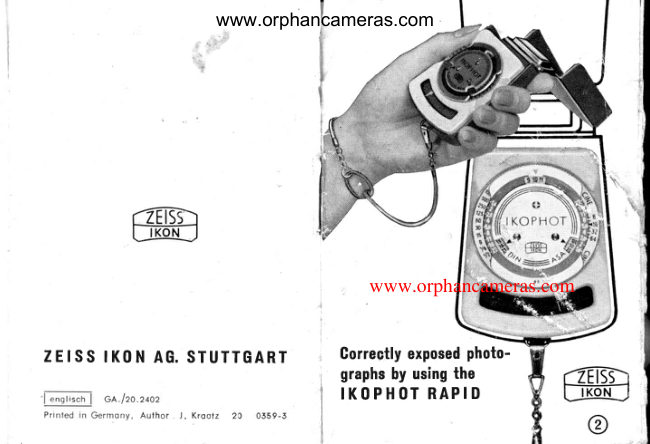
Z E I S SI K O NA G .S T U T T G A R T   Correctlyexposedphoto-
                               graphsby usingthe
                                                               I K O P H O TR A P I D
View original page 2Page 3 · Read text
www.orphancameras.com
          The scaleson the lK0PH0T
              a) Exposurevalues
              b) Apertures and shutter speeds
               c) Apertures and camera speedsof
              narrow-gaugecine cameras
              d) Film speed in DIN
              e) Film speed in ASA.

          The operativeGomponentsof the
        IKOPHOT
            1 Follow-up mark and pointer
            2 Button for setting the film speed
            3 Milled disc to follow up the
            mark (1)
            4 Photo-cell (behind the honey-
            comb lens)
            5 Incident light hood
View original page 3Page 4 · Read text
www.orphancameras.com                                                                             II'|
    The best companion                         Adjustingthefilmspeed
        lor your cAmerd is certainly a reliable ex-     posute meter su&t as tbe rkopsor,    The        To start with: this operationis nec-
          r K o p H or   is not  only  attractiue  in  ap-          essary only when a fresh lilm  in-
     Dearance but is also extremely efficient.  lt
              i s m a d e b y z a r s s   t K o N A G . s r u r r -           serted into the camerahas a speed
                                       bebind       c A R r,               manuf acturers                         wbo                               baoe               tbe                                              the           different to that used before.                                 of                            decades                                                   in     tbem                 tlte                experience
      design and construction  of  pboto-electric         Turn the disc by means of button
                                  wbat                                            type      exposure                melers.                   No  matter                                                 col-            (2) until the fflm speed figure, de-                         and wbite                                           or                  use, bla&       ol flm  you
       our, negatiDe or reuersal flm  or wbetber          noted on the fflm package or the
     you pbotograph witb dayligbt or  artificial
        ligbt, your exposureswill always be cor-           instructions for the lilm appears at
            t ect,                                      the triangle mark of the DIN-win-
     Tbe txoPHor                                instrument                             is                          a bandy
     and               its operation                                is simplicity                                                  itselt.                                               lou         dow (d) or that of the ASA-win-
      can carry   it  about wbeneoer and wber-        dow (e).
          you      eoer                    like,                                      it  is suitable                                        types                                   Jor all                                        you                  If the speedof your ftlm is rated in            and                 camera.                                                  lt  will  neuer                                                      let        ol  film
     down  if  you adbere to  tbe aduice giDen         BSI indices the appropriatevalues        in tbese instructions. 1t will  increase your
      pleasure in pbotograpby and decreaseyour   L i    can be found in the table on page
      expenditure on film.                                          t      19. Furthermore,the baseplateof
      So, bere is to good companionsbip and to       better pictures!                     l'l   the rxopHor contains a table de-
t,b                   ll
View original page 4Page 5 · Read text
www.orphancameras.com
noting  the  fflm  speed  in sunopnaN         en from the position of the camera
Scheiner  degrees (see illustration  on         towards the subject.The rKopHor,
page  16).                                  without  the  incident  light  hood
For colour fflms a deffnite speed rating  is         should be held horizontallv and so
impossible, since all the measuring systems          that its photo-cell(4) is pointing to
are based on black and white  ftlms. For          the important elementsof the subject
this    reason                   film manufacturers            the                                   abstain                                                to be photographed.\/hen measur-      givingfrom            a straightforward                          speed                                        rating
but use the expression "to be exposed like          ing a landscape, for instance, the
a film of  .  , ." In general these values may        IKopHor should be pointed towards
be used with confidence, but it  is neverthe-         the foregroundand not towards theless recommended that  tests should  be
made  with   different  shutter  speeds or           bright sky.
stops to establish the correct speed of the
colour film used with regard to your own
IKOPHOT.

Themeasurcment
Measuring can be done in various
ways.          nn%)l-,pu                                                _J ^\\z \                                                                                                                                                                                                           \                                                                                                                                                                                                             : /
Cenerally  the measurement is tak-

6
View original page 5
Page 6 · Read text
www.orphancameras.com
At shorter distances, particularly
for close-upsthe subject should be
measuredfrom as close a distance
as possible.The rKopHor (without
the incident light hood) should be
held as closeas possibleto the sub-
ject without casting a shadowon it,
however.

                                      For bacftlight photographs or in
                                                       all pictures containing high con-
                                             trasts it is essentialto get suf{icient
qilr                                 obtaineddetail in bytheemployingshadows.incidentThis canlightbe
 F^..-Ulll                               rneasurement.The rKoPHor with
 \/                                      slipped-onincidentlight hoodshould
                                        then be pointed towards the camera
                                      from the subject. %
View original page 6Page 7 · Read text
www.orphancameras.com
The adjustment
Vhatever way of measuren)entis
used the result will be that the
pointerdeflects.Now turn the milled
disc (3) with your thumb until the


           Reading-off position


                                   The reading
                                   The aperture values are given on
                                           the red ring (b) whilst the shutter
follow-up mark (1)  is bisectedby         speeds are immediately alongside
the pointer(by looking from above).         thern on the gold ring, both rings
The measuring value is thus found          together denoting the exact pairing
and can be read off frorn the rKo-           of stopsand shutterspeeds.Further-
PHor in any position.                    more, the red triangle mark on the

10                                                                                   1 1
View original page 7Page 8 · Read text
www.orphancameras.com
rKopHor (a) indicates the exposure         blad<triangle to make it more dis-
value.                                      tinguishable. The strokes on the
The  shutter  speed ffgures on  the          gold ring between the ffgures for
gold  scale above 1/+ denote  frac-           the camera speedsdenote the fol-
tions  of a second (8   :    l/s  sec.),         lowing intermediatespeeds: 72, 24,
those below  t/z whole seconds. The         48 f. p. s.
rKoPHor can also be used to read
off  intermediate  values which  can        Vhen  a fflter is used the values
then be transferred to the camera          indicated by the rKopHor should
shutter. This  is particularly  impor-         be extended according to the fflter
tant for colour exposures.                     factor. The rroprror  is then ad-
                                            justed either to a lower' exposure
For  cinematographic   shots  the           value, a  larger stop or a longer
stop to be used (gold ffgure on red           shutter speed. The increase in ex-
background)  should be read off  (at          posure time is
c) opposite the camera speed in use            for ftlter factor X 2       1 value
(black ffgures). The normal camera            for fflter factor X 4       2 values
speed of 16  f. p. s. is marked by a            for fflter factor X 8       3 values

12                                                         13
View original page 8Page 9 · Read text
www.orphancameras.com
For other fflter factors correspond-       rKoPHorneed not be removedfrom
ing intermediatevalues should be            its ever-ready case. The incident
set on the camera.                            light hood is accommodatedin the
                                                         lid. The hood (5) can be pushedIf the light source is extremely
                                      sidewaysfor use. The chain servesweak (candle) the pointer of the
                                                to fasten the rxopsor to your clothesrKoPHorwill not deflect,but a val-
                                            or aroundyour wrist (seeill. on frontuable indication may be obtained
                                     page).Thenecessaryloop can easilyby pointing the IKoPHor without
                                    be formed by means of the ring.incidentlight hood from the subject
                                    Thus both hands remain free andto be photographedstraight towards
                                         the risk of trosingthe rxopsor  isthe light source.The exposuretime
                                      avoided.thus found should be multiplied by
10. This methodcan be usedonly if         Adjustment
a single,weak light sourcecastsits                                 Vhen the rxopHor has been used
light directly on to the subject.                                                for a long period its correct adjust-
The ever-readycase                I   ment should be examined.For this
      the various measurementsthe        purpose remove the rxopHor from
      "tt
:".                                                                                    t5
View original page 9Page 11 · Read text
www.orphancameras.comrt
the case.The rxopsor can then be     Maintenance
removed.                                                               i The delicate movementused in the
The re-adjustment should be car-        I ,oon"ot  is well protected against
ried out in dim, not bright light. By      pressure,humidity and dust by the
turning the milled disc (3) the fol-     dust-proof hermeticallysealedcas-
low-up mark (1)  is brought to its      ing. To maintain the accuracy of
left stop. $/hen the photo-cell is     the photo-cell,it should not be ex-
completely blacked- out  (4)  the     posedto heat above 122oF (50o C).
pointer shouldbe positionedon the    The honeycomb lens on the front
left edge of the mark. If this is not     should be kept clean (4).
the case,rotate the adjusting screw                              And a ffnal important piece ofon the bottom plate of the mopsor
                                     advice: Consult your photo-dealer,(see ill.) until the pointer is in the
                                                                      if  you  are  in  doubt about anycorrect position.
                                    photographic problems.
View original page 11From the M. Butkus archive. Original publisher and archive notices are retained.
Check the model and edition against your equipment.
PDF verified 2026-10-10.