Film cameras
Ilford Advocate BOOKLET Product booklet
Product booklet for Ilford Advocate BOOKLET. 15 pages in English. Read the original PDF, download or print a copy without registration.
15 pagesEnglish1.2 MB PDF
Loading your manual…Open PDF directly
Document details
- Brand
- Ilford
- Model / document
- Ilford Advocate BOOKLET
- Document type
- Product booklet
- Language
- English
- Pages
- 15
- File size
- 1.2 MB
- Category
- Film cameras
- Document date
- Not specified in catalog
Search available document text
Find a term, then jump to its page in the original PDF. Image-only pages may not be searchable; check the PDF for exact wording and diagrams.
Page 2 · Read text
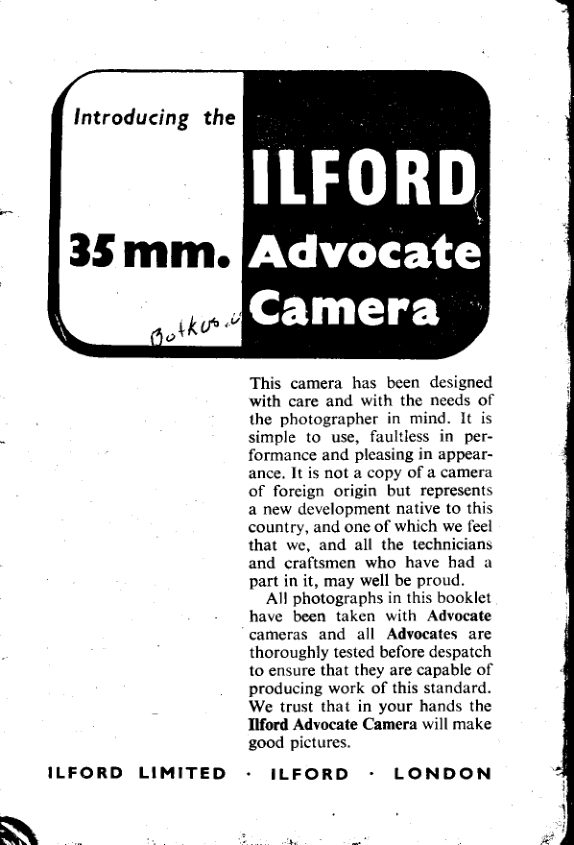
Introducing the

 35mm.


                         This camera has been designed
                           with care and with the needs of
                         the photograPher in mind.  It  is
                        simple to use, faultless in Per-           -                      formance and Pleasingin aPPear-
                       ance.It is not a copy ofa camera
                             of foreign origin  but represents
                       a new developmentnative to this
                         country, and one of which we feel
                            that we, and all the technicians
                      and craftsmen who have had a
                          part in it, may well be proud.
                                 All photographsin this booklet
                     have been taken with Advocate                                                 j
                 ;f,*:ff''xilJl':1"".:T$"?                            to ensurethat they are capableof                    {I
                       producing work of this standard.
                We trust that in your hands the
                                ilford Advocate Camera will make
                      good pictures.
I L F O R D  L I M I T E D           I L F O R D      L O N D O N
                                                                      r
                                                      ,'l)
View original page 2Page 4 · Read text
Specification


  I
 Ir-
       The Advocateis a modern miniature camera taking 35 mm.
          film in standard cassettes,the picture frame being 24 r.36
      mm. The body is a pressuredie-castingof aluminium silicon
          alloy and the finish of the outer surface is hard stoved ivory
        enamel.It is in two parts, hinged at one end and fastenedat
         the other with a clip of special design.The camera handles
         well and a particular feature is the ease with which  it  is
         loaded. The lens is a Dallmeyer Anastigmat, focal length
       35 mm., working at an aperture of f/4'5 and it is Dallcoated
         (bloorned). The depth of field is such that at full aperture and
         with the focusing ring set at  rnfinity, substantially sharp
        focus is obtained down to 12 ft. This means that a range
          finder is unnecessaryand that one's estimateof distancemay
        be considerablyin error without causingunsharp pictures to
        be produced. For critical work, however, the lens may be
        focused for any distance down to 3 ft. The optical finder
         gives a particularly clear view of the field covered. The
        exposuretrigger is situated on the top of the cameratowards
         the front  in the best position for operation by the right                                              'squeezing'          fbrefinger. The exposure is made by           and there
           is little tendency to jar the camera. An antinous release
        socketis also provided. The shutter is of the behind-the-lens
         type and has been specially designedfor this camera. It  is
        provided with settings for Bulb, 1/25th, l/50th, 1/100th,
          1/l50th and l/200th secs.Aperture, focusing, and exposing
         times are controlled by three concentric rings arranged
        around the lens mount. Film' transport and shutter are
         linked so that the shutter is set when the film is wound on,            ,
        and in the ordinary way two exposurescannot be made on
        one frame.                                                                     ,
                                       4q
L*                                                                                 )
View original page 4Page 5 · Read text
Opening


                                                                                     <
 l-hc body ol' the Advocate canterlt conrprircs r\\(! p()l.tt()n\,                              II
l'ront and back. hinged at onc cncl rrrrdlreld in close conlacr
b1 u spring clip at the othcr.-fo opcn thc ctrntcra,inscrt llrcthumb in the rccesscll'thc spring clip arrd prrll outwlrrcl..:.  IJ
The c:rment ma\ now be openecl bookwise and plucccl Lrporr
a flat surfaceu ith thc intcrnirl nrechunisnrctnoscd.


                                                        :il'                                                         }*'.


                www.orphancameras.com
View original page 5Page 6 · Read text
Loading


            'T
          hc Advocatecanrera takcs film in standard 35 mm. cassetrcs_
           Attrrch thc free end of the film (protruding from the cassette)
           to the spindleuttached to the knob marked'wind' by inscrt-
         rng it as far us it will go into the split tube surrounclingthe
          spindle on the side nearest to rhe sprocket wheel. If necessarl'
                r u r n t h e ' w i n d '  k n o b  t i l l  t h e g a p  i n r h e s p l i t r u b e i s u p p e r -
          nrosr. lf thc knob  will not lurn. iree ir by operating theII         \hutter rclease,which is situated between the viewfinder and
Ih..'
View original page 6Page 8 · Read text
Erposure and
        focusing controls
F      On the front  of the camera are three knurled  rings which
}      must be set before an exposure is made. To  fix the exposure
        time, rotate the outermost ring  to bring the engraved dot
        opposite to the required speed, i.e., ll25th,  l/50th,   li l00th,
                                    'Bulb'         l/l50th  or  l/200th sec.       exposures are also provided
          for. Having estimated the distance of the subject from  the
       camera, set the middle ring accordingly. The innermost ring
        controls the aperture of the lens.


                                                                                                                                                                                                                                              t
                                                                                                               ,.'
View original page 8Page 9 · Read text
Taking
   the picture


The subject is viewed through the optical viewfinder on the,
top of the camera. Release the shutter by squeezing the lever
gently but firmly when the camera is in the eye-level position.
On the front  of the camera below the lever release is a fitting
to take an antinous release.After making the exposure wind
on the film.
  When using the camera in the ever-ready case, make sure
that no part  of the case is in  front  of the lens whilst the
picture is being taken.


                       t


               www.orphancameras.com
View original page 9Page 10 · Read text
Rewinding
             the fllm


    When36 exposureshave beenmadeit will be found impossible
       to wind on any further and the film must be wound back
      from the take-up spindle into the cassette.To do this, depress
      lhe'wind' knob, and, keeping it fuily depressed,turn the      'rewind'            knob in the direction of the arrow until all of the film
     hasbeendrawn back into the cassette.you will feel the end of
      the film releaseitself from the'wind'  spindle. The back of
      the cameramay then be openedand the cassettewithdrawn.


\.
View original page 10Page 11 · Read text
.{,fl


                                                                                                                                                                                                                                                                                                                                  l
     Picture-making
      with the Advocate


        The Advocate camera will take good pictures in  all condi-               1           tions indoor or out, close-upor distant view. The Dallmeyer                                                                                                                           3{
          lens with which it is fitted works at an aperture of f l4'5 and      *{
           at this aperture with fast HP 3 film the shutter setting of
           l/50th sec. will provide adequateexposurefora street scene
        on a dull winter afternoon. With better lighting conditions
        you can, of course, stop down, use a faster shutter speedor
         a slower film.
          The angle embraced by the Advocate lens is slightly wider          ..-l
         than usual. so that the cameracan be used for indoor scenes
            in confined spaceswith good effect. If under other circum-
         stancesthe coverageis unnecessarilygreat the remedy is to
           print from only part of the frame. The definition provided
         by the Dallmeyer lens is such that from even a fractional part
           of the negativesbig picturescan be made. This fact should be
         borne in mind when considerations of perspectiveare in-          -I
          volved. For example, when it is desired to take a portrait  it
            is not desirable to come too close to the subject-better
          results will be obtained by having the camera at least 6 ft.
        away even although the picture area is not quite filled by
          the figure.
              In working with a miniature camera the main thing to
         avoid is camera shake. For this reason when the camera is
         held in the hands, exposure times should, if possible, be
           l/50th sec. or less. For critical work  it is desirableto use a
          tripod.
                   If you are a beginner in photography you will do well to
          obtain a reliable book on the subject. There are various
            Ilford publications which you will find helpful and a number
           of these are listed opposite.


                                                                                                                                                                            1

                        www.orphancameras.com
                                                                                     )L
View original page 11Page 12 · Read text
b            tlford  publications
               fo, the
        amateur photographer


     T H E  I L F O R D M A N U A L O F P H O T O G R A P H Y
     The most  popular  and comprehensive  photographic   text-
      book. Recently brought up to date, the llford  Manual  is a
      standard work  from which a thorough  working  knowledge
       of photography may be obtained.               Price: 10s.

     P R I N T ' N G A N D E N T A R G ' N G
      This book deals with the principles and practice  of contact
       printing  and enlarging and  explains how  to  get the best
       quality  prints and enlargements from  your  negatives.  In-
      formation  is also given on the preparation  of an Exhibition
        print,  together  with  suggestions for  titling  and mounting.
     Each book contains a set of small prints on  Ilford  photo-
      grhphic  papers.                            Price: 2s.6d.

    ILFORDBOOKOF WINTER PHOTOGRAPHY
     Outdoor and indoor winter photography can be done
      successfully with the Advocate camera, This book  gives
      instructionsand hints for each type of subject,together with
     suggestedexposuretimes.

   PANCHROMATISM
     'Panchromatism'                     deals with the use of colour filters with
     panchromatic materials for an improved and controlled
     renderingof colour in monochrome. Illustrations show the
      results obtained by using different filters for landscape?i?
      other subjects.                             Price: 2s.6d,


L              .+--.r;o
View original page 12Page 13 · Read text
-{
                                                                                                  l
      Using                                                                                        , l l                                                         l1
      colour fllters


       The sky is often an important part of the subjectand seldom        recordedexceptas a blank, uninterestingarea.With a colour'     IdI{            filter over the lens you can easily capture the beauty of sky'                   l
       and cloud formations in landscapesubjects.An important                     l
         point to remember when using filters is that the exposure
       must be increased,becausethe filter does its work by absor-                 eiI
                                      reason                                          each filter                              For  this                       the  light.          some of        bing                                                     has        I                                                      accord-                                   which                                                          is calculated                                     factor'                      multiplying         its'exposure
         ing to the colour and depth of the filter, and for each type of      J           film. The filters detailed below are those most commbnly
        used for outdoor work and supply different degreesof control
          in the rendering of sky and clouds

       'ALPHA'             FILTERNo. 104                                                                                  I!
                                                              J        This filter is pale-yellowin colour and givesa good rendering
          of the blue sky and clouds in a landscape subject. The
        exposureincreaserequired is quite small, being only  lf  to 2
                 for all Ilford panchromaticfilms.         .times
                         ' D E L T A ' F t L T E R N o1 .0 9
       A deeper yellow filter giving strong sky and cloud effects on                                                                                                     ,          clear days. Exposure factor 2 to 2L with Ilford panchromatic
          films.I
DPI        'BET'A'FTLTERNo. 401
I.        This filter gives reasonably good correction for  all colours     -A           in landscape work. Exposure factor 2 with  Ilford  pan-
I         chromatic films.                                                                                                                                                                                      'iIt
t
                        www.orphancameras.com\  H"
View original page 13From the M. Butkus archive. Original publisher and archive notices are retained.
Check the model and edition against your equipment.
PDF verified 2026-10-10.