Light meters
Imperial Exposure Meter User manual
User manual for Imperial Exposure Meter. 17 pages. Read the original PDF, download or print a copy without registration.
17 pagesOriginal document1.8 MB PDF
Loading your manual…Open PDF directly
Document details
- Brand
- Imperial
- Model / document
- Imperial Exposure Meter
- Document type
- User manual
- Language
- Check the original document
- Pages
- 17
- File size
- 1.8 MB
- Category
- Light meters
- Document date
- Not specified in catalog
Search available document text
Find a term, then jump to its page in the original PDF. Image-only pages may not be searchable; check the PDF for exact wording and diagrams.
Page 6 · Read text
www.butkus.us

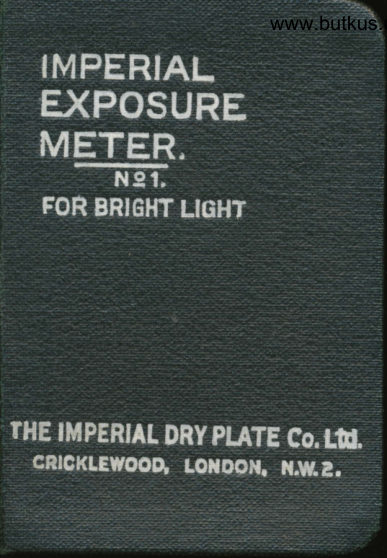
   IMPERIAL
EXPOSURE METER
       No.  r
  For Bright Light


           PRICES
     In Leather Cloth      ..    116
     Sensltlve Paper Ref ills,
     per dozen pieces              l,lL
     (Sufflcient for rSo exporures)
           Postage extra


lmperial Dry Platc Co., Ltd.
    Cricklewood, London, N.W. z
View original page 6Page 7 · Read text
IMPERIAL EXPOSURE METER
    No. l.-For Bright Light.
 What it is.
   This Instrument is" a  sirnple,
 accurate, and convenient means of            ,
 measuring the exposures to be given,
 under any conditions of light, subject,
 &c., &c.
      It is made in the form of a small
 folding pocket-book for the waistcoat
 pocket, and consists essentially of two
 parts--a strip of sensitive paper and a
 sliding scale. The Meter is made in
 two varieties:
  No. r.  For Bright Light.                                                                     :
   No. z. For Dull Light and interiors.
    'fhe size and shape of the two
 Meters are identical, and the same
 sensitive paper is used. Only the
 tints and exposure scales differ.::  When thc time tuhen to mutch the
 Stan,dard Tint e.vceeds about tuto minutes,
 it is ad,aisable to use the No. z llleter lor
 Dull Light.
  The price of either Meter in
England is r/6, and the two can be
View original page 7Page 8 · Read text
www.butkus.us
       supplied, bound together in leather
        f.or 316.
        The No. r Meter is also supplied
     bound up  with  the   ., Exiosure
     Reckoner." It  is then called the
       " Combined Meter-Reckoner', and
       costs 3/6 in leather binding.
        - When using the Metei, the opera-       tions are (r) count the time takdn to
      colour the sensitive paper to  the
      standard tint ; (z) set the scale, and
      the,exposure for every stop can be
      read off at once.
     tlow to use it.
       By artificial light or subdued day-
       light, take a piece of the sensitiv.e
       paperanri insert  it carefully in the slotin
      upper part of Meter, with the yellowish
      sensitive surface uppermost, and
      showing through the ciicular opening.
    The Meter is now ready for use.
         , To find the exposure required, place     the thumb of  left hand over the
       circular opening; draw the sensitive
      paper forward for I of an inch; hold     the Meter in such-a position that it
      receives as far as possible the same
                                   3

t,-,            .      .
View original page 8Page 9 · Read text
illumination as that fdllingon the object
to be photographed, i.e., vertically
facing the sky opposite the subject.
I)irect sunlight should not fall on the
meter. Withdraw the thumb, and
courit the time taken to colour the
sensitive paper to the standard tint-
this is the Actinometer Ti,me.
    It  is necessary to watch the
progress of the discolouration of the
sensitive paper closely. as tire success
of the operation depends on noting ac-
curately the time between the uncover-
i.rg of the paper and ttre moment
it acquires the same colour as the
surrounding standard tint. The match-
ing of the tints can be better judged if
the Meter is held about a couple
of feet from the eyes. When the
discolouration is rapid, and in  the
absence of a watch having a seconds
hand, the Actinometer Time may be
measured' by holding the watch to
the ear and counting the number
of ticks (usually four to one second)   ;
or, better still, by accustoming one-
self to time seconds-a little prac-
                        1
View original page 9Page 10 · Read text
www.butkus.us
tice with a watch having a seccnds
hand will ensure accuracv in  this
timing-by c<;unting  | 2 3 4; 2 2 3 4;
S 2 3 +i 4 2 3 +, and so on;  therate being such that each group is
exactly one second.
   This number of seconds (or min-
utes) is the Actittometer T-imi-to be
used as foliows: Move the slide so
that the H. and D. speed-number of
,the plate employed is opposite to the
Actinometer Iime; then the Exposure
requireci will be found opposite^to the
Stop used. If the Actinomerer Time is in
seconds, the Exposure will be in seconds,
or fractions oJ a second ; rf iro minutcs, th,e
Expontrc aill be in, mrrutres, or fractiort.s
oJ a minute.
  One of the many points of excel-
lence in the Imperial Exposure Meter
is the fact that the exposure for every
stop is indicated simultaneously so
that the exposure permissible for any
particular subject may be fixed, and
the necessary stop selected aithout
a.ny rearrangement of the slide, and
without any calculation.

                          5
View original page 10Page 11 · Read text
\
             ' The Exposures thus aseertained    are correct for the great majority
       of ordinary subjects-such as landscape
     with strong foreground, buikirngs,
       street-scenes, shady lanes, studio-work,
     and interiors-and may be used for       rl
      the larger proportion of regular u'ork.                   I
     Special Subiects.       The Exposure is reduced when the     I
      subject is white or very light in colour,
     and thus reflects a maximum amount
      of light ; or when the subject is at a
      considerable distance, and thus refl.ects
     from its extensive surface more light
      than the normal subject.
     On the other hand, the norrnal
      Exposure is increased when the subject
         is dark-coloured and near the camera.
        For a list of these special subjects,
     and the amount of variation frorn the
     normal Exposure, see instructions on
      the meter-
     General Notes.
       The sensitive paper should be kept
      perfectly dry. Each strip is sufficient
       for a dozen or more tests.
View original page 11Page 12 · Read text
www.butkus.us
         As each test is made. and the paper
      drawn out a little, it wili be conveni^ent
       to tear a short piece of it off, as it pro-
        jects on the right-hand side of the Meter.
       The H. and D. speed-nurnbers  ol
       Irnperial plates are marked on the
                              box.1     outside label of each
         In ihe small sDace available on the
                               to put a fuller                  impoisible                  is     Meter itt     range             H.            & D.  speed-numbers            of
       witfiout confusion. When Plates of      intermediate speeds are used, it  is
     easy to judge their correct position-
       Thirs H. & D. zz5 would be halfwaY
     between zoo and z5o, and so on.
         Whilst it is desirable to work to
     exact ligures where Possible, the
        " latitude "  which Imperial plates
       possess will readily cover any slight
       error made in estimating the position
       of intermediate H. & D. numbers.
     We strongly advise all  Photo-
       graphers to follow our instructions and
       to rise our formula exactly. They are
      worked out, after very careful experi-
      ments and investigation, to give the
      best results with the least trouble-
                                 7
View original page 12Page 13 · Read text
The balance of the constituents of the
developers is so arranged as to yield
the fullest detail without risk of fog,
and any variation of the respective
chemicals may involve trouble and
possible evils.
       EXAMPLES
r-Actinometer No.         40 sec.
   Flash-light Plates, H. & D., 4oo
   Stop                     -     Frr
   Subject:   Middle - distance land-
   scape with foreground.
   Exposure required -   1fo sec.
z-Actinometer No.          6o sec.
   Speciai Rapid Plates, H. & D. z5o
  Stop                    -   F 16
   Subject: -Bright Sea View with
   Shipping.
   Exposure (ordinary subject) $ sec.
   Exposure for Bright Sea Views and
   Shipping count six spaces to the
    ieft, rvhich gives              ,1u sec.
                          8
View original page 13Page 14 · Read text
www.butkus.us
        Where it is desired to use a Light
       F'ilter for  Orthochromatic photo-
      graphy, the Meter may easily be used
       as a multiplying instrument by moving
      the slide to the right.
      For example:
         Actinometer No.     -     8o sec.
         S.S. Ortho. Plates, H. & D.   300
         Stop               F8
         Subject (ordinary)
         Exposure required  without Light
                                                sec.          F ilter                    -    fr
        Exposure with four-times Filter;;
         count six spaces to the right, which
          gives $ sec.
       When half the lens is used, i.e', the
       front or back, it is necessary to extend
       the bellows of the camera to double tire
      normal focal length; the stop numbers
      are then doubled, and the required
      exposure is four times the normal. To
      aLlow for this it is,onlv necessary to
      count 6 divisions to the right to ascer-
       tain the equivalent exposure.
                                9

tL
View original page 14Page 16 · Read text
www.butkus.us
     ''  Orthochrome Plates:
Eclipse Ortho Soft               85o
Eclipse Ortho                   65o
Special Sensitive (S.S O.)        300
Special Rapid (S.R.O.)    :-       225
Non-Frlter (N.F ) does not
  require a Light Filter           225
  " Backed Plates" (Anti-halo).
Imperial Plates can be supplied backed'
either rvith the ordinary backing or
with our special D.S. backing ivhich
besides being a  perfect saf egttard
against halati<;n, is a desensitiser as
well. It dissolves in the developer and
is a great advantage when using p'an'
'Chromatic or high speed plates.
   " lmperial " Light Filters.
Specially suited to Imperial Ortho-'
chrome Plates. In seven sizes and
three densities. List sent on' applicutt'ort.
                                               II
View original page 16Page 17 · Read text
" lmperial" Exposure Meter.                (Actinometer)
    Actually measures the intensity of the
light and indicates with one movement only
the exposrrres required for every aperture of
the lens and tor every speed of plate.
    No. r.    For Bright Light
    No. z. -   ,,  Dull Light and Interiors  Price, cloth bound,  ri 6 each. Postage exrra.
Duplex Meter (No. r and No. z combined)
      bound in leather covers, price 3/6
                Postage extra.
         Sensitized Paper for Meters.
    Packet of rz strips, 4d. Postage extra.
                  t'           Exposure Reckoner." Imperial
   The Reckoner dor:s not measure the
strength of th,: light like the meter, but by
moving two slides the correct exposure is
simultaneously indicated for every aperture of
the lens, and all otber conditions, such as
weather, subject, plate, &c., are provided for.
    Price, cloth bound, r/6. Postage extra.
Combined Meter Reckoner (c.M.R.)
   This instrument consists of the  ,, No. r
Meter " and the " Reckoner." bound together.
With this combination the phorographei can-
not go wrong in the matter of exposuies.
      Price, bound in le:*her covers, 3/6
   Can be obtained from all dealers.
View original page 17From the M. Butkus archive. Original publisher and archive notices are retained.
Check the model and edition against your equipment.
PDF verified 2026-10-10.