Film cameras
Kershaw Raven User manual
User manual for Kershaw Raven. 18 pages in English. Read the original PDF, download or print a copy without registration.
18 pagesEnglish5.2 MB PDF
Loading your manual…Open PDF directly
Document details
- Brand
- Kershaw
- Model / document
- Kershaw Raven
- Document type
- User manual
- Language
- English
- Pages
- 18
- File size
- 5.2 MB
- Category
- Film cameras
- Document date
- Not specified in catalog
Search available document text
Find a term, then jump to its page in the original PDF. Image-only pages may not be searchable; check the PDF for exact wording and diagrams.
Page 1 · Read text
f

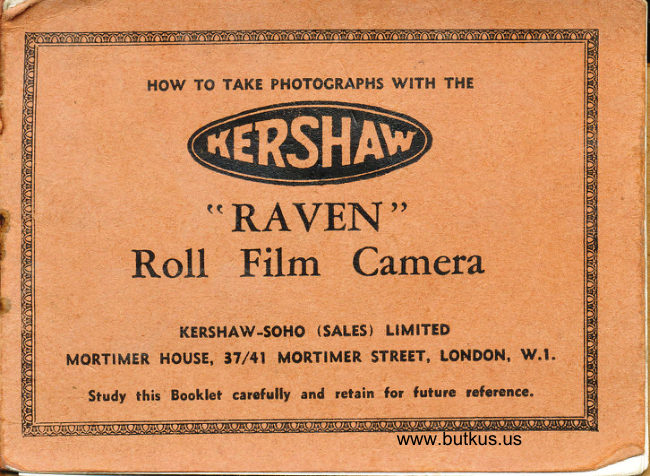
          HOW TO TAKE PHOTOCRAPFIS WITFI TFIE

         ,.RAVEN''
                Camera      Roll Film

                KERSHAW-SOHO (SAIES) TIMITED
      MORTIMER HOUSE, 37l4I MORTIMER STREET, LONDON, W.I"
              '          Study this Booklet carcfully and retain for future tefergnce'

                                        www.butkus.us
View original page 1Page 3 · Read text
Y    HOW TO TAKE PHOTOGRAPHS WITH
I   THE KERSHAW " RAVEN '' ROLL FILM CAMERA
   Foreword......
    of  the many imp.ortant features. possessed by the Kershaw "Raven" camera,    the most               outstanding                                   optical                          is the                               and shutter                                                      which                                                                     enables                                                                                              the                                                     c,quipment-ali    owner           to enjoy                  the pleas-ures_                                   photography                                                 under                             of                                                     normal                                                                                     conditions.                                                                      light    The camera,.which                        enrbodies                                 the renowried-Kbrshau'F/6.)                                                                anastigmit                                                                              will produce                                                                                                          '       fi.rst                       the hands           class. pictures in                                                                                                                                                        fiI1-r                                 of novice or expert.                                                                                    Ii takes                                                        iny standalJ     size 2I" X  3'r"  .
     The.,simplicity ,{ opening an.d closing the carnera should be noted. The opening    of the baseboard automatically brings the lens and shutter into position,- reacf    for focusing and taking a phoiograpF.
   The Kershaw "Raven" Camera is very  - simple to operate, but it  is strongly   recommended that the user should study t6is instruction- book carefullv ;j    not until the various rnovements of opening the camera, focusing, exposing and
      fi1aJly -closing- after use are thorougily-taken.fa"miliar, shouli the camera'be i6aded   with film and the first. photograpls       The newcomer to photography
    should learn the name and purpoie of each operational component which is described
    in Ftc. 1 so that the camera may be opeiated without hesitation in actual use.

                                         www.butkus.us
View original page 3Page 6 · Read text
-tHOW  TO  T A K      H o  o G                                           H   W{ T H  THE                             www.butkus.usA
2.  Place the new roll of unexposed film in the lower chamber, slit the gummed
paper and unwind sufficient of the protective backing paper to allow the
pointed end to be inserted in the wide slot of the empty spool in the upper
chamber (see Frc. 3).  Make sure that the red side of the paper will face the
back of the camera and that the protective covering paper winds evenly between
the two flanges of the spool.
3. Give the film winder two or three turns, replace the back of the camera
and see that the hinge on the lower end of the camera back is securely hooked
in-make sure, too, that the camera back is secured by the spring catch.
4. Again turn the film winder slowly, watching carefully the red window in
the camera back, until No. 1 appears. The film is now in position to take the
first Picture
                                                                                                 .'               To opEN THE CAMERA
1. Press the baseboard release catch at the front of the cameta and the baseboard
will be released Gently press on the base to ensure that the side struts have
"clicked" into position-this is important.

                                                                                         -/
View original page 6Page 8 · Read text
HOW TO TAKE  PHOTOGRAPHSwww.butkus.usWITH  THE
               THE VIEW FINDER
      The use of the view finder is clearly shown in Frcs. 4 and 5.

 The space enclosed by white outline
  in Flc. 4  contains the Picture
 which will be reproduced on the
  film when the camera is held in                                          t     an UPRIGFIT position.

                                                  #


                                Fig. 4

                                             -a
View original page 8Page 9 · Read text
KERSHAW   ..RAVEN'   ROLL  FItM  CAMERA

   which the lens is fully open; the next larger number (8) indicates that the
     lens aperture has been reduced, thereby increasing the length of exposure required.


                           TTIE SHUTTER
   rhe Kershaw "Raven" Camera is htted with a precision three-speed shuler.
   The engraved plate at the top of the shutter indicates the various exposures of
   which the shutter is capable. The figures 25,50, 100 refer to instantaneousI
    exposures expressed in fractions of a second. For example : when the shutter
   speed regulator is brought into the position indicated by the figure 25, an in-
    stantaneous exposure or "snapshot" of r/25th of a secon. will be made on
   pressing the shutter release lever.  In a similar manner, exposufes of t/loth
   and t,/tooth of a second may be made. The following page will provide some
   guidance for the correct use of the three shutter speeds.
                                        www.butkus.us
View original page 9Page 10 · Read text
HOW TO TAKE  PHOTOGRAPHS   W'ITH  THE                              www.butkus.us

L/2Jth of a second-"snapshots" in poor light or overcast conditions, subjects
in the shade, photographs with buildings or trees occupying the greater portion
of the picture.
1/r0th of a second-subjects in sunshine, open landscapes, etc.
1/100th of a second-fast moving objects, photograpns ot open landscapes or
seascapes in brilliant light.                                                                    {g,l
Vhen the shutter speed regulator is set at 'B,' what is known as a bulb exposure  h
may be made. The single pressure on the shutter release lever opens the shutter,
which will remain open until the pressure is removed.
                                                                                                                                                                                     .lI
                                                                                                                                                                                                                                                                                                                                                                                                                                                                              IWhen the shutter speed regulator is set at '7,' a time exposure may be made.
On pressing the release lever, the shutter opens and remains open until a second  e
                                                                ypressure is given, whereupon  it closes. Time exposures only should be made
for interiors, and the aperture of the lens may be closed to F/L6 or higher to
ensure good crisp definition.                                                                                                                            i
View original page 10Page 11 · Read text
KERSHAW   "RAVEN''   ROLL  FILM  CAMER,A


  \flhen the callera is helcl in  a
 IIORIZONTAL position, tlre pic-
  ture to be reprodr-rcecj rvill be seen
  in the view finder within thc area
  enclosed by a white or,rtline in FIc. 5.


                                      www.butkus.us
View original page 11Page 13 · Read text
."RAVgN''    ROTL  TITM'CAMERAKTRSHAW

                                                        the  photograph will   thenaperture. The scene   ;i to be reproduced in
appear outlincd by the .larger fratne in front. Flc, 6  clearly demonsttates  thc
rusc' of the Direct Vision View Finder.


                 THE CAMERA LENS
The Kershaw F/6.3 anastigrnat fitted to the "Raven" Camera is a  first-class
lehs carefully computed and produced to provide fine definition and covering
power. The outer lens cell bears a distance scale which is engraved for various
distances-6, 8, 10, 15 and 25 feet, and "Infinity," and its rim may be rotated
so that the focusing indicator coincides with the figure representing the
distance to the subject which it is intended to photograph; for example: to
nrake a portrait of a subject at, say, 6 feet, the focusing scale should be revolved
to bring the figure 6  in  coincidence with the focusing indicator ;   for
                                    www.butkus.us
View original page 13Page 15 · Read text
\             ..RAVEN''    ROLL_FIL.M  CAMERA    \I(ERSHAW


                                                                                  hands'Time and bulb exposufes cannot be made when the camefa is held in the
It should be supported by means of the stand leg or by a tripod stand for which
a special tripod bush is fitted on the outside of the Camera baseboard'

                                                                                                                           .{=.

Having loaded with film and opened the camera' an exposure may now be made'
Note the distance (in feet) from the cameta to the subject to be photographed,
 set the focusing scale to the required distance and set the speed of the shutter
and the diaphragm apeftLue setting lever.  The beginner should make the
                                                         F / 6.3 of  F /8 and at a shutter first exposures in good light conditions at
                                                                                                         sec.speed of t/t1th  sec., or elternatively at F/\t  with a shutter speed of 1/25th
As experience is gained the user will be able to select other lens aperture settings
                                                                                    theend shutter speeds to suit the prevailing light conditions and the nature of
subject to be photograPhed.
Having now located the picture in the view-finder, hold the camera perfectly steady
                                    www.butkus.us
View original page 15Page 17 · Read text
..RAVEN''   ROLL  FILM  CAMERA   KERSHAW
-          CLOSING
     THE CAMERA
      Press gently with the
     two thumbs on the strut
      release clips (see Flt,.
      9), and the baseboard
      will be released from
         its rigid position. 9o.-       tinue to Press the base-
     board back until it  is
               means of     engaged          by#                     catch.      the releasc
      Having exposed the roll
      of film. wind off until
      the end of the backing
      Daper is seen to Pass
         it-r" red window, then
    femove the  camera
      back. Revolve the film
     winder until all  the
      backing paPer is on the
      upper spool.
                        Fie. 9                   www.butkus.us
View original page 17Page 18 · Read text
HOW TO TAKE  PHOTOGRAPHS   WITH  THEV=                              www.butkus.usKERSHAW   "RAVEN''   ROLL  FILM  CAMERA

 Pull the film winder outwards, remove the spool of film and seal it by means of
 the gummed paper slip attached to the end of the backing paper.
 Take the empty spool and transfer  it to the upper chamber with the slotted end
 of the spool towards the 6lm winder, push in the winder until the key engages
 in the spool end. The camera is now ready for reloading.


          USEFUL HINTS FOR THE BEGINNER
Do not jerk the camera or your picture may be blurred.
The lens must be kept clean and not touched by the fingers. It must not be
unscrewed because it has been correctly focused to give clear, crisp pictures.
Do not take photographs in poor light.
Never let the sun shine into the lens.
Never close the camera with the view finder on its side.
View original page 18From the M. Butkus archive. Original publisher and archive notices are retained.
Check the model and edition against your equipment.
PDF verified 2026-10-10.