Film cameras
Kodak High Speed IR film User manual
User manual for Kodak High Speed IR film. 2 pages in English. Read the original PDF, download or print a copy without registration.
2 pagesEnglish1.8 MB PDF
Loading your manual…Open PDF directly
Document details
- Brand
- Kodak
- Model / document
- Kodak High Speed IR film
- Document type
- User manual
- Language
- English
- Pages
- 2
- File size
- 1.8 MB
- Category
- Film cameras
- Document date
- Not specified in catalog
Search available document text
Find a term, then jump to its page in the original PDF. Image-only pages may not be searchable; check the PDF for exact wording and diagrams.
Page 1 · Read text
www.butkus.us
                                                         4-71
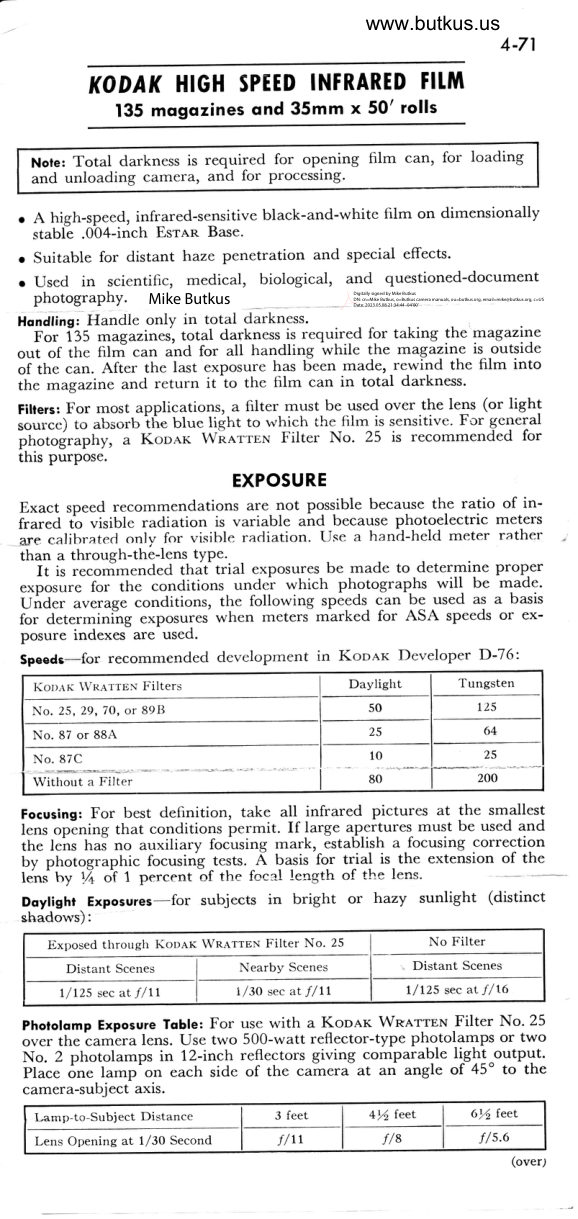
     KODAK HIGH SPEED INFRARED TIIM
          I35 mogozines ond 35mm x 50'rolls

  Note: Total darkness is required for opening film can, for loading
  and unloading camera, and for processrng.
o A hieh-speed, infrared-sensitive  black-and-white film on dimensionally
  stable .004-inch Esr.cn Base.
o Suitable for distant haze penetration and special effects'
                                                questioned-document  Used in  scientific,r
                                                                                                                                                             signedButkus,by  photography.                Mike Butkus                    medical, biological, andDigitallyDN:Date:cn=Mike2023.05.08                                                                                                                                                                                21:34:44                                                                                                                                                           Mikeo=ButkusButkus-04'00'camera manuals, ou=butkus.org, email=mike@butkus.org, c=US
Hondiingr Handle only in total darkness.
  For il5 magazines, total darkness is requir.gd f9r taking the magazine
out of the filni can and for all handling while the magazine is outside
of ifr" can. After the last exposure has been made, rewind the film into
tine rnagazine and return  it 1o the fiIm can in total darkness'
Filters: For most applications, a filter must be used over the lerrs (or light
r""r"") to absorb ihe blue light to -E9h the film is sensitive. For gcneralpfrotog."phy, a Kooer Wi.erraN Filter No. 25 is recommended  for
this purpose.
                   EXPOSURE
Exact speed recommendations are not possible because the ratio of in-
frared tb visible radiation is variable and because photoelectric meters
are calibratecl onl;r for visible radiation. LJse a hand-held meter rather
than a through-thi:-lens tYPe.
   It is recorimended that trial exposures be made to determine prop_erexposure for the conditions under which photographs will be made.
Under average conditions, the following speeds .^u" p9 used as a basis
for determini-ng exposures'when meters marked for ASA speeds or ex-
posure indexes are used.
speeds-for recommended development in Kooar Developer D-76:
  Kones WnertBI't Filters                           Daylight         Tungsten
  No. 25, 29,70, or 898                                 50               t25
  No. 87 or 88A                                          25
  No. 87C                                               10               64e
  Without a Filter                                       80               200
 Focusing: For best definition, take all infrared pictures at the smallest
 lens opEning that conditions permit. If large ap-ertures must be used and
 thethe lenslens hashai nono auxiliaryauxiliarv focusingfocusins mark,mark. establish a focusingng correctroncorrection
by photographic focusing-of-oftests. A basis for trial is the extension of the IeniIenj bvby tZtZ ,it,it tt percentpercent   thethe focalfocal lengthlength ofof thethe lens.lens.
 Dcyfighr Exposures-for subjects in bright ot }razy sunlight (distinct
 shadows):
    Exposed through Koler WnerrsN Filter No' 25          No Filter
        Distant Scenes       I     Nearby Scenes              Distant Scenes
                                                                           sec atf/16       1/125 sec at f/tl         I      t/lo  sec at f/ll               1,/125
 Phototomp Exposure Toble: For use with a Kooex WserrBN Filter No' 25
 over the camera lens. Use two 500-watt reflector-type photolamps or two
 No. 2 photolamps in 12-inch reflectors giving comparable light output.
 Place one lamp on each side of the camera at an angle ot 45" to the
 camera-subject  axis.
   Lamp-to-Subject  Distance            3 feet                        6)4 feet
  Lens Opening at 1/30 Second           f/rr                                             f /s.6
                                                                                                             (over,)
View original page 1Page 2 · Read text
Flosh Exposures: To obtain the lens opening for electronic flash or flash-
 bulbs, divide the guide numberty the distance in feet from flash to subject.
 Electronic Flosh Guide Numbers: use with a Kooer wnerrpx Filter No. 87
over the camera lens.
  outputofunit (BCpSor ECpS)      zoo  rooo  r+oo                                lsoo  I        I           I     lzooo lzsool+ooo lsooo
 GuideNumb".ro.r,i.l                          l-0 1-slss l*  lm  l"s  lt*lt-
Floshbulb Guide Numbers: The following numbers apply for the clear flash-
 bulbs indicated when a Konax Wnerinx Filter N;  25, No. 29, No. 70,
or No. 89B is used over the camera lens.
  Between-                                                           Focal-             svn-    Lens                              M3t                                                                    Plane                                                                          6              chroni-                  AG.1*   M2t     (t   Shutter                                                                        26+                                          r(+    40$11$     2292$      Shutter              zation   Speed                                                            Speed
   pen, 1/30 Xor  F'    190     200     290       32()     390      r/30       300
    r/30    M       140   NR      280     290     360      r/60       2lo
    r/60    M       140   NR     250     270     340      r/r2s       150
   r/r2s   M       110   NR     2t0     230     290              | /2so       105    r/2so    M       90   NR     170     180     220      1/s00        75
   r/s@   M        70   NR      120      130     t70      1/1000       50
  B-owl-Shaped Polished Reflectors: *2-inch; t3-inch; 14- to s-inch; g6- to 7-inch.   lf shallo-w cylindrical  reflectors are used, divide these guide numbers by 2. For
  intermediate-shaped reflectors, divide the numbers bv 1.4. NR:Not Recommended.
  cqulion:_Bulbs may shatter when flashed. use a flashguard over the reflector,
  Do not flash bulbs in an explosive atmosphere.

             PROCESSING PROCEDURE www.butkus.us
 l. Deve.lop: Times given are for development in a tank with agitation
at 1-minute intervals.
                                     Approximate Developing Time
                                                             (in Minutes)
     Kooer Developer
                        65F    68F     70F     72F     75F                         18C    20c    2LC    22C    24C
  D-76 (Normal Contrast)            t4          l2         1l          10        9
  D-19 (High Contrast)              9          8         7rh            6%
2. Rinse: At 65 to 75 F (18-24 C) with agiration.
     Konex Indicator Stop Bath-30 seconds
     or Kooex Stop Bath SB-5        seconds                         -30A running-water  rinse can be used                                                      if an acid rinse bath is not available.
                                                                                fixing.3. Fix: At 65 to 75 F Q8-24 C). -Agitate films frequently during      I(opax Rapid Fixer      to 4 minutes
     or Kooex Fixer       -2  to 10 minutes     or Kooer Fixing Bath F-5-5-5  to 10 minutes
4. Wogh: For 20 to 30 minutes in running water at 65 to 75 F (18-24 C).
To minimize drying marks, treat in Kooex Pnoro-Fr.o Solution after
washing, or wipe surfaces carefully with a Kooex Photo Chamois or a
1gft, wet viscose sponge. To save time and conserve water, use KoDAKHypo Clearing Agent.
5. Dry in a dust-free place.
Sloroge: Keep unprocessed film at 50 F (10 C) or lower in the original
can. To avoid moisture condensation on film which haq been refrigerated,
allow film to stand at room temperature for at least 4 hours bef6re use.
For more informotion, see Kodak Publication No. M-28, Applied Infrared
Photographlt, and Kodak Publication No. N-|, Medical Infrarid Photograph2.
Nolice: This film will be replaced if defective in manufacture, labeling,
qr packaging, even though caused by our negligence or other fauli.
PT".p.t fgr sqch replacement, the sale or any iubsequent handling ofthis film is without other warranty or liabilityi.
EASTMAN KODAK COMPANY o Rochester, N.Y. 14650
KPo 63317 4-7r                              Printed in the United States of America
       Kodak, Estar, Wratten, D-76, D-19, and Photo-Flo are trademarks.
View original page 2From the M. Butkus archive. Original publisher and archive notices are retained.
Check the model and edition against your equipment.
PDF verified 2026-10-10.