Film cameras
Kodak Premos Six-Three User manual
User manual for Kodak Premos Six-Three. 17 pages in English. Read the original PDF, download or print a copy without registration.
17 pagesEnglish1.2 MB PDF
Loading your manual…Open PDF directly
Document details
- Brand
- Kodak
- Model / document
- Kodak Premos Six-Three
- Document type
- User manual
- Language
- English
- Pages
- 17
- File size
- 1.2 MB
- Category
- Film cameras
- Document date
- Not specified in catalog
Search available document text
Find a term, then jump to its page in the original PDF. Image-only pages may not be searchable; check the PDF for exact wording and diagrams.
Page 1 · Read text
4
                              www.butkus.us
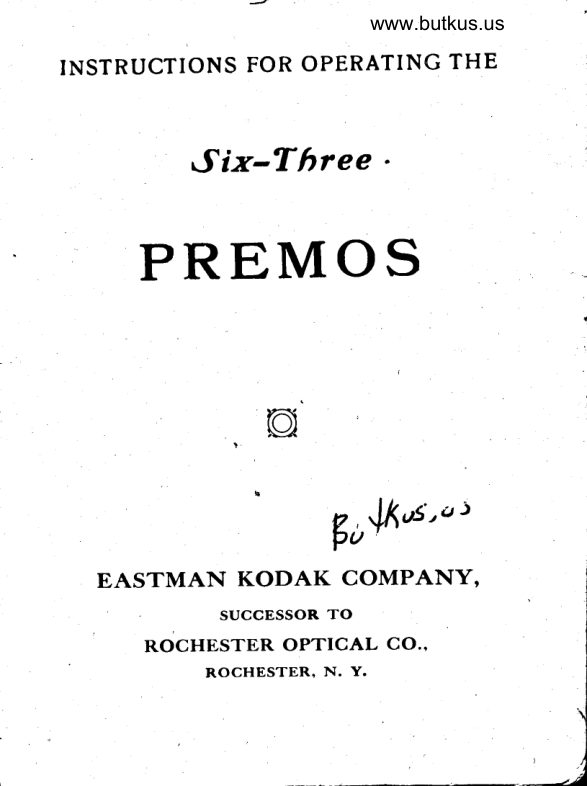
INSTRUCTIONS FOR OPERATING THE

             ,f ix-T frree
  PREMOS


                                      5
                                  'g                Fo$"t
  EASTMAN KODAK COMPANY,
              SUCCESSOR TO
      ROCHESTE,R OPTICAL CO.,
             ROCHESTER, N. Y.
View original page 1Page 3 · Read text
GENERAL
    INSTRUCTIONS.
   The general instructions in your premo nranual
 apply equally well to the carnera, wheilrer fitted.
 with R.'R. or Anastigmat lens.
   The only ditference lies in the timing of expo_
 sures and the use of the d.iaphragtn stops, inas_
 much as the anastigmat lens will work at a larger
 stop or opening than the single lens.
   Therefore if you have & Brl;r:- I,hrer: premo, just
follow all the instructio4s given in the rnanual
with exception of those pertaining to the oper_
ating of the shutter, the d.iaphragms used. and the
making of instantaneous, bulb, and time expos_
ures! for        substitute the instructio's in thisIeaflet.    'r.hich

  OPERATING THE SHUTTER ON THE
            Six-Three pREMOS.
   Perfeet familiarity wiilr ilre shutter is esse'tial
to suceessful picture taking rvith any camera.
The following directions shoulcl., therefore, be care.
                            2
View original page 3Page 5 · Read text
N()TE 'this rlisc is g.atluated i'   fi.a<rti.'al  lrar.ts .f a see.rrrl.        Thus                          l, l-2.                         l-i,1-10.                                   1-2i.                                        t-50,                                           f-100                                           anrt  ,f      a, ser.r r'd.                  the                                ( h                        :l% x b%                                                                   t,ea                          and 4                                     x i  Sir-Tlt                                                              prei,ii,ii_2a0-rrar'tsiiOO of a seuond is substituted for 1-2b0.
        lirl  irrstanta,neous exl)osut'es, when ilre sunlight is un_ trsualll  f tlgne'and there &r.e uo heavy shadou,s, fucir-as-in vlews at the se&sfrore or on the water, a shutter. s;ree<l Of 1-100 of a second and stop f. 16 should be used. lVhui light cf r_utt.t or,slightly stnoky-atrnosphere, use f. 11.:l anrt Jsf ,EeO of l-50 t>r. L-2to or f. 8 and a, slteed rjf  f -fOO.
   As & g'ener.al rule, the sltee<l of 1 200 or 1_2i0 shrmld be used. <.r-nl.v in rnaking snap shbts .f rnoving ob.iet.ts  irr tri'ight sunlig'ht, an<l ordinarily the stolr f.  o,:] siiou[h ue errrlitri-iert for  all  su<.h pi<ttures.
    With  heav5r clnuds, do not, atterrrlrt inst&ntant ous exl.x)sllr.es.
   Tnrno-Pull down lever I. to its  limit  of
motion.
  X'ounnn-Set lever B eontrolling diaphragm
openings a,t proper point, according to the tirne of
exposure and. subject. See instructions for use of
rliaphragms, page 16.                                                                                                                              I
   X'rrrrr-Press Push-pin at end. of antinuous
release D, or press down the release C.  ,I,ltis ttt.ctkes
l,hc e'.rpostr,re.
   Noro-Press Push-pin on antinuous r.elease rn,ith a firrrr11uigk- r'over'ent,  at the s&rrre tirrr. be sur.e t"  rr"iir llrieKorlak rig'id, as a slight.ian'ing  rvill can se a blur.rerl rit,glati;i  .
         TIME EXPOSURES.
   I.rnsr-Set knob E at the point T.
  Snconn-Turn disc until Figure I is opposite
Iitt,le white dot at A.
View original page 5Page 6 · Read text
www.butkus.us

  Tnrnp-Set lever B at F.6.3, 8, 11, 16, 22 ot 32,
accord,ing to time of exposure and nature of the
subject. See instructions for use of d.iaphragms'
page lti.
   F ounnrr-Press the Push-pin. This opens the
shutter. Time exposure by a watch. Again press
push'pin. This closes the shutter  Shut'ter rnay
                                                                                                                    Ibe opened by pressing release C and- closed by a
second. pressuret  if cLesired, but great care should     rS
be taken not to jar the eamera.                *.13"''
                                        9,,1"         BULB EXPOSURE,
   For short time exposures, the bulb exposure is
often ad.vantageous.
   Frnsr-Set knob E at the Point B.
  SncoNo-Turn d.isc until Figure I is opposite -
 little white d.ot at A.
                                                  32, as  Tnuu-Set lever B at./. 6.3, 8, ll, 16, tZ or
desired..
  FounnR-Press Push-pin to open the shutter
and release it to close the shutter.
   This makes the exposure. The shut'ter will re'
main open as long as the Push-pin is und'er presstlre.
  Do not oil any part of the shutter.
   In case of sccid.ent return shutter to your dealer
or to us for repairs. As a general rule, make expos'
 ures with the autinuous release instead. of release
 C. as fcrmer release is less liable to jar the camera.
View original page 6Page 7 · Read text
THE LENS.
   The Si,r-,f'lr,r.ee premos brd equipped with an
  A'astignrat lens, the speed. of whicir is indicated.
  as l. 6.3, meaning that it wiil cut to the corners at  its full opening which is I u 6.8 of its focal length.
  GET ACQUAINTED \VITH YOUR LENS.       :
    The user of any lens should famili arize himself                        i with its limitations as well as with its capabilities.         t{
 This is particularly true in the case of the Anastig_
 mats, and lve therefore ask that those who are not
 entirely familiar with photographic opties, read
 the following brief explzutation, that they *"y  g"t
 the full beneflt of ilre power of their lens and, that,
 on the other hand, they d.o not ask of it the impos-
 sible. It should be borne in mind, however, jhat
 u'hat we have to say here is applicabl,e oily  to
 lettses of ft.otrt i to  :J j-/t ineh foetts, sueh ,a ,"u ,"op-
 plied on our hand. cameras. These directions make
no pretension to covering the entire field. of photo-         +graphic optics.                                                                                                                                                                                                   I
   In comparing the work of one lens with another,
Jrou must, first of all, remember that such eom_
parisons must be made u,ith a stop opening of thesame      relative              size                        (/                            comparing                     value). In                                             the      fAnastigmat           with                      ilre                    ordinary                          Rapid                                    Rectiinear                                                                                                                                                                                                                                                                                                                                                                                                                                                                                                                                                                                                                               I
lens, do not expect as great a d.epth of focus with
                              6
                                                                                                                                                                                                                                                             l
View original page 7Page 8 · Read text
www.butkus.us

       your Anastigrtrat  set' at' an opening of /'6'3 as Jiour
       n. n. lens gives at its largest opening' /'8' The
       Anastigmai at .l'.8 will give as great depth of focus
       aswillanR.R,.ofthesamefocallengthwiththe
      s&me opening, while on t'he other hand' thtl R' R'
           u'ill not work at all at /"6'3'                                                                  the                                                        shorter                                               the                                      mind.that                                          in                         be borne                             It shoul<l           Norr                                                   gf                                                                  t'xplains                                                           Tlis                                                         f6r:us.                                trr"'g;a;ei.'itre-iiepttr                  9f f.<.us.                                                                                      (irrtnt<)v-                                                   focus"        le1g6'.;iii-'i:rrii'*iriair                                        a                                                  lrav_e                                                        "fixetl                                       t.an                                    ca,,i,rna,*
 I           alrle). rvhiJe' lal'ger;;i;;'"'t;t'e     all rrrarle so tltat thtry can be
            focttstd.d
        \MHAT DEPTH OF FOCUS MEANS.
          Suppose now' that you are using your Anastig-
       mat at the full opening f 6'3 and have s€t t'he focus
       atsaylsfeet.AilobjectlSfeetdistantwillbe
         absr,lutely she,rp, but objects 10 and' 20 feet d'istant
         will not be. Stop your Arrastigmat d'own to '/'8 or
            ./.11.3 artd those objects each side of the exact point
         oi focus will rnaterially increase in sharpness' Go
        further and rrse stop .l'.22.6, or a still smaller stop'         ancl everything from 10 feet on to infinity will be
       sharp. It rvill thus be seen that the smaller the
          st,op, the greater the depth of foeus'  i' e" the
         g"**t"" the power of t'he lens t'o sharply d'efine' at
        ih" .u**  time, objects nearer the camer& and'
                 . further from the camera than the prineipal objcct
         in the picture, which of eourse, is the obiect focused'
       upon. But it is obvious that u'ith the small stops
         the exposure must tie coruespondingly lengthened'
View original page 8Page 9 · Read text
ANASTIGMAT SPEED
  _    Using a stop of f.gor smaller, the ad.vantage of
 the Anastigmat over the really excellent frapid
 Rectilinear lenses furnished. with our came"*. i"
 not marked, but there is an improventent in defi-
 nition and in the correctness of lines. But let us
 suppose that we desire to photograph a rapidly
 moving object or to take a picture on a cloud.yday.
 WhaQ do we find? The,f value of a lens denotes
 the relation of the opening in ilrat lens to its foeal
 length. Suppose, then, that lve have asingle achro-
 matic lens of b inch focus, speed,lt4, a Rapid Fiec_
 tilinear lens of b i]1"1 foeus,spe ed,/.g,and anAnastig_
 mat lens, speed.l,6.B, of ilre same length of tocus, g
 inches. Elow do they eompare in speed ? To red.uce
 this to its simplest terms'we will divide the focal
 length (flve inehes) in each case by t]ne f  value.                5 -:. 14 :   .3i7
                 gro.'a=:ftig
 rt will thus be seen that in, using the single lens
the largest opening is  _r,l)5(,?0 of an inch in d.iameter
with the R. R,. lens rar%% o1 an ineh, and wfth ilre
                    of                 an inch.                        Theamount                                             of ligntacmrttedlffllqTatby                  foe-oioa lens                  in               a given                          time d.epends,                                                of       J
eourse' upon the area of the opening at itrat timebeing used in that lens. TG amount of lightad.mitted in a, given time with these different
                            8
View original page 9Page 10 · Read text
www.butkus.us

     lenses would., therefore, be in  d.ireet porpor-
      tion to the square of their diameters. Ilere, then,
     omitting the fractions, is the result:
            Sinsle lons      .357X.857:.727            R. R,. lens         .ti25X.625:.il9t)
I             Anastigrnat lens  .793X.793:.6?8
I   We thus fi.nd. that the speed. of R. R. lens is over
      three times that of the single lens, and the speed.
I      of the Anastigmat is 6LVo greater than the speed of
         tlr.c R,. R. lens. Therein lies the greatest Anastig-
    mat ad.vantage. But simply beeause  it has this
      speed, you don't always need. to use it. The speed.
     must be used with d.iscretion, just as greater care
      is required. in operating an automobile than in
      operating a bicycle
       Ifnder cond.itions that would give you good
      resultswith an R. FU. lens at f.11.3, (U. S. 8) use stop
       /.t1.3 with yorlr Anastigmat-d.on't use the largest
     opening for every occasion  ; use it only for emergen-
      cy. Your greatest Anastigmat ad.r'antage lies in the
      fact that when the light is so poor that' you cannot
      get a properly timed negative with your R. R. lens
            greatest opening,/.8, (U. S.4 )without resortingt     at its
       to a time exposure, yo[ can open up your Anastig-
I    mat toits fullopening and. get a sueeessfulsnapshot.
       For the same reason, i. e., because the Anastig-
     mat admits rnore light in a given time than does
     the R. R. lens, it is used in connection with high


                                                                        -/
View original page 10Page 11 · Read text
speed shutters for photographing rapid.ly moving
 objects. Even in bright sunlight the R. R. lens
 will not give sufficient, illumination to make its
 use practical with the extrernely high speed. shut_
 ters when worked at their shortest exposures_but
 the Anastigmat, by reason of the large opening
 that ean be used, enables you to take advantage of
 t'he high speed shutter.
  SHU TER SPEED AND LENS SPEED.
   Strange as it may seent, there are some arnatures
 r.r'ho do not und.erstand the difference between a
 fast lens and a fast shutter, thinking, apparenily,
 that because they have a fast lens they should.
catch all moving objects sharply, or beeause they
have a fast shutter that their pictures should be
fully timecl. The reverse of this proposition is the
truth. The fast, shut,ter, by reason of shortening
the exposure, euts down the liglLt and. tends
toward undertirning.* Remember that  ilrese
speeds are ahvays rclative. your Anastignrat
opened to./.6.:J lvill not give as fully timed. a nega_
,t"" ,r B o1o of a second as your R. R. lens r+.ill at

__,.      *'l'hi.s refers in t's1.111.11;ar to between-ilre-lens shutters.\f ith_a f...al. pla.e sh.tter, s.crr as ir,"ea itr ilre spee<r-xiiriar<satrrl (iratlt'x (.larneras,  rilrer  l'at.t.rs ent.r.   srictr .stluiieilsgivt'r'.r'e  iilurrrinati.n.f   ilre  prlate. in a  e.i.-,'ii Iiri,;";ii;,,tretwee'tlrt'lers  shutte.s- t^rt,  .'    ilie            lt"ti,i,lnA,n.\' tirnes faster. when at I'ull s;ree<i.      'i}r,rl               ":ili:r.
                             10
View original page 11Page 12 · Read text
il                                    www.butkus.us

          /.8. in rl,rr of a second. Your .t.6.3. Anastigmat is          61 per cent. faster, not 100 per cent. faster', than the
    R R lens.
            UNFAIR COMPARISONS,
       We have hacl some cornplaints that the Anastig-
       mats were not giving as fully tirned negatives as
          t,hey should in comparison rvith the R. R. lens,
        whieh' our customer had previously used..  ,frr
           ("Derltea.s(, we have found. that t'he fault was not in
        the Anastigmat, but in the old shutter with which
        the R. R. lens was used-such shutter having be-
          corlle clirty, or through the springs u-eakening or
        other eause, failing to work at its supposed speed.
       i     The result und.er such cireumstances being that
          I       the old. lens was getting'the benefit of a much
        longer exposllre than was intended, while t'htr
      Compound shutter fitted. to the Anastigmat rvas
       chopping off the light u'ith greater accuracy.
          TWO "STOP'' SYSTEMS.
        The user of an Anztstigmat should bear in mind
        that there are trvo systems under which shut,ters
       are marked, for stop openiugs, and this must be
         reckonecl with in rnakinll comparisons. Most shut'
        ters for R. R. lenses are rnarked. on the Uniform
        Systern (abbreviated to IJ. S.), lvhile the shutters
        for Anastigmats are marked by the 7'system. The

                                               11


Fi
View original page 12Page 13 · Read text
,f value of a stop is the proportion that its opening
 bears to the focal length of t,he lens. X.or instance.
 f.8 means that the diameter of the stop opening is
 1-8 of the focal length of the lens, etc. The uniform
 system is based. on the a?,eqs of the openings, each
 next higher number having half the area of the pre-
 ced.ing number, and. therefore requiring twice the
 €xposure. X'or instance: If l-100 of a second be cor-                                                I
 rect for stop U. S. 4, then, with the same light con-                                        :
 ditions and stop U. S. 8, 1-50 of a second. would. be
required.. I{o$.ever, the two systems are easily
,compared.
               TABLE      U s. 4   -            f.8           U. s.  r{  -                 l:t  l.:t                                               i.t6          U. S. 16          -   't.226          U.            s.           32      I -   -                                                                -f gz          U. S.             6{                                                'f.45.2          U. s. 128
   There is no exact U. S. designation for /.6.8, butit is approximately U. S. B.
                                fu*i+'''rt        A LA\V OF OPTICS.
  The larger the stop opening, the less d.epth of
focus. This is not a rule covering any particular
lens that w'e or any one else exploits. It's as fi.xed
as the eourse of the planets. With a large opening,
dept'h of focus must be sacrificed. In this matter
.of opening, then, the differenee between the R. R,.
.and. the Anastigmat is this: The Anastigrnat will
                              I2
View original page 13Page 14 · Read text
www.butkus.us

eut perfectly sharp on objects tr't t.ht: focttsctl dis-
tetlt:r', over the entire picture with a large opening,
admitting a large amount of light, thus requiring
a relatively short exposure; but when this large
opening is used., there is no great depth of focus.
The R. R. lens wiII not cut the entire picture sharp
                                                  focused'.with its large opening, even if correctly
With the smaller openings, as./.8, etc., the Anastig-
mat has the same d.epth of focus as the R. R,' lens
and. gives sharper d,eflnition over t'he entire pieture.
           DEDUCTIONS.
    It is perfectly evident then that it is best to use
only a mod.erately lar:ge stop opening (say./-.8 or
 /.11 3) even rvith an Anastig:nat, and time aecord-
ingly whenconditionswillperrnit. Ilowever, when
the light is d.ull and a snap shot is desired-. the full
opening may be used, or if it is d-esired to photo-
 graph rapid.Iy moving objects in good' Iight, the fuII
 opening may be used. I'r'ith a hi'gh speed' of the shut-
 ter.  It must'not be expected., holvever, that u'ith
 such full opening, objects in the foreground, in t'he
 nrid.dle distance and. at a long distance ean o'll be
 sharp. Set the seale for the eorrect focus on t'he
 principal object and that obiect rvill be sharp. As
                                                                                                     l rc xt,tlrc r   l t el  t t:r .t'or h,au in q cL r  t.t I e, ?l o t("t' lt  it.tt.tr tt tr  i'l l
 the uninpctrta,rt,t ltu,rts lt:ss sha,rltly de./inetl thq'n the
 1t t'  i tt  r:  i 1t ct'|, s r t' I t.i e r:t.

                                 13
                                      /tf.d''
View original page 14Page 15 · Read text
The Anastigmat lr.ill do everything better than
" the R,. R.  It will do some things that the R. R lens
  canrrot d.o at all-but no lens has yet been inventetl,
 or is likely to be, that can combine extrenre speed
 with depth of focus, except in very srnall sizes. or,
  in other words, exeept in lenses of very short focus.
 Even in theso. the error, though not notieeallle, is
 rthere-but that's anoilrer story.
     INSTANTANEOUS EXPOSURES.
     Irr'anr.rur-Alt_ho.gh                                              (lallrera                                n'ith                                              ilris                                                                    ilre.r-                                                                                  rre                                                                      r'a.r.  trrarlt'        at 1-200'r'1-2i0                          ,f-a                                     serr.ortd.                                                    (:ase                            as                                               ctr"                                                                       llla-\.                                                      be. ail €xlx)slu'es            slou'er.than                           1-2i                            of a se<ropd                                                         r1 11*t                                                                             ttg.                                                                             ciin*i-,i,lrle,t  tirrrt' t'x''srl'es                                  llr'virrirrg:a                                                     tr-ip.tl                                                                                  ,li.               so f_ar 315                                                                            -sii,",iir."  srrgrlrr.t            is co'ce.erl.                   The                             e&r.er& i,a^n_,,t                                                            rrero"tiiuil'iir.,,,                                     ue en'ug'lr in the hanrl or work at less speerl trran i_),islcii,r.r.
   To take instantaneous or snap shot pictures the
 object sh.ould be in the broad. open sunlight, but
 the camera sho*ld not. The sun should. be b.hincr
 the back or over the should.er of the operator.
   USE STOP F.8 AND EXPOSURE I-IOO.
   For all ordinary out-d.oor work when the sun is
very bright use stop /. 8 and exposur.e l_100. If a
smaller stop be used, the tight will be so much re-
duced that  it  will not suflieienily impress the
image on the f.lm and failure rvill result.
   In views on the water lvhen the sunlight is
 urttrst.rall..rl str.ott(t and there are no heavy shacLows,
                             I{
\
View original page 15Page 16 · Read text
I                                    www.butkus.us#
 I
   j      or in tropical or semi'tropical climates, d.iaphragm
            .f. 16 may be used..
 1            If a srnaller stop opening than /.16 be used. for
                                                                                                                                                 I I  rt: s  t t I t.      ordinary snap shots cttt sol u  t e .ftr,'ilure  u'/
  I       TIME NEEDED FOR INTERIOR
                 EXPOSURES.
 I      The table in the manual used. for this camera
      gives the tirne of the exposure required. for
       interiors und.er varying cond.itions of light with
                                       11 is used give       stop /. 16 in the lens.  If stop /.
                                  fiirne, with /. 8 give one-fourthIl    only one-half the
      the time, at /. 6.3 give one-sixth the time, if stop
          22 is used. give twice the time of the table,  at' .f . 32  t      f.
       give four times the time of the table. the srnaller
       the stop the sharper the picture. Stop No. 16 gives
       the best &verage results for interiors.
         TO MAKE A PORTRAIT
          Portraits should. not be too sharp, henee ordi-
       narily we ad.vise the use of stop l. 6.3 for such
      work.
      TIME EXPOSURES IN THE OPEN AIR.
        'When                     stop.f .32 is in the lens the ligltt ad.mitted
          is so rnuch redueed. that time exposures out of doors
     may be made the sarne as interiors, but tlr.e expo-
      sure rlrust be much shorter.
                                     l5

  It
L
View original page 16Page 17 · Read text
'Wrrn                    SuxsrrrNn-l- l0 second.
            Wrrrr Lrcur Cr,ouns-X'rom l-b to 16 second
            will be sufficent,.
            Wrrrr Hn-rvr Cr,oups-X.rom  I to B seeond.s
             will be retluired.
                  DIAPHRAGMS,
            The stops should be used. as follows:
                    .   F.6.3-For.qui<.k exl)osru.es of rrroving <lb.iects, wiilr shut-                   t('r  slx.ed of  l-2,r0 or  t-?()0 seeond as the r.ase nrav  lrt..                 ()<'<'asionall.v  frlr sl'u'er speetls <ln cloudl' tla.r-s; for. irirt.rlr.              portlaitur.e
               F.8-For retar.ded exl)osures of l-i0  <ttr sliglrily trlourl.v
                   tlals-. and_for 1-100 exlx)sures in brigtrt sunlight.'-
                      l'.11-X'or.  1-i-r0 exlrosur.es when tire sutr shines.
                  F.lti-For. instantaneous  1-100 exposlrr.es u,hen ilrt, sun_               light  is.unu.suall.r' str.ong and ther.e' &re n() lrt,ar:1: sira,t,,* s,
               sut'h a,s in vieu's on the st'ashore or on ilre $'&ter','or in trolr-
                 i<.al or'.serni- tr.opical clirr-rates; also for. interior titne e*1r,,_                  slll'es. ther titrre fol' u'hieh is g.iven in thel table in nrarrual                  rrserl u'ith this canrer.a.
                 F.22 an(l:12 F-or interior.s. F'ol tirrre or retarde<l expo-            sutes out of rloor.s in rleelr sharkru's ()1.()n ver): eloudy rla1.s.
                Ne.r,r' ./'.t, ittst<uttrotet)t n e"ltttsttt,es. The strraller the stoll ttie                  shar'1ret'  tlrt' lrietur.e.
               A bs.lutt' failux'  u'ill be the lesnlt if .vou use the snrallest                Stolr f1;f instatrtatrt,,()us exl)oslll.es.
              FLASHLIGHT PICTURES.
           'When                making fla-^h light pictures use Jtop ./.11.
              EASTMAN KODAK COMPANY,
                                               Slrr:t.t,ssor. to ]tclcltnstnR OI,TICAL Co,,
                                          Rochester, N. II.
  \                    'JlIrr t1. /srs.                    16


                        \.\
View original page 17From the M. Butkus archive. Original publisher and archive notices are retained.
Check the model and edition against your equipment.
PDF verified 2026-10-10.