Lenses & filters
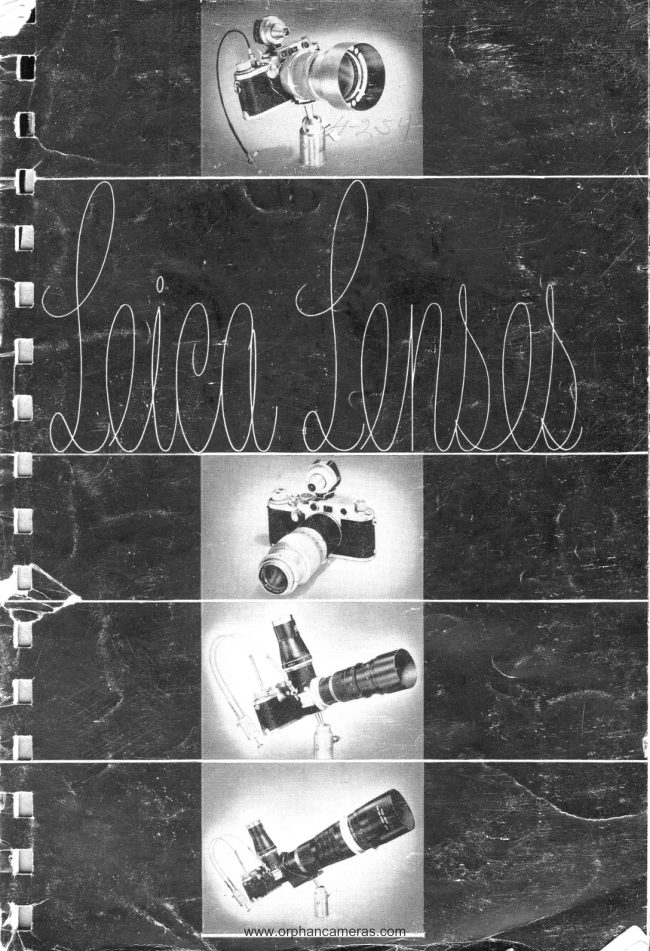
Leica lenses booklet Product booklet
Product booklet for Leica lenses booklet. 16 pages in English. Read the original PDF, download or print a copy without registration.
16 pagesEnglish4.4 MB PDF
Loading your manual…Open PDF directly
Document details
- Brand
- Leica
- Model / document
- Leica lenses booklet
- Document type
- Product booklet
- Language
- English
- Pages
- 16
- File size
- 4.4 MB
- Category
- Lenses & filters
- Document date
- Not specified in catalog
Search available document text
Find a term, then jump to its page in the original PDF. Image-only pages may not be searchable; check the PDF for exact wording and diagrams.
Page 6 · Read text
{c
,#


  t
 E     The fact that the Leica cameramay be fitted with a completeseriesof inter-
         changeable,coatedlenseswhich coupleto the rangefinderof all Leicacamerasis
         one of the most important characteristicsof the Leica systemof photography.
          The principle of interchangeabilityis not new, but as developedand ipflidd H
            to the Leica camera,it has been made avallable to a far greater numb6r of                  .. {: Il
         photographersthan was previouslypossible.                                              di
        The Helicol Mount. Each lens is provided with its own focusingmount. On                    1
              all lensesexcept Summarit 50mm. and long focus lenses,focusing is effected
         by meansof a l^ever.On the other lensesa milled ring is provided.Th. distun.e     d             is read off by an index mark. E    Collopsible lens Mounts. The Leitz Elmar and Leitz Summicronof jomm.,
           focal length are provided with collapsiblemounts,and must be pulled out be-
           fore using the cainera.\7hen the leni is fully drawn out, it is turned slightly to
          the right, where it locks in position. To push back the lens, it must hrst be  I
          turned a little to the left, then pushedstraight back into the body of the camera.
-f-      The lnfinity Cotch. N7henthe focusingmounts of the Hektor 28mm., Sum-
  Lr     maron 35mm., and Elmar, Summicronand Summarit)Omm.. lensesreachthe
            "infinity" pulk: they lock in_positionby meansof a catch.By pressingthe knob
        on the end of the focusinglever, the catchis releasedand can thenbe rotated
           for focusing.This deviceis only found on lensesof 28, 35 and 50mm., focal
    ;       length.
        The Aperture is set on the Leitz Elmar 50mm. and Hektor 28mm., by a small
          lever engravedwith an index to the front ring of the lens mount. On lhe other T    lenses,a narrow ring bearing the index mark, actuatesthe diaphragm. The
          figures indicate the relative aperture of the lens.
              In the following Pageswe state that a lens is of Gauss-typeconstruction.
          t$7hatdoes that mean? Gauss-typeconstructionis basedon a formr-rlawhich I        was devisedby Gaussin the 1880's.Originally, he simply took two identical
         Aplanatic lensesand mounted them end to end with an iris-diaphragmin
         bdtween.In other words, he combinedtwo identical lens systemr,...i   o.r. c    independentlywell-corrected.When he took thesetwo lensesand combined
        them into one lens, and placed the iris-diaphragmin between,he was able
           to still further improve chromaticaberrations. T


                               www.orphancameras.com
                                            ...s.&i*r.
View original page 6Page 7 · Read text
s _


                                                                                                                                                                                                               rJ

 HEKTOR 2Bmm",f /6.3
                   { W h e n A v q i l o b l e )

     Leitz extreme rlide angle (76 cleg.) lens. is the Hektor 28mm.,  f 7'6.3,
   tlcsigned as a tripiet r,r'ithtu'o ccmentcd surfaces.u'hich has been vu'idelyusecl
   for correction.Er-en at full aperture (f t'6.3), n'hich in a system of such a
   large angle of vieu' must be regarded as high,  it gives remarkable sharpness
   to the Lejca format without distortion-a novel feature in view of the very
   short focal length. In this objective, too, the requirement of extensive reduc-
   tion of vignetting has been taken into considerationby making the lens largcr
  than the dimension corresponding to the relative aperture. Proper reduction
   o.f the aperture. which is_always advisablefor wide-angle objectivesif concii-
   tions permit, resultsin a further increaseof the quality of the image (optimurrr
  ai)proximatelyat f / l1), and an in-rproveddistribution of light over the entire
       I rI age ?1rea.
    A 28n-rrn.adapter fits into the Imarect Finder to show the proper field of
   vieu' for the Zumm. Hektor"


 SUMMARON 35mm.,f/3.s

      In thc group of u'ide-angleobjectivesrve have the Summaron 3)mm., f /3.5
   (I3A"  )  u'ith an angle of 6-1 degrees,whicl-ris close to the norn-ralobsen'ation
  angle of the human eye.This objective belongs to the Gauss type grolrp and
   consistsof six lenses.two of which are independent; the remaining four are
   cetncnted together to  f orm two members. Particularly in the case of wide-
  ansle objectives,care must be taken that vignetting, rn'hichhas an increasingly            'i;'l':;:,
   .listurbing eflect u,ith increasingangle of vies,, is reduced to a tolerable meas-      E*
   Lrre.Iror this reason,the front lens of this objective is also nrade considerably
   largcr than would correspor-rdto the relative apertureof the systcm.Moreover,
   thc reir.rlens of thc s\,stelnis givcn sr-rchclirner-isior-r.sthat it additionirlly eniarges                                     g
   the crosssectionof ihe obliqi,. pencilsof ra1's.

H E K T O R2 8 m m .                  SUMMARON35mm.                        ru
                                           tul
               w
                            q
                                       rt
View original page 7Page 8 · Read text
I
L
t
t
L


                          ELMAR 50rnm.

            'I-he
                   cffctt of both these design f eaturrcsis that the corners of the irnage re-
         .civc much nlore Iight, so that vignetting no longer appears.The color correc-L
         tion of this objertive is excellent,and other defects ;re eliminated to ^ large
         c-xtent.The perfonttance is, therefore, exceptional even at full  aperture. n.
        .luced aperttue prodr-rcesincreasedresolution and contrast, and be'tweenf i5.6L      .tttd f .'t3,a.sl'rarPltessextending over thc entire image_areais reached.Thc clept[
         of lleld at f , t.6 is so great ttrit the rangefindernc-edhardly be usecl.
L
L-
    ELMAR SOmm.,t/3.s

           In its assernbll',                            Elnrar l0mm..  f r'3.1 (2")  angle of vicvu,J5 cieg..colr-L                               lh:
         stitr*rtesa kno\\'lt triplet varia.t-ttconsisting of tl-rrcerrentbcr.s.J'he last rnembcr
         contliit-tsa collvergillg (etnenteclsurface. and, uncler iar.'orablecorrectior-rcon-
 !t       ditions has a rclativel-ysimple.construction.The correctionpossibilitiesof t6is
 I*       i)'Pc of s1'stctl-tl-ravebecn wide ly utilized, and all resiclual defects, chromatic
       as u'cll as spherical.rtrc ad-jtrstedto each otl'rerso that an especiallyfar.,orlble
                corrc-ction                        aclapted                                       to the                                       Leica format                                                                       is                                                       obtained.                                                       The                                                                           slrarpr-rcss        $clrcral II       incrcases                 rapidiy as                          the aperture                                                  is recltrc'ed,                                          and at                                                                                                             f tr                                                                                          its ma.ximlnt.                                                          /B  it is at
        $7e u'ish to insert a statementhere wl-richapplies quite gene rally, not only to
              t hc E l ma r:
  I              ff.  in orcler to obtain maximr-rm dcpth of  focr,rs,the aperture is rcdr-rcecllEftt         l-'c-r'or-rcltl-reso-calledcritical apertr-rreof an objcctive, a dccicasein thc resolu-
          ,j9:  ca;racitt'-is thc'oretically to be expected bec'au.seof  the phenorrena of
         tlif{raction. If standard emulsions u'ith a resolution capacity irf as muc-h as
         rl-rotrt100 line.sPer millimeter are uSer].hou'ever, practiclllv no Io.ssof rcsolg-l-
        rion is gencrallyobsen'able, even at f /t6.
        The                              of pc-riod.icstructuresanc.ltcst frlnr.sof an csperially high              .reprodr-rction
L      rc-soltrtioncaPacitt'must renlain outsicleoLtr preseltt considcratioris
I                             www.orphancameras.com
View original page 8Page 9 · Read text
br

                                                                                                     I                                                                          J
                         SUfVlrVtlCRONSom'nn.,tr/ 2
                                 _t
                                J
                                J
                                J
                                J
  The Sun'rn'ricron )Ornm., f i 2 is a ne\ / addition to the Le ica line of lenses.
It has a new type of glass, new optical design and excellent correctiotr,esPe-
cially for color, flatnessof field and vignetti?g
  The Sumrnicron is more compact than thc Summitar and thc diaphrrstrr
adjustinq ring has click stops. All glass-to-airsurfacesare coated.
  Thcrcl     i.".tr  elementi, only one pair of which is cetnented.Utilizatiorr
            "r. "air lenses" to achieve an exceedinglyhigh degree of correction"is made of
Thc basic design is ^ variation of the Gar-rss-*p. Iens. (The Gauss-typeis
clraractertzedby two convergi.g lenses, one at each extremity gf the systettt.                                Jcnclosir-rgtu,o d iverging menisc'Lrslens components, located adjacent to  tht"
diaphragm.) This provides a favorable basis for color correction.
   tn.  Si,mmicron has been further correctedto reduce the extra axial spl-rericalaberration and loss of contrast at the edges to the absoluteminimum, while ar  J
the sametirne obtaining a perfect correction of the astigmaticcurvature of lield,
and reaching ^n optimun performance chromatically. Important in achieving
this high degree oT correctlon is a ng*  optical glass of high refractive indcxused for the two positive elements of the system.                         fl
  The Sr-rmrni.ronpcrforms excellently at full aperjur5, producing an exceed-
 ingly brilliant and even image over the entire field. Optimum image.quality,
*'hiih normally cannot be attaineduntil the lens is stopped dowrr considerably,                           3 is rcached in  ilte Summicron at the relatively large opening of   f /4.An   ex'
 trcn-rel1,high degrec of contrast and resoltrtion is obtained.
   Coriection of vignetting in a large aperture lens is of great importance.LJnlessspcciaIrrttentionis-paid^areas,to this, the edges of the negative will teceive J
 mr-rchlcss light than other       resulting in a darkening of the edges of thc
 pictr-rre,or in tl-recase of color photogra;rhy, a false rendition of color at Llte
 Ldg.r of the transparency. Tl-re front eletnent of the Summicron is largcr in                              J diamctcr than ,..1i ired for ^ relative aperture of   f /2. This design increascs
 the transverr. ucctionof thc bundle of oblique rays, permitting more light to
 rcrrchthe edgcs.therebl' rcclucingvignetting to a mtntmLlm.                        ru
                   n
View original page 9Page 10 · Read text
I
t*      Increasingthe width of the oblique bundle of rays to eliminate vignettinu
        increasesthI dilhculty of correcting other aberrations.The reduction of vignet-

                                                                                                         is                                                      The                                                                    Sutnnlicron                                                       of- optical                                  aClriet'ement                 an outstanding                as       rcgardcd                                                          .deslgn.L     ring in the Summicron, coupled-with  its over-all. high correction, can be                                                                            either color                                                                               for                                                              clesired                                                             to be                                      leaving r-rothing                 highest                          pcrformit-rcc               ,              f.,-,, of
L     or bleck-an.i-whitephotography.
    SUMMARIT Somm.,tll.5
l*
           J'hc high speedSummarit )c0 m m . , i  1 . i ( 2 " ) , , a n g l e 1 >d . g . ' , i s a s e v c n - l e n s
       ob jcctive belonging to the gtroup of Gauss typcs, which afTordsespecialty'

                                   lnsiderablCsharpnessis obtained over the entireL      r,ontrrstf.rvorableiscorrectionexcellent,possibiliti<so that coes for the present pltrpose.Color correctionand
        irnage area even at full  apertture. The generfl sharpnessis fr-rrtherincreased
          u'ith moderateclosing of the a1.pertr-rre,at-tdat about f /4  it reachesan unusr-rally
        hieh degreeof contrastand re::iolution. Also, the uniform distribution of light
        over the entire image area. ancd the elin-rinationof distortion. are excellentfor
       en ob jective of  sr-rcha larger initiei rtperture. \We have here an especially
        succcssfulrotlstructionof exc(eilent iretTorltl.In(e.suclr as is probably' seldorn
A-       fcund in oblectivesof this kin..t.


L.                                                 - ' -
       S U MMI TA R5 0 mm.                           SUMMARIT 50mm.


                             www.orphancameras.com
View original page 10Page 12 · Read text
I
-n
  U
     SUMMITAR Somm.,f/2 -
  m              ltllustrqtion on Poge 9l
   5          The faster objective, Summitar 50mm.,  f /2  (2"),   angle 45  deg., is based
         on the so-called Gauss type, which affords excellent correction possibilities for
      I       higher relative aperture and for greater angles of view. At variance with the
      f      normal Gauss type, the front member is composed of two lenses, so that addi-
            tional means of correction are obtained. The excellent color correction deserves
          special^     mention, whereby color defects of a higher order are made unnoticeable.
      t        Th"  other defects, tob, are limited  in thelr extent. \7ith  reduced aperture   sr          the sharpness of  the image increases rapidly and reaches its maximum  at
          about f /5.6. Special importance was attached to the extensive elimir-ratronof              Y
                    which  is of fundamental  importance, especially in  color photog-
"     !t         ;;if,;:,t"g

                                                                                                                                                                                                                                                                                               " : E
  I
 E  SUMMAREX 85mm.,t/t.s           The series of objectives of long  focal length begins with  the high-speed
        Summarex 85mm., f /1.5  (3rA"),  angle 28.) deg. This is a seven-lenssystem,
          which may be regarded as a variant of the Gauss type, and which  offers ex- B    tremely fine correction conditions. As a result of the special position of the
            axial and  extra-axial spherical aberration, the objective shows a slightly  di-
  rn     minished sharpness at full  aperture, which, however, does not go so f.ar as
  td      to make the objective "soft."
          The Summarex is excellent for news photography as well as an ideal objective
            for portrait photography. It  is particularly highly esteemed in these fields.
                   Ir is highly corrected for critical sharpnessand  it  is specially coated for re-  fi     duction of flare and scatter, for increased light transmission and image contrast.
               \7ith  slight reduction of the aperture, perfect sharpnessis obtained over the
           entire image area (maximum-approximately   at  f /a),  so that the objective is
          also suitable for photographs requiring an especially high resolution capacity. e
 t
 U
     ELMAR eomm.,(/4
 E               {fih                                                   same type of          Elmar 90mm., f /4  (31/2"), angle 27 deg., belongsto the
          objectiveas Elmar 50mm., f/3.5. \Vhat was statedthere with respectto the
          correctionconditionsand optimum sharpnessapplies here. The very slight*r     effect of vignetting in this objective is worth mentioning. It  is particularly
          suited for portrait photography,but can be used very successfullyfor scenery t        and for all purposeswhere a relativelylong focal length is needed.                                         ,i
 t3t                                                                       1 1
                               www.orphancameras.com
                                 *;)rt*u                .,..";.                                                                                    *&.ilffig.                                            ..-t,".r,.-
View original page 12Page 15 · Read text
I
                                                            I
       7'-'g
                                                            I
                                     8
                                                        O                                                        O                 I
                                                                                                                                                                                                   r-{
                                                        O
                                                                                                                                                                 |t
       The Depth of Field Scole.In order that the range
          of depth of field at any lens aperture may be_read off
         direc[ from the camera, a special scale is fitted en-
        graved with the aperture figures, which shows the                                                            I        distancesin front of and behind the actual focusing
        distance at which sharp focus is obtained, for  all
         lens apertures. The accuracy of  this scale is quite
          sufficient for most practical purposes, though  for                                                     t
        very accuratework special depth of field tables can
       be obtained from us (price 15 cents), in which the
         figures are calculated for a circle of least confusiou         of  I/3oth  of a millimeter.                                     I


        Lens Chonging.The  interchangeabilityof the va-                                                            I         rious Leica lenses is made possible by having a
        standardized screw thread on both the camera and
         the lens motrnt. The cameru flange into which the        lenses are screwed, and the lens thread. are made                     I
         with the greatest accuracypossible. The lenses are simply screwed into the flange
       and are then in correct register. A quick-thread mounl or a bayonet fitting has
        not been used, since these are liable to wear with use, and become inaccurate.                                                     t      When  changing the lens, the opening  in  the camera body should not be
       exposed to strong light and  it  is best to hold the front  of the camera against
        the body while the other lens is taken from the camera case. If the camera is         carried for some time withont a lens, a screw cover should be used to keep  T
        out dust and damp.
                                                     t

         lever of  the rangefinder. The coupling  is automatically effected merely by
        screwing the lens into the camera. This coupling makes the Leica extremely                                                     t
        convenient and quick to manipulate.  It should be especially mentioned that
        Leica lenses which are adapted for this coupling are suitable for immediate   t
r4                                                        I
View original page 15From the M. Butkus archive. Original publisher and archive notices are retained.
Check the model and edition against your equipment.
PDF verified 2026-10-10.