Light meters
LEUDI Exposure Meter User manual
User manual for LEUDI Exposure Meter. 5 pages in English. Read the original PDF, download or print a copy without registration.
5 pagesEnglish0.8 MB PDF
Loading your manual…Open PDF directly
Document details
- Brand
- Leudi
- Model / document
- LEUDI Exposure Meter
- Document type
- User manual
- Language
- English
- Pages
- 5
- File size
- 0.8 MB
- Category
- Light meters
- Document date
- Not specified in catalog
Search available document text
Find a term, then jump to its page in the original PDF. Image-only pages may not be searchable; check the PDF for exact wording and diagrams.
Page 1 · Read text
=#':'                       www.butkus.us
INSTRUCTIONS for usine
THE              EXPoSURE METER   LBIIIDT
                       o  Mike Butkus                                                                                                                                                                                                                                          DigitallyDN:email=mike@butkus.org,Date:cn=Mike2024.05.06signedButkus,by20:39:32Mikeo=ButkusButkusc=US-04'00'camera manuals, ou=butkus.org,
   Oil +ho rneler will be found three rows of fig'uree: To the
 left, S+ops and Scheiner degrees; in +he ceifer, Expoerre
 Ti{ne6 h facfbne of seconck, seconds and minutes: io thc
 rigst, the bcic fQures I to B and five {ields. These fields
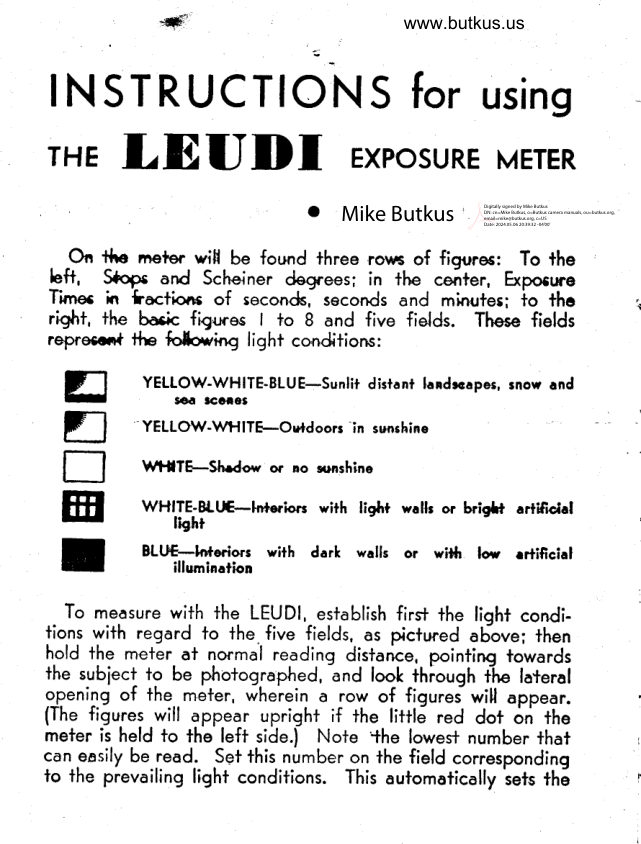
repreeo{ t{E {o$crying light conditiors:

            YELTOW-WHITE-BLUE--Sunlit   distanf lendrcapes, gnow and
                s3d tcctes
           YELLOW-WHITE-Outdoors'in sunshine

             Y1/fflTE-Sh.dory or no slnshine

            WHITE-BLtE-lntari<rs  with liglrt walb or b,rig&t artifrcial
                     lieht
            Blt}E-hferiors wilh dark walls or with lor  rti{icial
                     illumination  EEtlE!
  To measure with +he LEUDI, esfablish first +he light condi-
tions with regard to the" tive fields, as pictured a6ove; then
hold the meter at normal reading disiance, pointing towards
the subiect to be photographed, and look thiouqh ih€ lateral
opening of the meter, wherein a row of figurei will appear.
(The figures will appear uprighf if the little red dot di +he
meter is held to fhe left side.) Nofe the lowest number thaf
can eosily be read. Set this number on the field correspondinq
to the prevailing light conditions. This automotically ie+s fh6
View original page 1Page 2 · Read text
ti

 scales on fhe mgfgr a.nd lin-es yp                                lhe correct stops and exposure      any co.mbination of which will give the besi exposure |imej, for film speed of 26o Scheiner. In cas6 the exposure data for
  a. speed ofher fhan 260 is wanted, {or inslance for 20o Scheiner,
          move "20o'r to the place originally occupied by L[u.1.:irply "260".
    ff siop and exposure fime indicated bv the meter do nof
 exactly c_oincide with the figures on the'camera scates, the
 nearest figures should be chosen. Always favor the longer
 exposure.
  . Whql iaking_readings, preferably point the meier towards the halffones of ihe subiect.
   EXAI'/PLE l. On a sunny day a scene has to be photo-                              '"4".' graphed. The meier reads       Place "4" on fhe sunshine
 field (yellow-white), and as best average exposure will be found
with 26o Scheiner film l/50 sed. at-F/  | i, or l/2SO sec. at
 F/6..3,etc. For 20o Scheiner film, for instance, ihe exposure
would be l/25 sec. at F/8, or l/100 sec. at F/4.5, eIc.
  EXAM PLE 2. A dark room as a background. Reading the                                                                         -meter gives the figure 6. This is set on- the Blue field.  Thu
resuliing exposure is 5 sec. a+ F/3.5 {or 26" Scheiner, or 2s
sec. al F/3.5 for an emulsion speed of 20o Scheiner.
  Reading belween                           figures in marginal cases gives more                    .two
accuraie resuhs and is specially recommended when fakinq
color picfures. As poinied ouf, thal figure should b;
used as basic number fhal can be easily read when exam-
ining. the halftones of                       subiect. lf may happen that a                          'cleariy.+hecertain figure is seen        and, in adcition, roru detail of
the-nexf figure. In this case, the field corresponding to the
subiect may be set between lhe two figures'in qu6siion in                                                           -order to get the most accurate reading.
View original page 2Page 3 · Read text
Venmo @mike-butkus-camera  Ph. 2083
PayPal Name  Lynn@butkus.org      www.PayPal.me/lynnbutkus
View original page 3
Page 4 · Read text
www.butkus.us
       EXAMPLE 3. The figure 6 is seen clearly and fhe figure 5
         faintly, the light condifions corresponding  t'o the Whit"" fiuld.
       Set this field between "5" and "6" Exposure {or 26" Scheiner;
                          |       /25 sec. F/3.5.
        The fields themselves may be used in a similar way. An
         interior neither specially dark nor specially bright may be best
&     measured by setting the basic figure read'againsf the'halfionest      between ihe iwo b-lue fields.
       EXAMPLE 4. The observed figure be "7".  Place this
      beiween fhe White-Blue and Blue fields. As best average
       exposure for 26o Scheiner results: I second a+ F/1.4.
         The fwo blue fields shouid also be used in twilighf and in very
       dark woods and forests. Jusl before sunsei fhe observed
        figure should be set between the White and White-Blue fields.
         For Orthochromatic material the exposure time given by the
      meter should be doubled when working with ariificial light.
       Panchromafic malerial needs no such increase.
           Filters are not taken into account by the meter since their
       prolongalion factors vary.
      When a double extension camera is used for very near
        obiects, to iake full size pictures, for insfance, four times the
       normal exposure is required.
              lf +he speed rating of the fitm to be used is noi known to
       you, ask the dealer. As ii is impossible to produce absolutely
       accurate and practical figures for the sensifivity of the nega-
        tive maierial, it is best to gef used to one type of film and
      noi change wiihout good reason. When a new typ" of
       emulsion-is used and a row of underexposed negafives are
       obtained,  it is ceriain that too high a speed value has been
      used. lf overexposure resuhs, the opposite has obviously been
       the case.


                                                                                                                                                                                          I
View original page 4From the M. Butkus archive. Original publisher and archive notices are retained.
Check the model and edition against your equipment.
PDF verified 2026-10-10.