Light meters
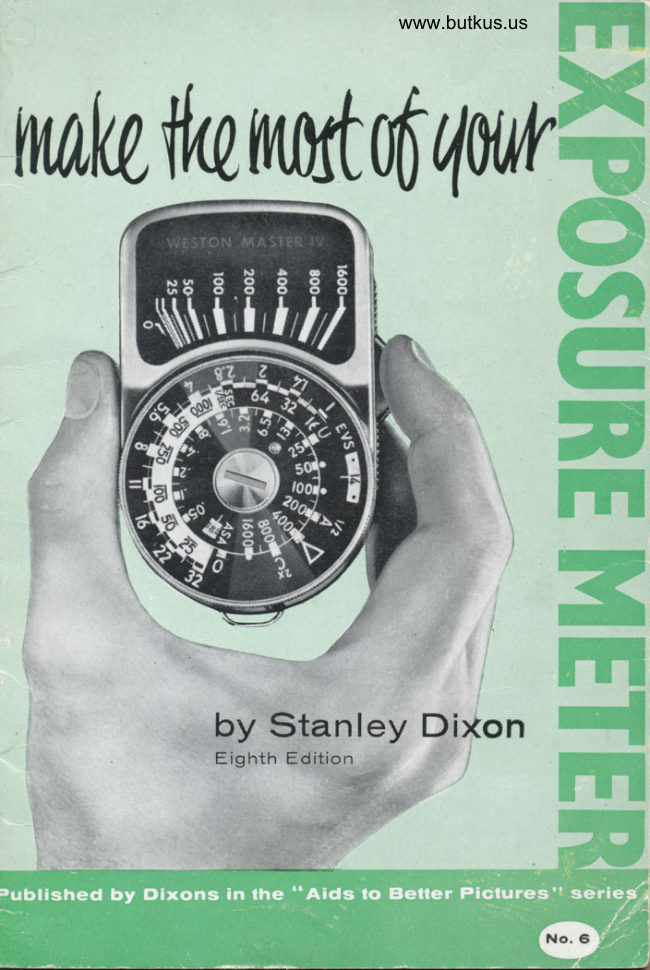
Making the most of your exposure meter Reference guide
Reference guide for Making the most of your exposure meter. 13 pages in English. Read the original PDF, download or print a copy without registration.
13 pagesEnglish5.0 MB PDF
Loading your manual…Open PDF directly
Document details
- Brand
- Various brands
- Model / document
- Making the most of your exposure meter
- Document type
- Reference guide
- Language
- English
- Pages
- 13
- File size
- 5.0 MB
- Category
- Light meters
- Document date
- Not specified in catalog
Search available document text
Find a term, then jump to its page in the original PDF. Image-only pages may not be searchable; check the PDF for exact wording and diagrams.
Page 2 · Read text
FOR QU'CK REFERENCE            DlxoN's
                              to Better                       "Aids
                                  Picturesttindex
                      Page         BOOKLETSCorrect Exposure         I
Read the Instructions  2
Film Speed             2
Different Systems      2        THISI of instructionalbooklet is onemanualsof a seriespre-
Speeds Compared     2             sented without charge by Dixons                                   to purchasers of photographicComparison Table        2             equipment.
Personal Tests           3                             Our purpose is not only toSet your own Rating     3            supplement the sometimes inade-
How Meters Work        3           quate information supplied by
                                         manufacturers, but to make cer-Double Scale Meters     3           tain that our customers have
How to Read            4             before them in easy-to-understand
                                     form all the necessary instructionAcceptance Angle        4              to ensure first-class results at once
Golden Rule             4            from new equipment bought from
                                         Dixons. Many letters on our filesSubstitute Plan           4          show this unique service to be
Extreme Contrasts     5             widely appreciated.
                                                                                                                                            IArtificial Highlights    6           Other volumes are: No.                             "Make the Most of your En-Incident Light            6             larger," No. 5 "Make the Most
Low Light               7             of your Camera," No. 7 "Guide                                         to 8 mm. Movie Making," No. 8Colour Exposure       7             "Electronic Flash Photography,"
Watch your Improvement 7          No. 9 "Colour Slide Showman-                                            ship."


                OIXON llOUgE l2B.l96  lllOH 9T EoOwARl MIDDX.

                                            Contents of these booklets are
                                                 strictly copyright and any person
                                            or persons infringing same will be
                                          proceeded against to the full extent
                                               of the law.
View original page 2Page 3 · Read text
www.butkus.us

     MAKE THE MOST OF
    YOUR EXPOSURE METER
           by Stonley Dixon
T-!ON'T tell me-I know. You   new exposure meter to glve correctv  used to guess all your expo-   readings for the particulztr film you
    sures. You never had any   intend using. Choose a good film                                                        maketrouble. Your pictures were always   and stick to it.  If you can'tpretty good, wonderful in  fact.  up your mind take my advice and
The family and the girl next door   settle for Kodak Verichrome Pan.often said so.                      or Ilford FP3.                         On the Weston Master-IV there  Then one day you shot those    is a tiny window showing the film
once-in-a-lifetime wedding photos   speed: after pressing a catch youand blandly promised lots of big,   rotate the dial until the requiredlovely enlargements. What went   speed appears in the window, andwrong? It was inexplicable, un-    readings will then be right for filmsaccountable, humiliating. Half the
negatives were too thin to Print,
others too dense. You retired for
the day to your dark-room before
you could face your family again.
and the girl next door, too.
  So then you decided to huy a
firsl-t'la.ss  er posure nl(l('r  lrrtnt
 Dixorts.
  And that, if the secret truth were
known, is exactly why most other
photographers bought an exPosure
meter.
  HERE'S something cute I must
tell you at once about Photo-
electric exposure meters. Thel'
havc large. very sensitive eyes-
but no brains. No brains at all.
You have to teach 'em exactlY
rvhat to look for. I'm writing this
booklet to show you how.
 CORRECT EXPOSURE depcnds
upon two things (l) the speed or
sensitivity of your film and (2)
accurate measurement of the light
reflected from your subject. 'Ihe
speed of films varies considerably;
perhaps you don't know that the   YOU couldn't take a direct
slowest ones often require as much     meter reading of this "fast"
as 32 times more exposure for the    young lady! But the "substi-.sante subject in the same light than     tulion" plan on page 5 will
the latest super-fast films.           give the correct exposure.
  So your first job is to set your          Kodak picture.
                                                     Page I
View original page 3Page 5 · Read text
ol' thc spccd shown. Other meters   but unfortunately, there is no uni-
         are adjusted for film speed by set-   versal method of assessing film
          ting an outer ring dial opposi[e the   speed. German film makers use
          sclectcd figure, or by rotating a   the DIN method; speeds are ex-
         llattencd rtlller engraved on - its   pressed. as one eminent photo-
           faccts with scales for different film   grapher said, in very vulgar        spccds. Each meter is different in    fractions, the denominator alwavs
           this.respect; but how to set your   being 10. the numerator indicatirig
          particular instrument for film speed   the speed, e.g.. Agfa Isopan ISS is
           is described fully in the manufac-    2l llO DIN. Other European          turer's instructit'ln sheet. Studv it   countries measure speeds in de-
                 clr rcf  rr  I lt'.                        grees Scheiner: here. when you
                                          double the speed the rating jumps
                                          in threes. Ilford film speeds are           I.'ILM SPEED. The speed of   designated hy the letters B. C. D.          nrost filnrs is printed boldly on the   E. F. C. H.         cartons. Some well-known manu-
           facturers. however. give no data on
        thc carton, but it wilt be found
          cither on the small adhesive paper-be-    SPEEDS COMPARED. A few           f:rstener which nrust be broken      exposure meters carry an engraved
            lirre the film can be inserted in the   table enabling you to convert one
             can)t: l'a. or on the  instruction   film speed system to another. If
            lcaflct inside the carton.             your meter is calibrated in DIN or
           Usually both film and ntetcr   Scheiner. you can thus use ASA or         u ill he marked in ASA ratinss   Weston ratings if you wish. Here                                                    is a sintilar conversion table
                                                                              I)l N  .\cheiner ,4:;A Weston                                                       Digitally signed by Mike Butkus

                                         camera                                                    manuals, ou=butkus.org,                                                                 er l0l   Mike Butkus DN: cn=Mike Butkus, o=Butkus                                             email=mike@butkus.org,                                                          c=US                                                 Date: 2021.04.16 19:38:23 -04'00'                   I r/r0J 20    6-to       8
                                                  t2ltol
                                   t4ltOt 23    t2-20    t6
                                                   Is/rol
                                     t7lt0t  26   25-40   32
                                                                                                    r 8/l0l
                                   20lt0l 2e   50-80   64
                                                           2l I l0t
                                  23lt0t 32   t00-t60 t00
                                              24ltOl
                                                26ltOt  35   200-320    200
                                              27ltol
                                               2elt0t  38  400-650 400
       The Prinz exposure meter-      For example. Kodak Panatomic
            exclusive to Dixons-features a      rollfilm is rated for daylight at 25
             large calculator which has merely     ASA, but you could set your meter
          to be lined up with the meter      at 26 Scheiner if it is calibrated in
           needle. Readings can be made     Scheiner. Remember, all these
             for all types of camera.             comparisons are approximate only.
       Page 2
L
View original page 5Page 7 · Read text
in only a cone of light covering
        about the same angle as a no'rmal
       camera lens. This is called the
        acceptance angle and, because of
          this it will be obvious to you that
             if an cxposure metcr is pointed
         straight forward at a landscape, a
          large proportion of the light aflect-
         ing the meter will come from the
         sky and much less from any darker
        objects in the foreground. The
         reading rvill average the light from
           all directions within the acceptance
        anglc. You will get a near-correct
        cxposure reading for the sky, but
        prominent foreground objects may
        be scriously under-exposed.
               It must be understood that the
        meter measures the light reflected     IN portrnilure:r close-up read-
        by objccts. A white cloud or white     ing should be taken of  the
        cottagc rcflects much more light      face, but make sure that meter
         than  ir dark grcen hillside or a dark      is held in such a way that no        blick building. The clouds or     shadow of it, or your hands, is
          cottirge give a higher reading on     cast on the subiect's face.         the nretcr, which will tcll you that          Zeiss Ikollex picture.           lcss cxposure is required.
      GOLDEN RULE. The clever   has buildings in the foreground,
      wav to use a meter. therefore.  is    y()ur c\posure nrust be based on
           nenler to takc a gencml reading but   thc light reflcctcd from these build-
       always to obtain your exposure     ingrs. not from thc scene generally.
       from the principal object before   ln talting a portrait, the reading
         the canrcra. Thus, if y'our picturc   slrould bc (aken  f ronr the face,                                          bccausc it is the flesh toncs of thc
                                              facc which it is most important to
                                           rcproducc faithfully. not the back
                                        ground which may be light or very
                                      dark. A glance at the illustrations
                                                 will nrakc this important matter
                                                      clear.

                                                     "SflBS'l'lTtJ'l'E" PLAN. How
                                                  perfectly ridiculous. I can hear you                                                                                                               I                                         saying. When taking a snap, am I
                                          crpcctcd to leave my camera oll
                                                   its tripod while I dash across
                                                   crluntry like a Marathon runner to
                                            gct a meter reading from a farm-
                                  house somewhere in  the fore-
        Make sure that you do not     ground?
         gct an exaggerated reading      Of course not  !        by including too much sky.                                  The way to use your meter in            Tilt the meter down slightly                                              these circumstances is to obtain a          as shown.
        Pugc 4
it
View original page 7Page 8 · Read text
www.butkus.us

        reading of some nearby obiect of   close-up portraits. When in tloubt,
         s!milur- reflective po$'er. This  is   alw,oys prelter lo err on the side ol
        called the "substitution" method.   ntor( genefous (xposut'(.
         Supposc that your picture has a   EXTREME CONTRASTS. You
         largc building or tree in the fore-  may sometimes be confronted by                                                                      and        ground rvhich it isn't convenient to   the problem of very bright                                                                   same       approach. Thcn take a close-uP   very dark objects in the        metcl reading of say a stone wall,   picture, both of which it is im-                                                                These sub-        gatc or trce trunk which is near   portant to record fully.                                                jects, which  f requently occur in       and easily accessible. You do not
       intcnd to  include this  nearby   indoor photography, are said to be         object in your photograph, but the   of high contrast.  If you expose         cxl;osure reading you obtain from   for the highlights, your darkerI             it will bc roughly the same as you   objects may not show sufficient
       would get if you could approach   "shadow detail" because they are
        closely to the similar object in   under-exposed. On the other hand,        your picture.                                    if  you expose for the darker
              If thcre is no single object which   objects, thcn your highlights may
         is particularly prominent, and a   be over-exposed and become quite
       landscapc consists of   general   white or "burnt-out" in your print.        countryside scenery composed o[     Probably thc best way to use
          trces. undulating verdure and so   your meter in these conditions is
            foltlr. it is a safe plan to base your   to take one reading of the bright-
          nrctcr rcading upon the ground and
       grass inrmediately before you.
        Flold thc meter pointing forwards
       but downwards. at an angle of
        about 45 degrees. [n this way you
        crclude nrost of the sky.
      WTIY EMBARRASS HER ?
        Anotlrer usc of this "substitution
        nrcthod" is in portraiture. What
      you really want is a  close-up
        reading of the facc, but it can be
          lu triflc disconcerting to the sweet
       young thing if you thrust your
         nrcter right in front of her nose.
            It's just as cffective to take a close-
       up rcading of the back of your own
       hand. holding the meter about
      6 ins. {rway. Your hand reflects
       about as nruch light as the sub-
          jcct's facc and. if ..yo^u .make thc         conrparison, you will find the read-
        ings arc practically the same.
      A nreter reading taken from your
        handkerchief can be "substituted"
        for ir direct reading of a child's
         light dress.
            All close-up subjects, however, re-
           flect far less general light from the   WHEN taking portraits, close-
       sky than more distant objects, and    up rcading of your hand is
     my personal practice is to double    near accurate substitute for
       the metcr exposure indicated for      direct reading of subiect's face.
                                                            Page 5
View original page 8Page 9 · Read text
cst part of the scene, and a second    INCIDENT LIGHT. Yet another
 reading of the darkest details you   plan of action which avoids all the
rvant in your print.  Base yout'    dilliculties due to objects of dif-
actual cxposure upon a figure half-   fclent brightness. is to take a
rvay bctrveen the two readings, and   rcading of the light-sourcc itself.
you rvon't be far wrong.             Usually you measure the light re-
  ARTIFICIAL  HIGHLIGHT.    flected fronr objects to be photo-
Another way of using your ex-   graphed, but in this method you
posure meter. which has much to   stand near the subject and point
recommend it,  is called by the   the meter at tlrc czntere. Because
somewhat terrifying name of the   the direct source of light which you
"artilicial highlight." Actually, it's   thus measure is so much stronger
cxtremely simple and can be used   than the same light reflected by
cqually well for landscapes, groups   your subject, the elcctric cell of
artd close-ups.                     your meter must lre shielded by a
   All you need is a piece of card-   semi-transparent cover which in
boa1j. not less than about 9 ins.    efTect makes the reading equivalent
square. Don't use shiny cardboard,   to a reflected light reading. With
but preferably a piece with a   the Weston Master-IV metcr. this
rough. white, matt surface similar    special cover is called an Inver-
to white blotting paper.            cone: it is circular and fits over
  fhis card is held up vertically so   the cell. The Sixon meter has a
that the prevailing light falls upon it    sliding translucent cover similar to
lrom the sanre direction as upon the  a Venetian blind. which can be
subject to be photographed. Then   moved over the electric cell win-
take a meter reading of the card,  dow. C)ther meters have similar
holding the meter 4bout 6 ins. away.    arrangenrents which arc fully de-
Care musl be taken to ensure thal
tto .sltudo'x, ol the meter itself fulls()n to the cunl. und the lutter
.rhoulcl be ntoved up and dowtt  tt
little until tt ntoxirnrtm reading is
ohtuined.
  This procedure is followed what-
ever rnay be the subject matter to
be photographed. even if  it does
not contain any items as white as
thc card. The exposure thus ob-
Lained has to be multiplied by a
"factor" which remains the same
after you have found out by test
what it should be in order to pro-
duce negatives of the kind you
prefer. As a basis for experiment,
I suggest you multiply the expo-
sure as indicated bv the "artificial
highlight" by 4.  If-this gives over
or under-exposed negatives, amend
the "factor" accordingly.
  When you have ascertained the
correct "factor" to use for vour
particular film/meter combinalion,   TAKING artificial highlight
this method yields very consistent     reading with white card as
results.                                     described on this page.
Page 6
View original page 9
Page 10 · Read text
www.butkus.us

 scribed in the ntanufacturer's in-                       iiT*'.,                                                               :lii,:!:  iii;{,al
 struction  leaflet.                                                                                                                                                       i'iil
  IN THE GLOAMIN'. In spite
 of the great sensitivity of modcrn
 plroto-electric meters. occasions
 arise rvhen the light is so poor that
 practically no deflection of  the
 needle is produced by reflected
 light or the usual incident light
 nrcthod described above. These
 conditions occur. for   instance,
 rvhen making interior pictures of
 buildings in  twilight. or when
 t:rking "candid" shots in  poor
 arti{icial light. Your meter can
 still be used. and quite accurately.
 too.
  The method is to take a reading
 of  the light source from the   THE trick I use for "contre position of the subject, exactly as     jour" or against ihe light pic- in the "incident light" procedure,      lures, such as this, is to turn but no translucent cover or blind     m.v back to the sun and take
 is used over the sensitive cell.        reading of immediate fore-    lf.  for example. you want to     ground, then multipl.y exposure
 photograph the font in a churclr           b.v lhree. Zeiss picture.and the only light comes from a fairly distant stained-glass window.   thin cnrulsions. and anv consider-                                able deviation'from ifre correct yt-ru would stand near the font and                                                                                      at poittt .r,ottr nteler.\truigltl ut lhe   c\posure required is revealed wirtdttx,. Reflected lieht front thc   oncc by quite fantastic changes infont might not be suffiIient to move    the colour rendering. Accurate ex.                             posure in colour photography. the needle at all. but a direct read-
 ing of the window probably will    tlrerefore. is essential. register.                                 Usually. if contrasty subjects are
   Translation of the reading thus   avoided.  it  is safe enough to
obtained to the actual exposure   take a reading of the highlight
rcquircd is based upon the fact   area. leaving the shadows to look
that an average subject reflects    after themselves.
about li30th of the light falling     Sonre colour workers. however.
upon it.  Thus, if the exposure in-   prefer the  "artificial highlight"
dicated by pointing the metcr   nrcthtld mentioned above. the ex-
directly at the window is l/10 sec.   posure thus determined being mul-
at f/5.6. the strbject requires 30   tiplied by 3 for  nrainly light-
times more. or 3 secs. at f/5.6. As   coloured subjects. but by 4  if
a smaller stop would no doubt be   durker colours predonrinate. Very
better for such a time exposure,    consistent results can be obtained
this could be 24 secs. at f/I6.          by' this method. but there is such
 COLOUR EXPOSURE. The  a great variation between colourhunran eye is renrarkably accom-    films as well as between exposure
nrodating to slight variations in the   meters, that it  is necessarv. first
density of tones in black and white   of all to devote one film to a series
photography, but it is far more   of test exposures on normal sub-
sensitive to  slight changes in    jects, in order to find out exactlvcolour. Colour films have very   what the numerical factors should
                                                     Page 7
View original page 10Page 11 · Read text
be with the particular film/meter   presented free with  all   flash
combination you use.                apparatus bought from Dixons.
 A DEVIL WAS HE. When    ALL BY KINDNESS. Finally.
taking close-up colour portraits by    let me urge you to look after your
artificial light I have found it best   exposure meter, and to treat itto disregard the recommendation,    ' with care. It is a robust yet delicate
 invariably made by portrait pun-   instrument; many meters have
dits to beginners in black and   jewelled bearings like a fine watch.
white photography, of having one  A good leather case for  it is a
main modelling light at one side   rvorthwhile investment. Do not
of the subject and a fill-in light to   leave your meter in a damp, humid
reduce the shadows. Club lecturers   atmosphere; and on no account
and judges are appalled  if you even   allow it to be exposed for any
whisper of double front cross-   long periods to strong sunlight.
lighting.                      With care it  will give you a
  Take my private tip, be a devil    lifetime's service.
and break all the rules. Light your
subject evenly with two photo-   WATCH IMPROVEMENT. Infloods. one at 30 degrees on each   the foregoing notes I  have notside of the camera, and you'll find   mentioned film development,  al-
that this flat, almost shadowless   though this is .closely related tolighting is ideal for colour photo-   exposure, especially in conditions
graphy. As a matter of fact, the   of poor light. When under-exposure
Zeiss people make a lighting unit   has been unavoidable, extra devel-called the Movilum which works   opment within limits may often
on exactly these lines.                yield a passable negative. Experi-                               ments on these lines can be ab-
  FLASI{. Meters cannot be em-   sorbing; but I strongly advise you,
ployed to  tell you the correct   to begin with, to stick to just one
exposures for flash photography,    film and one developer, and to
whether you use expendable bulbs   standardise your developing tech-
or electronic flash. Exposure  is   nique with the object of producing
governed entirely by a  "flash   negatives which yield the best
factor" which is peculiar to the   possible prints on normal-gradc
particular outfit and film  used.   Bromide paper.
These flash factors are given, to-       If your exposures, as determined
gether with full instructions, in the  by your new meter, are keyed to
leaflet acompanying  all flash bulbs   this standardised technique, you
and electronic flash equipment.  may be certain that you will get          f'Flash work of all kinds is explain-    the very best from your equipment,
ed in another of m.l booklets in  and a great improvement in the
this series entitled "Electronic    quality of your pictures inevitably
Flash Photography", which  is    will follow.


                                                                                                                                                                                                                                                                                                                                                                                                                                                        II
                                                                                                                                                                                                                                                                                                                          I
Page E                                                                                        f,
                                              L
View original page 11Related documents and language editions
From the M. Butkus archive. Original publisher and archive notices are retained.
Check the model and edition against your equipment.
PDF verified 2026-10-10.