Lenses & filters
Mamiya-Sekor C Interchangeable Lenses User manual
User manual for Mamiya-Sekor C Interchangeable Lenses. 8 pages in English. Read the original PDF, download or print a copy without registration.
8 pagesEnglish2.4 MB PDF
Loading your manual…Open PDF directly
Document details
- Brand
- Mamiya
- Model / document
- Mamiya-Sekor C Interchangeable Lenses
- Document type
- User manual
- Language
- English
- Pages
- 8
- File size
- 2.4 MB
- Category
- Lenses & filters
- Document date
- Not specified in catalog
Search available document text
Find a term, then jump to its page in the original PDF. Image-only pages may not be searchable; check the PDF for exact wording and diagrams.
Page 1 · Read text
www.butkus.us

                                Mamiya-l


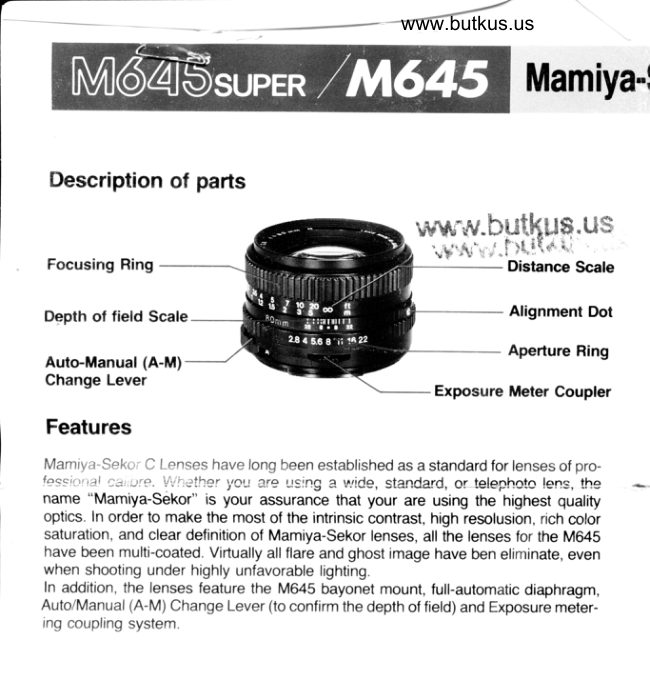
              of parts


 Focusing Ring

Depth of field Scale                                         Alignment Dot

                                                             Aperture Ring
Auto-Manual (A-M)
Change Lever
                                               Exposure Meter Coupler
Features

Mamiya-Seko' C Lenses have fong been established as a standard for lenses of pro-
fessiir t).t Ct',sJ'p. Wii".the,' you are uslng a rlide, standatd, or-telephoto lens, the
name "Mamiya-Sekor"  is your assurance that your are using the highest quality
optics. In order to make the most of the intrinsic contrast, high resolusion, rich color
saturation, and clear definition of Mamiya-Sekor lenses, all the lenses for the M64S
have been multi-coated. Virtually all flare and ghost image have ben eliminate, even
when shooting under highly unfavorable lighting.
In addition, the lenses feature the M645 bayonet mount, full-automatic diaphragm,
Auto/Manuaf (A-M) Change Lever (to confirm the depth of field) and Exposure meter-
ing coupling system.
View original page 1Page 4 · Read text
www.butkus.us
                                                             :
Sekor C Interchangeable Lenses   Momiyo
                                                                                                                                                                  '1

                                   lnstructions

    Types and Applications

     Mamiya-Sekor C Lenses are available from wide angle to telephotographics
       focal length as shown in the table at the back.

     For shooting in oamped quarters, for extensive depth-of-field, dynamic,
      perspective and exciting panoramics, you will enjoy the wide-angle lenses. For
        flattering portraiture, shallow depth-of-field, sports, and candid photography,
      the telephote lenses are ideal.

    As each lens alters perspective, a choice of lenses offers you a choice in
      photographic expresion. Mamiya-Sekor C Lenses are your tools for creative
      photography.

                                                                                                   Digitally signed by mike butkus
                                                                          DN: cn=mike butkus,
                                                                             o=orphancameras, ou=29,              mike butkus email=mike@butkus.org, c=US
                                                                                       Date: 2019.12.13 09:58:13 -05'00'

     The Fisheye 24mm f/4lens  is designed so that the distance from the picture
      center to any point is always proportional to the angle from the ortical axis to
      that point (equidistant projection). Angle of view is 180" measured on the
      diagonal of the image and it produces a full frame (56 x 41.Smm) image. Four
         filters are built-in: LB-A (81C), SL-LB, Y48 (Y2), and 065(02).

     Because the Mamiya-Sekor C 35mm f/3.5 and 45mm f/2.8lenses incorporate
      a floating system in which some of lens elements automatically move forward
       or backward as the lens is focused, high resolution, even at the very edges of
        field, is assured even at the minimum (closest) focusing distances.

     The Shift 50mm f/4 lens is a specialapplication  lens enabling some degree of
       control in perspective correclion. Since this lens has a mechanism to correct
      the image distortion,  it can be extremely useful in architectual photography.

     The Macro 80mm f/4 lens has a buift-in floating element system that automati-
       cally corrects close-distance aberration to ensure sharp resolution to the very
     edges of the picture in close-ups, copying and other short-distance work. Use
     as an ordinary lens trom ll2life-size to infinity is possible, and by using the
       optional Auto Macro Spacer, close-ups can be made with magnification ratios
      trom 112 to life-size.
     The 145mm f/4 srebniEE-FigF@                 <iesigh-ed-with major
      emphasis placed on partraiture. The soft-focus effect can be varied continuously
      by rotating the Softness Control Ring and the aperture ring. lt is also possible
       to use this as a "normal" lens with sharp images, by stopping down to f/8 or
      smaller apertures.

     The Zoom 75 - 150mm t14.5 and 105 - 210mm f/4.5 Lenses are suitable for
      both portraits and telephotography. The zoom function can also be used for
      easy, accurate focusing. First, turn the Zoom Ring to maximum focal length;
      the subject now appears large in the viewfinder and depth-of-field is shallow,
      so accurate focusing is easy. After focusing you can "zoom" (change the focal
       length) and vary the composition to your liking.

     The Reflex S(Xlmm f/8 lens is a compactly designed, telescope lens and fulfills
         its performance in photographing sports, or any distant subject.
View original page 4Page 5 · Read text
Lens Hoods
An important accessory to eliminate the detrimental effects of stray light entering the
lens.
The Lens Hood fcr the 45mrn lens is a square, slip-on tyrpe. .nttach so that the sides arc
parallel with the sides of the camera body.
bpecial hoods are required for the 55mm, 70mm, 80mm f/1'9, 145mm SFC, and Zoom
 t OS - Zt Omm lenses Even though the diameters are the same, the use of a lens hooddesigned  for a long focal length lens with a short focal length lens will result in vignetting
                                                           1 1Omm lenses share the same lens hood.of thl picture edges. The 80mm t12.8 and
The teiephoto lenses have built-in lens hoods. The built-in lens hood can be used by
simply pulling  it out. However  if you rotate and pull it out,  it comes out even more smoothly-

Care and Cleaning
Do not store the lens in a damp or salty atmosphere
Never touch the lens surface.  if a lens needs cleaning, blow away the dust particles
with a blower, and clean the surface with lens cleaning tissue and lens cleaner.
After removing the lens from the camera body, protect the lens by using front and rear
 lens caps.
View original page 5From the M. Butkus archive. Original publisher and archive notices are retained.
Check the model and edition against your equipment.
PDF verified 2026-10-10.