Film cameras
Mamiya SEKOR GUIDE Reference guide
Reference guide for Mamiya SEKOR GUIDE. 90 pages in English. Read the original PDF, download or print a copy without registration.
90 pagesEnglish7.4 MB PDF
Loading your manual…Open PDF directly
Document details
- Brand
- Mamiya
- Model / document
- Mamiya SEKOR GUIDE
- Document type
- Reference guide
- Language
- English
- Pages
- 90
- File size
- 7.4 MB
- Category
- Film cameras
- Document date
- Not specified in catalog
Search available document text
Find a term, then jump to its page in the original PDF. Image-only pages may not be searchable; check the PDF for exact wording and diagrams.
Page 3 · Read text
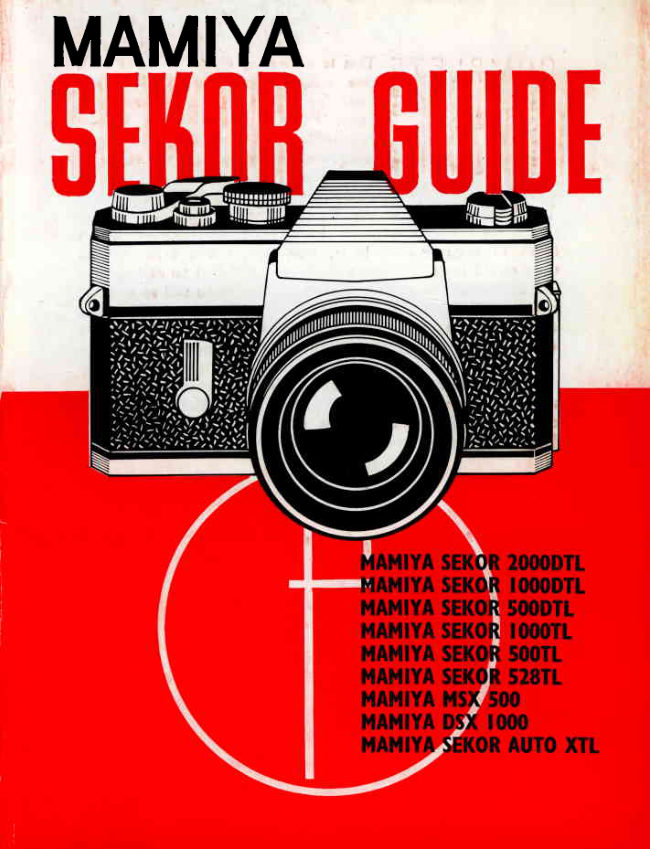
MAMIYA SEKOR
     GUIDE


           How to Usethe
  Mamiya Sekor 2000DTL, L000DTL, 500DTL,
     1000TL,IWTL,528TL and Auto XTL,
and the Mamiya MSX500 and DSX1000 Cameras

                   www.orphancameras.com
View original page 3Page 4 · Read text
CONTENTS
                         Page                         Page
The Mamiya Sekor Camera    4      Filters for Black-and-
  Body Construction        4       White Film            32
  Exposure Measurement     6      Filters for Colour Film    34
  Lenses                  6    The Polarizing Screen     34
  Shutter                  7
  Other Features            8   Expouue
  The Mamiya Sekor Models  8                                   Aperture and Speed     36
                                Choosing the Combination  37
Handling the Mamiya              Time Exposures        38
Sekor Cameru            10    Using an Exposure Meter  38
  Holding                10    Using the Mamiya Sekor
  Carrying                12      Meter               40
  Viewing and Focusing     12     Shutter Speedsand Move-
  Focusing Moving Subjects 14      ment                    4l
  Depth of Field Preview    14     Aperture and Depth of
  lnfra-Red Indicator       15       Field              41
  Film Plane lndicator              | 5    Zone Focusing          44
  Delayed Action Release   15
  Sequenceof Handling                                  Flash with the Mamiya Sekor 45    Operations           15
  Loading                 1 6    Flash Bulbs             45
  Shooting                     l8      Electronic Flash         45
  Unloading              20    Mamiya Sekor Flash
  Cutting offExposedlrngths 20       Synchronization        46
  Intentional Double Ex-          Exposure Guide Numbers  46
    posures                   2l     Synchro-Sunlight         48
  Changing  Partly-exposed
    Films                       2l    Using Alternative Lenses    49
  Film Packings for the                                 Wide-Angle Lens        49   Mamiya Sekor         22                                  Telephotography        49  Handling, Winding and                           Zoom Irnses           50    Trimming the Film      22                                       Alternative Standard  Loading StandardCassettes25                                   Lenses             50  Loading with Bulk Film or                                   L,ensChanging         52    Darkroom Refills       25                                Focusing and Depth of
                                         Field               52
Films and Filters          27     Aperture Control Systems 52
  Black-and-WhiteFilm     27    Depth of Field Preview   52
  Colour Film             28    Mamiya Sekor Lenses    53
  Colour ReversalFilm      30     Standard lenses        53
  Colour Negative Film     31    Wide-Angle l-enses      53
  Colour Film Speeds      31     Converter Lenses for
  TheChoiceofColourFilm  32      Mamiya Sekor 528TL   53
View original page 4Page 5 · Read text
Page                            Page
                                       Care of the Camers        60           Telephoto lrnses          54
            Special Lenses           55     Storage               60
                                             Exercise              60
         Close-ups with the                 Running Test after Storage 60
        Mamiya Sekor              Jv<A    Keepingthe Interior Clean 60                                             Treating the Camera with
           Close-up knses          56      Care              61
           Extension Tubes         56    Coping with Tropical Con-
          Lens ReversingMount     58       ditions                 6l
          ExtensionBellorvs       <e                                           Facts and Figures         63          Copying Stand               ;g
          Mamiya Sekor Accessories 58  How to . . . What is where?  70
                  The Green Section betweenpages 16 and 17
       THE MAMTYA SEKOR R.EFLEX MODELS                Page
        The Mamiya Sekor DTL, TL                             2
           Loading 4 - Shootine 4 -Unloading  4 - Exposure Deter-
            mination 4 - Changing Battery 6 - Self-timer 6 - Flash 6
        The Mamiya Sekor 528 TL
           Loading  I  - Shooting 8 - Unloading 8 - Exposure Deter-
            rnination 10 - Changing Battery 10 - Flash 10

        The Mamiya MSX500 und DSX1000                                1l
                                  - Shooting 12 - Unloading 12 - Exposure deter-rl  Loading Ll
            mination 12 - Changing Battery 14 - Flash 14
        The Mamiya Sekor Auto XTL                              15
           Loading 16 - Shooting 16 - Unloading 16 - Exposure Deter-
           mination 16 - Changing Battery 18 - Changing Lenses 19 -
           Flash 19
        Someitems of equipmentor certoin moterialsmentionedin this book
       moy not be freely ovoilable in everycountry.lmport ond morketingcon-
           ditions vory widely, ond ore outside the control of photogrophicdeolers.

                    Library of CongressCatalog Card No. 75-144054
                         ISBN 0817406123
                @ Focal Press,1977
                      Printed and bound  in Great Britain  by Staples Printers Limitcd  at
                              The Stanhope Press, Rochester, Kent
                           3

                               www.orphancameras.com
View original page 5Page 6 · Read text
TIIE MAIVIIYA SEKOR CA]VIERA
  The Mamiya Sekor 35 mm. singlelens reflex camerasare
of high precision,extremelyversatile,incorporating a range
of automatic features with a viewing system designedfor
accuratefocusing and preciseviewing.
  The Mamiya Sekor acceptsa wide range of interchange-
able lensesfrom 28 mm. to 400 mm. specificallymade for
this camera and as its lens mount is the Praktica-Pentax
thread mount, lensesnot specificallydesignedfor Mamiya
Sekor camerasmay be used. A range of accessoriesand
attachmentspermit the Mamiya Sekor camera to be used
efficiently on almost any photographic assignment.

Body Conilruction
  The die-castbody is coveredwith black resilient material
with exposedmetalpartsblack enamelor satin chromefinish.
The back is hinged on. The camerayields up to 36 images,
1x l}  in. (24x 35 mm.) on perforated35 mm. film. It has a
permanentlyfitted eye-levelrelex finder with built-ip nenlta-
prism giving a right-way-roundview. The centreof the reflex
finder area contains a circular microprism permitting ultra
fine focusing.The remainder of the finder field is a Fresnel
lens.The exposureindicator is visible in the viewfinder.The
image is brilliant and evenly illuminated. The screenfield
covers95 per cent of the actual picture field with a standard
55 mm. focal length lens. The taking lens itself is used to
form the finder image. In consequencethe finder shows
exactlythe sameimageas will be obtainedon the film, with-
   any parallex even when wearing eye-glasses.The reflex9utimageremainscorrect at any distancewith any lens,includ-
ing close-up supplementarylenses,extension bellows, ex-
tension tubes and other attachments.
  The reflex mirror automatically returns to the precise
focusing-viewing position the instant the exposureis made.
Vibration from the mirror's action is practically eliminated.
View original page 6
Page 7 · Read text
MAMIYA SEKOR REFLEX VIEVVING SYSTEM

                                                            Light path


                                             One  of the averaging cells


                                                  Exposure meter

                                                    F i l m


                                                     Spot reading cell on reflex
                                        m r r r o r


                                                            Battery

                                                     Spot reading selector
                                                  Lens

The image formed  by the tens is reflected  by the  mirror  on to the ground  glass s.creen, whence  it.is
again reilectad  to th6 eyepiece by the pentaprism. The image seen by the eye is right way uP and right
way round.
                                                                                      Digitally signed by mike
                                                                     butkus           mike           DN: cn=mike butkus,
                                                                   o=orphancameras, ou=29,
                                                                      email=mike@butkus.org, c=US
                                                                            Date: 2017.02.13 15:57:06           butkus       -05'00'


ii'.W::::::i::::i#:::iii::ii::iil:.::iiiiii:ii::iiii-:iii:


 Below:When the shutter reteaseis pressed,the iris diaphragm closesto th.e aperture Pre-set, the
 riiro.  strings up and the shutter -oie19. When the shutter closesagain, th.e.mirror swings down          liaphragm re-opensfully. While the mirror is in the upward position,the.imagecannot
"nit-*"liiib;;;;;,   tur  ttris peiiod is ionfined-to that of the actual exposure, as signified by the black strip in
the bottom diagram.


                          www.orphancameras.com
View original page 7Page 8 · Read text
E r p o sur e III easurement
  The Mamiya sekor has a built-in cds exposuremeter
 which measuresthe light_passingthrough the le^ns(TTL) and
 is crosscoupled.tothe shutterand lens aperture.The 6xpo-
 sure meter needleis visiblein the viewfinder.
  The rectangularframein the lower part of the finder indi-
 cates the area from which the cds photocell receivesits
 light (:spot  readjng) s_o_thatthe main area to be exposed
 correctlycan be decidedby the photographer.He cai also
 avoid incorrect.exposureof against the light, side-lit or
 contrasting subjects and ensuie well balanced exposure
 reading.In addition the DTL model has an averager^eading
system(seealso greenpages).
  The circuit is switchedon, with the film transport rever,
only whilethe light is measured,thus prolongingbatterylife.
Lenses
  The standardscrew thread lenses(as used on praktica,
Asahi Pentaxand similar cameras)ard interchaneeableand
a widp rangeof telephotoand wide anglelensesis-available,
togetherwith specializedlensesfor macro and architecturai
photography.
   All Mamiya lensesfrom 28 to 200 mm. havean automatic
pre-setdiaphragm. An internal link betweenthe shutter
releaseand the lens mount couplesin such a way that the
apertureis stopped^d-gwnonly during the actual exposure.
At other times it is fully open to permit viewing of thb reflex
screenwith maximum brilliance and minimum depth of fietd
for greatestaccuracy.on Mamiya lenseseveniniermediate
openingsbetweentwo marked aperturescan be setwithout
disturbing the operation of the automatic diaphragm. A
      of field previewcontrol is possiblesimply-bytirning{.plh
the lens to manual aperturefor pie-viewing and teiurning iI
to automatic for normal working.
  The lens mount carriesthe focusingscaleboth in metres
and feet, as well as a depth of field indicator and an infra red
mark. Focusingis effectedby a helical movementwhich is
part of the lens mount.
View original page 8Page 9 · Read text
The Mamiya Sekor 528TL has a fixed lens and wide angle
     and telephoto converterlens fronts are available.

       Shutter
       The Mamiya Sekor is equippedwith a self-cappingfocal
      planeshuttertravellinghorizontally.Focalplanemeansthat
      ihe shutteris locatedjust in front of the film. Self-capplng
     meansthat it remainsclosedwhile beingtensioned,ensuring
         full light protection. With this type of shutter, lensescan be
      changld wUite the camerais loaded. The shutter blinds are
     madefrom rubberizedcloth and fitted with a specialbrake
     mechanismto reducemirror shock and shutter sound.The
     model 528TL has a lens shutter.
       The shutterof the model2000has 12,and the model 1000
     has 11 automaticspeedson a singlering; the model 500has
     10speeds;the 528,6 speeds,which can be setbeforeor after
      the ihutter is wound; in addition B settingfor time exposures
        is provided.
       The speedshave click stops and the speedring can be
       rotatedin either direction.
       The automaticshutter speedsettingsate l,  t,  t,  t,  lll1'
      1130,1160,lll25,11250,1/500on the model5-00,plu-s-1lt^0!p
      sec.on the model 1000and also 112000on the model 2000.
     The model 528hasthe speedsof lll5-11500 sec.The shutter
        is flash synchronizedfor flash bulbs and electronicflash with
      conventional3 mm. co-aJ(ialcontacts.
       The speedof the film is setin the shutterspeed.!nobboth
        in ASAand DIN rating. A delayedaction is built into the
       shutterand will releaseihe shutter with a maximum delay of
      10sec.(not on Model 500DTL and 528).
       The dhutter releasebutton is convenientlyplaced beside
       thefilm transportleverand hasa cablereleasescrew-inthread
        in its centre.
      A full singlestroke of the film transport lever advancesthe
        film, tensionsthe shutter and actuatesthe exposurecounter.
      Double or blank exposuresare automaticallypreventedandffithe flash doesnot fire beforethe shutteris rvound.
lx                       www.orphancameras.com
View original page 9Page 10 · Read text
Otlwr  Features
  The exposure counter  is  self-setting and returns  to S
 (-start)  when a film is loaded.
  The camera back swings open on its hinge and the film
take-up spool  is permanently fixed. A  tripod  socket is
located in the camera base, centred for balance. A fold-up
rewind crank permits fast rewinding  of the film. There are
eyeletsto accepta shoulder strap on either side of the camera.
The focal plane (film) position is engraved for accurate short
distance measurement. The dimensions are 5.8 in. wide,
3.7 in. high and 2 in. deep. The body rveighs 279 oz.
The  lllamiya  Sekor Mod,els
  Mamiya Sekor 2000DTL, 1000DTL and 500DTL  are as
described above. They differ only in the fastest speed avail-
able which is 1/2000 sec. on the model 2000, 1/1000 sec. on
the model 1000 and 1/500 sec. on the model 500. All have
two through-theJens measuring systems.One is the averag-
ing meter, with two CdS cells for measuring different parts of
the subject and averaging the exposure for the total picture
area. The other is a spot reading, measuring only 6 per cent
of the total picture area, and mainly used in strong side or
back lighting.
  Mamiya Sekor 1000TL and 5fi)TL are as described above.
The 1000TL has l/1000 sec. as fastest shutter speed and
built-in delayed action, the 500TL has l/500 sec. as fastest
speed and no delayed action. Their  through-the-lens CdS
meter give spot readings of 10 per cent of the total picture
area, allowing both spot and average reading.
  Mamiya Sekor 528TL. This is a simplified version of the
TL models.  It has a fixed lens and a tele and wide angle
converter attachment is available to screw on to the front
of the fixed lens. A lens shutter (in place of the focal plane
shutter) is built  in for speeds of 1/15 to  l/500 sec. It has
automatic TTL  metering with manual override.  It has one
flash contact on the camera front and another for cordless
flash guns on the accessoryshoe. Its dimensions are 5.5 in.
wide, 3.5 in. high and 3 in. deep. It weighs 24 oz:.
                         8
View original page 10Page 11 · Read text
MAMIYA SEKOR MODELS


The 2000 DTL has a top  shutter
speed of  1i2000 sec. and  two
systems of TTL  measurement.
The  camera   is  an   all-black
model.


The 1000 DTL has a top shutter
speed o{  l/1000  sec. and  the
same metering  system  as the
2000 DTL.


The 500 DTL  is similar  to  the
 1000 DTL  but with  a top shut-
ter speed of   | /500 sec.


The 1000 TL  is similar  to  the
 1000 DTL   but   the  exposure
meter gives a single spot read-
ing.


The  500 TL   differs  from   the
 1000TL in its top shutter speed
and has no self-timer.


The 528 TL is a simplified ver-
sion of the TL models with a
fixed lens and no self-timer.


                          www.orphancameras.com
View original page 11Page 12 · Read text
HANIDLING THE MAMTYA SEKOR
             CANIERA
 Hotd.ing
    It is obviousthat the camerashould be herd as steadyas
 possible;the.slightestshake,evenif not seenin the negaiivi,
 rs immediql.ly obviouson an enlargement.
  FOR HORIZONTAL  PHOTOGRAPHS hOId thE
camerain the pglm of both hands,the fingersgripping the
 tiont of the body, the thumbs againstthe 6act. ui^e th"umb
and middle.fi.nggiofthe left han? to move the lensio;*il;
m-ount,and the index finger_ofthe right hand to operatethE
releasebutton. Keep the elbowspressedagainsttne body.
 Eith_erthe right or the left eye may be used-onthe findei.
  Always stand with your legsapart.
  FOR VERTICAL PHOTOG-RAPHS turn the camera
through 9-0"19 that the left hand pressesthe cameraagainsi
your foreheadfrom above. Use the thumb and the index
       to move the focusing mount. The right hand hotds4nger
the camerafrom below with the index fingei on the release
button. It is of no cons€quenceif the posilion of the hands
is reversed;you can suit your own coivenience.
  To releasethe shutter, pressthe releasebutton with the
ball.of the finger. Urg finger pressureonly, and keep thi
hand and its.grip on the camerasteady.Th6 actualpre.^ssing
down shouldbe slow and smooth.Th-esrowerthe exposure
time, the smoothermust be the release.A sharpjab^at the
releaseencouragescamerashake.
  For slow exposuresin the hand, it is advisabreto rest the  -
elbowsor at least to lean the body againstsome support.
In this way, even l/8 sec. can be-used without ex&isive
cameramovement.
         support is also desirablefor faster exposures,as  -such.a
quite-alot of movementtakesplaceinsidethe cimera after
           releasebutton. A-slightly unsteadyhold mayeressing.lhethus_easilylead to blurred pictures.
  The use of a tripod is necessarywhen taking time expo-
                                                       l 0
View original page 12Page 14 · Read text
sures and it is also recommendedfor speedsslower than
     sec- For upright photographsfrorn the tripod use aJ/30
ball-and-sockethead to allow changingfrom hoiizontal to
vertical position.
Carrying
  To be ready for quick action, it is bestto carry the camera
or.r-ashort strapround the neck so that it lies on your chest.
Li&ing it up to the eyeis then a matter of a splii second.
  For convenienceand protection, the Mamiya Sekor
camerashould alwaysbe carried in its ever-readycase.This
caseis desigledto hold the cameraready for use.The flap
of the caseis removablewhen the cameia is in continuoris
use to enablequicker working.
Yieuing and Focusing
    If you look through the eyepieceof the viewfinder of the
       Sgko_rcamera,you seeon the screenthe imagepro-Yu-lyurl-r'cedUy            lens and reflectedvia the mirror. The image is            tlrq
alwaysvisible exceptduring the actual exposure.A fraciion
of a second before the shutter is released,the automatic
pre-setiris of the lens closesdown to the aperturechosen;
as soon as the shuttercloses,the iris opensup to full aper-
ture. The imageseenis preciselythe sameas will be shown
on the film.  It  is free from any parallax. The screenis a
Fresnel lined finder field and has in its centre a circular
microprismsection.
  The distanceis measuredby observingthe subjectthrough
the-microprismcentreand turning the lens focusingmount
until the image appearssharply focused,that is, the line
pattern_of the microprism practically disappearsand the
centrebecomescrisp and clear
  The useof the microprismcentreis quite straightforward,
bur someexperienceis requiredto obtain the beit definition
quickly when gling lhe fine ground glassring. The best way
to arrive at critical definition is to turn the focusing mount
on the lens slowly to and fro, keepingthe subjectwithin the
ring. As you turn the mount, the i-ige  becoriesrh*rprr,rp
                       t2
View original page 14Page 15 · Read text
VIEVI/ING AND  F()CUSING


                                                                                                                                                  ':l
                                   ':iffi


The viewfinder of the Mamiya Sekor shows the image upright and the right way-round, whether  t-he
..r...    is held for horizontai  1te;t1 or vertical  (right) shooting.  With  the itandard  lens the image also
appears in approximately   natural viewing  size.


                           *fl
                                             c)


The Mamiya Sekor viewing  screen  (fef!) consists. of a circular  micropr;qT   .spot. The remainilS  a1e.a!s
.o"u."d  by a Fresnel lens.-The central-area  is the microprism  zone which  acts as a.kind  of multiple
iangennaer. When  the  image  is- sharply  foc.used,.the  pattern   of  dots  virtually  d.isappears (right).
Wh""n the image is out  of folus   it appeirs  blurred;  th9 pattern  is then strongly  visible.  lt remains
visibte eyen as-rhe image approaches-sharpness, breaking  up-th.e picture  rathgr  like the  lines of a
television screen or an dngriver's  screen. The disappearance  of the pattern  at the  point  of maximum
focus is quite abrupt, and ihus provides a really accurate means of checking the exact irnage sharpness.
                         13

                           www.orphancameras.com
View original page 15Page 16 · Read text
to a certain point beyond which it again losesdefinition. At
this "beyond" stage,turn the mount back, narrowingdown
the degreeof movementuntil you arrive at the point of best
definition.
F ocusing III ooing Sub jectt
  The orthodox way of focusing with either microprism
or ground glassring may be adoptedfor taking photographs
of subjectswhich are reasonably stationary. When taking
subjectsin motion, a different method of focusing is re-
quired. Set the distanceat which you expectthe subject to
be at a given moment, or foctrs on some spot which  it
actually has to pass. Press the releasewhen the subject
reachesthe pre-focusedpoint. With subjectsliable to react
self-consciously(e.g. children) set the lens to a suitable
distance,approach the subjectquickly, and exposeas soon
as the microprism centre becomes"clear" or the ground
glassring image appearssharp.
  Alternatively, focus on some object, which is at the same
distancefrom the camera to the subject but in a different
direction. When the range is found, swing round to press
the releasebutton as soon as the victim slips into the field
of view of the finder. (Seealso quick shooting with zone
focusing, page 44).
Depth ol  FieIiI Preoieu
  the piecise depth of field (seepage41) can be previewed
by pushing the manual aperture lever on the lens flange to
M. On doing this the automaticdiaphragmlensesclosedown
to the pre-selectedopening. The image in the viewfinder
becomesdarker but you can seethe extent of sharpnessto
the foreground and the background from the subject you
have focusedon.
  Setting the lever back to A opens up the aperture again
for automatic working.
  The previewcontrol is independentof the shutterrelease
and there is no danger of accidental exposure of a film
frame.
                        t4
View original page 16Page 17 · Read text
Inlra Red lndicator
  When working with infra red film, the distancesetting
requiredis slightly displacedfrom that of normal films. For
this reasona red line is shown to one side of the distance
marking on the lens barrel. Having focusedthe lens in the
normal w&y, rotate the lens a little further until the distance
shownagainstthe normal focusing mark comesoppositeto
the red line"

Film Plane Indicator
  The position of the film plane is representedby a circle
crossedby a line ( .e ) engravedon the top platecamerabody.
The precisedistancebetweenfilm plane and subjoctcan be
measuredfrom this position.

Delayed Action Release
 A self-timer, or delayed action release,is built into the
front of the camerabody to the left of the lens. This timer
permits self-portraits and  is also useful for  hand-held
exposureswith slow shutterspeeds.The transportlever can
be wound before or after the self-timer has been cocked.
  To use the delayedaction release,swing the lever down-
wards as far as it will go in a clockwisedirection. To bring
the timer into action, press the small button by the lever
which becomesvisible after the lever has been cocked, and
the shutter will automatically be releasedafter about 9 sec.
  By turning the lever only part of the w&y, but a minimum
of 90o,to horizontalposition,the delaytime is reduced.This
method can be usedto enablethe handsto be shifted to take
a particularly steadygrip of the camera.

Sequence ol Hanilling Operations
  To start with we take it for granted that we have our
cameratogetherwith the cassetteof film in front of us. Our
first task is to load the camerawith film.
                    15

                       www.orphancameras.com
View original page 17Page 18 · Read text
Loading
  The film should be loaded into the camera in subdued
daylight or, at least,in the shadowof your body. The pro-
cedureis as follows:
1. Open cameraback. Pull up the latch on top of the side
   wall of the camera body and the hinged-on back will
   spring open.
2. Insert fiIm. Placecassettewith film into the film chamber
  (belowthe rewind knob, which hasto be pulled out) with
   the hollow part towards the rewind key. The mouth of
   the cassettewith film end protruding has to point towards
   the fixed take-up spool of the camera.Push back rewind
  knob.
3. Fix film to takeup spool. Push the end of the leader of
   the film into one of the slots on the take-up spool. Gently
   turn the film transport lever, to seethat the film winds
   itself under the spool with the emulsionside down and
   the film perforations engagethe teeth of the transport
   sprocket.
4. Closecamera,by simply pushing the hinged-onback to'
  wards the body, when it will audibly click shut.
5. Take up fiIm slack. Turn the rewind crank gently in a
   clockwise direction until resistanceis felt, this takes up
   the slack of film, particularly when the cassetteis loaded
   with lessthan 36 exposures.
6. Make two blind exposuresby alternatively transporting
   the film wind and releasingand then wind the shutter
   until No.  I appearsopposite the index in the exposure
   counter window. This moves on the film leader. While
   doing this it is advisableto check that at the sametime
   the film rewind knob turns in an anticlockwise(against
   the arrow) direction. This proves that the film winds
   properly out of the cassetteon to the take-up spool, and
   for this reasonone has to take up the slack as instructed
  under No. 5.
7. Set meterfilm speed.Setthe speedof the film by lifting up
   the outer milled ring of the shutter speedknob and turn-
                          t6
View original page 18Page 19 · Read text
THE M     SEKOR REFTEX MODELS
  These green pages deal with the individual Mamiya Sekot
Reflex models in detail.
  Self-contained sections for  each model cou_erpoints  of
toading, unloading, shooting and specific controls.
  For-a fuller explanation of aspects common to all Mamiya
Sekor Reflex cemeras, comlxlre these sections with the same
headings in the main text.

Mamiya Sekor DTL, TL      2  Mamiya Sekor 528TL         8
  Loading                 4     Loading                  8
  Unloading                4     Shooting                 8
  Shooting                4     Unloading                8
  ExposureDeterminati on    4     Exposure Determination   10
  Changing Battery          6    Changing Battery        10
  Self-timer                6     Flash                 10
  Flash                   6

Mamiya MSX500               Mamiya Sekor Auto XTL
and DSX1000                     Loading                  l6
  Loading               1 1    Unloading               t6
  Unloading                l2     Shooting                t6
  Shooting                 t2     Transport Lever Lock      t6
  Transport Lever Lock      t2    Exposure Determination    t6
  Exposure Determination   12    Manual or Stopped-down
  Stopped-down Metering    t4       Metering           18
  Changing the Battery       t4    Exposure Hold Control   18
  Special Controls           t4     Checking and Charging
                                        the Battery          18
                                Changing Lenses         t9
                                    Special Controls          t9


                         www.orphancameras.com
View original page 19Page 20 · Read text
MAMIYA SBKOR DTL, TL
_-Tltt Mamiya Sekor.DTL cameras are as described on pages 4-8.
Their.specific feature is the unique exposure control by twb ieparate
metering systems:
    l.  Tlrc Spot method where the clearly indicated 3'S" section in the
fin-der,_whiChcovers 6 per cent of the whble area only, is useOfoi meas-
uring the exposure by a CdS cell behind the mirroi.-This  is useful for
back-lit or side-lit subjects or other unusual lighting conditions where
the spot section should be pointed to the partbf tne picture requiring
exact exposure.
   2. The Averagemethod, where one CdS cell on either side of the uew-
finder eyepiecein the pentaprism housing measuresthe light of the
whole subject and glves the result averaged out for the whble scene.
This method should be adopted for  all evenly illuminated subjects,
where no relevant matter is in a different (e.9. deep shadow) lighf. See
also pages38-41.
  There are three DTL models with different fastest shutter speed:
The Mamiya Sekor DTL 2000 has a speed range from  llzffi   sec. to
I sec.and B.
The l\{amiF Sekor DTL 1000 has the speedrange from 1/1000sec. to
 I sec.and B.
The MamiF  Sekor DTL 500 has the speed range from U500 sec. to
I sec. and B.
  The Mamiya Sekor TI cameras are as describedon pages4-8 and
are the same as the DTL  but without the average reading exposure
control. Its spot light sensor is enlarged to 10 per cent of ihe area to
permit both spot and average reading (see pagbs 38-41). The models
are as follows:
Mamiya Sekor TL 1000 has the speedrange from U1000 sec. to  I sec.
and B.
Mamiya Sekor TL 500 has a speedrange from U500 sec. to  I sec. and
B. It is without a built-in delayedaction release.
  THE LENS FITTED as standard on the DTL 2000 and 1000 is the
55-mm.f.].4 9\ f 1.-8;on the DTL 500,the 55-mm.f 1.8 or 50-mm.f 2;
on the TL 1000, the 55-mm.fl.4  or f1.8; and on the TL 500,-the
50-mm.f2  or f 2.8. Full data on theselens are on page 53.
 FOR CLOSE-UP PHOTOGRAPHY below the minimum focusing
range of 18 in., close-up lenses, extension tubes, bellows focusing
attachment, reversing adaptor and focusing slide are available.
  orHER  ACCESSORIES  include:  accessory shoe, right-angle
lndgr,  filters, lens hood,_microscope attachrnent, copy stand, copying-tele
device, slide copier and an extensive range of wide-angle and
lenses.


a  2 THE MAMTYA SEKOR DTL. TL
View original page 20Page 22 · Read text
Loading    (see paee 16)
l. Open camera back.
2. Insert film.
3. Fix fihn to tahe-up spool.
4. Close camera and take up film slack.
5. IVIaketwo blind exposuresand wind for first exposure.
6. Set the film speed.
Unloading    (See paee 20)
1. Push in rewind button.
2. Rewind film.
3. Open camera back, remove film.
Shooting   (Seepaee 18)
1. Wind film transport.
2. Pre-set shutter speed.
3. Focus and determine picture area.
4. Set correct aperture (-see"exposure determination" below).
5. Releasethe shutter gently.

Transport   Lwer   Lock


transport lever is actuated from its rest position.

E r po sur e D eJer mination
  The general working of the DTL and TL meter is described on page
40. To use the meter:
1. Set film speedby lifting up the outer milled ring of the shuttels_peed
   dial and t-urningit until the speedof the film used in ASA or DIN  is
  shown in the cut-out marked ASA or DIN  respectively,in the top


   setting chosen.

 Jl 4 THE  MAMIYA  SEKOR  DTL,  TL
View original page 22
Page 24 · Read text
4. Point camera to subiect with the meter field indicated in viervfinder
    in case of rL  @mera, and spot measuring with the DTL,  to en-
   compirss the darker subject matter which is important.
     For averag€ shots, e.g. evenly illuminated srlbjects with the TL        '64"   and      setting on DTL camera, the finder should cover the actual
   subject area to be taken.
   5. Press-infilm advancelever towards the camera body-this  switches
   on the meter-as  far as it will go and at the same-time rotate the
   apgrtu-rering o4 the lens mount until the needle in the right-hand
   side of the viewfinder is in the centre of the cradle (3) there shown.
  You are now ready to take the photograph.
    If the film advance lever, which is also the meter switch, is in the
switched-off position, -move it away from the body until the locking
button in the centre of the lever axis springs up.

Changing    Battel


_ It  is important to keep both the battery and its contacts free from
Qngermark_s,perspiration, dirt, etc., which can impair the function of
the meter. The battery should be removed and stoied in a dry place if
the camera is not used for some time.

Speeial  Controls
  SELF-TIMER.  All Mamiya Sekor DTL and the TL have a self-
timer (delayed action) built in. Seepage 15.
  FLASH. The camera is synchronized for flash bulbs and electronic
flash. Seepage 45.


I  6 THE  MAMIYA  SEKOR  DTL, TL
View original page 24Page 26 · Read text
IVIAMIYA SEKOR 528 TL


Loading   (See page 16)
1. Open camera back.
2. Insert film.
3. Fix ftlm to take-up spool. Note on this model the film winds over the
   take-up spool.
4. Close camera.
5. Take up film slack.
6. I\fialce two blind exp,osures.
7. Set film speedby pressing the film speed lever on the underside of
   the lens mount and move it to the required ASA or DIN speedthere
   engraved.

Shooting   (See paee 18)
1. Wind film transport.
2. Preset shutter speed.
3. Focus and determine pictue  area.
4. Set the aperturc either automatically (see below, "Exposure Deter-
   mination") or manually by setting the aperture individually.
5. Releasethe shutter gently.

Unloading    (See page 20)
1. Push in rewind button.
2. Rewind film.
3. Open camera back and remove film.

 I    I  THE  MA]'ilYA  SEKOR  DTL,  TL
View original page 26
From the M. Butkus archive. Original publisher and archive notices are retained.
Check the model and edition against your equipment.
PDF verified 2026-10-10.