Film cameras
Minolta Rapid FLIER User manual
User manual for Minolta Rapid FLIER. 4 pages in German, Japanese. Read the original PDF, download or print a copy without registration.
4 pagesGerman, Japanese0.8 MB PDF
Loading your manual…Open PDF directly
Document details
- Brand
- Minolta
- Model / document
- Minolta Rapid FLIER
- Document type
- User manual
- Language
- German, Japanese
- Pages
- 4
- File size
- 0.8 MB
- Category
- Film cameras
- Document date
- Not specified in catalog
Contents
Search available document text
Find a term, then jump to its page in the original PDF. Image-only pages may not be searchable; check the PDF for exact wording and diagrams.
Page 1 · Read text
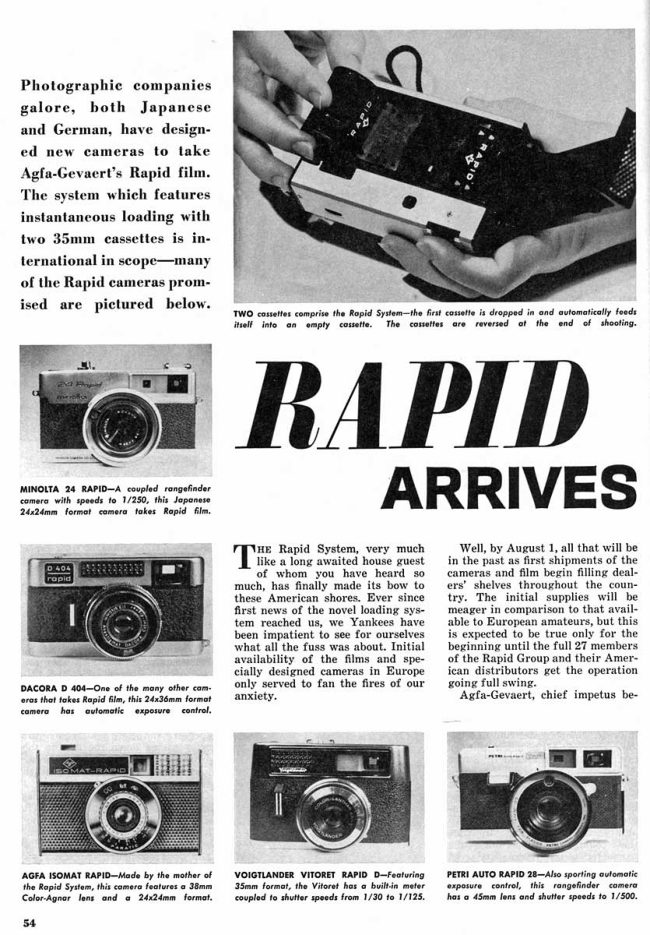
Photographie companies
both

and German, have design-

galore, Japanese

ed new cameras to take
Agfa-Gevaert’s Rapid film.

The system which features

instantaneous loading with
two 35mm cassettes is in-
ternational in seope—many

of the Rapid cameras prom-

ised are pictured below.

MINOLTA 24 RAPID—A coupled rangefinder
comera with speeds to 1/250, this Japanese
24x24mm format comera takes Rapid film.

DACORA D 404—One of the mony other cam-
eras that tekes Rapid film, this 24x36mm format
camera has automatic exposure control,

TWO cassettes comprise the Ropid System—the first cassette is dropped in and automatically feeds

itself into an empty cassette.

The cassettes

cre reversed at the end of shoofing.

RAPID

ARRIVES

HE Rapid System, very much

like a long awaited house guest

of whom you have heard so
much, has finally made its bow to
these American shores. Ever since
first news of the novel loading sys-
tem reached us, we Yankees have
been impatient to see for ourselves
what all the fuss was about. Initial
availability of the films and spe-
cially designed cameras in Europe
only served to fan the fires of our
anxiety.

Well, by August 1, all that will be
in the past as first shipments of the
cameras and film begin filling deal-
ers’ shelves throughout the coun-
try. The initial supplies will be
meager in comparison to that avail-
able to European amateurs, but this
is expected to be true only for the
beginning until the full 27 members
of the Rapid Group and their Amer-
ican distributors get the operation
going full swing.

Agfa-Gevaert, chief impetus be-

AGFA ISOMAT RAPID—Made by the mother of
the Ropid System, this comera features @ 38mm
Color-Agnor lens and a 24x24mm format.

54

VOIGTLANDER VITORET RAPID D—Featuring
35mm format, the Vitoret has a built-in meter
coupled to shutter speeds from 1/30 to 1/125.

PETRI AUTO RAPID 28—Also sporting automatic
exposure control, this rangefinder comera
has a 45mm lens and shutter speeds to 1/500.
View original page 1
Page 2 · Read text
FUJICA RAPID D-1—A motorized transport plus
@ 28mm lens makes this 24x24mm format cam-
era unique. It has automatic exposure.

hind the Rapid Group, will start the
ball rolling with two moderately-
priced cameras and three film emul-
sions: Agfapan Rapid ASA 200
black-and-white, Agfacolor Rapid
color negative film rated at ASA 40
and Agfachrome Rapid CT 18 ASA
50 transparency film.

However, at the recent IPEX
show in New York, numerous film
cartons from Germany, Japan, Eng-
land and Italy were on display along
with an overwhelming array of as-
sorted cameras from the camera
manufacturer members of the Rapid
Group. When and, even more im-
portant, if these films and cameras
are ever available here is the big
question; and one, I’m afraid, which
no one seems able to answer.

To understand the situation bet-
ter, a little bit of history will help.

RAPID FILM is standard 35mm size, but only
24 inches long. An inch of film extends from
the cassette, which, when the camera back is
closed, automatically feeds into the light-
tight take-up cassette. The film is backed
up by the camera pressure plate when exposed.

wos,

|

is

J KoONIcA

KONICA Rapid makes 12 exposures of full
frame (24x36mm), Camera features electric
eye. It will be avoilable here in early fall.

Back in September, 1968, the Rapid
Group and its intentions were first
announced. To those in the indus-
try, this appeared to be a direct
answer to the startling success of
Kodak’s Instamatie cameras on the
continent and England. Formation
of the group also made history be-
cause it was the first time that two
keen rivals, the German and Japan-
ese photographic industries, had
joined in a mutual venture. And, as
if to underline their determination
and cooperation, all members agreed
to share any Rapid developments
and patents with each other.

The European members include:
Adox, Agfa-Gevaert, Balda, Bilora,
Dacora, Ferrania, Ilford, Perutz,
Regula, Voigtlander, Vredeborch
and Zeiss Ikon. The Japanese ranks
are made up of: Asahi Pentax,

Lightproof Film Passage
—_ <a> Spool

Cassette Cover

ey I

_—

YASHICA HALF 17 RAPID—With a fost #/1.7
lens this holf-frame camera yields 24 exposures
instead of 12. It has an auto exposure system.

CANON DEMI-RAPID—Automatic exposure is @
feature of this compact 18x24mm format
camera with a 30mm lens ond speeds to 1/500.

AGFA ISOFLASH-RAPID—Providing @ 24x24mm
format, the Isoflash has a selenium exposure
meter fully linked to the diaphragm.

Canon, Fuji, Konica, Kowa,
Mamiya, Minolta, Miranda, Nippon
Kogaku (Nikon), Olympus, Petri,
Ricoh, Sankyo, Topcon and Yashica.
By July, 1964, six Rapid cameras
and sixteen Rapid films (seven
color, the rest black-and-white)
were on sale in Europe. As time
progressed, the number of cameras
and films increased. Even two non-
members, Rollei and Leitz, ex-
pressed interest in the system.
Briefly reviewing the system
since it is not really new to U.S.
Camera readers three important
features are stressed: drop-in load-
ing, no rewinding and quality re-
sults because a pressure plate is
used to hold the film plane flat. This
last point is a direct reference to
the Instamatic cameras and the
Kodapak cartridges which lack the
pressure plate method of holding
the film (Continued on page 80)

55
View original page 2
Related documents and language editions
From the M. Butkus archive. Original publisher and archive notices are retained.
Check the model and edition against your equipment.
PDF verified 2026-10-10.