Lenses & filters
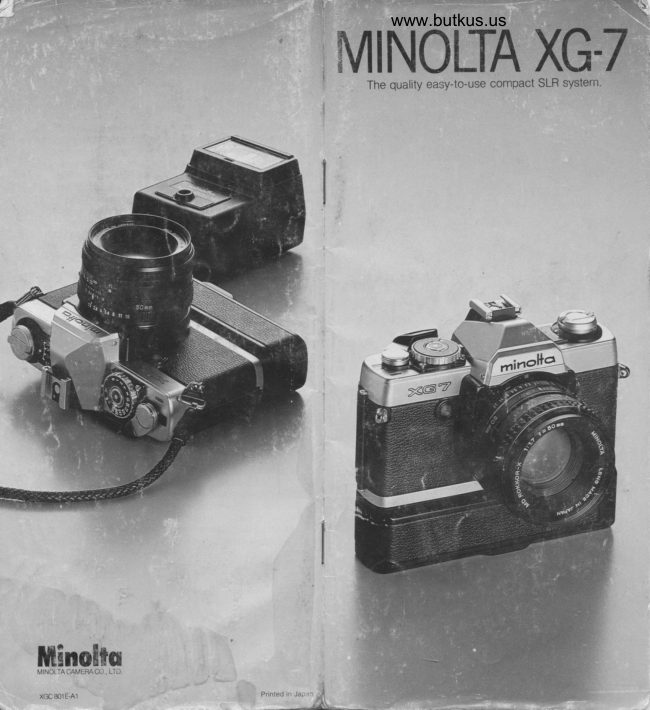
Minolta XG-7 guide, lenses, accessories Reference guide
Reference guide for Minolta XG-7 guide, lenses, accessories. 28 pages in English. Read the original PDF, download or print a copy without registration.
28 pagesEnglish7.3 MB PDF
Loading your manual…Open PDF directly
Document details
- Brand
- Minolta
- Model / document
- Minolta XG-7 guide, lenses, accessories
- Document type
- Reference guide
- Language
- English
- Pages
- 28
- File size
- 7.3 MB
- Category
- Lenses & filters
- Document date
- Not specified in catalog
Search available document text
Find a term, then jump to its page in the original PDF. Image-only pages may not be searchable; check the PDF for exact wording and diagrams.
Page 6 · Read text
www.butkus.us


        Electronlcs  at wqft insade th€ XG-7.                        You can even yary thg auto-gxpcure  setting.
       While you're concentrating on the enjoyment  of fine            You can add or subtract up to four times the "normal"
       photography,  information  processing  circuits in the XG-7                 light for out-of-the-ordinary shooting  situations and still
         will be computing light levels and cross-checking them              stay in the aulomatic exposure mode. This is
        to film speeds and lens openings. This information is                exceptionally handy for "bracketing". That's when you
        charineled to the electronically controlled focal plane               shool several pictures of the same subject at varying
        shutter  in the form of a shutter soeed selection                     exposures  to make sure you get that one exposure  that
      command.  All this happens in microseconds.                                  is the most flattering.
      The electronic information network can select the
       proper shutter speed from the XG-7's range of one               Manual expGur€ mode for tot8l control of every step.
      second to 1/1000th second. For instance, if light                From time to time, you might'want to pick aperture
        conditions  require a shutter speed of 1/675th of a                      settings and shutter speeds yourself. Drastically  varying
       second, that's exactly the speed that will be set. When                   light conditions or just plain experimenting requires a
         light is too dim or too bright tor the lens aperture you've          camera that lets you go off on your own. Not all
        selected, bright red triangles  will light up on top or               compact cameras allow  full manual control, but the
       below the shutter speed scale in the vieMinder. These            XG-7 does. You can start in the aulomatic mode to get
       are signals to change to a smaller lens opening  if the             an idea of the correct shutter speed lor a given lens
        triangle  is pointing up or a bigger lens opening if the                 opening, then switch to manual to set your own
        triangle  is pointing down.                                            exoosure.
             lf light conditions are so bright that speeds higher than
      1n000th second are still necessary, the XG-7 will lock
       the shutter and prevent you from making an oVer-
      exposed picture. The electronics that do this also lock
       the shutter to prevent poor exposures when battery
      power  is too low or when the camera main switch is in
       the OFF oosition.


\"                                                I
View original page 6Page 7 · Read text
The XG-7 viewfinder:
 control center for tine photogrcphy.


                                                                        Let your finger rest on the XG-7's operating button and
                                                           something incredible happens. The transient electricity
                                                                             that's pulsing across your finger completes the circuit
                                                                         that controls the meter. You don't have to apply any
                                                                    pressure to see the bright LED's in the finder come to
                                                                                                           life, showing exactly what shutter speed the XG-7's
                                                                      electronics are selecting. Gloves? No problem. lf some
                                                                                article of clothing comes between your finger and the
                                                                 operating button, a very slight pressure  will activate the
                                                            XG-7's systems.  Slightly more pressure on the operating
                                                                 button and the exposure  is made. No jarring. No blurred
                                                                     pictures caused by jabbing fingers.


              O Sdifimage/microprism  focusing spol.
              O Shuner speed scale.
              O LED shutter soeed indicator shows soeed
                                 being set automatically.
            O LED overexposure  warning.
              O LED undetrexposure warning.

 Focusing, composing and monitoring exposure are
effortless as you look through the XG-7's bright
viewfinder.
The combination  split-image/microprism center spol
makes even the most crilical focusing a snap, while an
overall fresnel screen assures corner-to-corner
brightness. At the mere touch of your finger to the
XG-7's operating  button, the metering system is
activated. A red LED lights alongside the shutter speed
being set automatically, from 1 to 1/1000th second. Two
triangles are ready to warn against over or under-
exposure,   lf the top triangle lights, the XG-7 will lock
rather than take an over-exposure.  And, if the Auto
Electroflash 200X is mounted and fully charged, an LED
will pulsate next to 1/601h of a second. This exclusive
Minolta feature means you never have to look away
f rom the finder to see if the flash is readv to fire.
View original page 7Page 9 · Read text
The Minolta Auto Winder G.
 For automatic lilm advance and
 exciting seguence photography.


                                                                micromotor inside will outperform bigger, more
                                                                     exoensive winders and at the same time use less
                                                                     power.

                                                                 Attaches in seconds.
                                                            The Auto Winder G quickly attaches to the tripod socket
                                                                            of the XG-7. All electronic connections are made
                                                                       automatically as you attach the winder. There are no
                                                        caps lo remove, store or hunt tor later on.

                                                                Forr penlight batleries shoot up to 150 rolls.
                                                                       That's 36-exposure  rolls we're talking about ... up lo an
                                                                                 incredible 5,400 pictures. Hi-energy Ni-Cd (nickel
Shoot two-frames.per-second  sequences or individual            cadmium) batteries let you shoot this much and then
shots.                                                           recharge in hours, indefinitely. Alkaline batteries shoot
Press the XG-7's operating button and let go. The Auto              up to seventy rolls.
Winder G will advance the film immediately  after the
shutler closes, so you're instantly ready for the next                  Film protection shut-ofl.
picture. Or keep your finger on the operating button and           When you've reached the end of a roll, the motor will
the shutter  will keep operating and the film will continue                automatically shut off without damaging the film. At the
to advance to give you dramatic sequences  at up to two           same time, a bright LED will glow sleadily to inform you
frames per second. A bright LED on the back of the                     thal the full roll is exposed.
Auto Winder G flashes each time an exposure is made.
Conpact and lightweight.                                         Flash synchronization.
The Auto Winder G was designed to match the compact           Team the Auto Winder G with the Auto Electroflash 200X
size and superior balance of the XG-7. Together they                and you can take electronic flash pictures at Auto
make one of the lightest and smallest camera/winder               Winder soeeds.
teams in SLR photography. Yet the new coreless
View original page 9Page 11 · Read text
Relinements that make the XG'7
easier and mote rewarding to use.


Minolta bayonet lens mount.
All Bokkor, Rokkor-X and Celtic lenses, including the
new N,4D Rokkor-X lens series fit with the same single,
fast twist. No realignment techniques or adjustments
are ever necessary. The rugged Minolta lens mount will
provide years of Precise servlce
Oversize front mounted LED self-timer.
Move the main swltch to self-timer and depress the
operating  button. lmmediately, a bright red LED  will
begin to blink silently on the lront of the camera The
electronic selltimer delays release for len seconds, but
as it aooroaches release time  it wlll begin to blink at a
faster pulse. Nol only does  it allow lime for you to get
into the picture, it tells you  if you have time to smile. At
any time during the ten seconds, you can cancel the
self-timer sequence  by turning the main switch to OFF

Convenient main switch.
The cenlral main switch is located on the XG-7 top left
side, where you can reach il easily. SELF-TIMER'  OFF'
ON and B.C. (for battery check) are clearly marked.
Each position is also equipped  with a detent to keep the
wrong position lrom being selected and to make sure
everything  stays in Your control.

Safe-load signal.
To let you know that the film is loaded correctly and
advancing  without problems, there is a safe load signal
to visually confirm proper  film advance.  lt is located in
front of the {ilm advance lever.

Remote conlrol socket.
This socket accepts an electronic remote conlrol cord
that lets you release the shutter on lhe XG-7 from as {ar
as 16.7 feel away.  lt activates the electromagnetic
release  for smooth vibration-f ree shots. This is critically
imporlanl for close-up and long lens shooting.
Standard mechanical cable leleases can also be used
in the same socket.
View original page 11Page 12 · Read text
www.butkus.us


 r2EV overrundet expcutE confol.
 There  will be times when you'll wish to vary the
 aulomatic exposure settings to compensate for unusual
 or complicated lighting siluations or for dramatic effect
 and emphasis in "average"  light conditions. YoLt can do
 this by using the over/under exposure override.  lt
 electronically instructs the XG-7 shutter to add or
 subtract light in the sleplessly variable amounts you
 select up to 12EV (equivalent to two full lens openings
 or shutter speeds).
 It's easy to do. Just depress the Auto setting release
 button and align the letter A with + 2, + 1, -2, -1 or
anywhere in betlveen.

Fllm advance levor.
The film advance lever is exceplionally smoolh and tree
from the grinding noises associated with many of the
compact 35mm SLR cameras.  lt provides a fast 130o
stroke with 30o offset for rapid access to the lever.
The lever tip is carefully sculptured to match the
conlours of your thumb for comtortable operation.

Inlogr.ted shutter sp€od, tunctlon  selector and
oloc{romagnotlc teleasa
The shutter speed selector allows you to switch from
manual to automatic mode by rotating the rlng in any
direction. You can go from A (for aperture-priority
automation) to 1/1000th second or to B (for time
exposures)  with a single motion of your index  finger.                                                                                                 DigitallyDN: cn=MikesignedButkus,by Mikeo=ButkusButkus camera manuals, ou=butkus.org,
                                                                                                                                                                           email=mike@butkus.org,                                                                                                                                                                       c=USIn the center of the shutter speed ring is the operating Mike Butkus                                                                                                                                                                                        Date: 2024.03.18 14:09:13
button lt's an electromagnetic switch that provides                                                                                                                               -04'00'
vibrationless operation with only the smallest amount of
contact from the tip of your finger to activate the
metering system and slight pressure to make the
exposure.
View original page 12Page 13 · Read text
Memo holder.
 It's always handy to have a reminder of the film you're
using. Jusl tear off the end of the film box and slip  it
into the convenient memo holder. lt's an ideal place to
put filter notes or any other information you want to
reler lo. For your convenience when traveling abroad,
there's a DIN/ASA conversion table mounted inside the
memo holder as well.

Oversize,  quick- return mirror.
The reflex mirror in the XG-7 is large enough to provide
exceptionally bright images edge-to-edge, top-to-bottom,
even when using extremely long lenses or high
magnification close-up equipment for
macrophotography.

Hol shoe.
The accessory bracket on top of the XG-7 pentaprism  is
equipped  with a hot shoe and a unique shutter control
that allows the Auto Electroflash 200X to set the shutter
to ihe synch speed (1/60th second) automatically.  lt is
designed for X synchronization so no other adjustments
are necessary. With the Auto Electroflash 200X or other
hot shoe fiashes attached, no cables are needed. Units
that require connecting cords can be used with the
built-in PC terminai
View original page 13
Page 14 · Read text
www.butkus.usTech nical Specifications


xG-7                                      AUTO ELECTROFLASH  2OOX
 Type: Compact 35mm SLR with automatic and full manual                   Type: Cligon auto/manual  series-SCR  electronic flash unit with
 exposure  conlrol                                                           camera-control provision
 Lens mqrnl: lvlinolta SLR bayonet (Standard  lenses: 50mm                 GuiJe numb€r          Feel, ASA 25      Meters, ASA 100'
 Ih.4 or 11.7 tvlD RokkotrX)                                    Automatic           Up to 33         Up to 20
 Aulo-exp6urs range: EV 2 to EV 17 at ASA 'lOO with fi1.4                 Manual "Hi"           33                20
 lens                                                                                l/anual "Lo"          12                 7
 Shutler:  Horizontal-traverse   focal-plane type, with                              Sync. contacl: Hol shoe only
 electromagnetic release. Exposure system automatically                     Piler sdrce: Four M-size (penlight)  cells
 prevents  shutter release when speed required  for proper                    R*ycling  timel                               1.2v 450mAh
ex@sure is over 1/10001h sec.                                          No. of bursts:    1.5v sealed   1.5v alkaline-  nickel
Shutter speods. 1/1000th  to 1 second steplessly on automatic                                  carbon-zinc manganese  cadmium
mode or in steps on manual mode                                       Auto operation*  0.5-6 sec.    0.5-5 sec./  0.3-3 sec./Metering:             Full-aperture                           through-the-lens                                       centetrweighted                                                                   type,                                                                                                70-600    300-2200 100-650
by two CdS               cells. Film speed                                range: ASA                                  25 to 1600. Auto-                                                                         Manual operation*
ex@sure  adlustment: Up to r2EV                                                "Hi" 6 sec./70  5 sec./300 3 sec./1 00
Mirror: Oversize quick-return type                                           "Lo" 1 sec./400 -1 sec./1600 0.5 sec./500
Viswfindor:  Eye-level     f ixed FEntaprism  type. Mat-Fresnelfield                 No. ol bursts
focusing  screen with central horizontaily  oriented  split-image               wth wrnder'  '
focusing  spot surrounded  by microprism band; stepless speeds                      "Lo"                       more than 40 at
 indicated by 10 light-emitting  diodes; LED over/undetrrange                                                       2 fps
indicators, LED at "60" position  blinks as flash-ready signal  in                     .  with fresh or fully -charged cells (as determined by Minolta's
auto or manual mode with Auto Electroflash  200X.                               testing method)
Fhsh contacl: X contact: 1/60th second "X" and slower speeds                   .. depending  upon subjects distance and flash setting
rc terminal and hot shoe                                                   AperturerDistance range:
Film                     l\,lotorized:                                   Winder     adyance:                        With                           Auto                             G                                                                                                                                   Subject                                                                                                                                               distance                                                                              400                                         ASA                                                               100                                                       25  50                                                                   200
 N/lanual:       BV lever               advance                           with                                         stroke with                                              1 30'                                             30' offset                                                                                                              3'3"-23'0-7m)                                             Red  1.4                                                           2                                                                            2.8                                                                    4                                                                                      5.6
Pfler sourco: Two 1.5v silvetroxide  cells, Eveready 5-76 or               Yellow 2.8  4   5.6    I   11  2' 3111'(0.7-3.5m)
equivalent                                                                Flash duration:
Others: LED indicated  self-timer, memo holder, safe load signal               Automatic: Approximately  1/40000 to 1/1000 sec.
and ASA-DIN conversion scale                                                              l',4anual: "Hi" Approximately 1/1000 sec.
Size and weighl: 2x3-7116 x 5-5/8 inches (52 x 88 x 138mm),                      "Lo" Approximately  1/6000 sec.
 1 7-1 3/1 6 ounces  (5059) without lens and power  cells                     Cderage: 45' vertically, 60' horizontally
Acce$ai€s: Auto Winder G, Auto Electrollash  200X,                         Sensor anglo oa acceptance: Approximately  20'
RemoteCordS&L                                                              Size and wefghi: 2-3h6 x 2-314 x 3-9i  1 6 inches (56 x 70 x
                                                               90mm); 7-3lB ounces  (2109) without cells
AUTO WINDER G
Type: Automatic film winder for lvlinolta XG-7
Winding time: Approximately  0.4 seconds
Winding sp€€d: Up to 2 lps.
Pfler source: Four 1.5v M-size (penlight)  cells
Drivg molor: Coreless-type  micromotor
Winding capacity: Successive  36 exp. cartridges
                Sealed carbon-zinc: approximately  50'
                    Alkaline-manganese:   approximately  70'
                 Nickel-cadmium: approximately 1 50*
'as cletermined by Minolta's testing method
Sho.nd  ureight: 1-3/8 x 1-7116 x 5-7116 inches (35 x 37 x
138mm);  7-318 ounces  (2109) without cells                                          Specificatim  subje€t to change  wilhqrt notice
View original page 14Page 18 · Read text
www.butkus.us35mm frl.8 MC w Rokkor-x
Construclion: I elements  in 6 groups
Angle of view: 64'
Min. focus distance: 0.3m (1ft.)
Filter thread diameter:
        55mm
Diaphragm:  Auto preset
            f/1.8-f/16


50mm  lr'1.7 MD Rokkor-X
Conslruclion: 6 elements  in 5 groups
Angle of view: 47'
Min. focus distance: 0.45m (1.47f1.)
 Filter thread diameter: 55mm
 Diaphragm:  Auto preset
            il1.7-1116


50mm lrl,4 ItD Rokkor-X
Construction:  7 elements in 5 groups
Angle ol view: 47'
Min. locus distance: 0.45m  (1.47f1.)
 Filter thread diameter: 55mm
 Diaphragm:  Auto preset
           It1.4-1116


58mm  tr'|.2 MC Rokkor-x
 Construction:  7 elements in 5 groups
 Anole ol view: 41o
 Min. tocus distance: 0.6m (2ft.)
 Filter thread diameter: 55mm
 Diaphragm:  Aulo preset
             fl1.2-il16
View original page 18Page 23 · Read text
Minolta rceltic Lenses  :
Ouality Optics at a Popula. Price


 23mml'24VOMINOf-r,.f(TlC                                                             ,,,       .,1"    o6ar.475-^      2tA9.8,.o/r
                  s/5  63'   ,rr  er  !f!]i      iit:".,
MO MINOLTA/CELTIC          atl    ft.   sr  z  !,61|;   f,q9,,,..,
lr3ilR3iio,"..r," 4/4 ,8.  srr rz frr6!|i  ir,o!rr,,-,
i,8ili131ro,"..,,"  5t5 12.3a en ra f$aj|  irPo%u,,-,
 l$.'Sfri,1fr3.ro,"..r,"  at 24. 12.3a sr  12 if33;;  iiil9.,,.".,
ffJ'lfot6t"uou,"o..o,",.r,"(Ava'able'nUSA    onlv)     u,  c6.  e n  ,r, &u!i,i- it'I.-,


2gmm 112.8 MD Minolla,Celtic
Construction: 7 elements in 7 grosp5
Angle of view: 75'
N4in. focus distance: 1 ft.
Filter thread diameter: 55mm
Deaphragm: Auto preset


ffi:;,fffi'*i:*.D iaph ras m  ;
            l;t"uyl", i)  @ D   i/         i-',   ri\il ffilnn&ffiffr_tr   l'r   ''-       ,',1,':                       'E-ftI   ,
View original page 23Page 25 · Read text
The Minolta XG-7 system is as easy and
 versatile as the camera.


The system behind the XG-Z  is as advanced as the
camera  itself.
Besides the unique Auto Winder G and the Auto
Electroflash 200X, the XG-7 will accept some of the
most sophisticated close-up, macro and copying
equipment ever made.  lt includes a range of |\,4inolta
electronic flash units that cover the needs ol the most
critical prolessionals and the occasional picture taker as
well.  |\,4inolta  light meters are generally acknowledged
as the first choice among c.reative and demanding
prolessionals. But the same care and attention to detail
is found in the smaller accessoriest the filters. the
eyepiece correction lenses, the cases and on
throughout the hundreds of components in the Nilinolta
system.
View original page 25
Page 26 · Read text
www.butkus.usTube Set llAulo Bellows  I                                               Extension
  Atlached to a Minolta SLR camera, this deluxe double                 This set of five separate tubes can be used in various
track bellows provides calibrated exlension between lhe              combinations  for closeup photography with Minolta
lens and Jilm.  lt features an aulomatic diaphragm                     lenses. Funclton ot the tubes is to increase
coupling device and attaches lo lhe camera body in the               magnification by lengthening the lens{Gfilm  distance.
same manner as a lens. used with the standard 50mm           When used with Minolta SLR cameras, no
Rokkor-X  lens, the Auto Bellows  I permits continuous                compensation for exposure is necessary since exposurg
magnification from 0.75X to 3.'10X.                                   readings may be taken through the tube and lens
                                                                    combination.


                                         MC Auto Extension Tubes
                                                         Added versatility is the key feature of the MC Auto
                                                                         Extension Tubes. Full aperture meter coupling  is
                                                                   automalic with all Minolta meter-coupled lenses.
                                                        Use of the tubes singly, or interlocked in various
                                                                combrnations of the 14mm, 21 mm and 28mm lenoths
                                                                    gives magnitication of approximately 0.27X lo 1.351 with
                                                         a slandard 50mm lens. Each tube has a Minolta
                                                               bayonet mount on one end and a matching receplacle
                                                         on the other. This all bayonet syslem makes for fast,
                                                            easy attachmenl and change

Bellows lll
   Reasonably  priced, compact and lightweight, this
Bellows performs many of the same funclions as the
Auto Bellows L Magnifications between 0.70X and 3.14X
can be obtained with the Bellows  lll and a 50mm lens.


                                                          Close-up Lensos
                                                           These lenses screw onto Minolta lenses with 52mm
                                                                        or 55mm  filter mount diameter to permit focusing at
                                                           closeup distances. Lens No. i and 2 mav be used in
                                                                 combination to allow work as close as glnches from
                                                                     the subject. Lens No.0 is for use on telephoto lenses.


                                                                                        47
View original page 26Page 27 · Read text
\
Auto Electrotlash 450                                     Auto Eloctrotlash 32 and 28
  The versatile 450 yields a maximum guide number of             Compact cordless/corded units with guide number of
72 (Ieel a1 ASA 25; 45 meters, ASA 100). The wideangle           32 and 28 (in meters at ASA 100, 52 and 46 in feet at
drffuser covers the field of a 24mm lens. Perfect              ASA 25). Both units provide automatic tlash exposure
exposure is assured with choice of 5 apertures on any            even with bounce operation. Auto Electroflash 32 has an
setting, and optional automatic bounce/off{amera   flash.              illuminated control dial and can select two dilterent
The 450 is powered by alkali-manganese batteries, or                apertures. Optional Ni€d battery cartridge, Charger and
optional rechargeable Ni€d battery cartridges.               AC adatoer are available.


Auto Electrollash 2E0                                     Auto Electroflash 25
  The 280 yields a maximum guide number of 46 (feet                This compact cordless/corded unit with max. guide
at ASA 25; 28 meters, ASA 100). The series-thyristor             number of 41 (teet, ASA 25;25 to( meters, ASA 100)
circuit gives shortest recycling time and maximizes                  slides into the hot shoe on Minolta SLR cameras and
flash-use per battery.                                     makes completely automatic electronic flash exposures
   Automatic direct/bounce flash exposure is featured  in           by means of a buillin sensor or can be used as a
the 280, covering the field of a 35mm lens. Poiver                  conventional non-auto  unit. Recycling is indicated by a
sources are alkalFmanganese  or rechargeable Ni{d               monitor lamo.
batteries.


                L
View original page 27Page 28 · Read text
www.butkus.usCopy Standard ll                                              Magnifier V
   ihis rigid camera support assures maximum stability                This is a useful tool for precise Jocusing when making
in all photomacrography, and is highly recommended for            photomacrographs, copying and taking distant telephoto
copying flat or thre+dimensional  materials.  lt features a              pictures.  11 features an adiustable eyepiece and a 2.5X
heavy duty l'rlrx 17t1, inch baseboard and a 2+inch                magnilication power, and can be focused for indivrdual
chrome tube to provide secure support for camera and                eyesight.
macro equipment.
                                                         l6gle Finder V B
                                                                     This eyepiece altachment permits viewing wilh lhe
                                                         camera held below the eye. Focusing may be made
                                                               from any position as the finder can be rotated in a full
                                                                                 circle and a right-way-round image can be achieved.
                                                       The eyepiece is adjustable for individual eyesight.


                                                       Panorama Head  ll
                                                         The Minolta Panorama Head  ll is specially designed
                                                                            to be attached belween a Minolta singl+lens-reflex
                                                         camera and a tripod for photographing panoramic views
Microscope Adapter                                       up to full 360' in a sequence of photos that can be
   This twopiece devtce is used to connecl Minolta SLR          matched accurately.
cameras to a mlcroscope.
One section bayonels into the camera body in place ol
the lens while the other end fits into lhe ocular adapter tube seclion ol the microscope. Taking       o
 photomicrographs is easy with this adapter because you
can lollow moving specimens up to the precise moment
 of exposure.
                                                             Eyepiece Corector vil
                                                                 Focusing aid for far and near-sighted photographers
                                                                                       is provided by these special lenses which snap into the
                                                                                                                                                                                             f rame of the eyepiece. Minolta makes nine difference
                                                                        diopter strengths, from -4 to + 3.
                       EIEI EI EI
                                    trl trl trl trl trl
                                                            )
View original page 28Related documents and language editions
From the M. Butkus archive. Original publisher and archive notices are retained.
Check the model and edition against your equipment.
PDF verified 2026-10-10.