Film cameras
Miranda Pop Photo REVIEW User manual
User manual for Miranda Pop Photo REVIEW. 1 pages in English. Read the original PDF, download or print a copy without registration.
1 pagesEnglish0.1 MB PDF
Loading your manual…Open PDF directly
Document details
- Brand
- Miranda
- Model / document
- Miranda Pop Photo REVIEW
- Document type
- User manual
- Language
- English
- Pages
- 1
- File size
- 0.1 MB
- Category
- Film cameras
- Document date
- Not specified in catalog
Search available document text
Find a term, then jump to its page in the original PDF. Image-only pages may not be searchable; check the PDF for exact wording and diagrams.
Page 1 · Read text
TYPE: 35mm eye-level single-tens reflex.
LENS: 50mm f/1.9 Auto Miranda, with
interchangeable bayonet mount, stops
to f/16, and focusing to 17 in,

SHUTTER: Cloth focal-plane with speeds
from 1 to 2/1000 sec. plus B and

FP, X sync.

VIEWING: Interchangeable prism and
screen, with full focusing screen, cen-
tral and fine focusing collar.

OTHER FEATURES: Instant-return mir-
ror, quick-return diaphragm. depth-of-
field preview lever, selftimer. Through-
lens TTP meter measures entire picture
area at shooting aperture,

PRICE: $229.95.

MANUFACTURER: Miranda Camera Co.,
Ltd., Tokyo, Japan. IMPORTER: Allied
Impex Corp. (interstate Photo Supply),
300 Park Ave., New York, N.Y. 10010.
PHYSICAL DIMENSIONS: 534 in. long,
3% in, high (maximum) and 314 in.
deep (from front of lens to camera
back). WEIGHT; 1 Ib. 24 oz.

No sooner had the Miranda G made
its place in the budgetpriced A, B,
C, T, D, DR and F camera line than
it was capped with the new through-
lens TTP metering system and emerged
as the GT. But first, what makes the
G model a G model? Basically here
are the changes over the F: beefed
up winding mechanism, double safety
catch on the swinging back, inter-
changeable focusing screens, mirror
lockup fever and modified instant-
return mirror made longer to prevent
edge light loss with long lenses.
There's also a provision for installing
@ rather complicated and awkward
coupled meter to the shutter-speed
cial but with the new TTP meter
(available, incidentally, for all older
models mentioned at $59.95) who
needs tha old? And so. let's take up
that new metering system:

The prism housing's flat top is ac-
tually no higher then the regular Mi-
randa prism's pointy top—that’'s
quite an achievement.

The meter integrates ali the tight
from the entire finder area, is not
coupled to the controls and has its
pointer on top af the prism housing.
Here's haw It works:

Set the ASA film index on the cal-
culetor diai (15) opposite the maximum
aperture of the lens you're using.
Now frame your scene of that part of
the subject from which you want a
meter reading in the finder. Push in
the small fock button at the left side
of the meter housing (17) and let it
go. thus locking the needia In place.
Now you can take the camera from
your eye and align the aperture scele
on the diel opposite the pointer. The
red pointer on the opposite side of the
dial (16) will indicate the right shutter
speed for that aperture.

When using bellows units or other

Decemuen, 1968

35mm Focal-Plane Shutter Reflex

Miranda GT

Optical. accessaries, you line up a
red dot apposite the ASA scale for
your film and read the right exposure
opposite a red arrowhead,

in our tests with the Asrotronic
P-BO3 exposure meter tester, we found
‘that the TTP meter wes accurate within
I f/stop of a known light source
over its entira range down ta what we
judged to be its lowest reading poten-
1/19 ot 1/30 sec, with a film
@ an ASA speed of 400. If your
eyesight is keen and you interpolate
between marked numerals, you can
probably get half-stop readings as weil.
The diminutive size of the meter

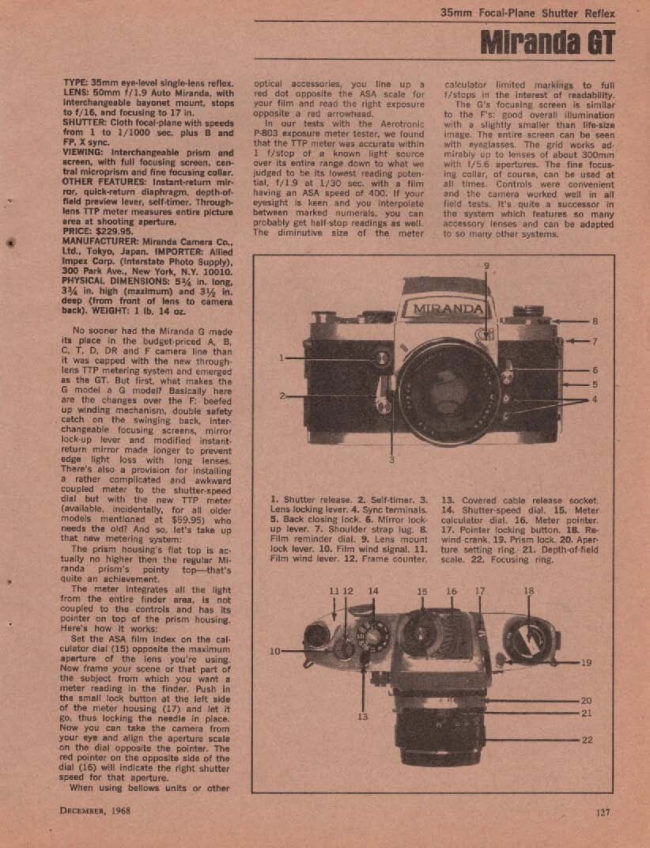
1, Shutter release. 2. Seif-timer. 3.
Lens Jocking lever. 4. Sync terminals.
5, Back closing lock. 6. Mirror jook-

up lever. 7. Shoulder strap lug. &
Film reminder dial. 9. Lens mount
lock lever. 10. Film wind signal. 12,
Film wind lever. 12, Frame counter.

1212 «14

calculator limited markings to full
f/stops in the interest of readability.

The G's focusing screen is similar
to the F's: good overall illumination
with @ slightly smatler than life-size
image. The entire screen can be seen
with eyeglasses. The grid works ad-
mirably up to lenses of about 300mm
with [/5.6 apertures. The fine focus-
ing callar, of course, can be used at
all times. Controls were convenient
and the camera worked well in all
field tests, It's quite a successor in
the system which features so many
accessory lenses and can be adapted
to so many other systems.

13. Covered cable release socket.
14, Shutter-speed dial. 15, Meter
calculator dial. 16. Meter pointer.
17. Pointer focking button. 18. Re
wind crank, 19. Prism lock. 20, Aper-
ture setting ring. 21. Depth-of-tield
scale. 22, Focusing ring.

16 (7 18

127
View original page 1
From the M. Butkus archive. Original publisher and archive notices are retained.
Check the model and edition against your equipment.
PDF verified 2026-10-10.