Film & darkroom
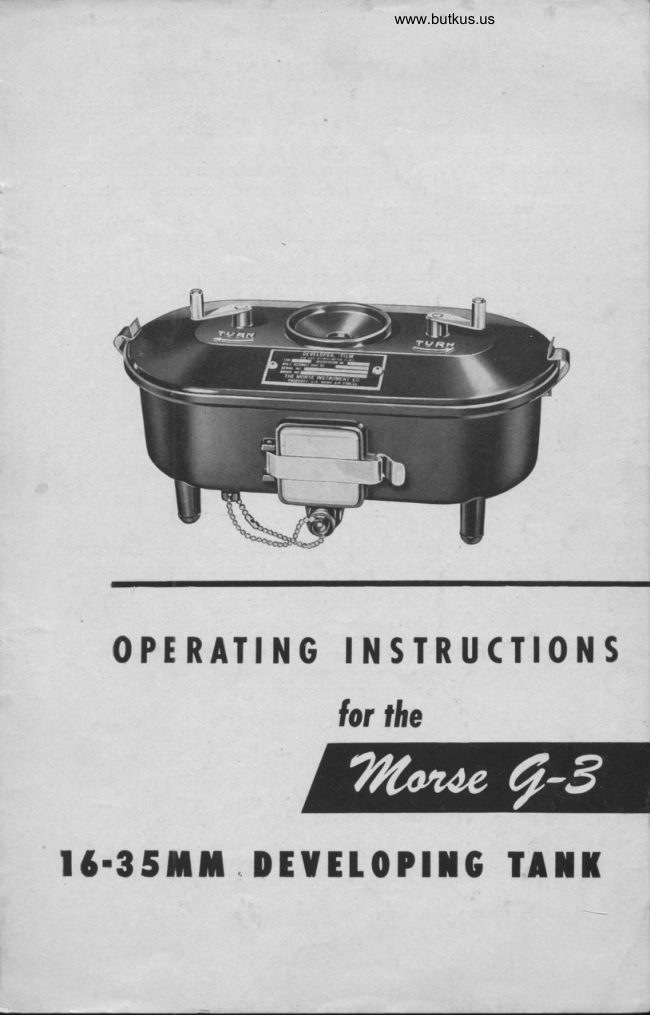
Morse g-3 developing tank User manual
User manual for Morse g-3 developing tank. 8 pages in English. Read the original PDF, download or print a copy without registration.
8 pagesEnglish1.2 MB PDF
Loading your manual…Open PDF directly
Document details
- Brand
- Morse
- Model / document
- Morse g-3 developing tank
- Document type
- User manual
- Language
- English
- Pages
- 8
- File size
- 1.2 MB
- Category
- Film & darkroom
- Document date
- Not specified in catalog
Search available document text
Find a term, then jump to its page in the original PDF. Image-only pages may not be searchable; check the PDF for exact wording and diagrams.
Page 2 · Read text
OPERATION
  The G-3 Developer is a manually operated mechanical
device for processing Double B,16 and 35 mm. morion picture
film. Film o"...ay be processed to a negarive or may be reversed
to a positive. However, reversal processing is more difficult.
Formulasr                  temperatures,      .otrditions of the process          -timing,                           "ndmust be followed closely.
  During the processing, the crank should be turned about
twice a second. This will pass 100 feet of film from one reel
to the other in approximately one minure. Care nzust be taken
to auoid clitccbing the film at tbe end of eacb pass, and if ltec-
essary, crank-ing speed reduced.
          TOADING
   | , Remove the tank cover and reels, making sure the window
      is in front or facing the operator.
 2. Adjust the plate on both reels to the proper width for the
    film to be used.
 3. In total darkness, place the filnc spool on the right hand
    spindle so that it will unwind counter-clockuise.
 4. fnsert the end of the film in the left han d reel. To insure
     straight winding give the reel rwo turns clockwise before
    clamping the end. This is the only time that the rwo
    spindles revolve in opposite directions. The loading is
    performed in this manner so that the film will be wound
    on the reel, etnulsion si.de out. (SEE FIGURE l.)


                                   www.butkus.us

        FIGURE T                                 LOADING


                                   Page 2
View original page 2Page 4 · Read text
dye coating. This silver backing is removed by the bleach used
in reversal processing, but is not affected by the ordinary nega-
tive processing baths.
      A. Deueloping
  | . A medium contrast developer is recommended, Kodak D-L9
   or equal. No preliminary soaking is required. The devel-
   oper should be poured fairly rapidly into the funnel top.
 2. Vind the film through once as rapidly as possible, but
    avoid clinching at the end of the pass. Continue winding
    until development is complete.
 3. Approximate developing time in this style developer at
    21.1" C. (20'F.)  is:
      Class A (Eastman Super X or Dupont 3L4 Superior
           pan)-50 ft., 8 minutes; 100 ft., 13 minutes.
      Class L (Eastman Super XX or Dupont 301 Superior
           pan)-50 ft., 10 minutes; 100 ft., 15 minutes.
      B. Rinse
 l. After developing, either a water rinse, a dilute acetic acid
    rinse, or a hardening stop-bath may be used. A thorough
    rinse is necessary to remove the black backing.
2. If difficulty in removing the backing is encounrered, the
    roller behind the window should be replaced with a piece
   of cellulose sponge of about the m-e dimensions. Atry
   backing not removed during the process can be removed
    afterwards by sponging the back with a weak aceric acid
    solution
      C. Fixirtg
  Film is fixed in an ordinary acid fixing bath solution. Fix
for twice the time required to clear. (Approx. l5 minutes.)
     D. Vasbing
  Cranking must continue while the film is being washed.
Vash for 1 5 to 3 0 minutes, either in running water or by
changing the water several times. Running water trray be sup-
plied through the funnel top or through the drain by means
of a small hose of equal size to the stopper opening.
      E. Drying
  Film may be dried on a Morse M-30 film dryer or impro-
vised drum or racks. Dry with the emulsion side out


                                      Page 4
View original page 4Page 5 · Read text
www.butkus.us

     REVERSAL PROCESSING
                                            negative process- . R.tgtsal .processing is more critical than                                       times rnJ t.-pJrrtrrr.r. ils. There is less latitude in processing variations in remperarures, of as little as 1.1" c. (zo F.) may
cause failure. Methodical procedure is also important and it
 rnay be necessary to vary tlie timing ro .o*p.niate for slight,
but constant variation in individual procedrire.
     A. First Deueloper
 1. First developer Kodak D-19 or equal, plus 29 grains of
   Sodium Sulfocya nate OR 3 6 grains of Potassium Thiocy-
   nate added to each 32 ounces of wate r, add developer as
    rapidly as possible through vent in rop. Developer Jhould
                                                                                   .   be 21.1 ' C. (20' F. )
2. Vind through once as rapidly as possible but, auoid clincb-
     irtg at the end of the pass.
3. Developing time at 21.1" C. (70" F.), as follows:
            25 ft.   50 ft.     7i  ft.   100 ft.
      Class A
      Class L  10 min.  15 min.  19 min.  2i min,
      Class A films include Eastman Super X, Agfa Hypan,
      Dupont 314 Superior pan.
      Class L films include Eastman Super XX, Agfa Triple S
        pan, and Dupont 3 01 Superior pan.
4. Temper2sul's-Jime Charts may be followed when lower
   temperatures are used.
     B.  Rinse
 t. After development, either a water rinse, a diluted acetic
    acid rinse, or a hardening stop-bath may be used. A thor-
   ough rinse is necess ary to remove the black backing.
2.  If difficulty in removing the backing is encountered the
    roll behind the window should be replaced .with a piece
   of cellulose sponge of about the same dimensions. Ary
   backing not removed during processing can be removed
    afterwards by sponging the back with a weak aceric acid
    solution.
3. For Super XX film, rinse until the drain water conrains no
   more black backing.
4. The rinse should be 21.1' C. (70 F.) or lower.


                                   Page 5
View original page 5Page 7 · Read text
www.butkus.us

       G. Re-Deuelopwent
  1 . close the window and re-develop in Kodak formula D-72
     or equal diluted according ro instructions on package.
 2. Re-develop to completion, about 5 minures at 2l.lo C.     (70' F.)
 3. The edge will completely blacken when re-development  is
    complete.
      H. Rinse, Fix, Vasb, and Dry
   These steps are the same as the iinal sreps of negative
 processlng.
NOTE:
  The bleach and firsr developer should be held at 2r.r" c.
 (20" F.). The other solutions are nor so critical, a remperatvre
                      21.1" C. (6i" to 70" F.) being-permis-range of .t8.1' C. to sible. There is considerable danger of frillin g, jf the solution
 temperatures rise above 22.2o C. (72' F.).

               O
 PRECAUTIONS AND SUGGESTIONS
   Do not open developer or expose to white light until time
    to re-expose. Stains and veiled highlights will result.
 2. To insure complete bleaching, wind to extreme end and
    see that fogged end is r cornplete deep red-no remaining
   black. The same applies to clearirrgirrr" dim white light
    for this check.
3. The film must be bleached completely or solari zed image
    will appear.
4. The film must be rinsed thoroughly between bleach and
    clearing to remove all excess bicromate. If rhis is not done
    the sulfite will be consumed in neurr alizing the bicromare,
   and incomplete clearing will result.
   The film must be completely cleared. If not, an orange-
   yellow stain will result which cannor be removed.
6.  If trouble is encounrered in removing anti-halation dy.
   from the film backing, replace roller inback of re-exporrrt.
   window with a cellulose sponge.
THE MORSE INSTRUMENT COMPANY HUDSON, OHIO

                                      Page 7
View original page 7Related documents and language editions
From the M. Butkus archive. Original publisher and archive notices are retained.
Check the model and edition against your equipment.
PDF verified 2026-10-10.