Film cameras
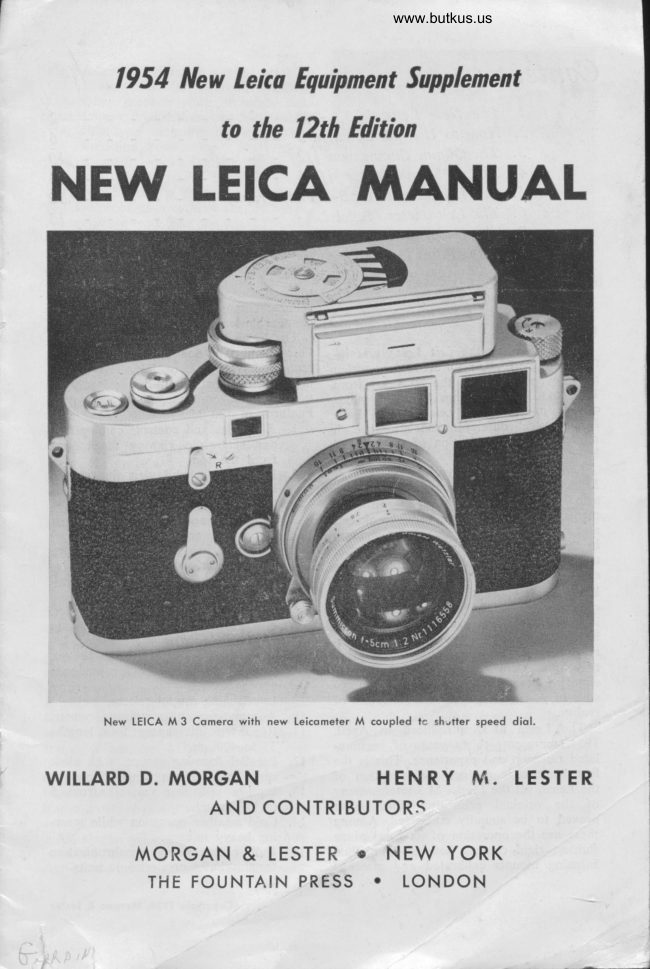
New Leica 1954 User manual
User manual for New Leica 1954. 17 pages in English. Read the original PDF, download or print a copy without registration.
17 pagesEnglish11.4 MB PDF
Loading your manual…Open PDF directly
Document details
- Brand
- Leica
- Model / document
- New Leica 1954
- Document type
- User manual
- Language
- English
- Pages
- 17
- File size
- 11.4 MB
- Category
- Film cameras
- Document date
- Not specified in catalog
Search available document text
Find a term, then jump to its page in the original PDF. Image-only pages may not be searchable; check the PDF for exact wording and diagrams.
Page 2 · Read text
Confients:
            1. The New Leica M 3                                 2
            2. How to Use the Leica M 3                            6
            3. The 50mm Summicron f/2                            10
            4. The l25mm Hektor f/2.5                               t1
                                         photography                    T2            5. The Leitz Stemar tor 3-D
            6. The Leicameter Model 2                               13
             7. The Underwater Housing                               t4
            8. Adox Films for the Leica                              15
                                           to each lens, forming a unit of extreme
                                                 accuracy; flange-to-flange seating of inter-          -f-                    changeable lenses, etc.
     THE TEICA M 3                          The Leica M 3 is a new member of the
       In 1924, when the first Leica was in-   Leica family and does not replace the cur-
      troduced, there was no precedent on which   rent models If, IIf, or IIIf. The camera
       to         ,base its design. In the 30 years from  now has built-in versatility previously at-     1924 to 1954 there has been no major   tained only through the use of accessories.
     change in the basic Leica. There have   Features of the M 3 are:
     been several difterent models, but each     1. All scales and controls can be read
     model was a modification of the original      and set while viewing the camera
       basic camera.                              from the top.
       During these thirty years thousands of    2. Range finder and view finder com-
     Leica enthusiasts, amateur and profes-       bined into one eye lens having
       sional, have voiced their praise und com-         brighter field.
      rnents. They stated thejr candid opinions     3. Coupled range finder of longer base
      and-offered many suggestions for changes         for greater accuracy.
      in the Leica which would better adapi  it    4. Both split-image and coincident type
       to_ their specific needs. Many suggesiions        range finder.
      offered were, in the light of ivailable     5. Automatic compensation for paral-
     knowledge at the time, mechanically or           lax.
      optically impossible. These thousands of    6. Built-in automatic universal finder.
     ideas were catalogued, none of them     7. All shutter speeds on one click-stop
      being overlooked. As new and better mare-           dial, set before or after winding. In-
       rials became available, as manufacturing         termediate speeds may also be set.
      techniques were improved and as knowl-     8. Built-in rapid winder for sequence
     edge progressed, the fantastic and impos-         photography.
       sible of yesteryear edged into the realm of    9. Interlocking shutter release.
        reality.                                  10. Automatic resetting exposurecounter.
      The Leica M 3, introduced in April,    11. Rapid lens interchange; focal lengths
      7954, represents thirty years of accumu-        35 to 400mm.
      lated research and experience. This is the     12.  Parallel focusing mounts with click
        first basic change since the inception of        stops and uniform flange diame'ters.
      the Leica, yet the N{odel M 3 retains many      13.  Built-in self-timer variable from 5
     of the original principles which have        to 10 seconds.
     proved to be soundly conseived. Among      t4.  Cold weather operation while wear-
      these are the operation of its focal plane        ing heavy mittens.
       shutter; rigid camera housing; individual      15. Full compensating synchronization
      focusing mounts calibrated and matched         for flashbulbs or electronic units.

     2                                                            Copyrighr 1954, Morgon & Lester

-   -r-                   r*
View original page 2Page 4 · Read text
Venmo @mike-butkus-camera  Ph. 2083
PayPal Name  Lynn@butkus.org      www.PayPal.me/lynnbutkus
View original page 4
Page 5 · Read text
One for the 90mm lenses
                                    One for the 135mm Hektor
                             The M 3 lenses in bayonet-type mount
                                         cannot be used on Leica cameras having
                                 a threaded lens flange.
                                          Lenses in short mounts for use in the
                                                 directly to the camera and coupling with
                                          the range finder are:
                                 35mm Summaron f/3.5
                                 50mm Elmar f/3.5
                               50mm Summicron f/2
                               50mm Summarit f/1.5
                               90mm Elmar f,l4 rigid mount
                               90mm Elmar f/4 collapsible mount
                                   135mm Hektor f/4.5
                                           Lenses in short mounts for use in the
                                               Visoflex housing are:
                                 125mm Hektor f/2.5
  All M 3 lenses occept lhe some lens hood      135mm Hektor f/4.5
  ond screw-in filters. A longer lens hood      200mm Telyt f.|4.5   is ovoiloble for the 90mm qnd l35mm lens                                 400mm Telyt f/5   if  desired.                                 The fronts of all lenses fitting directly
 The shutter release is threaded for a   to the camera (except the Summarit f/1.5)
standard cable and is set in the center of   are of the same diameter and require but
                                                                                  screw-ina saucer-shaped cup, which serves as a soft  one lens hood and one set of
release. Accidental tripping is impossible,    filters. There is a second and longer lens
and a safety feature prevents release unless   hood for use with the 90 and 135mm lenses,
                                                                                        thethe shutter is fully wound.                 giving additional protection, but if                                                                        desired, the  The exposure counter beneath the top  minimum of equipment is
plate is covered by a magnifying lens for  35-50mm lens hood may also be used
easy reading; when an exposed roll of film  on the longer lenses.
is removed from the camera, the counter
automatically resets itself to 0 minus 2.
When a new roll of film is placed in the
camera and the two "safe" exposures
wound oft, the counter reads 0.
  The Leica M3 incorporates a quick-
change bayonet-type lens mount in place
of the screw mount on other models, re-
taining the precision of focusing mount to
lens flange seating. Lenses are rapidly in-
terchanged with one hand by pressing the
mounting lock with the thumb and turning
the lens counterclockwise less than Ve of
a turn. A lens is inserted by aligning two
red dots and turning clockwise.
   All lenses that fit direotly on the Leica
M 3 and couple with the range finder are
in bayonet-type mounts: however, by
means of adapters, screw-mounting lenses
 for other Leica models can be used on the                                                         Lenses for the Leicq M 3: 35mm  f /3.5; 50mmM 3. Three adapters are available:                                             112; 90mm  t I I  (in rigid or collopsible
    One for the 35 and 50 mm lenses and     mount) ond l35mm 114.5. All hove new
       the Visoflex mirror reflex housing         boyonef-type  mounls.

 4
View original page 5Page 6 · Read text
www.butkus.us
  A self-timer is built into the front of
 the Leica M 3 and may be adjusted for
 any delay between 5 and l0 seconds. It is
 set by turning the lever to any inter-
 mediate position between horizontal and
 vertical and is operated by pressing a small
 button immediately above it.
   Cold weather enthusiasts will find the
 Leica M 3 ideal. All controls can be set
 and the camera smoothly operated while
 wearing heavy gloves or mittens. The click-
 stops of diaphragm and shutter speed dial,
 together with the lever-operated film ad-
 vance, make it as convenient to use as if
 the hands were free.
   Other synchronized models of the Leica,      Ronge-view finder window is qt left. Flosh
due to their rotating speed dial, necessi-      sockels ore for zero-deloy electronic flosh                                       qnd                                                      Clqss                                                                     floshlomps                                           F                                                                                                    (left)                                                                                       Clqss                                                             ond                                                        Mtated      the setting                      synchro                                         for               of a                                 dial                                                   floshlomps                                                                        (righr).                                                          Below                                                                                                                                      in-                                                                                      is                                                                                      film-fypeeach change                        speed.            in shutter                       The                                   Leica                                                      dicofor                                                                       film-speed                                                           with                                                                                                diol.M 3 has compensating synchronization; the
correct time delay sets automatically as the     Loading the Leica M 3 is a pleasure.
shutter dial is changed. Two synchronizing  When the base plate is removed, the
outlets are located on the top rear, one   knurled knob of the take-up spool auto-identified by a lighting symbol for elec-   matically pops up for convenient removal.
tronic units and short-duration bulbs. the  A detachable hinged panel in the back of
other by a bulb symbol for class ..Ml' and   the camera swings up, exposing to full
focal plane bulbs. The same flash unit as   view the film-advancing sprocket and the
supplied for the Leica IIIf is employed-ot       engagement of its teeth with the film. Thuswith the M 3, with the exception     itre     it is practically impossible to obtain blanks
connecting cord. The M 3 cord is fitted   as a result of improper loading. An over-
with a socket that may be snapped on in   sized swivel-mounted pressure plate made
any position and is held firmly by spring   from specially treated glass is located on
clips.                                        the hinged cover, and in conjunction with
                                          longer precision-ground film tracks holds
                                          the film flat regardless of changes in tem-
                                           perature, or any tendency the film may
                                   have to curl. A film bar on the hinged
                                            cover rides on the edges of the film, assur-
                                           ing positive engagement with the sprocket
                                              teeth at all times.
                                     Even when removing an exposed roll of
                                            film from the M 3, automatic features are
                                          brought into play. It is necessary to place
                                            the rewind lever at "R" to rewind the film,
                                         but upon inserting the new roll the rewind
                                            lever need not be reset to ..Advance," as
                                                                 it automatically resets when the first ..safe"
                                          exposure is made. After loading the Leica,
                                         the film-type indicator on the back of the
                                      camera is set to the type and speed of film
 Hinged bock permits looding film wifhout     employed.
 topered leoders. New pressure                               The M 3 metal magazine for loading                                  -filmplote ond improved film chonnels ossure          flqt-     bulk film may be used in all models of the
 nes3 eyen in exireme iemperotures.          Leica camera. Magazines originally de-

                                                                 5
View original page 6Page 7 · Read text
signed for other Leicas cannot be used in   pertnits incident as well as reflected light
the M 3. The new magazine for the M 3    ieadings. The meter may be removed from
                                                                                        desired.is designated as model "N."                the camera and hand-held if
  The film-type indicator has three sec-     Rounding out the accessories and com-
tors:                                      plementing the Leica M 3 is a new and at-
 A black and white hash mark f.or black    iractive eviready case. The case is designed
  and white film.                         to carry the camera with meter attached                                                                              extended A red sunburst indicating daylight color   and any of the 50mm lenses in                                                                                collapsed   film.                                       position or the 90mm lens in
  Lamp bulb in red to designate color film   position. The lens hood may be inverted
  lor artificial lieht.                     ind also carried in the case. The film-typeThe proper sector may be set opposite  its   indicator is viewed through a protective
                                                                                               short,rating in either ASA or DIN.            window in the rear of the case. In
  There are so many new innovations and   the design of the case, together with the
automatic features in the new Leica M 3  many built-in accessories of the M 3, make
that it is difficult to point to any one of   out of what might have been a cumber-
them as the rnost outstanding. There is   some gadget bag a neat carrying case.
one major feature, the coupled exposure
meter which assures correct exposure un-
der all conditions.
  The Leicameter "M" slips into the ac-
cessory clip and couples to the shutter
speed dial. In use, the desired lens open-
ing is set, the camera with meter attached   INSIRUCIIONS FOR OPERAIING
pointed toward the object being photo-   THE TEICA M 3
graphed and the meter dial rotated until    Now that we have examined the various
the selected aperture is in the sector oc-   features of the M 3 Leica, we can discuss
cupied by the meter needle. The shutter is   them in greater detail. Each camera comes
then automatically set to the correct shut-   with a complete instruction book; how-
 ter speed matching the exact light intensity.    ever, the following condensed instructions
Inaccurate exposure is no longer a prob-   for operation will not only be useful if
lem. The meter is fitted with a hinged   the book is not at hand, but will also give
 baffie increasing its sensitivity 125 times-   a quick rundown on all the features of the
 or the sensitivity may be increased an ad-   new camera, some of which might be over-
 ditional 4 times by adding a booster cell,   looked in the excitement of first handling
 giving an overall sensitive range of 500   the M 3.
 times. An adapter supplied with the meter     Let us start by loading the camera.
                                              Looding the Leicq M 3
                                    The Leica M 3 maY be loaded with the
                                        standard film cartridges supplied by all
                                                film manufacturers. A new model cassette,
                                  known as the Model "N," is also supplied
                                         for those who prefer to load their own
                                     from bulk film; the earlier Leica cassettes
                                                   will not fit the new M 3, though the new
                                                   cassette will operate in earlier cameras.
                                          Before loading, make sure there is no
                                             film in the camera. This may be checked
                                  by lifting the rewind knob and turning  it
                                              in the direction of the arrow; if resistance
 www.butkus.us                                     is encountered, the camera is loaded, and
   Leicomeler M  fits in  occessory clip  of     the film should first be wound back (move   comero ond couples with shutier speed diol.     rewind lever to "R" first!) and removed.

 6
View original page 7Page 9 · Read text
to the left and pushing in' To position
                                   u"v of these lensis for taking a pioture'                                         simply pull out as far as it will go and
                                                                                           locks'                                                        i"iti inJ barrel clockwise till it                                 The focusing mount of the collapsible
                            90mm Elmar *itt not operate unless the
                                          iens is pulled out to its taking position
                                     and locked.

                                                                                                                                                                                                                      Digitally signed by Mike Butkus
                                                                                                                                                                 DN: cn=Mike Butkus, o=Butkus camera manuals, ou=butkus.org,
                                                                                                                                                                              email=mike@butkus.org, c=US                        Mike Butkus                    Date: 2024.04.19 00:38:26 -04'00'


 A y8 lurn of the boyonet mount ollows
  ropid interchonge of oll leico M 3 lenses.
  The lenses oll hove porollel focusing move-
  menf ond rigid seoting.

Inserting qnd Removing lenscs
  To insert a lens, simply hold it so that     Ghost view of 90mm lens in  collopsible
the red dot on the mount is opposite the     mount in open ond closed positions. Closed,
red dot on the lens locking button im-         it  fits into lhe evereqdy corrying cose.
mediately to the left of the lens mount.
Push it into the camera body and give the                                         The Vicw Findcrlens a short turn clockwise, and it will
click into position. Lenses should not be    The new optical view finder of the Leica
changed in bright sunlight; there is a  M 3 features a new optical system in which
slight possibility of fogging the film.     a larger field of view may be seen than                                                                                           use.  To remove a lens, hold the camera in   is actually covered by the lens in
the left hand and press inward on the   The actual field covered by the lens is thencircular button just to the left of the lens.   outlined in the view finder by a bright
With the right hand firmly gripping the    line reflected into the eyepiece by a prism
lens barrel, and the lens locked at infinity,    device.
turn the entire lens barrel until the red     This new system of framing has two                                                                        necessary todot is opposite the one on the body of the   advantages. First, it is not
camera. The lehs may now be pulled   place-eyepiece;the eye exactly in the center of the                                                                                     ob-straight out.                                    even if the image is viewed
  When not in use, lenses not mounted    liquely, the field of view will be correctly
on the camera should be capped front   outlined. Second, an automatic parallax-and back; lens caps and dust covers are   correcting device is incorporated, which
provided with all Leica lenses.               shifts the bright-line frame towards the
  Lens apertures, focusing scales and   lens axis as the lens is focused on closer
 depth-of-field scales are the same as those    distances. Thus the finder always shows
on the corresponding lenses of  earlier   exactly what will be obtained on the film,
 models; full instructions will be found in  and pictures may be composed exactly,
 the Leica Manual.                              right to the edge of the film.
                                     With the 50mm lens in Position, onlY        J The Collopsible lenses                        the outer brightJine frame is seen. When
  The 50mm Elmar f.13.5, the 50mm Sum-   a 90mm lens is inserted, a second smaller
 micron f.l2 and, one form of the 90mm   frame appears in the center of the field;
 Elmar fl4 can be collapsed into the body   this frame outlines exactly the field of
 of the camera by turning the lens barrel   view of the longer focus lens. Likewise,

 8
View original page 9Page 10 · Read text
www.butkus.us

     when the 135mm lens is attached, a still
       smaller rectangle appears in the window,
       outlining its field of view. The parallax
      compensation works automatically in all
       cases; no manual adjustment is required
       either for field size or parallax correction.
           If the viewing angle of the view finder
      were made wide enough for a 35mm lens,
      the field .for the 135mm lens and range
       finder would be too small for comfort, so
      no provision is made in this finder for the
    35mm wide-angle Summaron. This latter
       lens is used, instead, with an accessory
      view finder which fits in the clip on top     Combined ronge'view ftnder hqs centrql
      of the camera.                                         bright qreq for focusing. A brightJine frome                                                     shows picture oreo qutomqticolly with eoch
       The Ronge Finder                                lens qnd moves for  porollox correclion.
tl      As in the earlier Leica cameras, the   finder, all that is left is to press the
       range finder is coupled to and operated by   shutter release, which is located at the
      the focusing lever of the lens. It  differs    pivot of the film transport. This is a "soft"
      from earlier finders in that no separate eye-   type of release, and only a gentle pres-
       piece is supplied; the range finder and view   sure anywhere on its surface is required
       finder are seen at the same time through   to trrp the shutter. The film transport can-
     a single eyepiece and in a single window.   not be operated until the finger is removed
       The second image formed by the range  from the shutter release.
        finder optics appears in a small rectangular    Any standard cable release with a
       area in the center of the view finder field,   tapered thread may be screwed into the
      and because of the rectangular shape and   threaded hole in the center of the release
       the large surrounding area it may be used   button if desired. The use of a cable re-
      for ranging by either the coincidence or   lease is especially recommended for long
        split-field methods. Looking inside the   "Bulb" and "Time" exposures; the latter
        rectangle of light, the image is seen double;    are made with a locking type cable releasc
     on focusing the lens by means of the heli-   (or TBI cable) obtainable a,t any photo
      cal mount, the double images may be   dealer. For long exposures, the button of
       fused into one, and accurate focusing  is   the release is pressed and locked down
       attained when the two images have been   with the set-screw until the time is up,
        fused. It is also possible to focus by observ-  and then released.
      ing any vertical line in the subject above
      and below the range finder field, and ad-   Winding rhe Film
        justing the lens until the second (movable)     After the exposure has been made, the
      image in the small area forms a continuous   film is wound ahead and the shutter is
       line with the par,ts above and below the   cocked by means of twoshortstrokesof the
        rectangle.                                  film advance lever. This has been found
         After focusing, of course, you can read   easier than a single long stroke, which
     the subject distance from the focusing   would make it necessary to change the
       scale of the lens; this is valuable in deter-   grip on the camera, while a single short
      mining flash exposures by the guide num-   stroke would advance the film so rapidly
      ber method, and also in using the depth-   as to risk damaging the film perforations.
        of-field scale on the lens.                The dial of the exposure counter au-
                                                    tomatically records each exposure as the
       Toking thc Picture                           film is advanced. It has provision for a
        With the lens pulled out into position,   maximum of 40 exposures, and automati-
       the shutter speed and lens diaphragm set,    cally resets when the film take-up spool is
      and the focus accomplished with the range   removed for reloading the camera.
View original page 10Page 11 · Read text
When the entire roll of film has been    Exposure data will be found in the
 exposed, the transport lever will cease to   Leica Manual.
 operate. The film is then wound back into
                                                          Accessories for the leico M 3 its cartridge for unloading. To do this,   Olher
 set the rewind lever on the front of the    One set of screw-in filters fits the 35mm
 camera to "R," pull up .the rewinding knob   Summaron, the 50mm Elmar and Summi-
 and wind the film back until resistance is   cron, the 90mm Elmars and the 135mm
 encountered. Overcome this resistance by   Hektor. And only two sunshades are
 one more full ,turn of the knob, which will   needed, one for the 35 and 50mm. the detach the fih from the take-up spool   other for ,the 90mm and 135mm lenses.
 and release it from the sprockets.        The lens hoods for all these lenses may
  Then open the camera and remove the  be reversed and fitted over the lens for cartridge. A small amount of film will   convenient carrying in the eveready case
 still protrude, which aids in keeping the   (except the 35 and 135mm lenses).
 slit light-proof; as a precaution- against    The new eveready case for the Leica using this roll again, mark the liader  M 3 accepts the camera with any of the
 "Exposed" in pencil, or ,tear oft all but a   collapsible-mount lenses in place, and with
 small amount of the protruding leader.     the Leicameter Model M mounted on top.
                                       For those who prefer to load bulk film, Flosh Photogrophy                                                  special cassettes are available for the M 3
  The Leica M 3 may be used with prac-  which open completely when the base tically any type of flash equipment and   plate of the camera is attached and locked;
 lamp; synchronizer contacts are built into    this avoids any danger of scratching which
the shutter mechanism, and no accessory   might take place if the ordinary thin metal
contaot-making devices are needed.         film cartridges in which film is supplied  Synchronization is automaticallv ad-   by the manufacturer are reused. The cas-
justed for the various shutter speeds and    settes supplied for earlier models of thelamp types, and it is only neiessary to   Leica will not fit the M 3; the M 3 cas-
plug the flash gun into the correct socket   settes, however, will fit all the Leicaon the back of the camera.                models.
  The Leitz Flash Attachment may be
mounted in the accessory shoe on top of
the camera, or in the special bracket withadjustable holder. Connecting cords must       -q-t-,
be specially ordered for the M 3, since   THE SUMI ICRON 50mm F/2
the plugs are larger than those used onother models.                           The Summicron lens was announced after                                               the Leica Manual was published, having in  When         Class                 (SM               lamps         F                        or                         SF) are   the interim been field-tested. It supersedesused,                plugged      the          unit is                           into                             the                                   left-hand                                      the well-known Summitar lens and em-contact socket and shutter set for l/Zs   bodies the latest knowledge and newestor 1/50 second. The actual exposure will    material.of course be determined by the flash dura-
tion of the lamp, in this case about ll2OO
second.
   Electronic flash ("strobe") lighting units
are also plugged into the left-hand socket,
and l/25 or 1/50 second shu,tter speed
settings used. Again, the actual exposure                                                                                              Atl-fltime is determined by the duration of ttre
flash.
  When using long-peak lamps (ft6 or         V                Kmr
                                                               ond sche-#31, Press-26 or #2A) the right-hand     Summicron 50mm I/2   |lens (k(lefi)socket is used. In this case, almost any     motic diogrqm of fhe lens  ((right). Shown
shutter speed may be used.                    here with screw-in mou,l nt.
l0
View original page 11Page 12 · Read text
www.butkus.us

  Development of new types of high re-
fractive glass and superior coating tech-
niques makes possible utilization of air
lenses, with consequent better correction
and overall performance. The Summicron
is exceptionally well corrected for color
and flatness of field and is remarkably
free of vignetting. Astigmatic curvature of
field has been reduced to zero, and spheri-
cal aberration and loss of contrast are held
to the absolute minimum. A cross section
of the Summicron shows 9 elements. 7
glass (only one pair of which is cemented)
and 2 "air."
  The Summicron  is fitted with a click-stop
diaphragm and parallel focusing mount,
and it is shorter and slightly larger in dia-
meter than the Summitar. The Summicron      Hektor l25mm 112.5 lens in shori mounf
produces an exceptionally brilliant image,      Jor Visoflex housing, complele with lens
                                            hood ond cop. Also shows hood ond cop inrich in detail, and is a general-purpose
lens for both color and black-and-white      ploce on lens for sforing.
photography.                              phers will no doubt find many other uses
                                         for this versatile piece of equipment.
                                                t                 The 125mm Hektor f/2.5 is supplied
                                       in a shor't mount intended for use with                         -rt'          .T -                  the Visoflex housing; it does not couple
                                    to the range finder of the camera and
THE l25mm HEKTOR F/2.5                  cannot be used without the Visoflex. Its
  The latest addition to the family of  125mm focal length provides a magnifica-
Leica lenses is a long-focus high-speed lens    tion of 2V2X as compared with the normal
which is particularly desirable both for  50mm lens of the Leica, yet this is ac-
sports and for portraiture, but photogra-   complished without loss of speed-f/2.5-
                               a very large aperture for a lens of such
                                           focal length. This high speed permits in-
                                       door photography with little or no auxil-
                                       iary lighting equipment.
                                   At full aperture there is just a ,trace of
                                            softness in the image (not blur!) which
                                      adds a touch of roundness to a portrait
                                 made with it. Stopping down very slightly
                                         about f|3.Z-completes the correc-                                     -totions for needle-sharp definition desirable
                                         for sports, nature, theater and landscape
                                             photography.
                                   The lens has, as standard equipment, a
                                           large lens hood and a pair of caps. For
                                                carrying, the back cap is first screwed onto
                                          the flange; then the lens hood is reversed
                                       and slipped over the lens barrel, and finally
                                          the front dust cap is attached. This closes
                                      the whole unit into a compact package,  Hektor l25mm J/2.5 lens mounted in Viso-
  flex (mirror reflex) housing ond ottoched     which is protected against dust and damage  lo leico Model  I I I f comero. Shown with     as well as if a separa,te carrying case were
  lens hood.                                    provided.

                                                                              11
View original page 12Page 13 · Read text
+*:#idilr
                                                                            ;;'''-'ll'a


                                                                     www.buktus.us


  Exploded view showing leitz Stemqr stereo oltochment for 3-D phologrophy with fhe leicq
  Model lllf cqmero. View finder ond close-up lenses shown on comerq. Sunshqde for close-up
   lenses is shown (front-righr) ond prism qflqchment for distonce work (front-lefi.)
                                   For distant subjects, a pair of special
                                          prisms is attached to ,the unit in place of
                                          the sunshade. These prisms are set 72mm
                                                apart, which is greater than the interocular
                                    of the ordinary stereo camera and gives
                                      improved depth to pictures at a distance
THE TEITZ STEMAR ATTACHMENT FOR         and a more solid image to objects in the3.D PHOIOGRAPHY WIIH IHE TEICA           picture.
  The new Leitz Stemar attachment makes     All lenses and prisms are hard-coated
it possible ,to take stereo photographs with   to avoid reflections and to resist scratches
any model of the Leica camera. The   and fungus growth in tropical climates.
Stemar consists of a pair of Elmar f.13.5,    The two lenses have coupled iris dia-
33mm lenses mounted in a special housing  phragms with apertures from t|3.5 to
with ,their optical centers spaced 18.4mm   f/11. The unit couples to the camera range
apart. This is a good setting for any sub-   finder for visual focusing. A single lever
ject up to 10-15 feet from the camera   focuses both lenses together. An accessory
and avoids exaggeration of depth in close-   view finder is used to outline the picture
up work.                                               field, which is vertical in format, l8 x 24mm

12
View original page 13Page 14 · Read text
www.butkus.us

 in size on the film, the two pictures ap_
 pearing side by side in a single 24x36mm
 Leica frame area. The diagonal angle of
 view of the lens is 47.5o, with or without
 the prisms.                                                                                                                                              "1"-i;;
  The special optical finder supplied with
 the Stemar unit frames the picture in a
 line of light in a manner similar to the
 finder on the new M 3 Leica. A small amount of space is visible outside the
 actual picture area so that moving objects
 may be tracked as they approach. A dotted
 line within the bright pioture frame allows
 compensation for parallax when the sub_
 ject is closer than 15 feet. The dotted line
 frames the area at 3Vz feet, and at dis_
 tances between ,this and 15 feet the top of
the subject is proportioned between the
dotted line and the top of the finder.
 A special twin lens hood is supplied for     Sfemor stereo ottochment qnd occessory
the Stemar attachment;  it gives btih lenses      prism housing ond opticol finder ottqched
maximum protection without cutting into      to comero, reody for 3-D phofogrophy.
the field of view. It mounts on the ittach-
ment by means of a bayonet.
  Because of the special format of the
Leica stereo picture, conventional viewers
cannot be used. A battery-operated  viewer
especially designed for stereo pairs will
be available for use with the Stemar.        THE TEICAMETER MODET 2
  In addition, a special twin-lens attach-    The new Leicameter Model 2 takes the
ment with polarizing fil,ters will be avail_   place of the earlier Leicameter, the princi-
able for the Leitz Prado projectors, so   pal difference being in size. The new Leica-that the stereo slides can be projectedfull 3-D to life size and -larger; thein   meterthe earlierModelmodel;2 is considerablyyet it has all smallerthe sensitiv-than
audience will wear Polaroid glasses similar    ity and wide range of the previous meter.
to those used for 3-D movies.               The meter can be carried either mounted
                                 on top of the Leica or hanging from the
                                   neck strap of either the camera or the
                                              case. It may be operated with one hand,
                                     and has as accessories an incident-light  a,t-
                                          tachment, a "booster cell" for dim light      ffi                (also with incident light attachment if
                                                desired) and a carrying chain with a plastic
                                                    clip to hold the meter.
                                                       If you have the new eveready case with
                                  room in the top for the meter, you may
                                           leave it attached at all times. Otherwise,
                                  you can carry the meter by hand, on its
                                              chain, and with its own leather case.
                                             Using lhe Leicqmeter 2
  Slemqr ottochment for close-up slereo work,      The first step in using the Leicameter 2
  wifh speciol sunshode ottoched. Stereo      is to set the film speed. This is done by
  finder fits in occessory clip.                     lining up the finger on the speed disc with

                                                                       t3
View original page 14Page 15 · Read text
Ftffi


   Leicomeler Model 2, miniolure photoelectric exposure meter for  oll  leico cqmeros, wilh
   incident light ottochment on choin (left). Supersensitive "booster cell" (center) increoses meter
   sensitivity 4 times. Compocl leicomeler is shorter thon motch siick (right).
the film speed-the left-hand rating scale   The Booster Cell or Supersensitive Element
is in DIN degrees, the right-hand scale in   A  supersensitive element or "booster
ASA Exposure Indexes. Once set, the   cell" is available which multiplies the
finger need not be moved again until a    sensitivity of the meter by 10 times. It is
film of difterent speed is used.              attached simply by sliding it into the same
   Pointing the window toward the subject   slot used for the incident-light adapter.causes a movement of the meter needle,   However, a slight change is necessary in
just as in any exposure meter. While hold-   using the calculator wi,th the booster cell:
ing the meter in this position, rotate the  when reading the calculator dial, use the
shutter speed dial until the triangular black   small rectangular pointer instead ol thepointer rests in the same channel as the    triangle.
meter needle. That's all. You can now find      If, when the supersensitive unit is inthe correct lens aperture for any desired   place, the meter needle reaches the upper
shutter speed, or, conversely, the correct  or right-hand four channels, the light isshutter speed for any lens aperture, simply                                        too bright, and the element should be re-by reading from the dial.                                  moved and the meter used normallY.  In reading reflected light, as above, you                                                Incident-light readings may be takencan work from camera position, provided                                       with the supersensitive element also, andyou point the meter slightly downward to                                a larger opal adapter is provided with  it
avoid a false reading due to excessive sky   for this purpos€.light. Or you can walk up close to your
subject, take separate readings of the   Adiusring the Zero Point
lightest and darkest part, and set the tri-                               To check the zero point of the me'ter,angular pointer halfway between the two                                      cover the photocell window completelyreadings obtained.                                   and note whether the needle rests on the
                                                does not, take a small screwIncident light Reodings                         zero. If  it                                            driver and turn the countersunk screw in
  For those who prefer to read incident   the rear of the meter housing until thelight, it is a simple matter to slip the   needle lines up properly with the zero.incident-light adapter into the channel in
front of the photocell. Then, hold the meter
near the subject and point it towards the
camera position and ,take the reading. This
will automatically average all light sources
illuminating your subject.
  Be sure that you use the opal adapter
only when ,taking incident-light measure-   THE UNDERWATER HOUSING
ments. If it is accidentally  left in place dur-   A new underwater housing for the Leica
ing a reflected-light reading, or if  it  is    If, IIf or IIIf is now being supplied. It
omitted when an incident reading is taken,    is manufactured to the design of Dr. Hans
incorrect exposure will result.              Hass, by the Akustiche und Kino-Ge.rbte
l4
View original page 15Page 16 · Read text
www.butkus.us

GmbH of Vienna, and will be available
through Leica dealers.
  The housing is about 73/q,,x7Vz" x93/q,,
including the frame view finder
 73/c" x7/2" x 7'l without it. It weighs- 7
pounds without the camera, 8Vz pounds
with it. Wi,thout special pressure compensa-   ADOX FITM
tion, it can be used at water depths to 330    Adox high-resolution, fine-grain film is
feet.                                 not new, but its distribution is new in
  Four watertight knobs on the outside   the United States. It is manufactured by
of ,the unit are provided to set the lens  Dr. C. Schleussner Fotowerke, GmbH,
aperture, focus, and shutter speed, and to   Germany, one of the oldest manufacturers
wind the film. A pressure-tight plunger   of film and photo chemicals. The film is
trips the shutter.                              distributed in the United States through
  An open frame finder is provided with  Leica franchised dealers and has been
a 3-ball sight to allow for parallax at close  made available by E. Leitz as a service to
ranges.                                     Leica owners. The quality of pictures taken
   Provision is also made to attach either   with the Leica is not limited by its lenses,
chemical or electronic flash units to the   but by the film. By using Adox film, Leica
underwater outfit for work in deep water   owners will a,ttain the fine results their
or in grottos, wrecks, etc.                 lenses are capable of producing. Most
  Full instructions are supplied with the  35mm film is made for use in motion-pic-
unit, which gives Leica photographers a   ture cameras and has a relatively thick
whole new field of endeavor. Underwater   emulsion. Adox has a thin emulsion and
pictures in either black-and-white or color   is especially formulated for miniature
can now be made easily, with the assur-   cameras.
ance and precision characteristic of  all     Thousands of words have been written
Leica equipment.                          about fine-grain film and its development,
                                          but little has been said about its resolving
                                      power or ability to record fine detail. As-
                                    suming the size of the sensitized silver
                                             grains to be equal in different films of the
                                  same speed, the film's ability to record
                                                fine detail is directly related to the thick-
                                            ness of its emulsion layer. The thinner the
                                            coating of emulsion that can be put on the
                                               base, the higher the resolution of the film;
                                            the thicker tha't coating, the less the resolu-
                                                      tion.
                           A given point in the object being photo-
                                         graphed will be recorded on the film as an
                                         area larger than that imaged by the lens.
                                 The detail that can be reproduced on film
                                                        is limi,ted to the base length of the triangle
                                     formed by light penetrating the emulsion.
                                       There will also be some scattering of light
                                         within the emulsion which will further
                                           enlarge the image. If the thickness of the
                                         emulsion is reduced, the base of the tri-
                                            angle is shortened and the recorded image
  Underwoler housing for teico comero hos     becomes smaller. Photographic resolution
  finder ond oll controls on outside. A direct      is,therefore a function of not only the lens,  view finder with porollox morking is on    but of the combination of lens and
  lhe upright  sighr.                            emulsion.

                                                                         15


                                                      -  4:' irLLZ-  -                                                                                     -  -)
View original page 16Page 17 · Read text
Adox 35mm film is panchromatic, with  Any standard fine-grain developer may be
safety base, fine grain, thin emulsion and   used, and complete time-temperature tables
high resolution. It is available in 3 speeds:   are included with each roll of film. The
  KB-14; Exposure Index 16 Daylight.   table below gives developing time in min-
Emulsion thickness 11 microns. A medium-    utes at 68'F for a few fine-graindevelopers.
speed film having ul'tra fine grain and ex-
ceedingly high resolution for critical work.         DEVELOPING ADOX FILMS
  KB-17; Exposure Index 32 Daylight.
                                                                                    TYPE                                                              ADOX                                                                  FILM
                                                                                           K8.21                                                                                     KB- 17                                                                                        14Emulsion thickness 13 microns. A high-      DEVELOPER           KB-speed film having very fine grain and high                                                                                               8          I            Iresolution for general photography.          Ansco Finex-L                                           Ansco Normodol          7          7y,     l0  KB-21; Exposure Index 80 Daylight.                                            Edwol Minicol          8L        I       s%Emulsion thickness 13 microns. A super-     Edwol Super-20         s%     l0speed film of fine grain and high resolution     FiR Super-33            6        6       L3UI
for general and existing light photography.     Kodok D-75                   Byl      s%       7
                                                                         8%         8Yz     l0  Adox film is available in 36-exposure     Kodok Microdol                                                                                                                   7Yz      7%     t0daylight loading cartridges and 50-foot     Pcnthermic  777
bulk rolls for darkroom loading. It is not                                                   Tines  liven   in  this  table  ate  fotdifficult to process, but its thin emulsion       tank developnent  to Y=0.75 aPProxrequires correct exposure and development.

                                                 '1                                    ,75


                                                                    PRINTED IN U.S.A, 16


                                                                                                      \
View original page 17From the M. Butkus archive. Original publisher and archive notices are retained.
Check the model and edition against your equipment.
PDF verified 2026-10-10.