Historical reference
Newspaper Review of Flemington Outlets - 1983 Reference document
Reference document for Newspaper Review of Flemington Outlets - 1983. 4 pages in English. Read the original PDF, download or print a copy without registration.
4 pagesEnglish0.4 MB PDF
Loading your manual…Open PDF directly
Document details
- Brand
- M. Butkus collection
- Model / document
- Newspaper Review of Flemington Outlets - 1983
- Document type
- Reference document
- Language
- English
- Pages
- 4
- File size
- 0.4 MB
- Category
- Historical reference
- Document date
- Not specified in catalog
Search available document text
Find a term, then jump to its page in the original PDF. Image-only pages may not be searchable; check the PDF for exact wording and diagrams.
Page 1 · Read text
About the Archive
This is a digitized version of an article from The Times’s print archive, before the start
of online publication in 1996. To preserve these articles as they originally appeared,
The Times does not alter, edit or update them.
Occasionally the digitization process introduces transcription errors or other
problems; we are continuing to work to improve these archived versions.

IMAGINE yourself an embroiderer for a moment. You are about to make a sampler of
small-town America, and the picture you come up with is likely to resemble Flemington:
an orderly main street of 19thcentury storefronts, houses, churches, even the mandatory
Civil War monument.

The images all suggest that the kindly doctor, the town character and the ol' swimmin'
hole are nearby. Small-town America, that is how we like to see ourselves.

But wait. Something is threatening to unstitch our sampler. Over on the courthouse
steps, a woman with a bullhorn is gathering a crowd around. They are coming off a large
tour bus - too large, it seems, for the scale of our picture. She is announcing:

''This is the courthouse where the Bruno Hauptmann-Lindbergh baby trial took place in
1935. Across the street is the Union Hotel, where journalists stayed ...''

She gives out maps and wishes everyone a good day of shopping. On Saturdays,
shoppers descend on Flemington, which markets itself in an appeal to our search for
that sampler of small-town America. But where is this ''simpler America'' when 75
percent of the nation is urban, shops at malls, seldom goes to church and spends more
time in the car than with neighbors?


Pressed in by three malls, Flemington has sold its quaintness in an effort to survive. The
affliction is not Flemington's alone. It's a familiar pattern. A quiet town is consumed by
the city, or its outreaching suburban fingers. It loses its old economic function -
Flemington was always known as a center of agriculture - and so it goes on to the next
stage to survive.

The town celebrates its quaintness, struts its charms on the stage for gain. Instead of
striving to be like its big-city cousins, as in the old days, it emphasizes the small, townly,
neighborly aspects.

Colonial facades are added. Stores are careful to include the word ''towne,'' village or
country. The more the town recedes, the more it is celebrated.

When something is no longer around us, we have to make believe. Boutiques spring up,
and stores are renamed ''Antiques n' Things'' or ''Expressions in Hair'' (nee Joe's
Barbershop). It's no longer the butcher shop, but ''The Meat Experience'' or ''Flanks n'
Things.''
View original page 1
Page 2 · Read text
Hang a few ferns in the window, a few Tiffany-style lamps over the meat counter or
install track lighting, chrome furniture and mirrors. Flemington is no longer a town. It is
a stage for visitors, an amusement park whose theme is small-town America. It sells
quaintness the way that a shopping mall sells convenience.


A mall contrives an atmosphere, takes on a theme. The town holds a mirror to itself and
becomes ''old fashioned,'' becomes that Norman Rockwell sampler that it probably
never was.

Every weekend, shoppers come to Flemington with a sense of determination to comb
through acres of cut-glass and pottery. Most of those who arrive by bus are of retirement
age, and they usually move in packs of four: two women toting bags that, by day's end,
are drooping down like a trick-or-treater's and - trailing behind - two men.

The women are shopping. The men are enduring. A big red bus from Schenck Tours
waits. It has come from Floral Park, L.I., nearly a two-hour drive from a place that has
no shortage of stores.

Its passengers have been lured to Flemington by advertising that promotes the town as
being better than many malls. One supplement refers to ''Historic Flemington'' and its
''period-piece'' architecture and says:

''Much of the stress that normally accompanies shopping expeditions is reduced by easy-
to-look-at surroundings.'' ''The buildings that house the retail shops,'' it continues, ''are
a combination of former homes, old warehouses and well-crafted Colonial
reproductions.''

Flemington is marketing its history. Unlike other theme parks that sell a specific era,
Flemington is selling the feeling of history, the sense of place. The 19th-century Main
Street Look is salable.


But they are selling an image of a town that is no longer there. Only the fragrance
remains. ''We have a smokeless industry called tourism,'' says Councilwoman Barbara
Hill, who is a co-owner of Flemington Cut Glass. It's easier to live with the gift shop than
a fast-food outlet or gritty industry, but everything has its price. What is Flemington
paying?

''When I moved to Flemington almost a year and a half ago, I never dreamed I'd be
living in a shopping mall,'' Chuck Gysi wrote recently in a New Jersey daily.

Mr. Gysi was complaining about the $60,000 worth of brightly colored directories that
are being put up around town, directories similar to those in malls like Woodbridge
Center.
View original page 2
Page 3 · Read text
Residents have other complaints. They despise the traffic on Main Street, the lack of
parking. Most visit few of the stores, drawing a distinction between ''downtown'' and the
tourist quarters.

As always, the alchemy of tourism takes effect: what the tourists have come to see has
been transformed by their presence. Everyone wants to live in the country; it becomes
suburbia. Everyone wants to walk down a forest path; it becomes a trail, and then a
road. Everyone wants to live in a small town. It, too, transforms itself just out of reach of
the poor weekend visitor. It ceases to function as a town.


There are few stores for locals to run their errands (like Higgins News Agency or
Orville's Barbershop). The rest are boutiques and factory outlets.

The ''townies'' become visitors in their own town. The tourist industry has divided
Flemington into the ''locals' town'' and the theme park. That is the way in every tourist
city and seaside resort. Locals and tourists take different paths and cross only - if they
can help it - where money is exchanged.

In Flemington, residents will cite the courthouse as the dividing line, although some
new stores are trying to pull tourists over the ''line.''

''Most people living in Flemington have never been in Flemington Cut Glass or
Turntable Junction,'' says one resident. Turntable Junction is an imitation town of old
buildings that have been hauled in from someplace else to house unicorn-and-rainbow
shops around a small Green. Instant history, instant theme. Just add a few plaques.

Two other theme areas also cash in on the small-town image - Paul Bunyan Village and
Liberty Village, a recreation of an 18th-century town designed to provide, in the words
of one travel guide, ''nostalgic entertainment.''


But Flemington's problems are those of success. Like any successful product, it has sold
us something we want. All theme parks, from Main Street USA in Disneyland to
Williamsburg, prettify the past (or future) and tell us a story we wish to believe about
ourselves.

We continue to chase after the image of the town because we want to go home again to
that America advertised on cereal boxes - the America on ''The Waltons,'' the friendly
Main Street of Mayberry, the rough-and-ready democracy of the Town Meeting. If you
can sell flour with a hometown image, why not an entire town?

We want desperately to hold on to that image of America as a nation of small towns. A
Gallup Poll taken in the early 70's showed that ''six in 10 Americans pined for the rural
life.'' And a Lou Harris Survey done for Life magazine reported:
View original page 3
Page 4 · Read text
''Americans paint an almost Jeffersonian picture of their aspirations: green grass and
trees, friendly neighborhoods, churches, schools and good stores nearby.''

We want to meet our neighbor over the white picket fence. We want our children to play
in the safety of some idyllic Winslow Homer scene.

We want to belong. As long as we yearn to go home again to some mythic past, towns
like Flemington will serve the function of a funhouse mirror. They will alter the picture
of ourselves until we are, for one afternoon, townsfolk going down well-worn streets and
past houses with honored family names, old houses with long histories that we can
pretend to know.

Howard Mansfield lives in Warren.

A version of this article appears in print on March 6, 1983, Section 11, Page 24 of the National
edition with the headline: OPINION; THE SELLING OF SMALL-TOWN AMERICA.
View original page 4
Related documents and language editions
M. Butkus collectionPDF
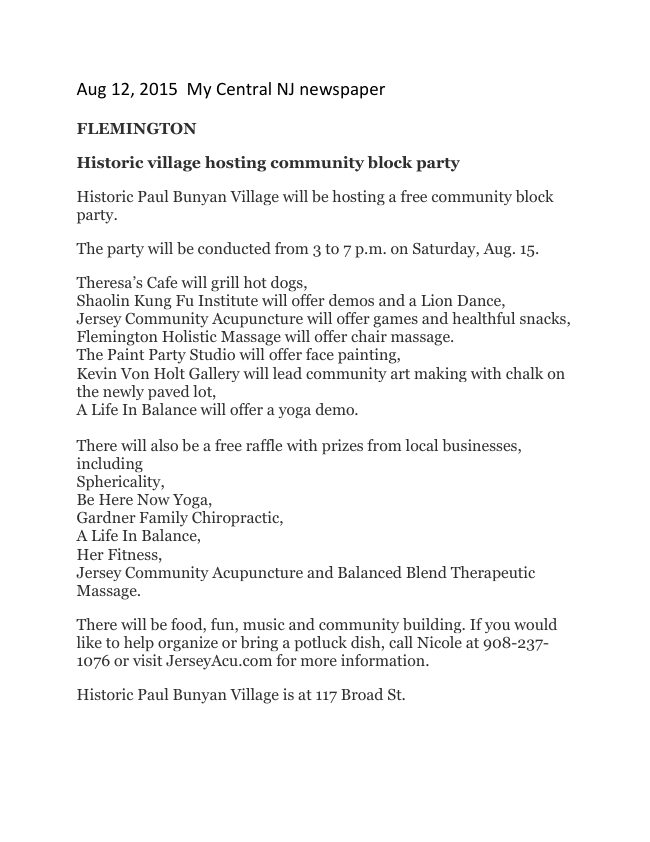
Paul Buyan Village party - 2015
Reference document
1 pages · EnglishRead →
M. Butkus collectionPDF
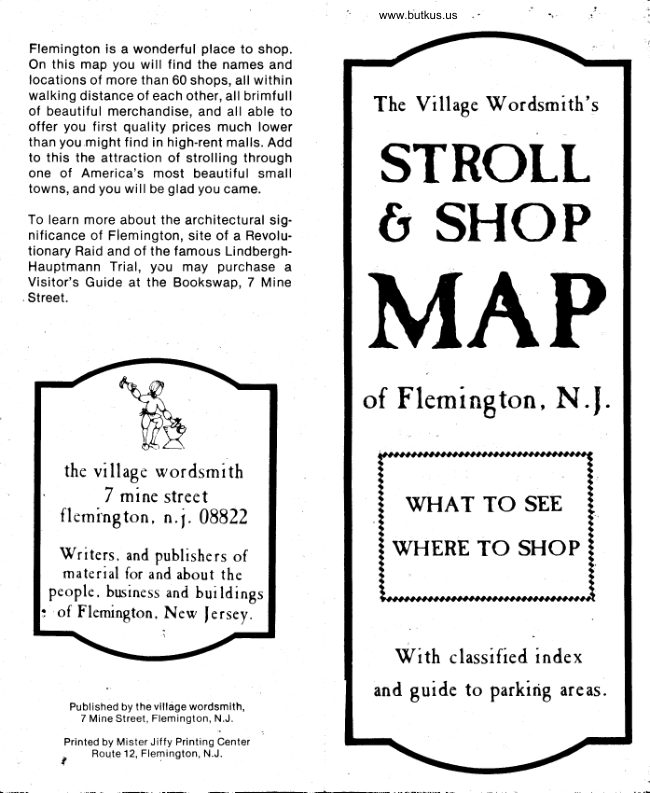
The Village Wordsmith's Stroll and Shop Map Flemington, NJ not dated
Reference document
5 pages · EnglishRead →
M. Butkus collectionPDF
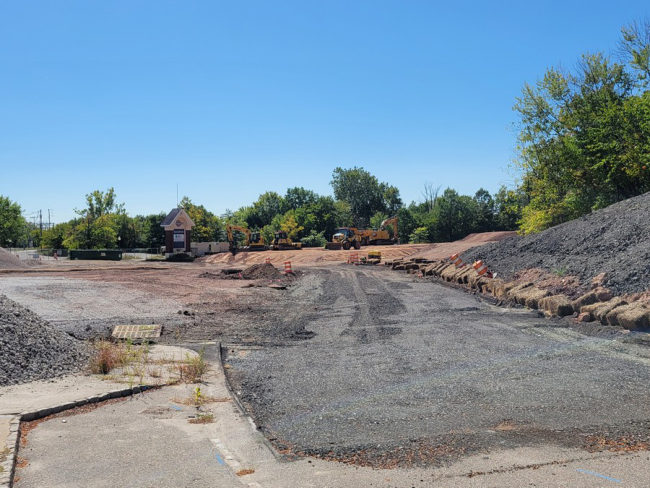
All the buildings of Liberty Village are gone
Reference document
2 pages · Not specifiedRead →
M. Butkus collectionPDF
Flemington Turntable Junction flyer - 1972
Reference document
8 pages · Not specifiedRead →
M. Butkus collectionPDF
The Flemington Guide - 1984 List stores and a map with locations
Reference document
31 pages · Not specifiedRead →
M. Butkus collectionPDF
WILTON FACTORY OUTLET Main St. Flemington, NJ - 1983
Reference document
4 pages · Not specifiedRead →
From the M. Butkus archive. Original publisher and archive notices are retained.
Check the model and edition against your equipment.
PDF verified 2026-10-10.