Camera accessories
Nikon PB-5 BOOKLET Product booklet
Product booklet for Nikon PB-5 BOOKLET. 27 pages in English. Read the original PDF, download or print a copy without registration.
27 pagesEnglish2.2 MB PDF
Loading your manual…Open PDF directly
Document details
- Brand
- Nikon
- Model / document
- Nikon PB-5 BOOKLET
- Document type
- Product booklet
- Language
- English
- Pages
- 27
- File size
- 2.2 MB
- Category
- Camera accessories
- Document date
- Not specified in catalog
Search available document text
Find a term, then jump to its page in the original PDF. Image-only pages may not be searchable; check the PDF for exact wording and diagrams.
Page 3 · Read text
NOMENCLATURE


                                                                         LenspanelWhiteindicatordot


Lensreleasebutton


Camerapanellocking knob


                                                                         LenspanelslidingknobLenspanellockingknob


                                                                                                  Slide-copyingadaPtersocketSlide-copyingadapter locking knob
View original page 3Page 6 · Read text
FOREWORD

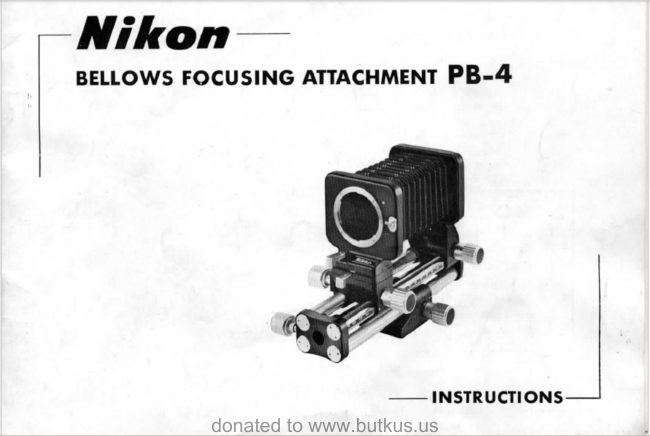
         The PB-5BellowsFocusingAttachmentis a simplified
           version of the top-of-linePB-4 model. The bellows
          extendsfrom 43 to 185mm for reproductionratios
           rangingfrom 1:1.2 to 3.6X with the 50mm f 12lens
           (1.6X to 4.4X when the lens is mounted in reverse
           using the accessoryBR-2 ring). The lens panel and
         camerapanel move independentlyfor easyfocusing
          and operatingconvenience.And the camerabody can
          be rotated 90"  for horizontal or vertical format
            picturesat any positionon the rails.
         The PB-5 acceptsaccessoryslide copying adapters
          PS-5and PS-4.
    w#e'6


www.butkus.us                                          5
View original page 6Page 7 · Read text
MOUNTINGTHE BEIIOWS ON THE CAMERA
                                            Loosenthe locking knob on the camerapanel and slide
                                                                                             it back on the rails as far as it  will go. Position the
                                            PB-5 in the camera'sbayonet mount, lining up the red
                                                    dot on the camerapanelof the PB-5 with the black dot
                                             on the camera.Twist counterclockwiseuntil it clicksinto
                                                     place.
View original page 7Page 8 · Read text
The camerabody can be rotated 90" for horizontalor
 verticalformat photos at any position on the rails.
Pressthe spring catchon the camerapanel and turn the
camerabody counterclockwiseuntil it clicksinto place.
To remove,depressthe lensreleasebutton on the camera
andtwist the PB-5clockwise.

Note: When used in the vertical position, the camera can be
removed from the PB-5 in the normal manner regardlessof the
camera'sposition on the rails.


                               www.butkus.us
View original page 8Page 9 · Read text
OUNTING
                                                  Positionthe lensin the bayonetmount on the lenspanel,
                                                         lining up the black dot on the lenswith the white dot on
                                                  the lenspanel.Then twist the lenscounterclockwiseuntil
                                                                                       it clicksinto place.
                                          To remove, press the lens releasebutton on the lens
                                               paneland twist clockwise.
                                          To mount the lens in reverseposition, use the Nikon
                                          Macro Adapter Ring BR-2. The ring has a bayonet
                                         mount at one end that fits onto the PB-5,and a screw
                                                thread mount at the other to acceptthe lens. lt can be
                                           usedwith any lenswith 52mm attachmentsize'
View original page 9Page 10 · Read text
Choosing a Lens                               any Nikkor lensmountedon the PB-5 in either normal
  Though any of the Nikkor lensesfrom 20 to 300mm can   or reverseposition and recommendedlens aperturesfor
  be usedwith the PB-5,the Nikkor Auto 50mm fl2 and  the bestresults.
  the Bellows-Nikkor105mm tlq are most commonly
I used. For critical closeups,the Micro-Nikkor-PAuto
 55mmf 13.5is an excellentchoice.
  For best results at reproduction ratios greaterthan  'l:'l ,
  reversethe lens in its mount so that its front facesthe
  film and its back is to the subject.
   lf the bellowsextensionremainsthe same,the shorter
  the focal length of the lens used, the greaterthe repro-
  duction ratio. lf reproduction ratio remainsthe same,
  increasingthe focal length increasesthe tens-to-subject
  distance.When mounted in reverseposition,short and
  normalfocal length lensesgive largerreproductionratios
  than when they are mounted in normal position. The
  oppositeis true for long lenses.
  At the maximum apertureof the lens,depth of field is
  minimizedand some marginalloss of image definition
 and illuminationis likely to occur. Thereforethe lensis
  usuallyfocusedat its maximum aperture,sincethis gives
  the brightestpossibleimageon the focusingscreen,then
  stopped down for making the exposure.However, the
  smallestapertureis not usuallyusedeither sincethis atso
  resultsin imagedeterioration.The tableson pages18 and
 19 show the rangeof reproductionratios possiblewith

                                www.butkus.us
View original page 10Page 13 · Read text
l_DETERMININGTHEREPRODUCTIONRATIO
Reproductionratio is the ratio of the imagesizerecorded By reversingthe aboveprocedure,the reproductionratio
on film to the actual size of the subject.At life-size can be predetermined.After consultingthe table,adjust
magnification,for example,it is 1 : 1. Furthermore,the   the PB-S'scamera and lens panelsto give the correct
subject and image sizes are proportional to  their  amountof bellowsextensionfor the desiredreproduction                                                                      trespectivedistancesfrom the lens.lf lens-to-filmdistance  ratio" Then focus by moving the subject or move the
increases,lens-to-subjectdistancedecreases.             entire assemblyback and forth until the subject is in
You can find out the reproductionratio for a particular  sharpfocus.
lens-to-filmdistanceusing the PB-5'smillimeter scale  Another simple method of determiningreproduction
engravedon the  rail. The scale can also be used to   ratio is by usingthe scaleon the oppositepage.Placethe
pre-adjustthe bellowsto givea desiredreproductionratio.  scalein the sameplaneas the subject,look through the
To determinethe reproduction ratio, set the distance cameraviewfinderand read off the length of the area
scaleon the lens being used at infinity. Focuson the  which is in sharpfocus.Dividethis numberinto 36 or 24
subject,then read off the numberson the scalewhich  (dependingon whetherthe camerais usedin the horizon-
appearnext to the outer edgesof the camerapaneland   tal or verticalposition).The resultwill be the reproduc-
lenspanel.Subtractthe smallernumberfrom the larger  tion ratio. For example, if the horizontal scaleimage
one to find the actual bellowsextensionin mm and  which'is in focus is 18mm in length,the reproduction
consultthe tableon pages2O and 21 to find the reproduc- ratio will be 36118= 2X. For quick referenceuse the
 tion ratio for the lens in use at that amount of bellows  table on the oppositepageto find the reproductionratio
extension.For example,if the outer edge of the lens  at any scalecoverage.                                                                    I panel is at 140mm and the outer edge of the camera
 panel is at 44mm, the bellows extensionequals14O -    Note: When using a Nikkormat camera, the reproduction ratio                                                                                            i 44= 96mm. lf the lensusedis the 50mm f 12 mountedin   obtained by this method must be multiplied by 0.9 owing to its
 reverseposition,the tablegives2.5X as the reproduction  smallerviewfinderarea.
 ratio.
                                                                                                                                                                                                                                                                                                                                                                                                                                                                                                                                                                     IIIIII
View original page 13Page 15 · Read text
DETERMININGEXPOSURE

                                              With built-in TTL meter
                                          The insertion of the PB-5 betweenthe lens and the
                                          camerabreaksthe linkageof the lensdiaphragmto the
                                                     thru-the-lensmeters of the Photomic-seriesfinders or
                                              Nikkormat cameras.However,thesemeterscan still be
                                            used to measureexposurevia the stop-downmethod.
                                               With the Photomicfinders,first pushthe couplingpin up
                                                         into the Photomicfinder with a coin or similarobject.
                                               With the Nikkormat FTr..ror the Nikkormat EL camera,
                                            push the camera'scouplingpin to the right as far as it
                                                                will go. Mount the lens/bellowsassemblyon the camera
                                            and switch on the meter in the usual way. The nextNikon F or F2-series          Nikkormat cameras
cameras                                          procedurefor eachcamerais as follows:
                                               Nikon F2 Photomicand Nikkormat FTN cameras
                                                  Selectthe desiredshutterspeedand stop down the lens
                                              manualty until the meter needlein the viewfinderis
                                                   centered,
                                               Nikon F2S Photomiccamera
                                                  Selectthe desiredshutterspeedand stop down the lens
                                              manuallyuntil the two signallightsglow.
                                                Nikkormat EL camera
                                                Set the shutterspeeddial at "A" (Automatic)and turn
                                                   the aperturering until the blackneedlein the viewfinder
                                                    indicatesa shutter speed appropriateto the subject.
                                     When non-TTL meter is used
                                                                                           lf a separatelight meter is used,exposurecompensation
                                                                    is necessaryat reproductionratios Sreaterthan 1  : 10.
View original page 15Page 16 · Read text
Thegraphson pages22to 25 show exposurefactorsand
exposurecorrectionsin f-stopsfor any Nikkor lens at
any aperture.Readjustthe lens diaphragmaccordingto
the indicatednumbers.
To calculateexposurecompensationin terms of shutter
speedrather than f-stopsfind the exposurefactor from
the graphsand multiply it by the exposuretime. For
example,if normalexposureat 1  : 1 reproductionratio
with the 50mm f l2is 1/8 second,the correctedexposure
will be 1/8 multipliedby 4, or 112second.

Note: When using a lens of retrofocus or telephoto type, the
differencein pupillary magnification must be taken into account
to establish the correct exposure. The pupillary magnification is
the ratio of the exit pupil diameter to that of the en1ran"" pupil.
The folfowing formula  is used to calculate the exposure factor
when a retrofocus or telephoto type lens is used in normal
position:
       Exposure factor = (1 + Mlv12
       (where V = pupillary magnification)
Whenthe lens is in reverseposition:
      Exposurefactor ='llv2    (l + vw12
To avoid complicated calculations,use the graphs on pages22 to
25 to determine correct exposure in aperture values.The graphs
are computed to take into account the pupillary magnification.


                               www.butkus.us                                         1 5
View original page 16Page 18 · Read text
Repro-CopyOutfit PF-2              ExtensionRing Set K
Sturdyand convenientset-upfor copy- Consistsof five rings used in various
ing documents,booksand other small  combinationsbetween the PB-5 and
objectswhich are more or lessflat.  lensto provideextra extensionsranging
                                  from 5.8 to 46.6mm.
                                  ExtensionRing E2
                             Usedwith the PB-5 to increaselens-to-
                                          film  distance.Offers semi-automatic
                                diaphragmcontrol for easierfocusing
                              and composingand also servesas a
                                   lenshood.
                                     SlideCopyingAdaptersPS-4& PS-5
                                 Both attach to the front of the PB-5
                                         for duplicating35mm transparencies.
                              The PS-4(shownbelow) provideshori-
                                     zontal and vertical shifts which facili-
                                       tate cropping.


                              www.butkus.us                                          1 7
View original page 18Page 22 · Read text
Lens set at inf ini
                                                                       Read off Values on Scale


      105 mm f/2.5


      135 mm f/3.5
      135 mm f/2.8


       300 mm f/4.5
Figuresin parenthesesindicate distance from the subiect plane in focus to the lens barrel edge in cm.


                              www.butkus.us                                     21
View original page 22Related documents and language editions
From the M. Butkus archive. Original publisher and archive notices are retained.
Check the model and edition against your equipment.
PDF verified 2026-10-10.