Camera accessories
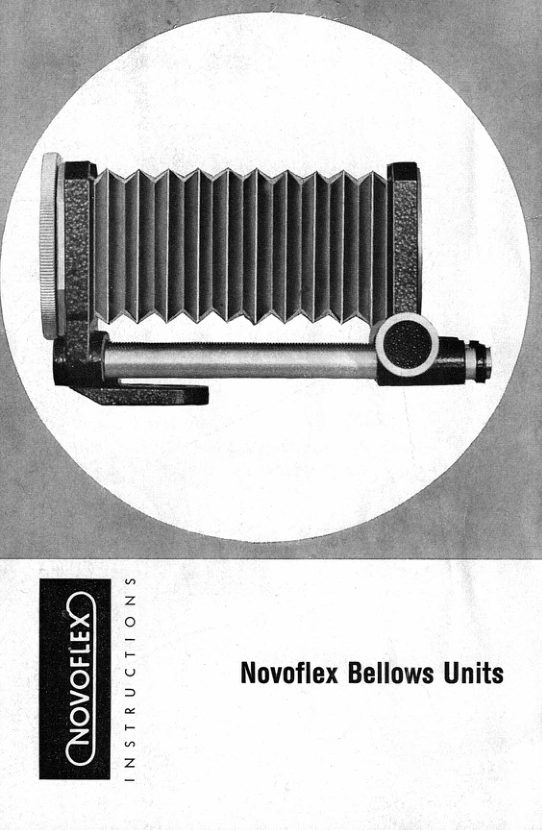
NOVOFLEX Auto Extension Bellows User manual
User manual for NOVOFLEX Auto Extension Bellows. 14 pages in German. Read the original PDF, download or print a copy without registration.
14 pagesGerman1.7 MB PDF

Loading your manual…Open PDF directly
Document details
- Brand
- Novoflex
- Model / document
- NOVOFLEX Auto Extension Bellows
- Document type
- User manual
- Language
- German
- Pages
- 14
- File size
- 1.7 MB
- Category
- Camera accessories
- Document date
- Not specified in catalog
Search available document text
Find a term, then jump to its page in the original PDF. Image-only pages may not be searchable; check the PDF for exact wording and diagrams.
Page 4 · Read text
l-

Automatic - Balgengerdt

 1) Kamera-Ansc{rluB
   Wie lhre Kamera und Objektive ist das Balgengerdt mit
    Springblendenhebeln  ausgestattet, die vor gewaltsamer
    Besc*riidigung geschlitzt werden miissen. Diese Hebel beim
    Einsetzen des Balgengerdts und des Objektivs nicfrt be-
    riihren, da sonst der einwandfreie Ablauf der Blenden-
    funktion nicht gewdhrleistet ist.
   Der Kamera-AnschluB ist nicht auswechselbar, und die
   Kamera kann nicht auf Hochformat geschwenkt werden,
   da er Teile des Springblendenmechanismus trdgt.
 2) Hintere Standarte
 3) Vordere Standarte
 4) Objektiv-AnschluB (ebenfalls nicht austauschbar, da die
    Springblendenmechanik bei den Kamera-Fabrikaten  ver-
    schieden ist).
 5) Kamera-Objektiv, dessen Springblende am Balgengerdt
   ebenso funktioniert, als wiire das Objektiv direkt am    Kamera-Gehiiuse. Mit einem Objektivkopf  ( :   Objektiv
   ohne Einstellfassung) von 105 mm Brennweite  ist Einstel-
    lung von nah bis unendlich mtiglicA.
 6) Zahnstangen
   Die linke obere Zahnstange trdgt Gravierungen, clie die
   Auszugsverldngerung (A) angeben. (A ist Null, wenn das
    Objektiv direkt in die Kamera eingesetzt ist, also ohne
    BalgengerAt).
 7) Triebkniipfe, gekennzeichnet mit der Aufschrift ,,drive,,.
   Auf der linken Seite des Gerdts sind diese Knopfe zum
    Feststellen gekennzeichnet mit der Aufschrift ,,lock,,. Letz-
   tere blockieren den 7_ahntrieb, wenn sie im Uhrzeigersinn
    festgedreht werden. sie konnen ebenfalls zum Ein"stellen
    bentitzt werden, wenn sie im Gegen-uhrzeigersinn festge-
   dreht werden.
View original page 4Page 5 · Read text
8) Einstellsclrlitten, bzw. dessen Gleitsttick. Letzteres hat zwei
         Gewinde-Bohrungen, die zu jedem Stativ und Reprogestell
r!          passen.
a
      9) Kupplungswelle f0r die Springblende
     10) Utfnungen zum Einschieben der Balgensonnenblende
        BALSON-A
     Ein Gerdt ftir Aufnahmen von nah bis unendlich, mit dem
      selbst Makroaufnahmen ohne Stativ spielend einfach sind.

                                                                                                                                                                          I
     VORTEILE ALLER NOVOFLEX.BALGENGERATE                                                      T
      1. lhre Kamera-Objektive (Normal- und Weitwinkel) werden zu
         Makro-Objektiven.
      2.   f hre Tele-Objektive (bis ca. 240 mm) werden zu Nahaufnah-
        meobjektiven. Blumen, Insekten etc. flillen das Bildformat.
       Trotzdem bleibt zwischen Objektiv und Aufnahmegegen-
              genrigend Abstand: Wichtig bei scheuen Insekten, ge-          -sJ?ng          fiihrlichen Reptilien, Operationen, Blriten auf Bdumen oder
         jenseits von Zdunen und auch fi.ir die Zusatzbeleuchtung.
      3. lm Gegensatz zu Zwischenringen ist bei Balgengerdten der
         Einstellbereich luckenlos und in sekundenscEneiie zu riber-
         bruicken. Hier mussen besonders Objektivkopfe (:  Objek-
          tive ohne Einstellfassung) hervorgehoben werden. sie bie-        ten alle unter Punkt 2 erwdhnten vorteile plus Einstellung
         bis unendlich.
      A.           jedem der unter 3 erwdhnten Objektivkopfe spart man           P."i         die teure Einstellfassung.                                      ,I
      5.        ldeale Zusatzgerate                               Balgensonnenblende                      wie                                        und Diako-I         piergerdt                                atte                  gibt es ftir                               Novoflex Batgengeriite.ry'{
      6. Qualitdt und ZweckmdBigkeit: Bei allen Novoflex Gerdten  ti
           ist hochste Prdzision und groBte Stabilitdt eine Selbstver-
          stdndlichkeit. Niemals wird aber sinnloser Aufwand getrie-
       ben: Die Gerdte sind so klein, so leicht und so preiswert
        wie nur irgend moglich.
    sl                                www.butkus.us
View original page 5Page 6 · Read text
VORTEILE DER AUTOMATIC.BALGENGERATE
     1. Stets helles Sucherbild. Setbst bei t22 bleibt die Blende
        bis zum Auslosen offen. Dies ist umso wichtiger, als gerade
       bei Nahaufnahmen ein Lichtverlust unvermeidbar  ist. Z. B.
        entspricht  f 22 bei MaBstab 1 : 1 der effektiven Blenden-
        offnung  f 44!
     2. StAndige SchuBbereitschaft. Kein manuelles Abblenden  er-
         forderlich. Man kann nicht vergessen, die Blende zu schlies-
       sen'           B          -fKu g. €l
     3. Die Vorteile 1 und 2 ermoglichen Freihandaufnahmen  selbst
      im Makro-Bereich. Das ist meist unerldBlich bei quickleben-
       digen Insekten, Blumen, die der Wind bewegt und auf Rei-
      sen und Wanderungen, wo man kein Stativ mitfiihren will.
        Letzteres ist ohnehin keine Losung dieser probleme. Mit
       synchronisiertem Blitz wird man stets ein Automatic-Bal-
       gengerdt verwenden.
     4. Auch Aufnahmen mit Stativ werden vereinfacht: Novoflex
       Automatic-Balgen sind mit Einstellschlitten und Stativge-
                                                        Ob-t     windenjektivkopfeausgestattet.konnen ebenfallsNicht-automatischeverwendet werden.Objektive und

   WELCHE KAMERAS SIND VERWENDBAR, WELCHE NICHT?
     Novoflex-Automatic-Balgen werden ftir folgende spiegelreflex-
    Kameras geliefert:
    Nikon, Nikkormat, Nikkorex Modelle.
    Ganon FX, FT, Peltix,
    Topcon Modelle mit SchlitzverschluB,
     alle Kameras mit Praktica-Gewinde und schlitzverschluB wie
     Praktica (-mat), Edixa (-mat)*, pentax, yashica Reflex, Ricoh
     Singlex etc.
     Nicht verwendbar sind Kameras, die eine andere springblen-
    denautomatic haben, auch wenn es z. B. ,,AnschluiJrinje  ftir
     Praktica-Objektive" vom Kamerahersteller  gibt.
View original page 6Page 7 · Read text
BELICHTUNGSZEITVERLANGERU NG
I     Kameras mit Lichtmessung durchs Obiektiv zeigen auch bei
a    Makroaufnahmen die richtigen Belichtungswerte an' Zum
I     Messen wird manuell abgeblendet. Bei kleinen Blenden kann
      es sein, daB der Belichtungsmesser nicht mehr anspricht' Man
      blendet dann so lange auf, bis der MeBzeiger reagiert und
      rechnet auf Arbeitsblende um nach der Regel: minus 1 Blen-      denstufe :  plus 1 VerschluBzeitwert.
        lst die Beleuchtung so schwach, daB auch bei offener Blende
      der Belichtungsmesser nicht anspricht, dann ist ohnehin eine
      Zusatzbeleuchtung (stdrkere Lampe oder Elektronenblitz)  not-
      wendig.
      Bei Kameras, die keine Lichtmessung durchs obiektiv haben,
    muB bei Nahaufnahmen der Lichtverlust, der durch Verlange-
      rung des objektivauszuges  eintritt, berticksichtigt werden. wie
      lange die Belichtungszeit verliinEert werden muB, kann man
      anh-and der Belichtuhgsfaktorenfelder  feststellen, die -  unab-
      hdngig von Brennweitb und Objektivfassung - immer ftir eine     gegeOene AbbildungsgroBe genau richtig sind.

     AUFNAHME.TECHNIK
      Freihandaufnahmen mit Blitz macht man am zweckmdBigsten
      wie folgt:
            Scharf eingestellt wird nicht mit dem Triebknopf des
            Balgens, sondern einfach, indem man sich dem Aufnah-
           megegenstand niihert, bis er scharf auf der Mattscheibe
             erscheint und lost aus. (Mit dem Automatic-Balgen sind
             Schiirfe und Bildausschnitt  blitzschnell, leicht und ge-
           nau zu erkennen, weil selbst bei f 22 die Blende bis zum
           Auslosen offen bleibt).
            Vorher schon hat man den Balgen so weit ausgezogen,
         daB der Aufnahmegegenstand formatftillend abgebildet
              wird. Auch die Blende wurde vorher so gestellt, daB sie
            der Leitzahl des Blitzes entspricht. (Dabei muB aber der
                  Blitzref lektor neben dem Objektiv gehalten werden;


                                www.butkus.us
View original page 7Page 8 · Read text
denn nur so bleibt die Blende bei jedem Abbildungs-
     maBstab gleich. GroBerer Balgenauszug wird durch
      groBere Ndhe der Lichtquelle kompensiert).
      Der Blitzreflektor ldBt sich leicht mit einer Schiene am
      Stativgewinde des Balgengerdtes befestigen. So haben
      Sie beide Hiinde frei. Bei Verwendung von Filmen mit
      einer Empfindlichkeit von 18 DIN und mehr wird es
     manchmal notwendig sein, das Blitzgerdt auf halbe
      Stdrke zu schalten cder ein dirnnes weiBes Tuch rlber
     den Reflektor zu stulpen, um Uberbelichtung zu ver-
      meiden.

ZUBEHUR
Auto-Bellows-Noflexar 1 :4/105 mm, ein Objektivkopf mit dem
man l{.ickenlos und in Sekundenschnelle den gesamten Be-
reich von nah bis unendlich 0berbrtickt, und dessen Spring-
blendenmechanismus jeweils dem der Kamera entspricht.  Fil-
tergewindeM52x0,75.
Balgensonnenblende, BALSON-A, eine Gegenlichtblende, bes-
ser als normale Sonnenblenden und deshalb auch bei extre-
mem Gegenlicht noch wirksam. Verwendbar mit Objektiven
bis ca. 150 mm Brennweite. Gleichzeitig Baustein des Novo-
flex-Diakopier-Systems. Mit den sogenannten M-Ringen wird
BALSON-A an die Objektive angeschlossen. Diese M-Ringe
werden in das Filtergewinde der Objektive geschraubt. Bei Be-
stellung ist deshalb Angabe des Filtergewindes  erforderlich,
z. B. M 49 x O.75.
Diakopiervorsatz. Der Novoflex Diakopiervorsatz BALCOP wird
auch mit dem Automatic-Balgengerdt verwendet. (Separate Ge-
brauchsanleitung BALCOP).

PFLEGE UND GARANTIE:
Novoflex garantiert ftir die einwandfreie Qualitdt seiner Ge-
rdte. Die Fiihrungsstangen des Balgengerdtes sollten sauber
gehalten und von Zeit zu Zeit mit Vaseline leicht eingefettet
werden. Die Triebknopfe tragen die Aufschrift ,,drive". Auf der
linken Seite sind Feststellknopfe, die mit dem Wort ,,lock" ge-
View original page 8Page 9 · Read text
kennzeichnet sind. Es ist darauf zu achten, daB beim Einstellen
       die Feststellknopfe nicht festgezogen sind oder sich von selbst
;      festziehen konnen (am besten festdrehen im Gegen-Uhrzeiger-a      sinn, dann konnen auch die Feststellknopfe zum Scharfein-
       stellen benutzt werden).
      *)         Mit Edixa dtirfen keine kiirzeren VerschluBzeiten als 1/30
         sec. verwendet werden, da man sonst Gefahr liiuft, einen
         Bildrand riberzubelichten. Trotzdem bleibt die Edixa auch
            ftir das Automatic-Balgengerdt gut verwendbar, wenn man
        bedenkt, daB bei Freihand-Makro-Aufnahmen ohnehin ein
         synchronisiertes Blitzgerdt gebraucht wird.                                                                                 l


                                www.butkus.us
View original page 9Page 10 · Read text
Automatic extension bellows

      Camera mount
     The Automatic Extension Bellows incorporate the same
                                                  your                                                                        len-                                        and                                 as your camera                              levers                   releasing      diaphragmF1,                                                   dama-                                            being                                       from                            mechanism       ses. Protect                 the releasing
       ged. Do not touch it while attaching the lens and the bel-
      lows in order to ensure functioning of the diaphragm.
       Since the diaphragm releasing mechanism is also part of
       the camera mount it is not interchangeable or swivelling
        like in bellows models S or  ll.
      Rear panel                                                                                                                              rl

                                                                                                                                                                                   il                     uJfr:l       Front panet ul tug.
     4l Lens mount (equally non-interchangeable since the dia-
      phragm releasing mechanism is different with each camera
        brand).l;
 .5)  Camera Lens. lts automatic diaphragm works as if it were        fitted directly to the camera body. A 105 mm lens head
        (:  short mount lens) focuses from close-up to infinity.rt
    6) Focus racks
      The upper left rack shows the extension increase (A). (A
i*      direct,equals withoutto zero whenbellows).the lens is fitted in the camera body
i7l    Driving knobs
       are marked ,,drive". On the left side of the device similar
      knobs lock the focusing gear when turned clock-wise.
      These left-hand knobs are marked ,,lock". They may also
      be used for focusing when locked in counter-clod<-wise
         direction.
    B) Tripod Rack (its racking block with 2 tripod sockets for
       both r/1" and 3/s" tripod screw).

                                                                10
View original page 10Page 11 · Read text
8) Diaphragm releasing bar
10) Holes accepting the rods of the bellows lens hood BAL-
    soN-A.
A Bellows Attachment for continuous focusing from macro and
close-up to infinity, making possible free-hand photomacro-
graphy (without tripod).
ADVANTAGES OF ALL NOVOFLEX EXTENSION BELLOWS
(1) Your camera lenses (normal and wide-angle) become
   macro lenses.
(2) Your tele lenses (up to 24O mm focal length) become
    close-up lenses. Frame-filling shots are possible without
    disturbing shy insects, dangerous reptiles, doctors during
    operations, and you can reach out for flowers on trees
   and beyond fences etc.
(3) Unlike with extension tubes, the focusing range of the ex-
    tension bellows is continous and within fractions of a se-
   cond the entire focusing range may be covered. Lens   heads (:  lenses without helical mounts) are of greater
    usefulness because they offer all advantages mentioned
   under section 2 plus focusing up to infinity!
(4) With every lens head considerable saving is obtained be-
   cause no helical mounts are required.
(5) The usefulness of the Novoflex extension bellows may be    'f
    further extended through ideal accessories like the Bel-
    lows Lens Hood and the Slide Copying Attachment.                                          i
(6) Quality: Novoflex products are manufactured under the               i,I
     strictest conditions consistent with high quality. The stan-
   dard of quality in this field is Novoflex.
ADVANTAGES OF THE AUTOMATIC NOVOFLEX EXTENSION
BELLOWS
(1) Bright focusing screen: Because the Novoflex bellows is
    automatic the diaphragm stays wide open and the screen


                         www.butkus.us
View original page 11Page 12 · Read text
stays bright and it is easy to focus. Without such a fea-
    tur6 (even on the brightest day!) if you are stopped down
    to t22 and you are shooting 1 :1 the effect on the ground
    glass is t 44 and an impossibly dark ground glass image'
(2) Always ready to shoot! lt ,s not necessary to stop down
    the ciiaphrajm manually. You can concentrate on the pic-
    ture becaus-e there is no danger of forgetting to close the
    diaphragm.
(3) The advantages mentioned under section 1 and 2 make
       it possible to take even macro photographs free-hand. This
     is necessary for lively insects, flowers moved by the wind
   and on trips and excursions where it is inconvenient  to
     carry a tripod. A tripod is no solution to a moving subiect
    anyway. But with Novoflex Automatic Bellows and flash a
   moving subject is never a Problem.
(4) Picture taking with a tripod is also facilitated: The Auto-
    matic Novoflex Bellows Attachments are equipped with a
    Tripod Focusing Rack and with tripod sockets.

WHICH CAMERA MAY BE USED
Automatic NOVOFLEX Bellows are available for the following

Canon FX, FT, Pellix
Topcon, all models with FP shutter
Pentax, Praktica (-mat), Edixa (-mat)*, and all other SLR came-
ras having Praktica threads and FP shutters.
Not suitable are cameras having other diaphragm releasing
mechanism, even if the camera manufacturers supply ,,Adap-
ters for use of Praktica-lenses".

INCREASE OF EXPOSURE TIME
Cameras with TTL meters show the correct exposure time also
in close-up photography. Measuring of the light with the lens

                                                             12
View original page 12Page 13 · Read text
stopped down manually. lf the light is too dim for the meter,
op-.i'iine-Oiapnragm  uritit the needle of the meter shows how
       io- eipbse.'Then you may stop down aqain.increasing                                                                 :  plusin"-"*posrtb'.riu"n        time accorbing to inq rule: minus 1 f-stop
i L"po"rre time stop.  tf the light is so weak the needle doesnot show any deflection even at full aperture, it is necessary
to use artificial light (tungsten or flash) anyway'
cameras without TTL meter require increase of the normal                                                              repro-e*po.ure time according to the increase in ratio ofdu'ction. How much the normal exposure time should be in-
6reased can easily be seen from the chart supplied with every
Novoflex Bellows attachment.

FREE.HAND CLOSE.UP TECHNIQUE                                                \
The most convenient way to take close-ups free-hand with a
flash is as follows:
Do not focus on the subject with the focusing knob of the
bellows but simpty by m6ving towards the subiect until the
shutter release is'pressed,  it-is very easy to tell when maxi-
mum focus and best framing is reached.
setting the bellows at the required extension and the dia-
pnragir at the correct f-stop is therefore done before. The
istofi may correspond to the guide number of the flash, re-gardiess 6t tne bellows extension and the focal length of the
l-ens, if the flash reflector is always kept at the same distance
from the subject as the front lens is. Increasing bellows ex-
tension is th-us compensated by increasing proximity of the
light source.
The flash reflector is best attached to the tripod socket of the
bellows attachment with one of the usual brackets available
on the market. Like this you can easily hold the entire equip-
ment with one hand and have the other hand on the camera
release at ready. With strong flash units it may sometimes be
necessary to use the flash at half power or cover the reflector
with a white handkerchief in order to avoid overexposure.

13
                          www.butkus.us
View original page 13Page 14 · Read text
ACCESSORIES
    105 mm  | 4 Auto-Bellows-Noflexar a lens head for continuous
     focusing from macro up to infinity. lts automatic diaphragm
    mechanlsm corresponds to the one used in the camera lens
    and is therefore different with each camera brand. Filter thread
  M 52 x 0.75.
    Bellows Lens Hood (BALSON-A), a lens hood outperforming
    any other means to protect the lens against stray. light and
     inrier reflections. lt is effective even in scenes with strong
     back-light and glittering water surfaces. Can be used with
    most lenses up to 150 mm focal length.  lt is also a component
    of the Novoflex slide copying equipment. BALSON-A is at-
    tached to the lenses with step-up adapters which are screwed
    to the filter thread (when ordering please indicate  M................)
     of the lens.
    Slide Copying Artacfrment (BALCOP): Same as for the other
\ s- Novoflexuse)     bellows attachments. (See separate instructions for
   MAINTENANCE AND GUARANTEE
    Novoflex guarantees the superb quality of its products. The
    guide rails should be kept clean and coated slightly with va-
     seline. The driving knobs are marked ,,drive". The knobs on
    the left are marked ,,lock". The latter lock the rack gear  if
    turned clock-wise. Please do not try to focus when these knobs
     are turned colck-wise, even not if they can unintentionally lock
    movement. But these knobs may be used for focusing, too,  if
    locked in counterclock-wise  direction.
     .)      with Edixa (-mat) please do not use the automatic dia-
      phragm with exposure times shorter than 1/30 sec. to avoid
       overexposure on one side of the picture. With 1/30 and
    longer exposure times the Edixa is a camera suitable for use
    with the Automatic Bellows. ln practice this is quite sufficient
    since a synch flash is necessary in freehand photomacrog-
    raphy anyway.
  NOVOFTEX D-894 I[EftIfrrI NGEN                                                                                                                                                                                                                                                                                                 lt                      Printed in West Germany
                                                                                                                      rl
                                                                                                                                                                                                                                 t
                                                                                                                                                                                                                                                                                                                                                                                     rlI
View original page 14Related documents and language editions
From the M. Butkus archive. Original publisher and archive notices are retained.
Check the model and edition against your equipment.
PDF verified 2026-10-10.