Film cameras
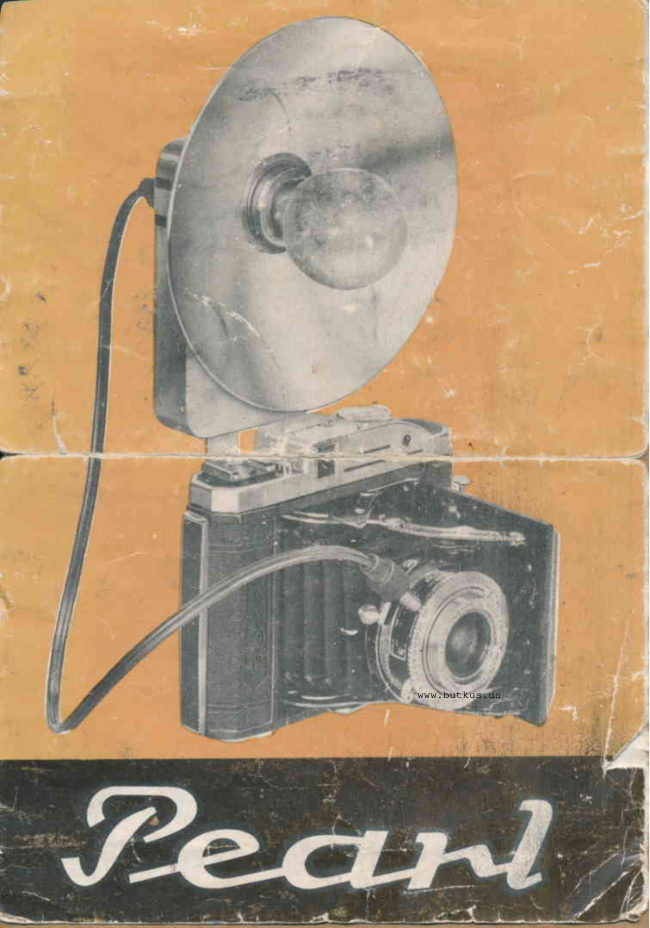
Pearl III User manual
User manual for Pearl III. 13 pages in English. Read the original PDF, download or print a copy without registration.
13 pagesEnglish2.7 MB PDF

Loading your manual…Open PDF directly
Document details
- Brand
- Pearl River
- Model / document
- Pearl III
- Document type
- User manual
- Language
- English
- Pages
- 13
- File size
- 2.7 MB
- Category
- Film cameras
- Document date
- Not specified in catalog
Search available document text
Find a term, then jump to its page in the original PDF. Image-only pages may not be searchable; check the PDF for exact wording and diagrams.
Page 3 · Read text
PEARL       ilI

    KONISHIROKU's PEARL ill  is an ultra-modern oreci.
sion folding camera of unsurpassable  quality and perf ormance
Because of its thoroughly engineered and  f ield- tested lens,
shutter, coupled rangefinder, and other components, and
because of  its compact and fool-proof construction, the
PEARL III  is capable of taking clear and truly satisfying
pictures at any time and under almost any condition.
 .   Picture and Film Size  The PEARL III uses I20
     "Brownie,,   f ilm and gives sixteen exposures of 4.5 X
    6 cm. (1* X 2*   in. ) Per roll of  f ilm.
 .   Hexar t/3 5 75mm Lens with improved amber coatrng.
 .   Seikosha-MX Shutter with settings B and 1, %, %,
    Xo, /rt, Xo, Xor, /rro, %oo second (synchronization
    at all speeds)
 .   Coupled rangefinder incorporates patented "Color
    Complementary Mirror,,, and produces crystal clear
    rmages enabling easy and positive focusing.
 .   Shutter Speed Indicator and Depth of Ferld Scale can
    be seen through the eyepiece.
 .   Fixed concentric helicoid traverage lens mount
 .   Safe and posrtive bar body release
 .   Pre-set mdtered automatic film advance bv use of a
    start marker
 .   Convenient Film Reminder Indicator and Accesorry  Clip
View original page 3Page 4 · Read text
www.butkus.us

LENS
               Konishiroku HEXAR 1,4.s, focal  length
75 mm, with rmproved amber hard-coating. The resolving
power of this lens is excellent at all points within the
image area, while the amber coating not only gives extra
transparency but provides color correction by  slight
suppression of  light at the red end of the spectrum.
Consequently, clear and distortionless color photography
is possible, while with ordinary film the effects of yellow,
red, and green  f ilters is enhanced.

SHUTTER
                SEIKOSHA.MX    Shutter, with shutter
settings: B, and 1, %, %,  Xo,  /ro, Xo, Xoo , /zso  ' and
                                                                                        isXoo second. This sh utter is of  the latest tvPe, and
renowned for its accuracv and  its   f reedom
from trouble. By shifting the
svnchro-flash adiustment to                                            \
the correct setting lor  the
type of  f lash used  - -  "F,,  f or
F class llashbulbs; "M,, for
M class; and "X,,  f or electr-
onic  f lash tubes   accurate
synchronization can be obtained
at all shutter speeds.
View original page 4Page 5 · Read text
PEARL  II COUPLED RANGEFINDER


       0ut of focus         Correctly focused

    The rangefinder incorporated rn the PEARL   III  rs a
spccially developed single-eyepiece conrbrnatron range and
view finder employing the double center rmage system. The
special semi-reflecting mirror  in the line of  vision rs  ol
patented lPatent No 184797)  trtple layer constructron
which, besides providing the easy-to.see complement color
double images  ( violet and yellow ) which merge as a single
natural color image when the camera is correct ly   f ocused
upon the sublect, grves hrgh retlection and transparency
through ingenious utilizat ron of  rnterterence. Because
spccial attention has been accorded rn desrgh to  optrcal
and mechanical accuracy, theie  rs no cor,rplrng error; and
extrenrely precise locusing adlustments are possrble. Sharp
and clear phot ographs are   t hcrcfore assured. The wrndow
3  of the conrbrned vren,and rarrge trnder of the PEARL  III
has a notch cut  in the lower edge to pernrit reading.
through the eyepiece v,,ilhout shitting the canrera, of  the
shutter speed. aperture, anci iocus (drstance, and depth of
ticlcl ) scttinps
View original page 5Page 8 · Read text
www.butkus.us
THE SEIKOSHA-MX SYNCHRO.SHUTTER
    This high-grade precision shutter provides full synch-
ronization with flash equipment al  all  shutter speeds.
Synchronization adjustment is done by changing the settings
of the small red lever @ protruding below the flash
contact plug CD The synchro-adjustment  lever has three
positions --   'F,,, "M,, and "X,.
     "M,, position  - -  this setting is used in conjunction
with M class  f lash-bulbs (time lag about 20 milliseconds  )
to obtain correct synchronization at  all shutter speeds
including )$o  Sec.
     "X,, position   At  "X,, position, no allowance  is
made tor time lag.The synchroflash contact is made at
the instant the shutter blades are fully open. This position
consequently is  for  instantaneous strobo lights (gas
discharge flash tubes) or for shutter speeds of less than
/r, Sec. when used with  f lashbulbs.
       It  will be seen from the above explanation that  in     *F,,       and  "M,, positions an extra train of  speedthe
ggverning mechanisms is engaged for synchronizing purposes.
Consequently, the shutter is paved from extra wear and
tear if the syrrchro-adiustment lever is kept in "X,, position
during normat (non.{lash) use. g,lil<uSzV f
View original page 8Page 9 · Read text
LOADING WITH FILM
    When loading or unloading the PEARL
III,  avord dir ec t   su nligltt to  prevent
f ogging of   f ilm. Because this camera is
of  the automatic  f ilm advance type,
utilizing the start-mark on the paper
leader of the film at the time of loading,
see that the symbol V appears in the
                                                                                            AovANcE                                                                                                                                                                        ri FrLMexposure counter window 6D and the                                                                           STARTfilmwind knob 6$) turns free  (tfre film                           DOTS
stop mechanism is disengaged ) bef ore attempting to load or
unload. Ooen backlid (D of camera by oulling out catch (i)
and permitting the back to swing  f ully open. Fit  ertrpt y
                                                                           ( f ilmwind knob side ), rndspool in take-up spool chamber
position unexposed roll  of    f ilm in the other chamber.
Remove gaper seal from unexposed film and discard. Pull
out paper leader of the unexposed film by about four
rnches, and thread the tapered end through the longer slit
in the emptv take-up spool .  Give the   f ilmwind krrob r
couple of turns to see that the prper leader is being
wound onto the take-up spool correctlv and firmly, thcn
continue windilg, keeping the paper lceder taut, until  tltu                 .A-                                                                        m.trl<sstart-marks U  appear. Wind until  these start
match the whrte dots @,) on tlre canrera. Close bac[.:li,l
and push in catch to lock the  lid.
    Next, press filnrwind stop release
lever Ctu) in the direction indicatecl, then
turn filmwind knob until it stoos. Numeral
l  will then have appearcC in the exposurc
courlter wrndow, ancl thc first frarne oi
the film is in posrtion rcady lor  tl-rc tirsi
picture. Repeat the sanre procedurc, ther
the filmwind will stor; autorrr.ttically  for
each of the fittccn subsecuent frames.
View original page 9Page 10 · Read text
OPENING THE PEARL  I www.butkus.us
   The PEARL III  is a   f olding camera, so it must be
opened for picture taking. Press front cover button @
and allow front cover @ to spring open and lock gentlythrough the action of the struts @  lmpatiently shakingthe front cover into open position is inadvisable because
the shock may damage the delicate lens'shutter'levers
assembly, while sudden distension of the bellows sometimes
displaces the  f ilm to cause mislocusing and blurred pictures.
TAKTNG PICTURES WlrH THE PEARL U
    After setting shutter speed and aperture opening at
the desired readiigs on the shutter speed dial @ and-theaperture dial @ against the indicator dots @ & @, theshutter is cocked by moving the shutter cocking lever @uoward and over until  it clicks stop.
    The PEARL III  is held in both hands with the two
thumbs pressed against the back. The qiddle finger of the
right hand rests on the finger rest A,  of the focusing
mount, and the other fingers of that hand grip the lront
of the camera. The index  f inger of the lef t hand is hooked
on the shutter release bar- @, and the other  f ingerspress against the front cover in such way that the small
round window of the rangefinder is not obstructed.    Peering through the eyepiece q?, the camera is trained
to take in the desired field, then the iocus is adiusted bv
bringing together the double images seen in the center of
the field. After the composition and focus are properlv
adiusted, the picture can be taken at any time by gently
oressing upon the shu  t ter release bar with the index  f inger
of the left hand. After a frame has been exposed, move
the  f ilmwind stoo release lever and wind- until the knob
stops with the next frame in position for exposure.
cLosf NG  ( FoLDING ) THE PEARL  il     o"t+k.tt ""
    Before closing the front cover, see that the focus
setting is at  inf inity; then with the thumbs of both hands
oress down on the serrated oortions of the lock-struts.
Thc lens-shutter assemblv will be retracted, and the front
cover will swing up. Press home {ront cever until   it
clicks shut.
View original page 10Page 11 · Read text
REMOVING EXPOSED ROLL OF FILM
     After numeral 16 has appeared in the exposure counter
window, and the last frame has been exposed, push the
filmwind stop release lever then wind until the film and
paper leader have been completely taken up on the take-up
spool (the lessening of resistance is sensed by  f eel) Open
up the backlid, remove the exposed roll of   f ilm taking care
not to let the roll loosen;  f old back inward a short length
of the paper leader and seal with the gummed paper
strip provided.
      Shif t the empty spool to the take-up side in readiness
for the next loading
DEPTH OF FIELD SCALE
   The depth of field scale @ shows at a glance theamount of tolerance available, in  f eet, within which objects
will be in sharp focus, depending on.the aperture setting.
After bringing the camera into focus upon a specific subject
 (merging into a single image of the subject within the
                                                                                                        f ocusing mountrangef inder ), the distance scale on thewill inCicate the exact distance between the camera and
the subject, while the depth of  f ield scale      will  indicate
how much leeway is permissible, depending on hnw much the
lens is stopped down. For instance, if the camera is  f ocused
on an object at exactly 15  f eet, all objects within a range
of about 11  f eet to 27   f eet will be in sharp  f ocus with
the aperture setting at
t,/8. At f/16   (at the
screw heads ) the range
of sharp locus will be
between 9  f eet and 50
feet from the camera.
I n of her words.  t he more
the lens is opened up
a nd  t he c loser  t he su-
bject to the camera, the
focus tolerance becomes
the sma ller.
View original page 11Page 12 · Read text
www.butkus.us
FILM REMINDER INDICATOR
    The  f ilnr type indicator (6. is used
 as a reminder of what tyPe of   f ilm is
 loaded and in use, or to show that the
 camera is empty. The indicator is set
 manually at the most convenrent time.
INFRA-RED FOCUSING MARK
     Because of the diflerence in wavelength of infra-red
 light, the  f ocusing point must be slightly changed in the
 case of  infra-red photography. The infra-red f'ocus mark
 is the red dot (25' on the depth of  f ield scale. When using
 inf ra-red  f ilnr, read distances in the regular way, then shif t
 the indicated distance re!ading to the red dot position to
 obtain correct and sharp focus.
SHUTTER RELEASE SCREW SOCKET
   A screw socket €i'is   provided at the foot of one
 of the struts to permit the use of cable releases or  a
delayed action self-timer
ACCESSORY CLIP
    This clip @  is used lor  direct mounting on the
PEARL  III  of such accessories as the KONIFLASH
 pocket  f lashgun.
FLASH CONTACT PLUG
    The  f lash contact plug on the shutter body is of the
 German type. Consequent ly, in order to connect up a  f lash
 attachnrent with the PEARL  lll '  a connector cord with
 the German type socket ntust be used.
View original page 12Related documents and language editions

From the M. Butkus archive. Original publisher and archive notices are retained.
Check the model and edition against your equipment.
PDF verified 2026-10-10.