Film cameras
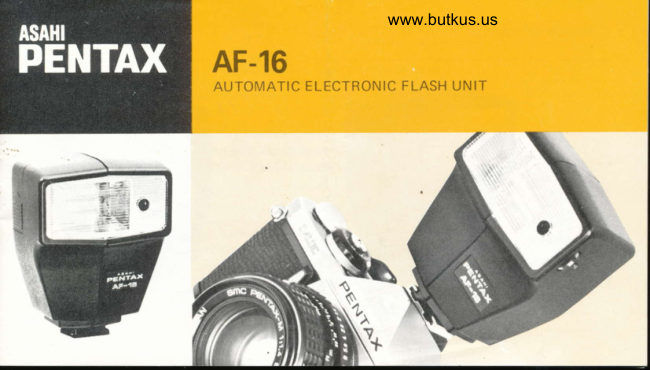
Pentax AF-16 User manual
User manual for Pentax AF-16. 16 pages in English. Read the original PDF, download or print a copy without registration.
16 pagesEnglish2.4 MB PDF
Loading your manual…Open PDF directly
Document details
- Brand
- Pentax
- Model / document
- Pentax AF-16
- Document type
- User manual
- Language
- English
- Pages
- 16
- File size
- 2.4 MB
- Category
- Film cameras
- Document date
- Not specified in catalog
Search available document text
Find a term, then jump to its page in the original PDF. Image-only pages may not be searchable; check the PDF for exact wording and diagrams.
Page 4 · Read text
www.butkus.us     SPECTFICATIONS                                                                            II

          Type:                Clip-on electronic  f lash unit (with hot-shoe contact)
         Guide number     32 (ASA 400 in meters) 16 (ASA 100 in meters)
           Flash control:       Automatic; with two-way output selection
           Flash range:        Red setting: O.5m (1.54 ft.) - 4m (13.12 tt.l
                             Blue setting: 1.0m (3.28 ft.) - 6m (19.68  ft.)
          Sensor reception
           angle:                 2O'' (silicon photo-diode)
          Angular spread:     48" vertical; 65'' horizontal (for up to a 28mm wide-angle lens)
           Flash duration:     1/40.000 - 1/4000 sec.
          Color temperature:   Equivalent to daylight
          Recycle time:      approx.6 sec. with alkaline batteries. S sec. with mangnese batteries
        Number of flashes:  Alkaline batteries (approx. 200) manganese (approx. 40)
         Power source:     Two 1.5V AA-size penlight batteries
          Other features:     Open  f lash button, Automatic   f lash output stabilizer, Pilot lamp,
                             Color-coded exposure table
          Dimensions:      65mm (width) x 78mm (height) x 41mm (depth)
          Weight:                               i 02q (3.5 oz.) without batteries
           Accessories:          Flash cord


I
I
View original page 4Page 5 · Read text
I FEATURES OF THE AF-16L
   The AF-16 was designed for today's camera-      AF.l6 F LASH CO NTR O L
compact, light and efficient. lt features an               The AF-16 features two-way output
electronic "eye" which measures the light                 selection. Even when you change the distance
 reflected from the subject and controls the flash        between the subject and the camera while the
brilliance for correct exposures. Thus, there's            subiect is within the ef  f ective   f lash range, correct
no more  f ussing with  f igures - anyone can get          exposure can be obtained without changing the
perfect  f lash pictures everytime. Moreover, the                           f -number.
AF 16 can be used with any camera. With its           FULI- Hi!D EVEN LIUHTINU UVER H
light-weight and dynamic design, it balances         WIDE SPREAD AREA
well with the camera and permits   f ilm rewind            The AF-16 easily takes care of the narrow
while it is mounted to the camera.                       spread of illumination required for a standard
                                                                    lens, and more. lts illumination spreads over
                                                    a wide area to of  f er  f ull and ample coverage for
                                                    a 28mm lenses, thus giving rich and well
                                                                                                                                                          il luminated  f lash pictures.
View original page 5Page 7 · Read text
SETTING UP

 ii,J:tt  :t fiNG 8A I I ERiE:l                          3) Slide the unit's hot shoe bracket into the
1l Slide the battery compartment cover                 camera's hot shoe. This is easier if you grasp the
located on the right side of the AF-16 open as            unit at the bottom near the bracket.
shown in the photo. Insert two penlight batteries      X lf you are using a camera without a direct-
in accordance with the polarity symbols on the           contact hot shoe, attach the accessory flash
inside of the battery compartment.                     cord to both the flash cord socket of the AF-16
2) Slightly depress the batteries and slide the           and to the camera's X-synchronization (X-synch)
battery lid closed.                                          terminal.
                             1
View original page 7Page 8 · Read text
www.butkus.us


IL:,T YTJUR UNII I]EFORE FILI,'] LOAt]ING         2l  After the unit has flashed,  it will immediately
1l Turn the power switch to ON. Soon you will        begin to recycle. The next time the pilot lamp
hear a faint whine which indicates that the unit        comes on, press the camera's shutter release
is charging. The pilot lamp will come on in a            button. lf the flash and the shutter synchronize
few seconds; then, the charging sound will cease.        everything is f ine. lf not, check that the unit is
At this point, test the  f lash circuit by pressing        mounted properly or that the  f lash cord is
the open  f lash button with your   f inger.                connected properly,  if you are using one.


                                                                                                                                                 Digitally signed by Mike Butkus
                                                                                                             DN: cn=Mike Butkus, o=Butkus                       Mike             camera manuals, ou=butkus.
                                                                                                                                        org, email=mike@butkus.org,
                                                                                                      c=US
                                                                                                                               Date: 2020.11.23 19:34:05                         Butkus         -05'00'
View original page 8Page 9 · Read text
SHOOTING
1) Set the shutter speed dial to the "X" setting
for flash synchronization.                                   2l The AUTO section of the table on the
                                                        back of the AF-16 permits a choice of
                                                     two f-numbers, which differ according to
                                                                the film's ASA rating. For close and
                                                            intermediate distances use the red setting;
                                                                  for longer distances use the blue setting.
                                                           For example,  if you are using ASA 400
                                                                  film the  f -number to use at the red settinq
View original page 9Page 11 · Read text
I,,lANUAI OPERATIOII                           3) Set the aperture ring of your camera to the
2l When using the AF-16 on MANUAL, the                             f -number indicated by the exposure table and
lower section of the exposure table is employed        then set the output dial on the side of the unit
for computing the correct  f -number based on           to "M".                                                     *  The computed  f -number  is ef fective as longsubject distance and ASA  f ilm speed.
      lf the subject is 2 meters (6 feet) away and           as the subject remains at the same distance. Each
you are using ASA 100  f ilm, for example, pick         time you shoot at a different distance, however,
out the number in the ASA 100 column which            refer to the exposure table and compute a new
corresponds to the subject distance. Thus, the                             f -number. Adjust the camera's aperture ring
f-number to use is f/8.                                     accordingly.
View original page 11Page 12 · Read text
www.butkus.us
      4) Turn the power switch on and focus. Shoot       When not using the AF-16 for long intervals,
      any time af ter the pilot lamp comes on. After           turn of f the power switch to save batteries.
        the exposure is completed the unit will                  Recycling stops when the unit reaches peak
       immediately begin charging. This is known as           charge; however, the charge will gradually
         recycling, which is the time it takes to converr               fall of f. lf the power switch is left on battery
       the low-voltage   f rom the batteries into the             energy will be used constantly to restore
        high-voltage needed for electronic  f lash.                 the charge to its peak.
lL
      4


    =
      o)5t                  LPilot Lamp                                                                            o                                                                                                                            i ghts                t!                                                       tJ.                                                                                   IL
        .cl8l      r!l

                                 Rttcyclirrg Trrle
               -+
View original page 12Page 13 · Read text
1. GENERAL POTNTERS                                                                                                                                                          ,l
GUARD AGAINST UNEXPECTED REFLECTIONS      Incident light                              I          Reflected liqht
                                                                            Angle of                                                                ofThe direction in which light is reflected off an                     \     Angle                                                                                                ion   It incidence                                                                                                     ref lectobject is shown in the illustration. lt is not always
possible to actually see these ref lections, but
precautions can be taken against them. Do not
shoot directly into highly ref lective surfaces as
the reflections will be picked up by the lens. Even                Strongly ref lecting surface
when shooting at an angle, care should be taken to
reduce ref lections. Non-white and nonglare
backgrounds are suitable for direct  f lash, while
backgrounds such as glass windows and white
walls will produce a highglare. For beautiful
prints without glare, angle your camera so that
the  f lash doesn't rebound into the lens.


 12
View original page 13Page 14 · Read text
www.butkus.us


     BATTERY PRECAUTIONS
                                                                                                           is notdesigned for use with Ni-Cd               ' Remove batteries when not using the flash        o The AF-16
        unit for long periods of time. Batteries tend to         batteries, which have different characteristics and
        leak if left long in the unit and may cause            different voltage ratings.
         serious damage.                                          Batteries are very sensitive to cold and
       3 When the pilot lamp no longer lights within        performance  wi ll deteriorate at temperatures
       60 seconds after the power switch is turned on, or     near freezing. Performance is restored
,      when the charging sound can no longer be heard,    completely as soon as the batteries are subjected
I           i, is time to replace batteries. The unit may          to normal temperatures. Keep a set of warm           still flash even though the pilot lamp no longer       spare batteries in your pocket when shooting  in
.         lights, but such  f lash is insufficient for correct        freezing weather; substitute them when the                                                                                                                                                                                                   i      exposure.                                            others get cold.
               ' Battery performance tends to deteriorate with         Batteries wi ll perform better if allowed to
         batteries that are left lying around for long             rest. When doing a lot of shooting. turn the
        periods of time. Make it a point to use batteries    power switch off intermittently, even when the
        that are fairly new                                      unit is charged, to rest batteries.


                                                                                                                                   13
View original page 14Page 15 · Read text
LIGHT OUALITY (COLOR TEMPERATURE)
                                               The color 'cast' or temperature of the AF-16 is
                                                        5,800" K (Kelvin) which is compatible with that
                                                        of normal daylight. Tungsten light bulbs have a
                                                       temperature of 2,800' and the evening sun is
   l-      1/4OOO sec. duration of 1/2 peak              3,2OO' K. Thus, electronic  f lash has a higher            level on manual
   \                                                    temperature than tunqsten bulbs and can be used
                                                             freely with daylight films in rooms  lit by tungsten
                                                        bulbs without producing a reddish cast.
                                                   Di"  r                  INTEi'"r;i :  i                                                             '-ii{CEli-IGHT(light intensity) drops off as distance                                                         Brightness
FLASH DU RATION                                from the lighting source increases. As brightness
The duration of the flash at the half peak value is       drops off with the square of the distance  f rom the
a very fast 1/4000 sec., which in dark place is              light source to the subject, light intensity at a
equivalent to the extremely  f ast shutter speed of        distance of 2 meters  f rom the camera will only be
1/4000 sec. Consequently, camera movement  will       114 oI the value it is a 1 meter. Thus, allelse
not blur images and very sharp and clear pictures        being equal, objects two meters  f rom the camera
will be obtained.

1A
View original page 15From the M. Butkus archive. Original publisher and archive notices are retained.
Check the model and edition against your equipment.
PDF verified 2026-10-10.