Film cameras
Praktica Praktiac cameras & company information User manual
User manual for Praktica Praktiac cameras & company information. 14 pages in German. Read the original PDF, download or print a copy without registration.
14 pagesGerman0.3 MB PDF
Loading your manual…Open PDF directly
Document details
- Brand
- Praktica
- Model / document
- Praktica Praktiac cameras & company information
- Document type
- User manual
- Language
- German
- Pages
- 14
- File size
- 0.3 MB
- Category
- Film cameras
- Document date
- Not specified in catalog
Search available document text
Find a term, then jump to its page in the original PDF. Image-only pages may not be searchable; check the PDF for exact wording and diagrams.
Page 1 · Read text
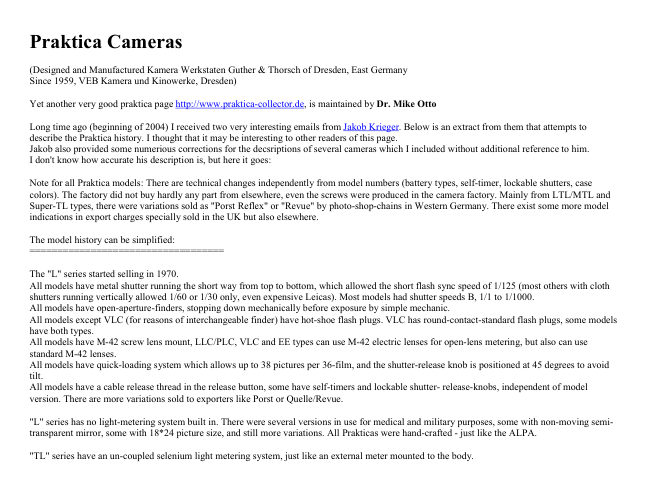
Praktica Cameras

(Designed and Manufactured Kamera Werkstaten Guther & Thorsch of Dresden, East Germany
Since 1959, VEB Kamera und Kinowerke, Dresden)

Yet another very good praktica page http://www.praktica-collector.de, is maintained by Dr. Mike Otto

Long time ago (beginning of 2004) I received two very interesting emails from Jakob Krieger. Below is an extract from them that attempts to
describe the Praktica history. I thought that it may be interesting to other readers of this page.
Jakob also provided some numerious corrections for the decsriptions of several cameras which I included without additional reference to him.
I don't know how accurate his description is, but here it goes:

Note for all Praktica models: There are technical changes independently from model numbers (battery types, self-timer, lockable shutters, case
colors). The factory did not buy hardly any part from elsewhere, even the screws were produced in the camera factory. Mainly from LTL/MTL and
Super-TL types, there were variations sold as "Porst Reflex" or "Revue" by photo-shop-chains in Western Germany. There exist some more model
indications in export charges specially sold in the UK but also elsewhere.

The model history can be simplified:
===================================

The "L" series started selling in 1970.
All models have metal shutter running the short way from top to bottom, which allowed the short flash sync speed of 1/125 (most others with cloth
shutters running vertically allowed 1/60 or 1/30 only, even expensive Leicas). Most models had shutter speeds B, 1/1 to 1/1000.
All models have open-aperture-finders, stopping down mechanically before exposure by simple mechanic.
All models except VLC (for reasons of interchangeable finder) have hot-shoe flash plugs. VLC has round-contact-standard flash plugs, some models
have both types.
All models have M-42 screw lens mount, LLC/PLC, VLC and EE types can use M-42 electric lenses for open-lens metering, but also can use
standard M-42 lenses.
All models have quick-loading system which allows up to 38 pictures per 36-film, and the shutter-release knob is positioned at 45 degrees to avoid
tilt.
All models have a cable release thread in the release button, some have self-timers and lockable shutter- release-knobs, independent of model
version. There are more variations sold to exporters like Porst or Quelle/Revue.

"L" series has no light-metering system built in. There were several versions in use for medical and military purposes, some with non-moving semi-
transparent mirror, some with 18*24 picture size, and still more variations. All Prakticas were hand-crafted - just like the ALPA.

"TL" series have an un-coupled selenium light metering system, just like an external meter mounted to the body.
View original page 1
Page 2 · Read text
"TTL" series has an internal light-metering system, a semi-integral centered system built into the prism, coupled but to be used with an extra stop-
down-shift, which allows to view the real depth of field on working aperture. Variations are "Super-TL" with highest speed of 1/500, and "MTL"
with LED exposure control indicators instead of electromagnetic pointer. LTLs were sold a lot by Porst and Quelle (Revue) under "OEM" label.


"LLC" series had an open-aperture-metering system in connection with M-42 electric lenses (or Tamron LLC adaptor). The metering system is very
similar to the LTL one, except for the missing metering-and-shut- lense-knob. Metering was done by slightly pressing down the shutter release
button. Later versions were names "PLC", some had LED metering indicators.

"VLC" series worked like "LLC", using electric lenses of LLC type, but had interchangeable finders (prism, top-view, magnifying adapters) and
independently interchangeable screens (clear, raster, fresnel, split-view). Therefore, the metering system was re-engineered, the light was taken out
from a semi-transparent section of the mirror, which resulted in spot-characteristic rather then semi-integral. Note that unlike many other
interchangeable-finder-cameras, the internal open-lens-metering works on any finder you wish to use. VLC had no hot-shoe, but round standard flash
contacts and a hot-shoe to be stuck on top as accessory (still I recommend to use a flash-grip, better!).

"EE" series were just like the LLC, but with automatic shutter-speed, according to the selected lens stop. They could as well be operated fully-
mechanically without battery. They had most advanced features of the series like exposure compensation, a shutter blind for the finder (to avoid back
light when used on tripod) etc. Unfortunately, the electronic was as reliable as the one of a recent BMW car - there are few really good working ones
around. Forget the EE for everyday use. All other models are still reliable if in good shape, despite of the poor economical power of East Germany in
the days they were produced.

Later Prakticas used the mechanics of the "L" series, but instead of M-42 screw mount, a bajonet fit which no other producer copied yet. And they
used more plastic, more electronics - forget about it.

Although there are things one can love on a Nikon or a Leica, I am using my VLC all the time, and I am using it professionally, too (for 24*36, else I
use a Linhof), and I am pretty sure that this dinosaur will not leave me alone even if I'll reach a grandpa's age. Anybody who doesn't love it should
sell it and get an Ixus Dig.

There is something more to say - roughly, the "L" series started in 1974, the "L2" in 1976, the "L3" in 1978 (there was a variation of the LTL3 called
"DTL3" with LED metering indicators - due to material lack, later models had the old pointer instrument again).
There was no "L4" series, instead the "B" types were introduced, which technically were alike the "EE" with smoother design, smoother quality
(lower flash sync time because of weaker shutter mechanic, but bayonet instead of M-42, something one would have wished BEFORE the zoom
lenses came up - then, and also today, nobody had the need anymore for a quick lens change) in some better and worse variations.

From ca. 1980 on, the "LTL" versions "MTL5" (and some "MTL50" with LED indicators) were sold as entry Praktica models, all other variations of
the "3" generation were discontinued in favor of the "B"-types, which had problems because of electronic control - Eastern Germany was imposed on
a ban to buy electronic parts elsewhere (COCOM list).
View original page 2
Page 3 · Read text
The last "MTL"s and "B" were built about 1990, then the factory was downed instead of modernizing it to a top-quality brand (note that from
Praktica and Zeiss Jena came the production blue-prints for Tamron lenses, Bronica cameras and so on).

Some background-information about the end:
==========================================

Praktica cameras, production and development died in the early 1990s, shortly after the GDR (East Germany) was annexed to the (western) Federal
Republic. During this process, all industry of Eastern Germany was erased by the neo-conservative "re-unification"-politicians, which caused a crisis
that Germany still today suffers without an idea of how to re-furnish the budget, how to get the East employed, how to re-populate Eastern cities, etc.
This is why there are no more Praktica cameras now, there is nothing left today than the label on cheap Chinese plastic cameras (film and dig).

What happened with the cameras?
===============================

At first time after when the East was annexed, you could get any Eastern product for free or almost for free - cars, for example. The cameras flushed
the used-camera-shops. You could make good business buying one. Mint LLCs cost about 20 US$ - far beneath value. But this didn't last long. In
South-Eastern Europe, Hungary, Romania etc., Praktica used to be the GOOD brand nobody could afford - there the Russian Zenit etc. had been sold
before, not real bad cameras, not at all (the lenses had been constructed at Zeiss Jena, too, like for Praktika, Tamron, Bronica and many more
Japanese brands), but the Russian cameras had severe problems with product quality. Parts broke which really shouldn't have done this, new lenses
had to be re-adjusted to focus, shutters hung because the lubricant or even some parts were missing - ok, a Zenit or a FED which once worked may
work for 300 years, but most didn't when they left the plant. Excellent (yet simple) constructions, but poorly-made.
Ok, these people had always dreamed of a real Praktica, and they bought the whole stock after the state borders opened for them. Also Italians, who
always belonged to the "west", but still prefer simple cheap technique and spend on excellent food rather (if you ever travel to Italy - eat!), bought a
lot of these Prakticas.
Today, in Germany it is not easy any more to get a good Praktica for a good price (ok, the MTL5 you can get, but this type had faults in quality as it
was sold as the cheap brother of the "B"s), and someone like me who owns TWO good and functioning VLCs is a lucky guy. Yes, I use the VLC
professionally (journalist, media-designer and artist), and people always ask "hey, what equipment do you use, these results are excellent" - of course,
I use a camera which doesn't try to think for me (but cannot) - this simple. I'd never take a Leica to bad places (like Yugoslavia in war-time - yes, I
luckily survived, but I also wanted to KNOW what is happening next to me).
Good mechanics must work even in hell, and the Praktica "L" types do. This is what makes them to have so many friends.

What I have done to my Praktica equipment? Well, I got some really fine Tamron lenses, a 24 mm which hardly distorts still, a light-weight and
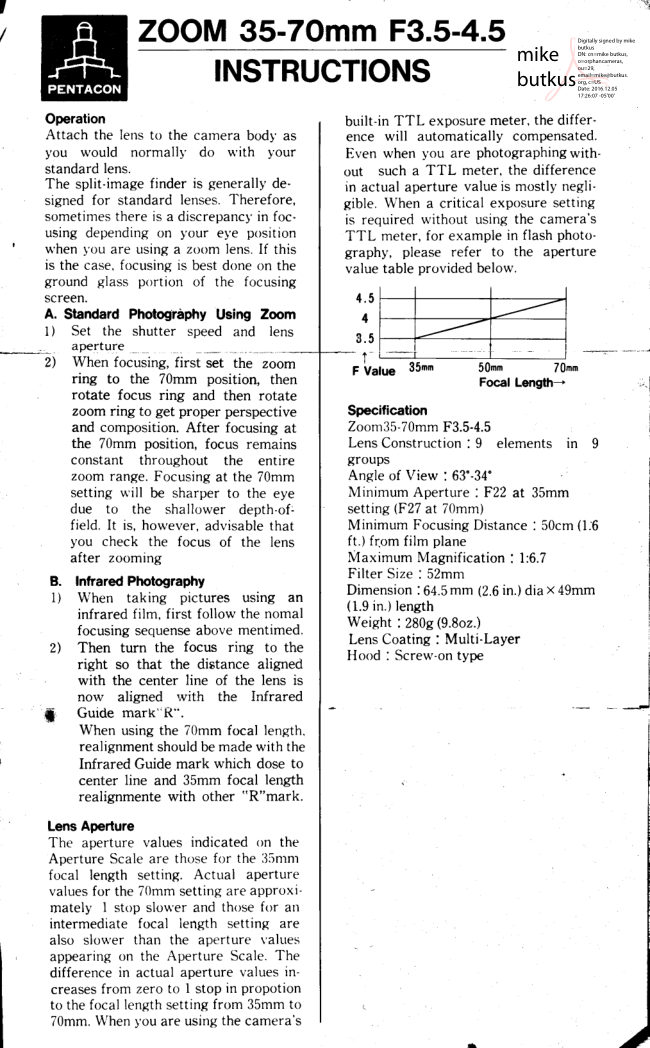
small zoom 35-70 (all at f3.5) which kills most of the tasks, and the big and heavy old zoom 35-210 which is sharp through all from wide to real-tele
at virtually no light-loss - show me another 210 mm zoom lens with f4. For this, I do carry all this glass. At 95% of time, I use this old-fashion top-
view-finder, after getting used to it, you appreciate this view of a picture in a frame instead of the very subjective telescope view with a pentaprism,
which makes you unaware of tilt and picture composition. Oh, I had somebody to cloth my VLC with fancy French goat leather, looks better. Next
modification will concern the battery (all LLC / VLC / EE), the original one is an ecological hazard, based on mercury and acid. But since (except
EE) the measuring system is built as a Wheatstone Bridge, which is a differential measuring system, where the currency between the light-sensitive
View original page 3
Page 4 · Read text
photo cell is adjusted which a variable resistor to ZERO currency running through the meter, the power supply voltage is secondary. It should work
with no modification (except for battery size) with a long-lasting lithium cell 100% fine.

Ok, the finder is smaller and darker than the one of a Canon EOS. This is where the photographer's skill is asked for. Anyone can use a Polaroid or a
Dig. And anyone can press on a Praktica's release button. The difference is, that a pro or an ambitioned amateur can do magic with a Praktica or
similar cameras, but with a Pol or a Dig, there is no chance to get better results than a bum who can't even spell "cheese". Ok, there are digitals in
studio quality, I don't speak about these. I also use a Linhof 4x5" for real good results, but this is a completely different level.

Due to economical problems, they never came along to build an unchanged series over one, two years. Out of five Prakticas with same model brand,
you'll find two or four variations in build.

Praktica is a classic. Exakta and Praktica (both of neighbor breed) were the first 35mm-SLRs ever. Leica was earlier on 35 mm, but only with its
range-finder model (still good). Everybody who views his/her dog named Boo through the lens, uses the heritage of Praktica. It is very sad that the
plant was grounded.


Praktica, 1949-??

(Similar to post-war Praktiflex, but different mount and better construction)
Shutter: 1/2, 1/5, 1/10, 1/25, 1/50, 1/100, 1/200, 1/500, B
Flash: none (synch terminals on bottom of later models)
Metering: none
Finder: Waist-level viewfinder, condenser type ground-glass
Battery: none
Non automatic diaphragm
No instant return mirror (Mirror returns with film advance)
Knob film advance

The first Praktica model with the M42 mount. Earlier Praktiflex (1938) used smaller 40 mm lens thread.

Praktica, 1952-??

Similar to the previous model, but improved viewing optics and magnifier
View original page 4
Page 5 · Read text
Praktica FX, 1955-?? (Prakticaflex FX, Astra 35 FX, Rival Reflex)

Waist-level viewfinder, condenser type ground-glass
Shutter: 1/2, 1/5, 1/10, 1/25, 1/50, 1/100, 1/200, 1/500, B
Flash: There have been different versions of the camera with different flash contacts.
Earlier version - F and X non standard contacts in the base
Later version - 3 non-standard flash contacts on the camera front: F at the bottom, X at top and neutral at the centre
Another version adopted the standard 3 mm contact and had one socket for X sync only.
Flash sync at 1/40.
Metering: none
Non automatic diaphragm
No instant return mirror

Praktica FX2, 1956-??(Practiflex FX2)

Pentaprism could be fitted on the view-finder
Shutter: 1/2, 1/5, 1/10, 1/25, 1/50, 1/100, 1/200, 1/500, B
Flash: Standard F and X Flash contacts
Metering: none
Non automatic diaphragm / some models were made with automatic diaphragm

Praktica FX3, 1957-??(Practiflex FX3)

Same as FX2 but with automatic diaphragm

From Erik Jakobsen:
Finder equipped with fold-up-lens for holding camera directly to the eye; not only for 'Waist-level' focusing, also a simple fast-viewfinder by opening
the 'top'cover of the finder + a small slide-up thing right behind the ground-glass; not TTL view. The shutter speeds selected in the same way as
described for model 'IV' by Jugean Patrick and same speeds. By the way, someone told me years ago, that there are also different types FX3; one of
them like mine called 'F.X3' , don't know if it's true.

Praktica IV, 1959-??

Pentaprism become permanently attached to the body
Has both the knob-wind on the top and the lever-wind on the base plate
Flash: Standard F and X Flash contacts. Synchs are 1/30 for F and 1/40 for X (marked with the flash symbol on the shutter dial)
View original page 5
Page 6 · Read text
Several models were made: IVB, IVM, IVBM, IVF and IVFB
B - expose meter, selenium cell at the pentaprism front, needle next to the rewind knob
M - Split image range fined
F - Split image range finder surrounded by the ground glass collar. This model introduced the Fresnel lens over the viewing screen. Unfortunately,
there was no ground glass. As the result
the screen area outside the range finder can't be used for focusing.

Shutter: 1/2, 1/5, 1/10, 1/25, 1/50, 1/100, 1/200, 1/500, B
Shutter (F model): 1/2, 1/4, 1/8, 1/30, 1/60, 1/125, 1/500, B
(note that there is no 1/15).

Automatic diaphragm
No instant return mirror

From Jugean Patrick:
The IV F I recently acquired has the following shutter speeds: B, 1/2,1/5, 1/10, 1/50, 1/100, 1/200, 1/500, syncro and 1/25. The speeds 1/25 and
above are in black and those below are in red. The red & black pointers on the shutter dial are selectors. Both the speed 1/2 and 1/25 share the same
spot ( a red dot between 1/25 and 1/2 ). If you select the black pointer, you get the shutter firing at 1/25 and 1/2 if the red pointer is selected.
A bit of warning: the 58/2 biotar does not fit the practika I have - its screw mount is too deep and blocks the mechanism.

Praktica VF, 1964-??

Same as IVF but with the instant return mirror.
Model VFB (VF with the selenium meter) was also made at the same time

Praktica Nova, 1965-??

New body form: lower line pentaprism, lever wind on the top, shutter release button at an angle
at the camera top. The rewind knob now incorporates conventional fold-out crank. The back was hinged instead of being detachable as in the older
models. The exposure counter become self-zeroing. The ground glass was put under the Fresnel lens so the whole screen image could be used for
focusing. A lock was incorporated in the release button.

Flash: Standard F and X Flash contacts. Synchs are 1/30 for F and 1/40 for X (marked with the flash symbol on the shutter dial)
Shutter: 1/2, 1/4, 1/8, 1/30, 1/60, 1/125, 1/500, B
(note that there is no 1/15).
Metering: none, but Nova B model has buildin selenium meter.
View original page 6
Page 7 · Read text
Automatic diaphragm
Instant return mirror

Prakticamat, 1965-??

Introduced the through-the-lens metering using a beam splitter to divert part of the light entering the lens to a CDS cell. (Hence, the light entering the
viewing eye-piece doesn't influence meter reading).
The shutter speed range 1-1/1000, unusually set on a disk surrounding the rewind knob.

Praktica Electronic, 1966-??

Same as Nova, but with electronically controlled shutter from 30 to 1/500 and mechanical speed of 1/60 for X & F sync.

Praktica Nova I, 1967-??

(Hanimex Nova I in USA, Cavalier SLR-II in USA )
Introduced usual shutter knob with speeds 1-1/500. (The older models had a separate knob on top of the shutter speed knob. When the arrow head on
this knob was set to the black marker, the faster speeds were obtained. When it was set to the red marker - slow speeds 1/2 - 1/8 (1/10) were set).
Introduced the quick load system. Now all which need to be done is to place the film leader on the take-up spool so that the end of the film lines up
with the mark below. Then close the camera back. And that's it!

Nova IB has a build in selenium meter.

Pentaflex SL, 1967-1968?

(also Porst Reflex FX 3)
Similar to Praktica Nova I, but shutter speeds 1/30-1/500, B

Praktica Super TL, 1968-??

(Cavalier STL-1 in USA, Pentor Super TL in Netherlands)
The split image range finder was replaced by a microprism type focusing screen.
Flash: Standard F and X Flash contacts. Synchs are 1/30 for F and 1/40 for X (marked with the flash symbol on the shutter dial)
Shutter: 1, 1/2, 1/4, 1/8, 1/15, 1/30, 1/60, 1/125, 1/500, B
Metering: TTL stop-down metering (different version from the Prakticamat, so the light entering the viewfinder eyepiece may affect the meter (but
usually it doesn't), as in most others cameras).
View original page 7
Page 8 · Read text
Automatic diaphragm
Instant return mirror
Quick load system

Praktica L, 1970-??

The new body shape - more compact with straight lines and squared corners. New shutter - vertically moving metal shutter (it was cloth horizontally
running shutter before). Coaxial flash contacts were removed in favour of a single, X-sync. contact in the fixed accessory shoe. The rewind button
was moved to the base of the camera. The automatic diaphragm mechanism was of the new design. Now the diaphragm would stay closed until the
shutter closes. Before, it would stay closed only while the shutter release button is depressed. This could cause incorrect expose if the shutter release
button was released during the long expose.

Flash: X Flash hot shoe. Sync is 1/100 (marked with the flash symbol on the shutter dial)
Shutter: 1, 1/2, 1/4, 1/8, 1/15, 1/30, 1/60, 1/125, 1/500, 1/1000, B
Metering: none
(LB model has built in selenium meter)

Automatic diaphragm
Instant return mirror
Quick load system

Praktica LLC, 1970-??

Same as L, but has a TTL metering at full aperture with the lens design for this model. Stopped-down metering with the ordinary screw-mount lens.
The special lenses have electrical contacts transmitting the aperture setting to the meter. The meter switch is incorporated into the shutter release
button.
The battery is relatively large Mallory PX21 4.5V alkaline battery (may not be available now(?)).
The life of the battery was estimated to be 1 year.
Self-timer was introduced for the first time in Praktica.

Note from Ken Hancock: I have recently purchased a new battery for this camera (28th October 2000) as a Panasonic PX-21, so it is still available.

Note from Larry: I have a great place to get these Batteries for the LLC it is radioshack.com. It is listed as a PX21. It is only available online and not
in their stores. It is still used as a Memory Battery in some Apple Computers. Larry
View original page 8
Page 9 · Read text
Work with the automatic diaphragm lenses on LLC model is not easy. Three operations need to be done simultaneously:
1) Depress the shutter-release button to switch on meter.
2) Operate stop-down switch on the lens (and it may not be available!).
3) Operate aperture control or shutter speed dial to centre the needle visible in the viewfinder.

Praktica LTL, 1972-??

Same as L but has a strait forward stop-down metering as Super TL and self-timer as LLC.
The meter uses PX625 (as Prakticamat and Super TL) battery and is controlled by a switch beside the lens mounting above the shutter release.

Praktica PLC2, 1976-??

Same as LLC but better finish

Praktica PLC3, 1978-??

Same as PLC2, also uses match needle.


Praktica L2 and LB2, 1976-??

(Photo by courtesy of Joyce)
Same as L and LB but better finish.

Praktica LTL2, 1975-??

Same as LTL but match-lights instead of match needle.

Praktica LTL3, 1976-??

Updated version of LTL2.
View original page 9
Page 10 · Read text
Praktica VLC, 1974-??

Interchangeable finders and screens
Flash: F and X sync (1/125), but no hot shoe. (hot-shoe was provided as acessory mounted above rewind crank).
Shutter: Metal, 1-1/1000,B
Metering: TTL aperture open metering with electrical lens (same as LLC). Stop-down metering with other M42 lens.

Automatic diaphragm
Instant return mirror
Quick load system
Variations: Some have lockable shutter release knobs, most have self-timer


Praktica VLC 2, 1976-??

(information by courtesy of Chris Eve)
Interchangeable prism and screens
Flash: X Flash hot shoe. Sync is 1/100 (marked with the flash symbol on the shutter dial)
Shutter: 1-1/1000,B
Metering: TTL aperture open metering with electrical lens (same as LLC?)

Automatic diaphragm
Instant return mirror
Quick load system

Praktica VLC3, 1978-??

Same as VLC2 but with split-image rangefinder

Praktica MTL3, 1978-??

Same as LTL3 but with split-image rangefinder and second sync terminal
View original page 10
Page 11 · Read text
Praktica DTL2, 1978-??

Same as LTL3 but with match-LED

Praktica DTL3, 1978-??

Same as DTL2 but with with split-image rangefinder and second sync terminal

Praktica Super TL2, 1976-??

Update of super TL with L-series body and metal shutter
Flash: Standard F and X Flash contacts, hot shoe, sync at 1/125.
Shutter: 1-1/500, B
Metering: TTL stop-down metering

Automatic diaphragm
Instant return mirror

Praktica Super TL3, 1978-??

Same as TL2 but with with split-image rangefinder and second sync terminal


Praktica Super TL 1000, 1980-??

Same as TL3 but with top shutter speed of 1/1000 and without second sync terminal.

Praktica Super TL 500, 1981-??

Same as TL 1000 but with top shutter speed of 1/500.
View original page 11
Page 12 · Read text
Praktica EE-2, 1975?-??

Automatic and manual exposure camera.
Shutter: Metal, 1-1/1000 stepless electronic and 1/30-1/1000+B manual and mechanical.
Flash: Standard F and X Flash contacts, hot shoe.
Metering: TTL open-aperture with Pentacon electric lens
Automatic diaphragm
Instant return mirror
Self-timer
View finder blind
Has aperture priority exposure.

Praktica EE-3, 1979-??

Same as EE-2 but with split-image rangefinder and second sync terminal

Praktica MTL 5 (or 5B) (Revueflex ML, in Germany), 1984-??

L-type body and match-needle
Shutter: Metal, 1-1/1000, B
Flash: Standard F and X Flash contacts, hot shoe, sync at 1/125.
Metering: Stoped down TTL metering, CDS cell
Battery: MTL-5 - Rx625; MTL-5B - R76 or SR44
Automatic diaphragm
Instant return mirror
Self-timer
Diagonal split-image range finder and microprism.

Praktica MTL 50, 1985-??

Same as MTL 5, but with match-LED
View original page 12
Page 14 · Read text
Meyer Orestegor                            500                            5.6                                 Preset
Zeiss Catopric Lens                         500                       4                               Fixed
Zeiss Catopric Lens                         1000                           5.6                             Fixed
Note 1. Apparently not all lenses are listed in the above table. A saw several manual diaphragm lenses of Meyer (50/2.8 and 100/2.8) and several
more are mentioned in [1]. This table is the copy of the table on page 275 of the [2].

Note 2. According to [2] all Meyer lenses will eventually be known as Pentacon lenses for the non-electric models and Pentacon Electric for the
Praktica LLC.

Note 3. Of course, all screw mount lenses can be used on the Praktica cameras. (See, however, note about LLC).
View original page 14
Related documents and language editions
From the M. Butkus archive. Original publisher and archive notices are retained.
Check the model and edition against your equipment.
PDF verified 2026-10-10.