Film cameras
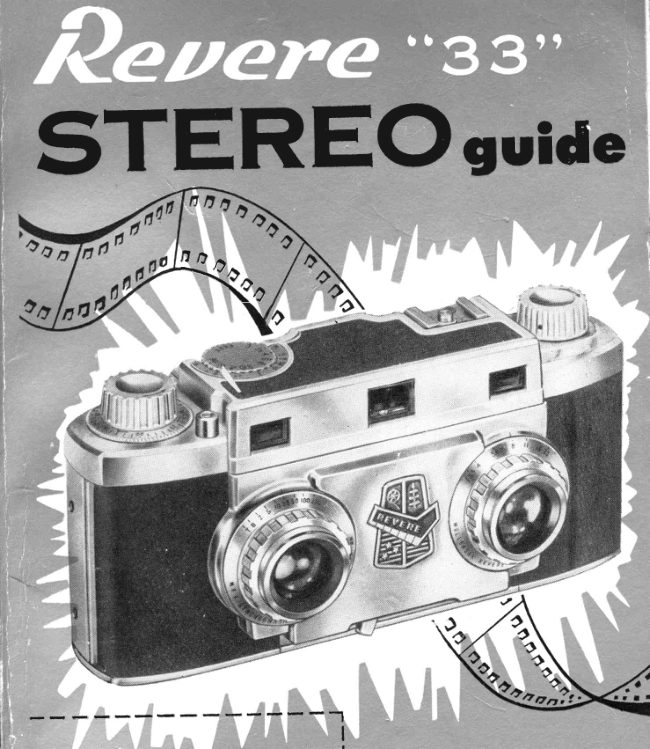
Revere 33 Stereo Guide Reference guide
Reference guide for Revere 33 Stereo Guide. 64 pages in English. Read the original PDF, download or print a copy without registration.
64 pagesEnglish6.4 MB PDF
Loading your manual…Open PDF directly
Document details
- Brand
- Revere
- Model / document
- Revere 33 Stereo Guide
- Document type
- Reference guide
- Language
- English
- Pages
- 64
- File size
- 6.4 MB
- Category
- Film cameras
- Document date
- Not specified in catalog
Search available document text
Find a term, then jump to its page in the original PDF. Image-only pages may not be searchable; check the PDF for exact wording and diagrams.
Page 2 · Read text
Tntroduction

Why should you choose a Revere 33 Stereo as your own personal
camera? Every manufacturer will tell you that his model is the best,
but it is the using of the camera that proves to you which one is the
most adaptable for your purposes. Unfortunately, you cannot give
every camera a trial run in order to arrive at a conclusion. Therefore
you must determine your choice on the basis of the actual design
features.

It is presumed that you have come to realize the magic of stereo
photography—how it reproduces a picture with a startling reality of
truelife images—how it outmodes the usual type of flat-plane photo-
graphs by duplicating the subject in its actual perspective—and how
it gives you the sensation of seeing the object rather than its picture.
You are “sold” on the idea of stereo, so you are buying, are about to
buy, or have bought a Revere 33 Stereo. If you have been a careful
investigator of all stereo camera characteristics, and have decided that
the Revere meets all your requirements, then you will have been con-
vinced that the following features outweighed those found in any other
stereo camera:

1. The Revere has an automatic film wind and shutter cocking.
This means that you need never lose a picture because you forgot to
cock the shutter. So long as the film is wound in the Revere, the
shutter is always automatically cocked and ready to take the picture.

2. A superimposed image rangefinder quickly and clearly shows the
position of sharpest focus.

3. A focusing wheel is conveniently located for easy turning with
the thumb. Its location eliminates the chance of accidental focusing-
wheel travel into an out-of-focus position.

4. A double exposure is prevented by means of a coupling of the
film wind and shutter cocking.

5. Intentional double exposures may be made when needed for
trick effects.

6. Intentional separated exposures may he made for both hypo-
(close-up) and hyper- (long distance) stereo.

7. Simplified loading assures the full number of exposures.

& The camera is flash-synchronized for all flashlamps and flash-
tubes.

3

‘www orphancameras.com
View original page 2
From the M. Butkus archive. Original publisher and archive notices are retained.
Check the model and edition against your equipment.
PDF verified 2026-10-10.