Film cameras
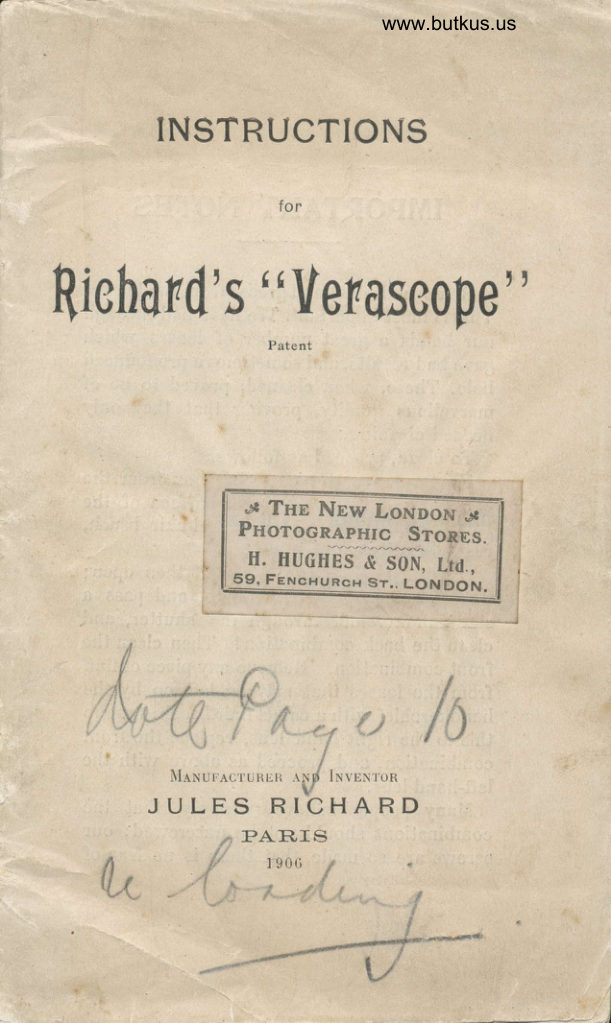
Richard's Verascope 1906 User manual
User manual for Richard's Verascope 1906. 46 pages in English. Read the original PDF, download or print a copy without registration.
46 pagesEnglish3.3 MB PDF
Loading your manual…Open PDF directly
Document details
- Brand
- Various brands
- Model / document
- Richard's Verascope 1906
- Document type
- User manual
- Language
- English
- Pages
- 46
- File size
- 3.3 MB
- Category
- Film cameras
- Document date
- Not specified in catalog
Search available document text
Find a term, then jump to its page in the original PDF. Image-only pages may not be searchable; check the PDF for exact wording and diagrams.
Page 2 · Read text
IMPORTANT NOTES

  Remove all dust and grease from the lenses'
This is most important. We have had through
our hancls a great nurnber of lenscs rvhich
gave bad results, and sometimes a pronounccd
Lalo. These, l-hen cleaned, proved to be of
marvellous quality, proving that they only
needecl clcaning.
  To clean, proceed as follos's.
  First remove the clranging box from the
camera, and clcan the inner surface of the
bacli combinaLion rvith a camel-hair brush,
removing all dust,.  '                                          '
  Set the shutter to time, and then open;
unscrerv the front combination, and pass a
silk handkerchief through l,hc shutter, and
clean the bacli combination ! Then clean the
front combination- Removc any pier:c of fluff
from the lenses that may be let't on by the
handherchief rvith a camel hair brush; first do
this to the right hand lens, replace the front
combination, and proceed as above lvith the
left-hand lens.
  ilIany people believe,  wrongly, that the
combinations should not be unscreu-ed; our
scre\\-s are so made, that there is no fear oI
View original page 2
Page 4 · Read text
Venmo @mike-butkus-camera  Ph. 2083
PayPal Name  Lynn@butkus.org      www.PayPal.me/lynnbutkus
View original page 4
Page 5 · Read text
I TSTR U CTION S

           CHARDVE:RASCOil ;I
             Fatent S. G. D. G.

  'l'hese inst,ructions enables the \-eretscope
to lre used irr-rmetlia[el;' al'tcr prtt'cllaso.


                                www.butkus.us


    T'h e pri n r:  i pal poin Ls of Ilrc various opera-
 l.ions are fulh. given.    l}y' aLLentivcly rcading
 l'or a fen' rninutes th o I'ollorving, one can bc-
View original page 5Page 7 · Read text
-6-
           mera, it is advisable to keep it locked, and also
            to prevent any fear of it flying open and thc
          Verascope falling out.
                    ?2 2. Yery important.    Before passing on                                     -             to the clescrip[ion of the Verascope, it lvould
           be as rvell to first explain the method of chan-
             ging' the plates. 'I'o lcaln this, ib is unneces-
            sary to load the chang'ing box r-ith plates as
         the ernply sheaths s'ill ansl-er the purpose
            just as rvell, and the neccssily of learnine the
           operation in l.hc dark room is dispensed rvith,
          and all l,hat is to be lcarned can be learnecl in
          broad daylight.
                 Follor,v the instrucLions exactly. Alu-ays do
          every rnovemenL completely, but never use
          force. If the Verascope be held quil,e lcvel,
              t,he lenses pointing tou-ards the sky, ancl lhe
          camera firmly grasped u'ith the left hand hold-
           ing the chang;ing box, no difficulty will be
          experienced. If the camera be tilted at'all,
           alrvays depress l,he handle of the changing
             ltox, for, if the handle end be elevatetl, there
               is a danger of brealiing the plates, anrl bcnd-
           ing llre sheatlrs.
                     I1' any resistance be felt rvhen closing the
              dra\\', pull ou[ the drarv again, and give thc
          camera a gentle shake, rvhich rvill cause the
            sheath to assume its proper position ; the drarv
          can be closcd  t.
                        (1) A sheath that has been bent should nevcr hc uscd, as i[ is
                  liable to scratch thc platc l-reneath  rt, rs it, plsses olor  it rlrrlirrg
                 changing.


I


I

I

                                                      -#,,t
View original page 7Page 8 · Read text
www.butkus.us


                                 7
                             When  2 3. To Load the Changing Box
 sold the Verascope is not loadetl  ; the changit g
box contains tn-elve nretal sheal,lts, l,he plates
  f or n-hich must l,e purchased"
  Note  The loaditg and unloaditrg must
 alr\-a.r,s be done in tot,al clarlincss, or in a darli
room furnished u-ith a recl (or grecn) lamp.
  The Regular Model  A. 'l'o remove the
changing box from the camera, lift the spring
that rvill be founcl close to the plate indicator


                                                                           I,   i il.    t).
near the handlc (fiS. 5) ancl slide the changing
lror out, until one feels a Iil,tle resistance pro-


          www.butkus.us

                                                    4,
ducetl lr)'the velvct liglrt trap ; do not try to
overcome this resistance by pulling out the
View original page 8Page 9 · Read text
changitrg box l'orciblv,  lru t pa ss  i I gen tly or.er
 I h e velr-et.
   If the changing box be pullod righl. oul, in
one movemenl,. therc is a tlansor of tearing t,hc
velveL.


                                     ig.  ii.
  Ilaving romor.erl l,he changing lrox   :
     Il . Withdra\\- l,he lii,tle metal bar that closcs
the opposite encl to l.he handle, using lhe nail
                                         11.as shou-n in figuro
  C. To removc the shcaths, [alie [he changing
box by the handle (fi9. ir) ancl partlr. u'ithdra\v
View original page 9Page 10 · Read text
www.butkus.us


                                                             ()
the dran' alrout one qllart,er of ilre \\-a], ancl
closc ag'ain ; tlre sheat,h u.ill bo pushed out of
 tlrc slo[, antl can llren lrc ollsilr removctl. ller-
llent tlre o[)erat,ion thrce or firrrr Iirnes unlil
tlre sht'al,lrs aro lrll rcmor.ed. ll'o remo\.e tlre
last l'e\\',  i I rnay bc rlecessar.\- lo  I,ill. ancl shalie
Lhe chang'irrg' box (fig. {i).


                                       l"is'  ;   '
  D. I)ul l,lre plnles inlo tlrc slrcaths, antl place
salne in  u-illr Ilrc scnsitir-c e'elaline surlar,e
r-lppcrrrlost   ( fig. 7 )., arrtl carcl'ully rornovo a n)'' clust
[,hat l]raJ'lravc adlrererl to Llre emulsion, and also
sce thaL r'ro small ptrrliclt's ol'glass arc on the
s u rl'a ce.
  H. Ilar-ine' loaclcd the sheatlrs, relrlace them
View original page 10Page 11 · Read text
'l ()
int,o the changing box. Iloltl the r:ha ngirtg
box in Lhe lef't, hancl (fig.8) and in[rotllrco  thtr
shca[hs through the opening, being caret'ul  t,o
hold the sheaLhs by their edgcs.
  Alu,als load the bo-rjr,i[h [he shcaLhs having
the turnecl u1t cnd in firs[, antl the plato uppcr-
most. 'fo geL t,he last four in, drarv out l,he
shuLter thr:ee quat'lcrs of thc \\'fl)'lry dt'alving
or) S (fig. { ), prcss lig}rtly on the shcatlts as
[he;. enter. Cover [lrc finger rvith dty paper
l'ol t,his purpose, ttntl aln'ays prc$s cln Iho cc'nl,r(r


                               Fis. 9.

ofthcslteath. IJecarel'ul notto scratchtheplatc
rvith the finger nail. Be \rery careful noL to fin-
gernlark the plate, &S this shou-s afLer develop-
ment, ancl ruins the ncgative. By means  o{'
pressing the sheaths alreacly in the changitg
box, all l,tre sheaths can be inserted. Alrvays
put them in closed encl (or turned up end) first,
ancl never fail t,o puslr rt-r,ll ltome,
View original page 11Page 12 · Read text
www.butkus.us


                                                           ,1 I
   F'. Replace Lhe little metal bar. If the l:rst
sheath is not completely home, [o insure tltis,
tlra\\' ouL Lhc dr':ru' by tlre handle a little \\-ay
(fiS.9), u'lten the metal co\-er u'ill slide in
easilr-.
  G. To replace the cltanging box, put tlre
shu[ter o1' the cltanging bor otr, nexb take thc


                                     l'ig. 10.
chang'ing box in thc righl, hand (fig. |0) the
botly of the camera in l.he lcf[, slide the chan-
ginf+ bor in Lhc groo\'o antl push n'ell hotne
until the catclt holtls iL in position.
  1{. Il' l.hc plarte inrlicator is oI tltc ittttomatic
type, anrl il, cloes not register I2 (rvhich coI'res-
ponds to 0) change plates until it cloes. In the
case o1' the ordinary indicator, set it rvith tlte
finger
  tfodel1900 and l905  To remoYe the chan-
ging box from thc camera, turn the lever by
the light trap close to the autotrtatic indicator;
lil't the little rebatc l,hal. holds the shutter of
the Nfagazine, ancl slicle out the changittg box
lilie a drarv ju,st till the resistance is felt, to
avoid tearing the velvet lhat forms l,tre light
View original page 12Page 13 · Read text
12
  trap, d.a\\-iL ouL gcntly. The loarling is cl.ne
                                                                                         .1 as dt.'scribecl on pagcs 7 t,o                      0 po.ngraphs
  IJ.c.D.li. tr. when the changing box ir.{rtaced
 as per page l(l e (i, put do*.' thc rcl-rate
 again, and replace th c lever i'  r,he original
  posi Iions.
   a 4. To take a picture.  The use of the
 two finders.   The camora is no*, loacled ancl              -  reacl;' for use.                   Tlre picture can be talien eiilrer
 at ele levcl or fro'r llrc le'cl of the breast.
     T'lte pir:l,L(,re tul;ert ut tlrc lt.eiglrl ol. tlrc bt,cr,tst.
 __ Ilold the \'-erascope in the t*'o hands at tre
 height of the Lrreast, ancl point it at, t,he sub-
 ject and man@uvre until it is seen cntir.ly in
 t,he finder (fis. il ); trvo lines clr*rv' at right


                                    www.butkus.us

angles [o one anotlrer across ilrc fincler enable
t he subjcc  l, to lle ccntrecl
    T'lte Ttir:lut,c tcrl,:en, trt e!/e lcuel. To talie a
pictLrre i'this  posir,ion,  lift, the t:loar. finrler,
    thc siehter on thoir hi'ges rrntil they are"i,1.
at.righl, ansl*s to the bocly o{'tlle oamera, Next,
take the camcra in tlre  f rvo frantls, arrcl holcl  it,
View original page 13Page 14 · Read text
www.butkus.us

                -13-
  in such a position, that the sig.hter is close to
  the left eye, and the vert,ical line on the finder
  passes dorvn Lhe rniddlc ol'ilre picl,ure. The
 .new pallcrn finrle.r that gives lhc picture the
  propcr \\'ay up, and not upsidc doln, rvhich rve
   fit to order, neccssitales tle sie.hter being very
  near the eye. Ilaving the picture in the"firrder
  just as seen by the naked cye enables phol.o_
 graphs to be talien .r,ery quickly, and thus ena-
 bles pictures to be secured blfore people in
 ,Jr. vicinity of the photographer      urun." that they are included.              "r.
   General observations.    \\rhen taliing pho_                          - tographs, the fact l,ha[ near                               objects wlll'not
 be in focus must ne\rer be forgotter-r. The Zeiss
 lenses are in focus from g l[et to infinity. If
 the objects that are rvithin ilris clist,ancl are
 on the side ol'the picl.rrre anti not in the cenlre,
 thcy can be ig'norecl. In lhis \\.illr it is possible
 to havc the ohjects very near in th; sides,
 and the distance in the centre. 'Ihis rnahes the
 stereoscopic eflect bel,ter, and enhances the
 arl,istic r-alrrr'.

  Risingfrontof the 1903 and Z>-l|models.
  When iL is rlesirable to cut off the fore_-ground, or to talie a high mounlain, or to
reduce lhe amount of sliy, or l,o take a sub.ject
lielorv the camera without l,ilting ilre camera,
the front is raised, throning l,he'lense, out oi.
lhe centre of the plate,
                                                                                                      (,
View original page 14Page 15 · Read text
IltI
              \Vhen lrolditg the \rerascope normally, tlrlrt
                   is rvitit llre shut,l.etr l'el('a-qo uppermost, [he lronl,
              rna) be raisect by simpl.y pushittg the front, trp.
              Care must lre used [,o move  il. in strict parallel so
               Lhat Lhc lcnscs are in col'l'cSpon(ling'positions
             on their rclaLive plal,cs. ln this \\-ay, l,he lertses
             rna) be placetl eitlrcr alror-c [,lte cen Lrc. The


                                                                              tlipotl
              rising fronl is placet[ on models  { 905 and
                7 >< 15 cm" The possilrle adiustment being
               llTt in the former and  I 12 " in the latter.
            The finders are raised to an equal ertent,
             but the altered vietv only slton's in the eye level
                    olle.
              A 5. To make an exposure" Tlre first
               point in exposure is light, Ihc sr:bject should


t
View original page 15Page 16 · Read text
www.butkus.us


                                      -llt-
     be ivell lit, and thc sun shoulcl never be allorv-
'#i   ed to play on the lenses. Tlre position that
      gives the bost eff'ects is that in u'hich the sun
       is at an angle ol' 45" [o tlre lenses. If tlre sun
     be directly bohind the operator, the effcct pro-
     duced suffers l'rom llatness, and loss of ste-
      reoscopic ell'ecL.


                                                lri;. 12.
     The lenEth of exposure depends on the
     anrount of light and the nattrre of the sullject.
        Instan,tatxeoLt; e,q)osure.    X[ove thc  lil,l,le                                -


                                              t'ig. 15.
     button situated on the top of the camera, above
                                             rr    the left lens to    I " rvlticlr is engrayed iq
View original page 16Page 17 · Read text
'l (l
                      \\'hi l,e. I)raw thc linolr situated lrctu-een llre
             Ienses (fig. l5) across. and lcI go, allou'ing  it  t,o
                    -.pri ng bacli.
              RenroYe tlte  shutter of   t he chanuing lror
                          (fiil . I4), u-it h thc naill arld u-ithrlr{r\\' it so as


                                                                l'ig. 1t.

              to erpose Lhe plat,e, ltut nol. l'ar onouglt [o allou'
                   it to pass thc velt'et ligh  l" trap.
              In tho 'ttl,or,lel l9(X) and 1905, Ilris sltttt,Lcr is
             rerxoved, anC a shot'Ler ono sullsl.itutctl so as
            to tlisponse l iLh l.he Ilecessilv of rvithdrarvinsr
           each [,irne.
                    l"inrl the picture in l,he vicu'fintlor its .|reforc
              rlescrilrcd. IlcleASe thc sltutt,er lry pt'cssing the
                lcvef , SiLuatctl ai)ove Lhc riehl htrnd l(-'Ils., rt'itlt
             the right Lh u rnl-l  .
                In thc  I {}{}0 antl 1905 models, tlte arrangeutent
                of  I he shutLcr releilse difl'crs only in otre rcspect,,
             namcly, &t thcr side of t,hc shrrtLer release,  t,ltetre
                 is a litt,le picce of rnetal lhaL appears u-hen the
                shutt,er is se[, and disappoars u-hen the shutter
           has crossed thc lenses. When a time expo-
            srue is made, l,his indicator only lrqlJ'disap-


\-."-
View original page 17Page 18 · Read text
www.butkus.us


                                         l7
           pears rvhen [he sllutter is opened ancl cluite
                              rf isai)poilrs n'lren tlre shrrl l,cr is closcd.  I1',
              Iron-cvcr, il, rloos r-roI mov(', [,lrcn il pror-cs thaI
                    llrr. slrrrl,ter lras noI lrt.ern sr.,l" und tlrc lrlaLc lhc-
              ref'ore has noL lreen cxposed.
               trnaportaret moticec   The shuLter release                                      -             l'equires ortly a \ror)r gttnLle prcsspl'e so 1hab
          movernent o{' [he calnora (,:an lre ar.oit]ecl. Do
           not move lhe c_1.c from thc {inder rr-hen making
              arl exposure, flS lhis rnight .jerli llrt' canrera.
              Ilaving taltr.n lhe picl,rrfo. replace the shtrtler
            of Lire changing lrox (fii;. 14.)
         To charage the plate    r\lu'ay,s change the
            plaLc imrnediatelr. afterr ntaliing' an exposnre so
                ils Lo lre rearly for the nexl.  lior the methocl
               o1' chaneing see paqo i, paragrallh 2 u-herc  it,
          has been previouslv described, i. e. (fig'. lir)   :


r                                                                                l ig. 1li.
h                    I fokl |,lre Vcrascopc lr)' [,ho changing Lrox in
         the lct't hanrl. [he lenses pointing sliyu'artls,
            ancl  I hcl canlora pcr'{bc;tl,v lcvel. Dra\\' otr  l, the
          movablc prrrL ol' Ilre changing bor by means o1'
View original page 18Page 19 · Read text
{t{
the hanclle until thc noise nraclo f,)-the plaLc
l'alling is hei-rnl. Push bnck Lhe drau-, that has
t,hus been pulled, out gcrrtly.
  The pnate inldicator    11' tlris is not of the
attLotnatic pal,[ern, ncvcr ['org'ol, to move il, cln
so as to pr'ovcnt, any possibility of exposing
the samo plaLc Lrvir:c.
  Note .  To avoitl any {car o[' fog'g'ing clu-         -ring l,lris opcnrtion, iL is bcst Lo sl,and ri'ith onos
l-racli to [,lre slllr, so  t ha l. thc changing l-lor is
shielcled frorll anv.Ja  clircct rays.
  Tirne cxposurc. \\'hen a lr'iporl is not
usctl (f iS. l0), the Verits{:ope tnust be t't.'sLetl on
:r tablc ol' sonlo srtcit supporl.. Ptrslr the buL-
ton oyer Lo (( P " \r-lrit:h is cng'f{lved on thc t,op


                                www.butkus.us

                              Fig. 10"
 of the carnera jusL above l.he lef't han d lens  ;
pose the subj cct in the fincler, aucl drau' ottt
 Lh e shuttel of thc changing box, ancl press
View original page 19Page 20 · Read text
www.butkus.us

                       -19-
            gently on the shutter release until a clicli is
         heard. This indicaLes that tlre shutteris open.
          Judge thc length of exposure, ancl rvhen this
           has expired, press the release again to close
           the shu[ter. A pneumatic release lacilitates
              this operation(fig. l6) and removes any danger
             ol'spoiling a plate by shaking the camera.

              Th."diaphragrns.   The motlel 1900 lras an                                -            indicator ['or the diaphragms just above the
                   lel't lens. Therc are bhree posilions that this
            indicator can assllme. The exlreme ones are
          marked respectively " O eb'F " ; these Lrvo and
           one intermedial,e, marked by an engraved  line,,
            har,e the l'ollowing significance.  t( Il )' indi-
           cates that the lcnses are complctely covered,
          and also l.he finder. This prevents the plate
           being exposed by accident. " O " indicates the
          open apert,ure ot' the lens, and the line inter-
            mecliate indicates that l.he lcns has an aper-
            ture of' hall' l.heir open aperture  ; this increases
            the exposure ['our tirnes.
            The ?X{5 crn Verascope is fit,t,cd rvith Iris
             diaphrag'rns, l.hich arc connected by means of
        a connocting rotl, thcrcfbre they are altered
              together', and arc als'ays at the same aperture.
               scalo on each inrlir:alcs the stop used, and{      A
          thus the exposure call be regulated accor-
\            dingly.
           Q6.Tounload the Verascope. - The unload-          ing musl always be done in a dark room by
View original page 20Page 21 · Read text
F

                20-
 red or green light. On page 6, paragraph 5
 lvill bc lbund the directions 1'or unloadinE the
regular model, aad oll page 1'1, those ['or lhe
 '1000 morlcl.
  To remor.e l.he plates from thc sheaths, pro-        &
                                                                                                                                                                                     Iceed as indicated in fig 17. T'he plate rvill
                                                        a


                                                    l ig. 17.
comc onL I'ar er-rough for it to be caughl hold
of, ancl complctelv rvilhrlrawn.  If this proves
not to bc suflficient,  it, may lre starterl lty ir-rscr-
ting a penlinifc bladc Lretrvecn thc cntl ot'the


                                                                  I
                                                                            II
platc and the sheatir, and pushcd out until it
projects far cnough to be cornpletely rvithdrarvn
View original page 21Page 22 · Read text
www.butkus.us

                     -21 -
          (nS. l8). Care must, be takcrr rvhen dorng
             this not, to bend Llrc shcat,h. Ii'prel'erretl, the
             nail rnay talie the place of the linifc. 'fhe sur-
  L         Iacc of the plate mus[, never be touchecl by the
c1          finger, as this marlis the platc, ancl u'hen so
          marhed, it, is irretrievely spoilt.
                                                                                                                                                                    \            Ahvays hold the platcs Lry their edges.
             Ilaving carelully remo.ved thc ,llate, pack
           l,hem l'ace to l'acc in paljer', an,l place them in
         a box; the original box rvill be found usel'ul
                I'or this, as rvhen so packed, they cannot move
          and scratch one another. Thel can then au,ait
           dcvelopment, or be sent by post n-ithor.rt risk.
                   If the dute of exposure and place rvhere ilre
             viervs rrere lalicn be rvril,ten on thc box, it rvill
             facilitate t,he tleveloping.  I1' a piccc o['gunr-
        mcd paper' Lre sLucli around the edgcs ol' the
         box, it, n-ill prevcnt any lealiing of light oi
          damp.


JI
   t
}}

        /
    l}
         I


              '
View original page 22Page 24 · Read text
www.butkus.us

                        -25*
            C. D. A special apparatus shorvn in fig. 20 is
             designed lbr amal,errrs rvho have had no expe-
 r            rience -rvith glass crrtting
  0
 (t
     {


                                 Itig. 20.   The Alrparatus fol Cu[ting thc Negatives.                                    -
             Next place a positive plate in the dark room
             in thc plinting l'rarne taking care, as before-

tI
   I
    F.                      Fig. 21, -  I)rinting li.arne fol making transparencies.
View original page 24Related documents and language editions

From the M. Butkus archive. Original publisher and archive notices are retained.
Check the model and edition against your equipment.
PDF verified 2026-10-10.