Photography reference
Subminiature camera techniques — part 2 Reference guide
Reference guide for Subminiature camera techniques — part 2. 44 pages in Japanese. Read the original PDF, download or print a copy without registration.
44 pagesJapanese5.0 MB PDF
Loading your manual…Open PDF directly
Document details
- Brand
- Various brands
- Model / document
- Subminiature camera techniques — part 2
- Document type
- Reference guide
- Language
- Japanese
- Pages
- 44
- File size
- 5.0 MB
- Category
- Photography reference
- Document date
- Not specified in catalog
Search available document text
Find a term, then jump to its page in the original PDF. Image-only pages may not be searchable; check the PDF for exact wording and diagrams.
Page 2 · Read text
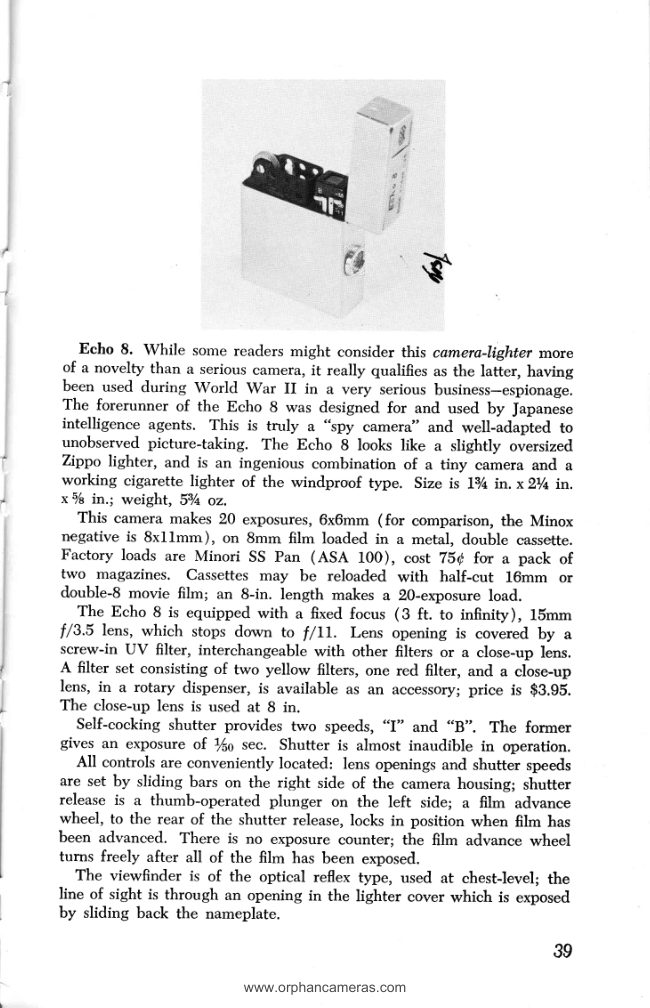
Echo 8. While some readers might consider this camera-lighter more
of a novelty than a serious camera, it really qualifies as the latter, having
been used during World War II in a very serious business—espionage.
The forerunner of the Echo 8 was designed for and used by Japanese
intelligence agents. This is truly a “spy camera” and well-adapted to
unobserved picture-taking, The Echo 8 looks like a slightly oversized
Zippo lighter, and is an ingenious combination of a tiny camera and a
working cigarette lighter of the windproof type. Size is 1% in. x 2% in,
x % in.; weight, 5% oz.

This camera makes 20 exposures, 6x6mm.(for comparison, the Minox
negative is 8x11mm), on 8mm film loaded in a metal, double cassette.
Factory loads are Minori $$ Pan (ASA 100), cost 75¢ for a pack of
two magazines. Cassettes may be reloaded with half-cut 16mm or
double-8 movie film; an 8-in. length makes a 20-exposure load.

The Echo 8 is equipped with a fixed focus (3 ft. to infinity), 15mm
4/355 lens, which stops down to f/11. Lens opening is covered by a
serew-in UV filter, interchangeable with other filters or a close-up lens.
A filter set consisting of two yellow filters, one red filter, and a close-up
lens, in a rotary dispenser, is available as an accessory; price is $3.95.
The close-up lens is used at 8 in,

Self-cocking shutter provides two speeds, “I” and “B”. ‘The former
ives an exposure of %o sec. Shutter is almost inaudible in operation.

All controls are conveniently located: lens openings and shutter speeds
are set by sliding bars on the right side of the camera housing; shutter
release is a thumb-operated plunger on the left side; a film advance
wheel, to the rear of the shutter release, locks in position when film has
been advanced. There is no exposure counter; the film advance wheel
tums freely after all of the film has been exposed.

The viewfinder is of the optical reflex type, used at chest-level; the
line of sight is through an opening in the lighter cover which is exposed
by sliding back the nameplate.

39

wow orphancameras.com
View original page 2
Page 3 · Read text
Considering the very small negative size, the Echo 8 makes remarkably
good pictures. Price is $19.95 for the camera and four cassettes of film.
Made in Japan, by Suzuki Kogaku Co., Ltd. of Tokyo, the Echo 8 is
distributed in the United States by Silver Bells Ltd., Box 982,
Carmel, Calif.

‘Mamiya Automatic 16. Most advanced of the current Japanese sub-
miniatures, the Mamiya Automatic 16 is a product of Mamiya Camera
Co. of Tokyo and is distributed in the United States by Caprod Ltd.
of New York City.

The Mamiya Automatic 16 makes 20 exposures, 10xl4mm, on
perforated or imperforate 16mm film. ‘Three black-and-white films and
‘one color film are presently available in the United States: Panatomic-X,
Plus-X Pan, Tri-X, and Kodachrome Daylight; these double-perforated
Kodak films gre respooled into one-piece, plastic, dual-chamber cassettes
(not reloadable). Empty film cartridges for bulk-loading are available.

‘The outstanding feature of the Mamiya Automatic 16 is its built-in,
diaphragm-coupled photoelectric exposure meter. This gives direct read-
ing of proper shutter speed for preselected lens aperture, or automatically
sets the diaphragm for correct aperture at preselected shutter speed.

Lens is a 25mm #/2.8, which stops down to f/16 and focuses as close
fas 12 in, A sliding cover protects the lens when the camera is not
in use and also locks the shutter release. Built-in filter holder slides in
front of the lens and is supplied with yellow filter, interchangeable with
other filters. Focusing is by scale; a 12 ft. “xed focus” setting (6 ft.
to infinity) is provided. The shutter has seven speeds from Yop to
4% sec, and the bulb is synchronized for flash; flash contact is in base of
the camera. The release button is located at the top of the camera in
the right front comer. Aperture, shutter speed, and distance scale
controls are all conveniently located on the top deck of the camera.
One-third turn, a flick of the thumb, on the rapid film-transport wheel
advances the film and exposure counter and-cocks the shutter. Film-type
reminder dial is concentric with the wheel, exposure counter is visible
through a window at its left

40
View original page 3
Related documents and language editions
From the M. Butkus archive. Original publisher and archive notices are retained.
Check the model and edition against your equipment.
PDF verified 2026-10-10.