Photography reference
Camera Craft magazine — part 2 Product booklet
Product booklet for Camera Craft magazine — part 2. 36 pages in English. Read the original PDF, download or print a copy without registration.
36 pagesEnglish4.3 MB PDF
Loading your manual…Open PDF directly
Document details
- Brand
- Various brands
- Model / document
- Camera Craft magazine — part 2
- Document type
- Product booklet
- Language
- English
- Pages
- 36
- File size
- 4.3 MB
- Category
- Photography reference
- Document date
- Not specified in catalog
Search available document text
Find a term, then jump to its page in the original PDF. Image-only pages may not be searchable; check the PDF for exact wording and diagrams.
Page 2 · Read text
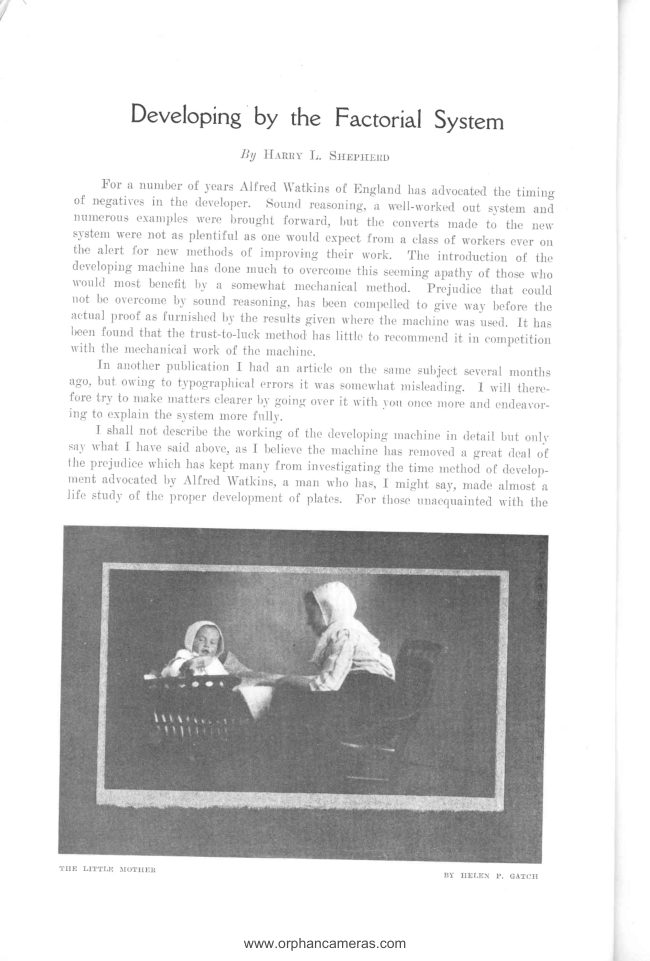
Developing by the Factorial System

By Horny 1. Sierneny

For a number of years Alfred Watkins of England has advocated the timing
atives in the developer. Sound reasoning, a well-worked out system and

but the converts made to the new

of ne

numerous examples were brought forward

system were not as plentiful as one would expect from a class of workers ever on

the alert for new methods of improving their work. ‘The introduction of the

developing machine has done much to overcome this seeming apathy of those who

would most benefit hy a somewhat mechanical method. Prejudice that could

not be overcome by sound reasoning, has been compelled to give way before the

‘ven where the machine was used. It has

actual proof as furnished by the results
reen found that the trust-to-Inck method has little to recommend it in competition
with the mechanical work of the machine

In another publication I had an article on the same subject several months

to typographical errors it was somewhat misleading. I will there-

ago, but ow

ing over it with you once more and endeavor

fore try to make matters clearer by
ing to explain the system more fully
I shall not describe the working of the developing machine in detail but only

say what T have said above, as I believe the machine has removed a great deal of

z the time method of develop-

the prejudice which has kept many from investigati
ment advocated by Alfred Watkins, a man who has, Em
life study of the proper development of p

zht made almost a

www.orphancameras.com
View original page 2
Page 3 · Read text
DEVELOPING BY ‘THE FACTORIAL SYS 145

time method, or Factorial System of development, as it is also ealled, Twill try to
make the matter clear

‘The exposure is the dominatin

factor in the production of a
no matter how you go about developin;

rood negative,

wit, I quite agree that great variations
from correct exposure can be compensated for in development to a certain extent,
if you know how, and this applies much more to over-exposure than under-exposure,

as with an under-exposed negative you cannot produce something from nothing.

The sooner every amateur recognizes the fact that within ordinary limits correct

nitial toa good negative, then the sooner he will obtain better work
Now the amateur I mention herd

is the one who docs all his or her work and not
the “but

Do not think that if the correct exposure is, say, one twentieth of a second and
1 give one tenth

or one fifth that you are getting out of the hounds 1 have
mentioned. If, when possible, instead of

ve one twentieth or even one tenth and use a diluted developer (no bromide, 1

speak of pyro), the negative would develop just as quickly and we would have

detail in the shadows and not a chalk and soot print

I go out in, say, September and take an average landscape, trees, bushes,
a stream of water or something of that kind, I use a Seed plate, stop U.S. No. 8

Yime of day 4p. a. Bright sun from one side, ‘The exposure I would give would

not be less than one tenth, rather one fourth to one half, Say 1 give it one halt
View original page 3
Related documents and language editions
From the M. Butkus archive. Original publisher and archive notices are retained.
Check the model and edition against your equipment.
PDF verified 2026-10-10.