Light meters
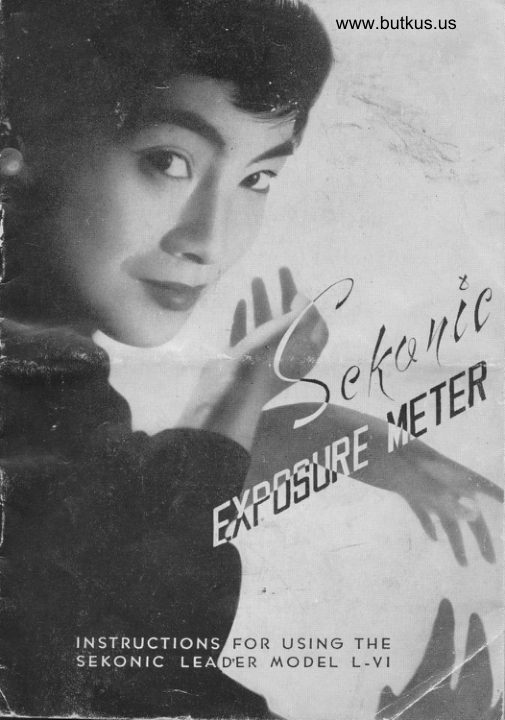
Sekonic Leader L-VI User manual
User manual for Sekonic Leader L-VI. 18 pages in English. Read the original PDF, download or print a copy without registration.
18 pagesEnglish3.4 MB PDF
Loading your manual…Open PDF directly
Document details
- Brand
- Sekonic
- Model / document
- Sekonic Leader L-VI
- Document type
- User manual
- Language
- English
- Pages
- 18
- File size
- 3.4 MB
- Category
- Light meters
- Document date
- Not specified in catalog
Search available document text
Find a term, then jump to its page in the original PDF. Image-only pages may not be searchable; check the PDF for exact wording and diagrams.
Page 6 · Read text
www.butkus.us
    HOW TO USE YOUR METER FOR
           qel4zbal Se*ez


                              ,,'[=


PROCEDURE: Aim your meter directly ot the scene or
               center-of-interest from cqmero position.
            Toke reoding, ond use computer to deter-
            mine comero setting.
CAUTION  :   Point the meter ot the foreground to
            ovoid " reoding " the excessively bright
               sky.
View original page 6Page 7 · Read text
HOW TO  USE
    YOUR METER FOR
   el*-ry


PROCEDURE   Point the meter ot the subiect from o
                                       '  distonce of obout 4 inches. ,Avoid
             costing o shodow on the subiect with
              the meter; olso prevent the light source
           from shining directly into the meter.
          The meter moy be directed ot  the
           shodows ond the highlights ond the
                resu lts overoged to yield o pleosing
            overoge exposure.
View original page 7Page 8 · Read text
www.butkus.us
    HOW TO USE YOUR METER FOR
 Snout, Su, ared B"-c/t Senert,
PROCEDURE : Aim meter ot the subiect.
CAUTION  :   For more occurqte exposure of obiects
             neorby, or of people, toke o c lose-up
              reoding, or use the method  descr ibed
               in the nexf section whereby the reod-
             ing is token of your hond.


                   Wff#";
              ,-W;                             *1*  ;;$*
View original page 8Page 9 · Read text
HOW TO USE YOUR METER FOR READINGS OF
         laasat^ehle Olticptt


i;, lr1
fi'l


   METHOD:     Reflected Light.
   PROCEDURE:  Toke o close-up reoding of ony neorby
               obiect hoving texture ond lighting
                  similor to thot of the subiect; such
            os flesh tones, folioge, rocks ond
                 ground, etc.
              Your hond will olso serve for good
                   flesh tone reodings. Ho ld hond so thot
                the light strikes it qt the some ongle
               qs the subiect.
                             6
View original page 9Page 11 · Read text
HOW TO  USE
    YOUR METER IN


 eahn
 tt@


                                         www.butkus.us

   Color films hove very limited lotitude ond there-
        f ore require occurqte exposure. The SEKONTC
  LEADER is designed ond constructed ,to provide
   precise €xposure reodings.
  The some methods os described for vorious types
   of subiects opply when using color film. Set the
  ASA scole of the computor occording to  the
   recommendotions of the film monufocturer.
CAUTION   Color film yields best results when the                  '           subiect does not hove  , too greot o
             controst ronge (deep shodows ond br.ight'
             highlights). Flot lighting rherefore yields
           most pleosing effects.
View original page 11Page 12 · Read text
www.butkus.us
                      AaL"e Jlarl to %tc.t/rp " lit/ot
   Sr/fPn" a,l, la.ztpffi
 itt t/rc /V"r,rt emTzun S/r.rrJhal'.


After setting the ASA film index, toke the meter
reoding os previously described. The oppropriote
" Light volue" setting is seen in the opening on
the computor diol morked 'Light Volue'.
Set the Light Volue scole of the shutter to cor-                 irespond with the Light Volue given by the meter.
Correct exposure will now result, even if  either           I
the f/stop or the shutter speed is chonged, pro-
vided the Light Volue setting remoins constont.
                                                                                                         f
                                         I
View original page 12Page 13 · Read text
Jlerl ta %te t/rp 'SiaPpt
                 Renilraq /L("J/raA'
     You will notice thot the morkings on the light
        scole ore colibroted from I to 8 in intervols thot
       correspond directly to the  f /stops of the comero
       diophrogm trom  f l1 to  f /8.
       This permits reoding the  f /stop directly from the
        light scole, without using the computor, under the
       following conditions:
     When using film with
li     {ASAIASA Indexlndex ofof 10050 ondond shuttershutter speedspeed ofof l/50I /100               ' IASA Index of 200 ond shutter speed of  l l2OO
   CAUTION: The cover must be open when using the
                 direct reoding method.
        This method is porticlorly useful for toking quick
       reodings under the specified conditions of  film
       speed ond shutter speed.


          ASA                             ASA
           50                                  100
                                         /toosec.       /sosec


                                  ASA
                                  200  y'zoilrr.
                              l0
View original page 13Page 14 · Read text
www.butkus.us
 PRINCIPLE OF YOUR EXPOSURE METER
 Lr6Hr |  |  |      |
                                  LEADFR


                                  MA6NET
       PHOTO.CEL[

                                       c0t L
 A BRIEF ANALYSIS of whot your exposure meter
is ond how it operotes will help you use it to best
odvontoge. Your meter hos o photo-electric  cell
which converts light energy into electricol energy.
A tiny golvonometer then meosures thot omount
                                                                                                                                                        Iof energy by moving o pointer ocross o colibroted
scole...thus moking on octuol meosurement of light.
  Then, with o computer os provided on the meter,
you relote the light meosurement to the speed or
"exposure index" of your film ond obtoin combino-                           I
tions of f/stops ond shutter speeds usoble forperfect exposures with your comero.                       I
ANY COMBINATION of  f /stops qnd shutter speeds
thus indicoted by the computer on Your meter
results in the some omount of light reoching your
film. Your choice of which combinotion to use
depends on one of two  f octors:  (l)  lf your picture
must " stop " oction or movement, use o combino-
tion with o relqtively  f ost shutter speed; or  (2)
lf you ore more concerned with depth-of-field,
choose o combinotion with o relotively  smoll
f/stop, or lens opening.
                                          il
View original page 14Page 15 · Read text
Still Subie_ct Slow Action Fost Action  Extremely Fost
 1 125-1 l5O      I / I 00 Sec.  I /200 Sec.      Action
  Second                                              1 l25o-1l 1000
                                                    Sec.
  YOUR MOVIE CAMERA hos o fixed shutter speed
   for ony given " fromes-per-second " setting; thus
  you need choose only the one lens opening or
      f /stop thot goes with the octuol shutter speed of
  your movie comerq.
     Figur:es corresponding to the number of fromes,
  from 8 to 64, ore engrqved on the diol.  Find the
  number of fromes of your comero on the diol ond
  determine  f /stop opposite the number.


i

i
t

t
I

l


i
L
View original page 15Page 16 · Read text
www.butkus.us
   CARE AND USE OF YOUR METER

 Alwoys remember-ybur exposure meter is o delicote
  instrument ond should be treoted os such !  The
  following precoutions will help you give it o long
 ond sotisfoctory life:
DON'TS
  1. Avoid subiecting your meter to ony sudden
      iorring or dropping which con very  eosily
    domoge the sensitive mechonism.
  2. Avoid extreme temperotures.
DO'S
  3. Use thE Choin  f urnished with the meter os
     odded insuronce ogoinst dropping.
  4. Store your meter (pref erobly in  its corrving
     cose) in o sof e, dust-free ploce.
  5. Check " Zero "  setting once or twice o yeor.
     Should you find thot the needle does not register
     "Zero"  when the cover is closed ond oll light
      is prevented  f rom reoching the photo-electric
       cell, the " Zero" odiustment screw on the reor
     of your meter moy be turned in either direction
     to bring the needle to o " Zero" position.
  Proper use of your meter will olwoys give you good
  results.  lf you find thot your negotives or trons-
  porencies ore  regulorly over-exposed you con
  compensote by using o higher ASA INDEX number
  thon thot indicoted by the mqnuf octurer of  the
  film; in the cose of under-exposure, use o lower
 ASA INDEX number. With proper core the " SEKONIC
 LEADER" will give you yeors of qccurote service.
                       l3
View original page 16Page 17 · Read text
TECHNICAL DATA
    The expossure required to photogroph on overoge
    scene is determined by these formuloe:
      For Reflected Light
            ,   K.A'   T : Exposure Time in Seconds                            a:-'-  B.S A : Relotive Aperture (f /stop)
  I                  B : Brightness in Condles per sq. ft.
                 S : ASA Film Index
a              K : ASA Colibrotion Constont
   I     SEKONIC Meter: K:  l.l6


   I     ACCEPTANCE ANGLE: ASA Closs B.
 WARRANTY: The SEKONIC LEADER hos been corefully
              inspected bef ore shipment. Shou ld  it
            prove to be defective within 90 doys
             ofter dote of purchose,  it  will be
              repoired or reploced   f ree of chorge.
            This guoron tee does not opply to
              meters which hove been mishqndled or
             tompered with.
                  FILM INDEX TABLE
                      .E. lJlN   lA.5.A. \ryE5. g.E.
         8   e llo  li 80 61 t00 20110                    100 80 125 21 t10
     tz to tc   tzfi 0        t o61?5 zoo 23 n o      l6 l3 20  l3/r 0    200  I 6-0250 24116    20 l6 24  14lr(0    ,5o 16-300 2str0
    2s 20 32  l5/r0    320 25O 4OO 26110      sz--zt t0     I 6/ r 0-  400 320 500 27 110    40 32 18 17110-   500-aoo 600 28l1o
     50 40 64  l8/10    650 500 800 29lto
     64 50 80  l9110
View original page 17From the M. Butkus archive. Original publisher and archive notices are retained.
Check the model and edition against your equipment.
PDF verified 2026-10-10.