Light meters
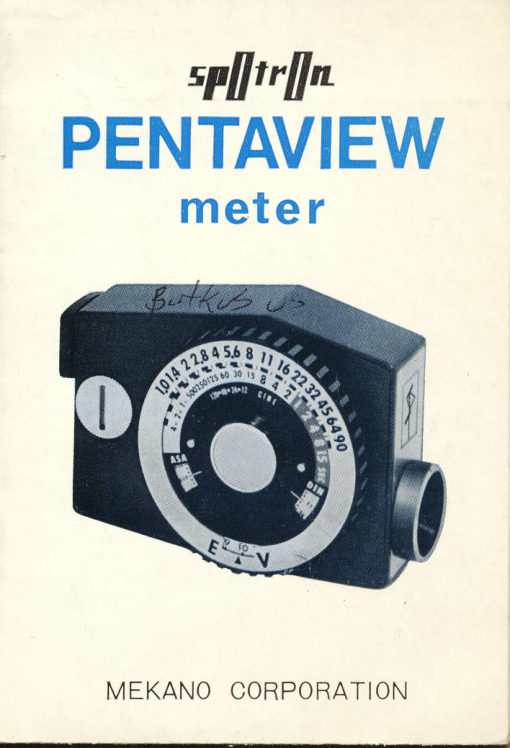
SPOTRON PENTAVIEW METER User manual
User manual for SPOTRON PENTAVIEW METER. 5 pages in English. Read the original PDF, download or print a copy without registration.
5 pagesEnglish2.3 MB PDF
Loading your manual…Open PDF directly
Document details
- Brand
- Spotron
- Model / document
- SPOTRON PENTAVIEW METER
- Document type
- User manual
- Language
- English
- Pages
- 5
- File size
- 2.3 MB
- Category
- Light meters
- Document date
- Not specified in catalog
Search available document text
Find a term, then jump to its page in the original PDF. Image-only pages may not be searchable; check the PDF for exact wording and diagrams.
Page 3 · Read text
spfirrfin                                                  r      PENMMIEW  mete
GENERAL DESCRIPTION
The Spotron Pentaview exposure meter has been designed
to cover a viewing angle of  10." This  angle has been
 picked in order  to  provide a high degree of  accuracy
along with ease of use  f or. general  photography.  It     i s
particularly  advantageous not only for objects at normal
                                                          'at                                                   medi um tocl ose di stances but espee  i al  I y   f or   ob ject s
long distances. The ability  to obtain an accurate reading
of objects without being required  to physica,lly approach
them has   I ong been desi red. Qeneral  I y exposure met ers
read an average of anywhere from  30 to  60." Some
of the meters currently  available read as little  as 17."
The principal problem in supplying narrow angle meters
has been the need for accurate sighting in orderto deter-
mine exactly what and how much of the  f ield of view is
being measured. The Spotron P entaview employs a penta
prism which enables you to accurately view and  center
your subj ect withOut any guesswork. In principal  thi s  i s
the same system that     i s empl oyed  i n the  If ei uxe S pot ron
Professional  2" reading meter'

One of the main adventages in using a  narrow   angle
meter such as the Spotron Pentaview    i s  t he abi I ity     t o
                                                                                                                                                                                             5. Frame Speed           9. Battery chambertake readings of a subject's  face for  example, without          .1. Adjusting dial
                                                                      2 Adjusting disc  for    f ilm Index 6. E. V. indication     10. Finder
the need for  getting so close that the possibility   of cast-         3. f-stop                                          7. ASA Index number ll. Objecti ve  lens
ing a shadow occurs.                                                                          4. Shutter speed                           8. DIN lndex number 12 Switc h
View original page 3Related documents and language editions
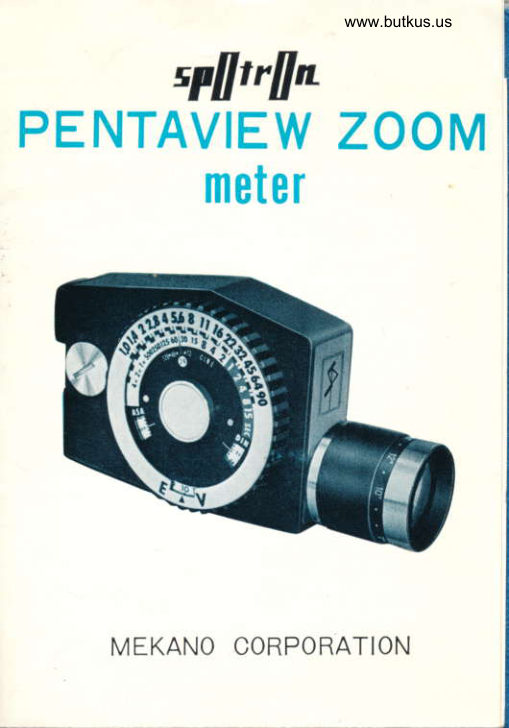
From the M. Butkus archive. Original publisher and archive notices are retained.
Check the model and edition against your equipment.
PDF verified 2026-10-10.