Film cameras
Stereo-Tach Model D User manual
User manual for Stereo-Tach Model D. 6 pages in English. Read the original PDF, download or print a copy without registration.
6 pagesEnglish4.9 MB PDF
Loading your manual…Open PDF directly
Document details
- Brand
- Stereo-Tach
- Model / document
- Stereo-Tach Model D
- Document type
- User manual
- Language
- English
- Pages
- 6
- File size
- 4.9 MB
- Category
- Film cameras
- Document date
- Not specified in catalog
Search available document text
Find a term, then jump to its page in the original PDF. Image-only pages may not be searchable; check the PDF for exact wording and diagrams.
Page 1 · Read text
www.butkus.us
DIBECTIONS FOn USHNG THE Stereo-taeh
                           trIOIDEL ID
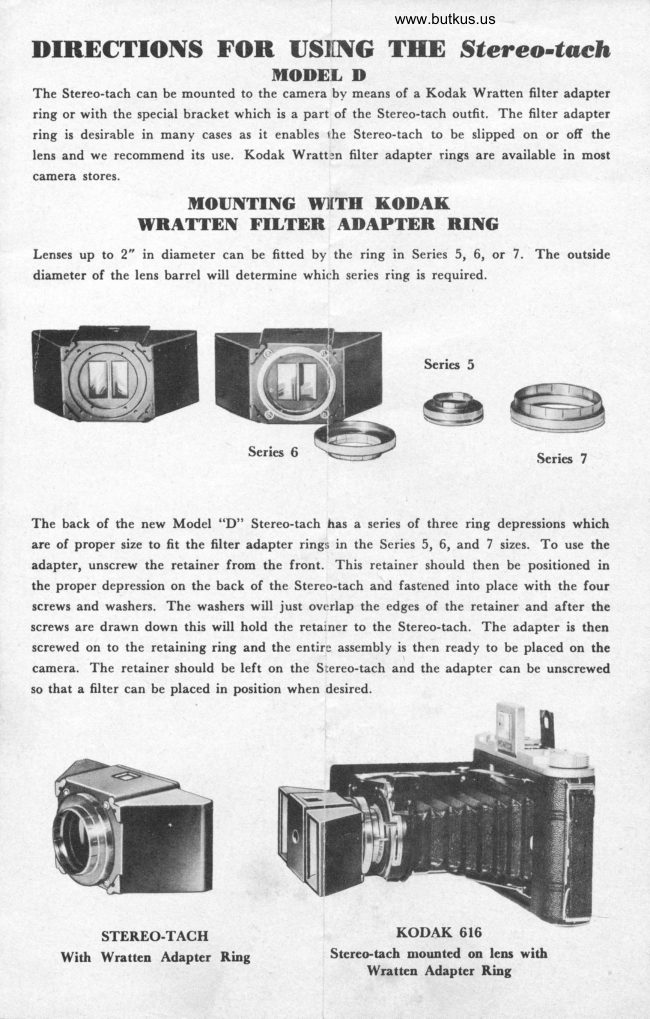
The Stereo-tach can be mounted to the camera by means of a Kodak Wratten filter adapter
ring or with the special bracket which is a part of the Stereo-tach outfit. The filter adapter
ring is desirable in many cases as it enables the Stereo-tach to be slipped on or off the
lens and we recommend its use. Kodak Wratten filter adapter rings are available in most
camera stores.
           MOUNTING W]TTH I(OIDAI(
       WNATTEN FILTDN AIDAPTDN NING
Lenses up to 2" in diameter can be fitted by the ring in Series 5, 6, or 7. The outside
diameter of the lens barrel will determine which series ring is required.


                                                              Series
                    5ffiffi
                                                                                Series 7


The back of the new Model "D" Stereo-tach has a series of three ring depressions which
are of proper size to fit the filter adapter ringri in the Series 5, 6, and 7 sizes. To use the
adapter, unscrew the retainer from the front. This retainer should then be positioned in
the proper depression on the back of the Stereo-tach and fastened into place with the four
screws and washers. The washers will just overlap the edges of the retainer and after the
screws are drawn down this will hold the retainer to the Stereo-tach. The adapter is then
screwed on to the retaining ring and the entire assembly is then ready to be placed on the
camera. The retainer should be left on the Stereo-tach and the adapter can be unscrewed
so that a filter can be placed in position when desired.


       STEREO.TACH
   With Wratten Adapter Ring             Stereo-tach mounted on lens with
                                             Wratten Adapter Ring
View original page 1Page 2 · Read text
1I[OUNTTNG WITH BBACI(DT
 Each  Stereo-tach outfit includes the  universal adjustable bracket pictured below.


                       Fig. t shows the complete bracket assembly
The bracket is adjustable at two points:     Make whatever final adjustments necessary
                                            to center the Stereo-tach properly in front
 (l) BV means of the holes in brace (A)  ;   of your lens. fn use the Stereo-tach should
 (2) Bv means of the supporting post (C)   be as close to the lens as possible.
      and set screw D.
Determine which hole in brace (A) to use   Be very careful when adjusting the bracket,
by centering the supporting post (C)  di-   tighten set screw (D) thoroughly after all
 rectly in front of the lens,                     final adjustments are made. This can be
Fasten bracket to camera by  inserting   done with a small screw driver. After the
 knurled screw (B) through proper hole in   proper adjustments are made, the unneeded
brace (A) and into the tripod socket of   parts of supporting post (C) and brace (A) camera,                          may be cut off. This gives you a .neat,                                                 substantial bracket that slips on and off as
 Adjust supporting post (C) to proper height   a unit and need never be changed.by moving it up or down and tighten set
screw (D).
 fnsert knurled screw (E) into the bottom   Thcre is a tapped hole (F) in the bracket.
 of the Stereo-tach and slide ogto supporting   This permits use of a tripod when bracket
 post (C). Tighten knurled screw.                 ls on camera.


                                                                                                                                                                                                                 Digitally signed by Mike Butkus
                                                                                                                                                             DN: cn=Mike Butkus, o=Butkus camera manuals,
                                                                                                                                                                               ou=butkus.org, email=mike@butkus.org, c=US                         Mike Butkus          Date: 2023.04.05 20:48:59 -04'00'


TO GET THE BEST NESULTS WITH YOUB
                 Stereo.to,eh*
There is nothing complicated or difficult about using your Stereo-tach.  It  is far simpler,
for example, than learning to use your camera itself.
But like anything else worth while doing, taking pictures with a Stereo-tach is worth
4oittg WELL. And to take the best picturerreal Stereoscopic pictures which give you theDEPTII, roundness and contours of the figures and scenei you take-to get the itind of
pictures you have always WANTED but were never quite able to achieve-it is worth
while to study the following instructions and hints CAREFULLY.
*Stereo-tach products describcdherein,.ii#frf116&:nder U. S. Patent Nc. D-120634,
View original page 2Page 3 · Read text
r
                                             www.butkus.us
      GENDRAL INSTNUCTIONS
Stereo-taeh MUST BE 55SQUABE" ON CAIIDRA..See dlagfram
            FINIDEB3  The Stereo-:ach is provided with        Fr    mrir                               olill'i,,1"ffi-ll"l"il:Ii    -
                  L,.;l;:,':i iLTm7V\'ourshappenstobeoneofrhefew-cameras:--Ek--.-.m
   \       ,,         inStereo-tachwhich theisregularplacedfindelon theis coveredlens. when the   Square on Camera
  Transparent
 CelluloseTapelfyourcamerahastheopticalEyeLevel                  Finder,  it  is necespary for you to mask this            o
finder to make it include the same view as included by the Stereo-
tach. This is because the Stereo-tach splits the image, taking
TWO pictures on one negative. Each picture, naturally, is HALF Not Square on Camera
 as wide as if  it occupied the entire film. The HEIGHT is un-
changed. To do this, place a strip of transptrent cellulose tape on each side of the front
 of your camera finder as shown in the diagram. The central part of the opening will then
 be square instead of oblong, and should correspond with the view observed in the Stereo'
 tach finder. The tape, being transparent, can be left on the finder as it will not interfere
with taking pictures without the Stereo-tach"
            EXPOSURE
Avoid under-exposure when taking pictures matter of personal preference depending upon
with the Stereo-tach. Under ordinary cir-   the degree of negative density desired. The
cumstances you will find  it  advisable to   latitude of black and white film allows for a
increase the exposure by 50o/a when black  greater differential in exposure than is possi-
and white film is used. In using Koda-  ble with color film. We suggest that your first
chrome and other color film, we advise that   roll be in the nature of a test roll that will
exposure be doubled. Exposure is sometimes a   enable you to determine proper exposures.
              PRINTS
Contact prints from 2 /r*4%" negatives are  When taking pictures with the Stereo-tach,
correct for the Stereo-tach Viewer. Minicam   it  is important that camera should not
negatives and other sizes may be enlarged be tilted to your right or left. Hold camera
to the size of the sample prints enclosed.   in a horizontal position. While camera may
                                    be pointed up or down for special effects'The separation between identical points on                                              *:"d general rule is to hold the camerathe two pictures, when printed or enlarged,  :
should not exceed zyg'.  Contact prints   lever'
from 2 %*3/+" negatives shguld be split in  Trim prints so that the                                                                         edges "line up with
the center and mounted so that the separa- the edges of the negatives, identical points
tion between identical points does not exceed on the two pictures will then be on a hori-
zys". Because the distance between eyes zontal line.  If  this is not done you may
varies somewhat in different persons, a sep- have trouble in getting the proper stereo-
aration of 2/+" between the identical points  scopic effect when prints are placed in the
is a good average.                           viewer.


                                         Horizontal
                                          Line

                                                Not Properly Trimmed
View original page 3Page 4 · Read text
Venmo @mike-butkus-camera  Ph. 2083
PayPal Name  Lynn@butkus.org      www.PayPal.me/lynnbutkus
View original page 4
Page 5 · Read text
The Stereo-taeh 85lilft Transpareney Viewer
 The Stereo-tach 35mm Transparency Viewer
  is a part of our outfit No. l0l, or is avail-
 able as a separate item, Catalog No. 103.
 This is for use with black and white positivo.:
 transparencies or color film. Films can br
 used in the paper ready mounts or can be
 mounted in lantern slide binders. This Vievl'er
 is for use only with 35mm double frame
 cameras and the Kodak Bantam f-5.6 and
 f-4.5. The Bantam Special cannot be used.
                                                                www.butkus.us
  HOW TO TAIIE Stereo-taeh PICIUBDS
 Follow the usual routine of taking pictures,    greatest depth of field. As a rule, it is well
 but remember that the best stereoscopic   to set the focus at the hyper-focal distance
 pictures should be sharp in all planes. Close    (this varies with different focal length of
 objects give the most pronounced sterec    lenses and stops used) and stop down the lens.
 effect. Include some foreground in your   With miniature cameras (those having lenses
 composition.  If ..you are taking a closeup.,   of approximately 2" focal length) use stops
 focus on the subject. (Use depth of focus   from f-8 to f-4.5. Stops from f-8 to f-16
 table if your camera is equipped with one).   are recommended for larger cameras. Fixed
 When taking pictures of landscapes or gen.   focus cameras without iris diaphram should
 eral scenes, set your camera to allow for thg   be used with the largest stop provided.
          OPTICAL IDATA
 Optically the Stereo-tach has been designed,   of the two pictures. Smaller openings do
 to work well with practically all  small   not give proper coverage. With the longer
 cameras that have a lens of normal focal    focal length lenses, 3', 4o, and 5", we do
 length for the size of the film or plate   not advise using stops larger than f-8.
 covered. Telephoto lenses cannot be used,                                                               It is advisable to mount the Stereo-tach asand wide angle lenses are not recommended                                              close to the lens as possible, regardless of
when the Stereo-tach is used.              which method you use for attaching it to
                                      the camera. If  the Stereo-tach is not It  is important that proper stops be used.                                       mounted close enough to the lens, it mayWith a 2" or 50mm lens, the best stops are'i                                                  result in negatives that are not thoroughly
 f-5.6, f-6.3, and f-8. Stops as wide as f-4.5,   covered to the edges. By using reasonable
may be used with this lens. Wider openings,   care and studying the directions thoroughly
 cause an undesirable overlap at the cente{  you will get excellent stereoscopic results.
   HOW TO CLEAN IIOUR Stereo-tueh
Your Stereo-tach is a fine optical instrument,   surfaces gently with a tuft of clean cotton.
and should be treated as such. The reflecting  Do not touch the reflecting surfaces with
surfaces are aluminum on glass, applied by   your fingers. If by mischance you should
vaporization of the metal in a vacuum-the    get grease or oil on reflecting surfacesl r€-
latest development in this field. Loose dust   move by using a little benzol on a tuft of
may be repoved by blowing into the instru-    cotton wrapped around a toothpick. A final
ment, but be sure not to blow any saliva into   swab wifh a little alcohol is recommended.
the instrument. For thorough cleaning, rub    Finallyrpolish off with tuft of cleanrdrycotton.
   ADVER,TISINg DISPLAYS. INC.
                                                                              aa  COVINOTON         :    3              aa                         KENTUCKY
 r05.D
                                                                         PRINTED IN U.g.A.
View original page 5Page 6 · Read text
www.butkus.us
           Spntial Jnttzuctiont fo, the Stnreo-tatlt
   The Stereo-toch will work well with most 35 ffim.. ohd. other      of F:I.5 ond the exposure is colculoted occording to o stop of
    smoll comeros, up to ond including size 4" x 5", providing the     F:5.6. Under these conditions, cqmeros with lorge operture
    lens is of normol focol length.                                        lenses cqn be fitted ond the results obtoined ore very sotisfoctory.
   Wide ongle lenses connot b" ,r"i ond we do not generolly     The Stereo-toch con be used with'comeros such os the Rolleiflex
   recommend lenses of longer thon normol focol length, i. e.,     ond oiher reflex types, size 21h" x 21h" for block ond white
     semi-telephoto.                                         work only. These comeros produce o poir of stereoscopic
    There ore o few 35 mm double frome comeros which cqnnot      negotives, eoch picture meosuring opproximotely  I " x \".   In
    be used with the Stereo-toch. The Eostmon Bontom Speciol ond       this cose o portion of the top ond bottom ore not completely
    Retino comeros qre so constructed thot the Stereo-toch connot     covered ond must be mosked off when moking prints. This in
   be fitted close enough to the lens. We regret to odvise thot we     no woy interferes with the excellent siereoscopic results obtoin-
   do not deem it odvisoble to use this instrument with either of     oble. Enlorged prints from these negolives ore mode to fit the
    these comeros. This is olso true of the Weltini 35 mm comero.      viewer, which is o port of Outfit No. 100.
                                                                               comerqs ore sometimes fitted w[$ qdop_t_erj ___   On oll 35 mm double frome comeros                                       the lenses should be of     _-forThese 2l/t" x 2r/t"                                           'rpe?t-ure--- 50 mm foc6i oncl the moximum          ;ot greoier ttron fi2       35 mm oi 8ZB colol filin.-ln geneiol, we do not recom;CnA
    for best results when the Stereo-loch is used.                       using the Stereo-tqch under soid conditions; thot is, with 35 mm
                                                                     odopters. This is becouse the lens hos o focus of opproximotely      lf lenses of lorger operture ore usud (F:1.51, it is necessory thot                                                             3", which is longer thon it should be for best stereoscopic   we be odviserl occordingly. Give us complete doto regording                                                                               results. However, the Stereo-toch con be odiusted for use with    the moke of lens, "F" volue, size of film or plote covered, etc.,                                                       35 mm odopters on 21h" x 21/t" Iormat. ln this cose, it is nec-   ond olso odvise qs to the outside diometer of the lens borrel.                                                                         essory to qdvise us occordingly when ordering. The stereoscopic
  On these lenses hoving opertures greoter thon F:2, it is neces-       results would be good, but the field covered would be very
    sory thot we mqke o speciol odjustment of the Stereo-toch, ond      norrow, ond it would be necessory to toke the pictures q con-
    olso fit the instrument with o stop which is equivolent to op-      sideroble dislonce from the subiect. Under these conditions,
    proximotely F:5.6. Pictures qre mode with the lens wide open          it would be similor to toking semi-telescopic stereo pictures.
                                                                           .TRu-Tu- Lt F'tr.
                                      gu,nDusuw*mrs
                                                          ncorporated
                                                         PIKE STREET AT MAIN
                                                        COVINGTON KENTUCKY
                                                                      Y
View original page 6From the M. Butkus archive. Original publisher and archive notices are retained.
Check the model and edition against your equipment.
PDF verified 2026-10-10.