Film cameras
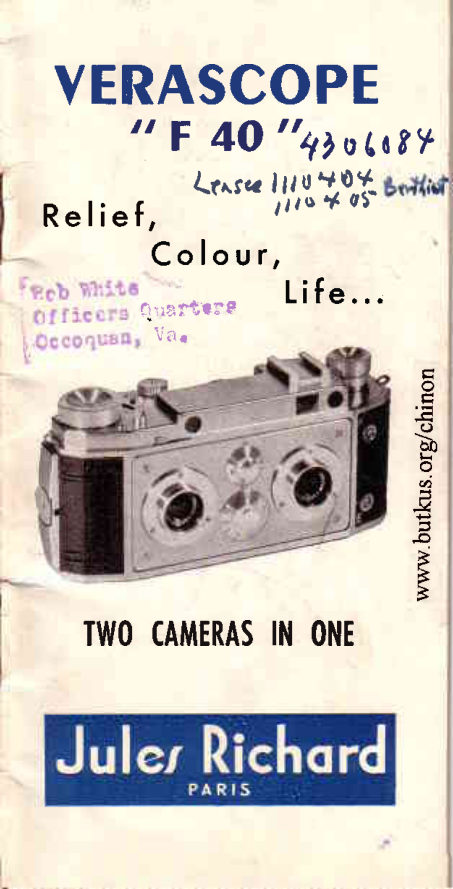
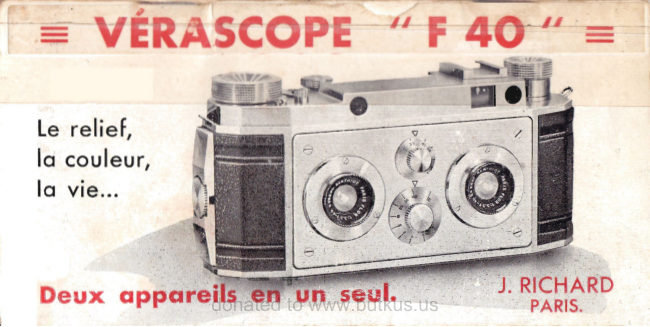
VERASCOPE F 40 User manual
User manual for VERASCOPE F 40. 16 pages in English. Read the original PDF, download or print a copy without registration.
16 pagesEnglish1.1 MB PDF
Loading your manual…Open PDF directly
Document details
- Brand
- Verascope
- Model / document
- VERASCOPE F 40
- Document type
- User manual
- Language
- English
- Pages
- 16
- File size
- 1.1 MB
- Category
- Film cameras
- Document date
- Not specified in catalog
Search available document text
Find a term, then jump to its page in the original PDF. Image-only pages may not be searchable; check the PDF for exact wording and diagrams.
Page 5 · Read text
expo-                                                                                  the  alternate                                                                   otherwise    STEREOSCOPI'C                     frames,                                                                                               pairs  would                                                                        the  stereoscopic                                                         sures  of
       OR                                        interfere   with  the  single  monocular
MONOCULAR EXPOSURES' 1 r ) i | :                   frames   and   would   cause   trouble,
                                                              especially when  cutting colour  films for
  The Verasccpe F 40 allows  either                                                             viewing.     If, however,    it  is necessary
stereoscopic or single mcnocular pho-                                                                     to iake both sterec and monocular  views
tographs as desired. When used for                                                     on  the same  film,   it  is Possible  after
stereoscopic pictures, the film is auto-                                                                     aliorving   for  the   iast  number    of  the
matically transported so that alternate                                                           stereoscopic  pair.
frames are exposed simultaneously as
shown in the sketch below,             DOUBLEEXPOSURE
           Slereoscopic exposure             PREVENTIONDEVICE
  4 l h p o i r              2 n d p o i r
                                                                Rrr oorrnlincr the  shutter  to  the  film
                                                                transport, the shutter cannot be released
                                                                             until   a new  length   of  fiim  has been
        3 r d p o i r                           I st p o ir                       drawn  into  position  and  similarly,  the
When  in the monocular  position, the                     film cannot be drawn on untii the shutter
film  is transported in single frames so                has been  released.
that each successive frame is exposed                                  It is however  necessary  tc ensure that
as shown in the diagram.                                 the film has been  fuliy wound, and  this
                                                       can be determined  by checking  that the
 S uc c es s i o no f   i m o g e  i n m o no cu lo r o p e ro lio n                  red   triangle  on  Winding  Knob  1, or
                                                                  alternatively  the red  dot, are immedia-
                                                                       tely  opposite  th.e red triangle 25 on top
                                                                     of  the  camera.  This  remark   aPPiies
  Onlythe lens onthe ieft of the camera,                  only  to winding   for stereo  pairs, as for
when viewed from the back,'is  then               monocular  operation,  there  are  two
employed.    It  is advantageous to use                  positions     in    between     the    red
the  complete   fiIm,  either   for  only                   dot and  the red  triangle,  to which  the
stereoscopic films or oniy for monocular                 winding  knob   I may be  set.

                                                                                                                                                    c
View original page 5Page 6 · Read text
L O A D I N G

  To open the camera, turn knob 9.
anticlockwise and open the back panei.
To close the camera, press the back
nanelI J U ] I v r     whon    the   snrincr     r:atr':h   will
become  automaticaliy engaged.  AII
35 mm.  Standard type cassettes can
be used in the Verascope F 40.

                                           Thumbpositionon milledknobsof re-windingreel
                                                              facing the red  triangle  25 on the top  of
                                                             the camera.  Exposure  counter  B will
                                                now  show  No  40.    If  not,  com;cletely
             o o o o o o o o ! b o o ; o                   wind and release  the shutter  to unlock
              F o l d o t 4 m l m l r o m L i a . /                           the mechanism,
                                                                                     ^\cJ  n^^-\JIJen  +l^^lrre  carrlera.^^*
  Cut  off  the  end  of  the  film  (unless                          ^\  D"ll  "^    - o.n'i- r f knOb  2,
alreadv  so  nrenarerj)          qaccnrd'inr-rv v v r             g l l I : ,       tcl                       e)  Insert   the  end   of the  film  into  the  slot
above  sketch.   Fold  the  end   of  the                          in  the  take-up   spool   lB  and  by means
film  as shown  by  ttre dotted  line  with'                        of the  milled  edges   of the take-up  spool,
the sensitive  emulsicn  inside.                             give the film one or two turns to ensure
  Be careful  not to  split the  film.                             that   it  is  firmly  engaged   in the take-up
                                                           spool.
Now  operate  as follows   :
                                                                                                                                                                                                       Lf'))   Tnsert the new  film into chamber  23,
a) Place  rewind   ciutch  16  in  posilion
                                                   unwinding  only the required  length of
in  which  red  signal   is  visible   in  the
                                                                 film and then push in rewinding knob 2
aperture  24 above.
                                                           g) Engage the  film  transport mecha-
b) Revolve  the  film winder  and  shutter               nism by moving rewinding'clutch l6 so
setting  knob  1 until  the  red  triangle   is                   that the red signal disappears from the

6          -
View original page 6Page 7 · Read text
tr
anorirrras v v r                 l s r      2.4  in   tho' - - J   tnnt u P    nfu l   thet l r g    r:ama-'u q r r r g r      q              g                          UNLOADING
"nd  ob."r,re  thai the fiim sprocket wheel          O
begins  to revolve  when  winding  knob          o0
1 is slightly  revolved.
                                                            a
h) Ensure   that  the  perforations    of the           t    ' !
film  are  engagetl  on the sprockets.
                                       s
i) Close the camera.                                           t
j)  Revclve  winding  knob  1 until expo-
                                                                   d
sure  counter B shows O, releasing  the            trsh.utter as frequentiy  as may be necessary
when  it becomes set with a final release.                      r l''t
The  beginning    of  the  film  which  was                 q)
foggeC when loading  will thus be trans-             Jd
ported  on  to  the  take-up  spool,  The        F     When  the  full  loncrfh    nf  tho   film  has
camera   is  now  ready   for  operation.                been exposed    :
'The     exposure  counter  is  at O and  the                   a) Place hoods on the lenses, or cover
sh,utter  is not  set.                                  thom  tn       InrorrentJ  r v Y v  I  r  t      licrht rcanhincr the film
                                                                         in case the shutter  has been  left open
                                                             inadverdently.      ',
                                                                 b)  Disengage  rewinding   clutch  16 so
  CHECKINGDURING                      that the red  signal appears  in the aper-
                                                                ture 24 on the top  of the camera,
     OPERATION                               c) Wind  the  fiim back  into  the  cassette
                                                       by  revolving   rewind  knob  2  in  the
                                                                direction  of the arrow  until no resistance
  To check  the  correct  winding   of the                       is  felt.
 fi]m  observe   rewind   knob    2,  This                   d)  Open  the  camera  and  take  or-rtthe
must revolve  each iime  that the winding                   cassette,    It  is  aclvisable  to do  this  in
 knob  1  is  revolved   to  transport   the               subdued  iight  (e. g. shadow) and away
 fiim.                                                    from  rain  or  dust,

                                                                                               9
 8 _ - -
View original page 7Page 8 · Read text
MAKINGAN EXPOSURE                     i. e,, between 1/25th, and 1/50th., the                                                exposure  would  be  aPproximateiY
                                                           I/37th,
                                                            "B "                                                                          (Brief)the shutter remains  The sequence  is a follows:                               In position
  I J a f a r m i n a                 t h a    a v ' n n q r r r a                 l i m o                       open a long as the pressure is maintai-
                                                                                                                               "   "                                              ned on the release, whilst in position T
Set the diaphragm   to the F value  requir-                 (Time) the shutter will be opened by
                                                       the first pressure and closed by  the
Focus through  the rangefinder,                     second  pressure,  No  intermediate
                                                         position  can be  used  between    I
Wind  on the film arrd thus set the shutter,                                                     sec, and between B & T,
Fress  the  shutter  release  7  firmly  but
evenly,  or use a  cable  release  in  the
shutter  socket  release,
                          USING FLASHEQUIPMENT
Note:     It will be observed  that the red
triangle  and  the  red  dot on the  top  of
                                              The shutter of the Verascope F 40 is
knob  1, face the red  triangle  25 a.terna-                                                                    fuliy Flash-Synchronised. i.  e., for all
telv when  set for stereo  frames.                                                        shutter speeds when using Electronic
                                                                flash, or  llz5tln., or l/50th.  using flash
                                                         bulbs.  The  flex  supplied  with  the
                                               camera has a plug  fitting at one end to
                                             engage  in  the corresponding socket
 EXPOSUREDURATION                (F for Flashbulbs, E for Electronic).

  The time of the exposure may be set            DIAPHRAGM
frnrn      I qon   fn    I /26nth   qoa    l-rrr,  rorrnlrri- - '  - - ' - n 9
the shutter control 5 so that the desired               The Veraseone F 40 has lenses with
speed is opposite the red triangle, The               a maximum  aperture  of  F/3,5 and
figures  indicate fractions of a second                smaller apertures to F/16. are controll-
and  it is possible to work in between,              ed by knob 4,

l 0                                                                                                                                                                                                                                                                               l  l
View original page 8Page 9 · Read text
FOCUSSING            SHUTTERSETTING
                                              By  revolving  winding knob  1, the  This  is  accomplished   by  means  of
the  rangefinder   which   is  coupled   to                shutter becomes automaticallyset. The
the  forward  and  backward  movement               knob shouid be wound as far as pos-
of the  lens  panel.  The  milled  wheel                  sible in the direction of the arrow and
6  ccntrols  the  movement.   To  obtain                                                                                                    it will then remain locked as long as thethe  correct  focus place  the camera  so         1    shutter is not released. Remember thethat the eye  is nexi  to the  rangefinder
^s y, ,w^ P^ r: s^ u^ ^E       1r TA,                                            {.       two positions for the fully wound shut-
                                                                  ter, explained on page 5.
                                                    For Stereo sequence there "r"  oniy
                                                 two positions which are correct, viz.,
                                          when  either the red  dot or  the red
                                                          triangle on winding knob 1 are imme-
                                                          diately opposite the red  Triangle  25
                                              on the camera top.    D o u b l e i 'm o g e   F o c u s sin gis co rre ct wh e n
                                                     l h e  i m o g e s o r e c o i n c i d e n t
                                              To avoid any mechanicai stress, set
    It will  then be observed  that a small                                                       the shutter and wind the fi)m only just
circular  transparent  image  is visible   in
                                                    before making Jhe exposure.the  centre  of the  tinted  image,
   In the inner  circle,  a double  image  is
shown  and  which  moves  horizontally
when the milled wheel 6 is turned.  The
camera  is correctly  focussed on a given
cbject when both of the separate images
are brought  into  coincidence:   in other             RELEASINGwords,  to form one complete image.  T
  As the movement  of the centre image        *        a) Push down fuily shutter release 7 or
is  horizontal,    it  is  easier  to measure
vertical  lines,  but   if these  are  absent                 b) Employ a cable release which can
in the view,  the  camera  can  be  held              screwed into the centre of release 7,
upright  to measure  horizontal  lines.
View original page 9Page 11 · Read text
EXPOSURECOUNTER        TO FIXTHECAMERA
  As the Verascope F 40 may be used         ON A TRIPOD
for  both stereo pairs,  or monocuiar
                                              The Verascope F 40 is Provided with
frames, the exposure counter has been              a bush of 3/8" dia. (adaPters for ll4"
paiibrated for  single  frames, Hence              can be supplied) and to which a tripod
                                         may be   fitted.the reading is to be taken:
 I,   for monocular operation, the expo-
    sure  counter shows  the  correct
   number exposed,
2.  For  stereo operating, divide  the
   number recorded by two, but take
    the next higher even number when
   an uneven number  is reached.
Example:   Counter   shows 17 :  9
pairs  of  itereo   frames  have  been
exposed.
Actually the counter shows the amount
of film which has been wound  on, ex-
pressed in single 24x30 frames of which
40 are obtainable on a standard length                                                                   .;      The bush also serves  to hold the camera                                                                                                                                                          ll:of 35 mm. film.                                                                                                                                               useerrrelvv v q r              v r         ) /  in  its Errer-roadv  ease.v u v v  l    and
                                                       the tripod  fitted underneath the case.The exposure counter returns to zero
when unloading the film (see pa.ge 9),
                                        s-    ACCESSORIES:   l) Cose

                                             The  design  of  the  case allows  the
                                              camera to be used without withdraw-
                                                          ing  it from the case.

t 6                                                                                                                                                                                                                                       l 7
View original page 11Page 12 · Read text
Tc obtain the correct results from a
         2) Lens Hoods                          pair  of stereoscopic photographs  at
                                                                        .^^^-I l t j d l      Ur';^+^-^^^I J L d ] I U U D ,       j+I L       IjqJ  neccssarvI I E V g D D q I       Y  tnL V  takeL C
The use of lens hoods is strongly recom-                                                       separate  pictures  as rendered  by  the
mended as they serve to render a clear-                                                                       right  and   left  hand   lenses  and  not
er image, and are essentialwhen wcrk-                 simultaneously  because  the camera has
ing against the light.                                          to be placed  in two  different  positions
                                                                      for  close-up  work.   Accordingly      it  is
           3) Filters                             necessary   to  reset   tlr.e shutter  without                                                          winding  on the  film  between   the   first
                                                  and  second  exposures.   To  reset  theIn a selection   cf  densities   for  various
                                                             shutter  in  this case, the  lever   26. haspurposes.
                                                                   to  be  moved  the   fuil  distance  of  its
                                                                   travel,  that  is, from  right  to  left when
      4) Supplementory                       viewing   the camera  from  the back.
                                                                                           TI hIiUa    ULUI( f a r a n qgVDUVyfUn n n i ^        RUglIUlla - ^ l . r             irD.   qa  Dysuroto n a n i a j      Close-up Lenses
                                                                                                                                                                                                                      r r r v r q !              ,iicrr Y   which   holds  the  camera   and  And StereoscopicBench                        rnofal
                                                                            is provided  with adjustable Setting cams
 . The Verascope  F 40 can be provided                     for the correct  positions  of the camera
with  close up lenses  for phctographing                  displacement   at  the  various  distances
subiects   at  short  range,   five  types   of                required  by  th.e 10, 20, 30,40,' l a a f l o f )  and 50
Ienses being  available    :                                                                                                        f l m             l o n q a c            / S a a     q n o n i a l
Allowing  photographing   at 10, 20,  30,
40 or 5O em.                                        5) Front Pqnel
  Vfihen using  these lenses  the focus  of                Porollox Corrector
the camera  must be set at infinity.
  The  lenses  are  mounted   in  slip-on                   This  accessory   is  ntounted  on  the
rings  like  the lens hood and the  filters.               camera   shoe.    It  allows  one   to  see
  The distance  from  the subjects  to the                  the   parallax    error     for   close   ups
camera  must be measured  very  accur-               and to correct them exactly by moving
ately,   The  origin   of  these  distances                   either  the camera  or  the subject  (see
should  be  measured  from  the   front                     D^ ^y ^Y^Ui r^ ql l         rI v^ q^ lf rl g^ r+. /     \
panel  of the Verascope,

 l 8
View original page 12Page 16 · Read text
MAINTENANCE

   Keep the Verascope F 40 thoroughly
  clean.  Prevent any dust from remain-
  ing  inside the camera,  Clean  it with
  a soft brush and wipe the }ens surfaces
  very  lightly  with  a chamois leather,
  also the  ranqefinder  and  viewfinder
  glasses, Keep the camer4 in  its case,
  without the film wound on or the shutter
   b u t .


      VERASCOPE F '[O
    PRECISIONINSTRUMENTS

   ErneussEMENTs
JulerRichord
 Soci616 Anonyme ou Copitol de 91.500.000Froncs
  25, RUEMELINGUE   PARISXIX.
             FRANCE


     €eb ltu}ltc
      0fficers Quaf**re
      flecorluanrVa,s
View original page 16Related documents and language editions
From the M. Butkus archive. Original publisher and archive notices are retained.
Check the model and edition against your equipment.
PDF verified 2026-10-10.