Light meters
Weimar Lux CDs translate User manual
User manual for Weimar Lux CDs translate. 11 pages in English. Read the original PDF, download or print a copy without registration.
11 pagesEnglish3.9 MB PDF
Loading your manual…Open PDF directly
Document details
- Brand
- Weimar
- Model / document
- Weimar Lux CDs translate
- Document type
- User manual
- Language
- English
- Pages
- 11
- File size
- 3.9 MB
- Category
- Light meters
- Document date
- Not specified in catalog
Search available document text
Find a term, then jump to its page in the original PDF. Image-only pages may not be searchable; check the PDF for exact wording and diagrams.
Page 1 · Read text
www.butkus.us

  Weimarlux CDs Light Meter
              (Translated by Google)


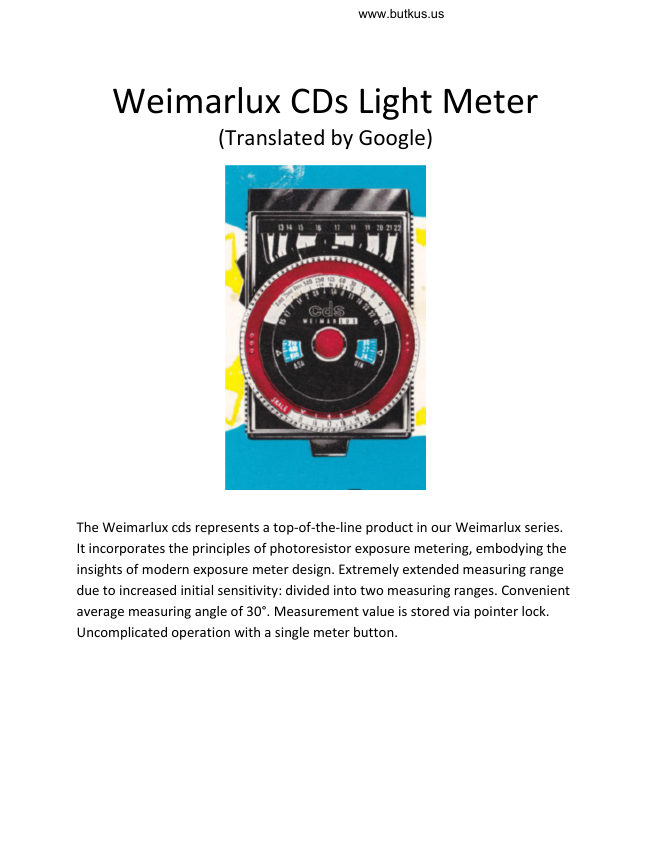
The Weimarlux cds represents a top-of-the-line product in our Weimarlux series.
It incorporates the principles of photoresistor exposure metering, embodying the
insights of modern exposure meter design. Extremely extended measuring range
due to increased initial sensitivity: divided into two measuring ranges. Convenient
average measuring angle of 30°. Measurement value is stored via pointer lock.
Uncomplicated operation with a single meter button.
View original page 1Page 3 · Read text
www.butkus.us


                       www.butkus.us


Unambiguous readings thanks to automatic scale switching. Convenient light
measurement via a swiveling diffuser flap. Battery check for monitoring the
power source. Film sensitivity range: 9 to 45 DIN and 6 to 25000 ASA. Special
version: 9 to 45 DIN and 6 to 22000 GOST.
View original page 3Page 4 · Read text
Aperture scale from 0.5 to 4511 Time scale from 11,400 seconds to 8 hours
Cinematic frame rate from 8 to 128 frames per second.
Extension factors from 1 to 16.

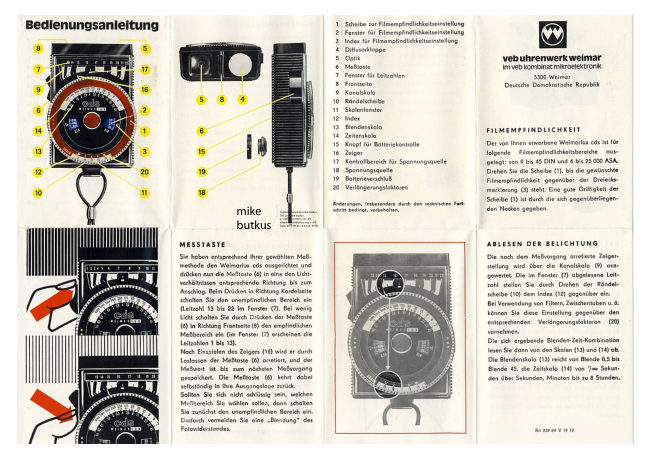
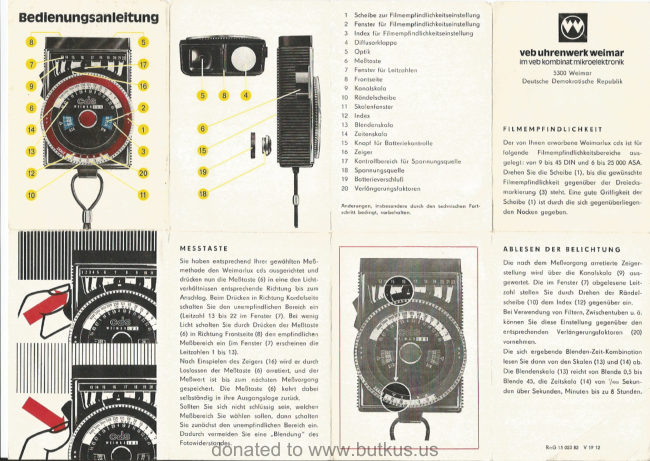
1.Film speed setting dial
2. Film speed setting window
3. Film speed setting index
4. Diffuser flap
5. Optics
6 .Measuring buttons
7. Guide number window
8. Front panel
9. Channel dial
10. Knurled dial
11. Scale window
12. Index
13. Aperture scale
14. Shutter speed scale
15. Battery check button
16. Pointer
17. Power source check area
18. Power source
19. Battery cover
20. Extension factors


FILM SENSITIVITY The Weimarlux CDS you purchased is designed for the following
film speeds: 9 to 45 DIN and 6 to 25,000 ASA, or, if you have the special version, 9
to 45 DIN and 6 to 22,000 GOST. Turn the disc (1 l.) until the desired film speed is
opposite the triangular mark 13. A good grip on the disc III is ensured by the
opposing cams.
View original page 4
Page 5 · Read text
www.butkus.us


                          MEASURING BUTTON
                                     According to your chosen measuring
                                  method, you lift the Weimarlux cds
                                       aligned and now press the measuring
                                    button 161 in a direction corresponding
                                       to the lighting conditions until it
                                     reaches the stop. Pressing button 10
                                   towards the cord side activates the
                                          insensitive range (guide numbers 13 to
                                 22 in window 171). In low light,
                                       pressing the measuring button 161
                                   towards the front (81) activates the
                                          sensitive measuring range (in window
                                      171, guide numbers 1 to 131 appear).
                                        After the pointer 1161 has moved, it is
                                     locked by releasing the measuring
                                    button (61), and the measured value is
                                      stored until the next measurement. The
                                   measuring button 161 then
                                       automatically returns to its starting
                                          position. If you are unsure which
www.butkus.us                        measuring range to select, first activate
                                     the insensitive range. This will prevent
                                            glare. Photo · resisted it.
View original page 5Page 6 · Read text
READING THE EXPOSURE
                                  The pointer position, still affected by
                                      the metering process, is evaluated via
                                      the channel scale (91). The guide
                                number read in window 171 is set by
                                        turning the knurled dial 1101 relative to
                                      the index 1121. When using filters,
                                       extension tubes, etc., this setting can be
                                       adjusted relative to the corresponding
                                       extension indexes 1201. The resulting
                                        aperture/shutter speed combination is
                                    then read from scales (13) and (14)
                                     above. The aperture scale 1131 ranges
                                  from f/0.5 to f/45. The time scale (14)
                                      ranges from 114,000 seconds through
                                     seconds and minutes up to 8 hours. The
                                     time scale (14) shows... Likewise, the
                                 Cone recording frequencies of 8 to 128
                                    frames per second for rolling picture
                                   cameras are specified. The gong
                                 numbers 24 and 48 are represented by
                                    a rhombus and a


BATTERY CHECK
Your Welmorlux cds exposure meter uses a PX 13 or RZ 53 (18) oxygen-powered
battery. This voltage source has a lifespan of approximately 2 years due to the low
current draw and short-term operating conditions. Therefore, checking the
operating voltage is only necessary at longer intervals, depending on usage. For
this purpose, button 1151 is pressed, and at the same time, the measuring switch
(61) must be pushed in the direction of the cord side until it stops. This releases the
pointer (16).
View original page 6Page 7 · Read text
www.butkus.us


During this measurement procedure, the pointer (16) must be aligned with mark
(17). If the pointer (16) lies to the left of mark (17), the voltage source (18) must
be replaced with a new one. In the case of no-charge. Reloading is not permitted
(explosive tube)


 www.butkus.us


BATTERY CHANGE
When inserting a new power source (18), pay attention to the correct polarity.
See illustration. The mercury oxide element is inserted into the device with its
seal.
View original page 7
Page 8 · Read text
Before attaching the battery cap (19), the label and the + (plus) number
must be legible. The battery cap is screwed in until it stops. You can use a coin for
this.


                              MEASURING METHODS Indirect
                                 measurement (object measurement) In
                                              this measurement, the diffuser block (4)
                                                       is positioned directly in front of the
                                          optics (15). You direct the Weimar lux
                                      cds from the commerosal point onto
                                      the object, thereby measuring the
                              mean luminance (brightness) of the
                                           object. The measuring angle of 30°
                                            results in an object section that
                                     corresponds approximately to half the
                                        distance of the Weimar lux cds from the
                                           object.


The measuring angle of 30° corresponds to the focal length of a camera lens of 80
mm. We chose this measuring angle so that, during indirect measurement,
primarily outdoors, the interfering component of the sky is reduced, making a
clearer approach to the object possible without any blurring.
View original page 8Page 9 · Read text
www.butkus.us


MEASURING METHODS
Indirect measurement (object measurement) In this
measurement, the diffuser block (4) is positioned directly in
front of the optics (15). You direct the Weimar lux cds from the
commerosal point onto the object, thereby measuring the
mean luminance (brightness) of the object. The measuring
angle of 30° results in an object section that corresponds
approximately to half the distance of the Weimar lux cds from
the object.


                           www.butkus.us


Direct measurement (light measurement) You perform the light measurement with
the diffuser flap (4) swiveled in front of the lens (5) by measuring from the object's
position towards the camera. The Weimarlux cds then evaluates the light falling on
the object. Light measurement is particularly suitable for high-contrast subjects
with side lighting. Indirect close-up measurement! Close-up object measurement
This measurement is particularly recommended for high-contrast subjects. You
measure the important part of your subject from close range without a diffuser. It is
important to ensure that the measuring direction is the same as the camera's
shooting direction and that you do not block the object being measured with your
body.
View original page 9Page 11 · Read text
www.butkus.us


VEB Uhrenwerk Weimar
within the VEB Uhren- und Maschinenkombinat
Supplement to the operating instructions for Weimarlux CDs Section D

The relationship between exposure time and cine recording frequency is designed for a sector aperture
of a 180° 8mm film camera in the Weimarlux cds. Conversion for any aperture sector is easy.


                  Opening angle of the sector aperture
Exposure time =     _______________________________
                 Frames per second · 360°

Example of a 2x8 mm standard camera from Czechoslovakia:

    120 degrees       1
T =  -----------------     = ----
    16 div 360 degees   48

The reading is taken at the mark on the time scale (14).
View original page 11Related documents and language editions

From the M. Butkus archive. Original publisher and archive notices are retained.
Check the model and edition against your equipment.
PDF verified 2026-10-10.