Sewing machines
Wilson Buckeye — User manual
User manual for Wilson Buckeye. 12 pages in English. Read the original PDF, download or print a copy without registration.
12 pagesEnglish7.8 MB PDF
Loading your manual…Open PDF directly
Document details
- Brand
- Wilson
- Model / document
- Wilson Buckeye
- Document type
- User manual
- Language
- English
- Pages
- 12
- File size
- 7.8 MB
- Category
- Sewing machines
- Document date
- Not specified in catalog
Search available document text
Find a term, then jump to its page in the original PDF. Image-only pages may not be searchable; check the PDF for exact wording and diagrams.
Page 1 · Read text
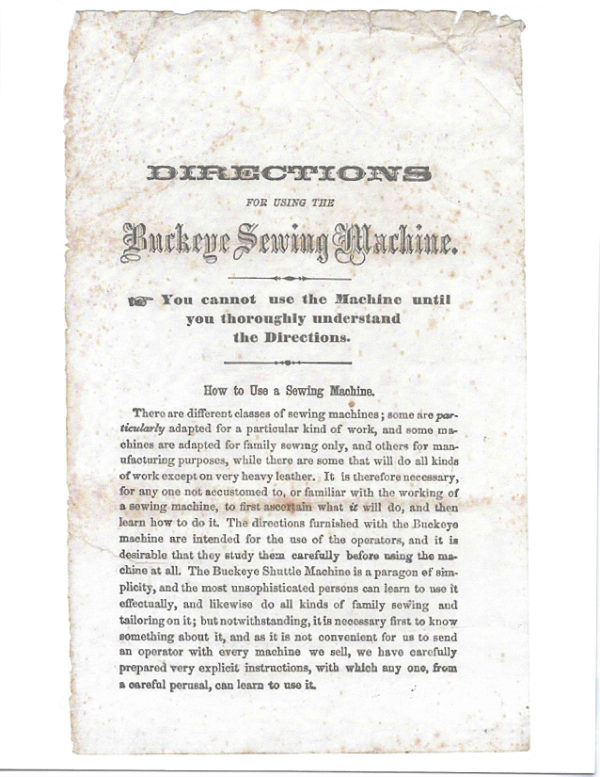
DIRCOTIONS
                  FOR USING THE
Buckeye Sewing Machine.

  re- You cannot use the Machine until
       you thoroughly understand
               the Directions.


           How to Use a Sewing Machine.
  There are different classes of sewing machines; some are par.
  ticularly adapted for a particular kind of work, and some ma-
 chines are ndapted for family sewing only, and others for man-
  ufacturing purposes, while there are some that will do all kinda

 of work except on very heavy leather. It is therefore necessary,

 for any one not accustomed to, or familiar with the working of

a sewing machine, to first ascertain what it will do, and then

 learn how to do it. The directions furnished with the Buckeye

 machine are intended for the use of the operators, and it in

 desirable that they study them carefully before using the ma-

 chine at all. The Buckeye Shuttle Machine is a paragon ef sim-

 plicity, and the most unsophisticated persons can learn to use it

 effectually, and likewise do all kinds of family sewing and

 tailoring on it; but notwithstanding, it is necesary frat to know

 something about it, and as it is not convenient for us to send

 an operator with every machine we sell, we have earofully

 prepared very explicit instructions, with which any one, from

 a osrefal peruel, can learn to use it.
View original page 1Page 2 · Read text
Soggestions to New Beginners.

    Before sewing on the mschine, set it before you and take a
  general investigation of it, nur DO NOT TAKE IT APART; compare
 it with the illustrations, and learn the names of the different
  parta of the machine.
    Notice the mamner in which the machine is threaded, follow
  the thread from the spool through the different eyelets until you
  arrive at the eye of the needle. TuB MAchINE NUBT BR
 PROPERLY THREADED TO SEW AT ALL. Also be very careful and
observe the particular manner in which the shuttle is threaded;
  it is very simple, nevertheless it is necessary that it should be
           inst richt. Some persons will immediately commence doing
  impossibilities, for them, the first thing they try to do on a ma.
          chine; it requires practice and experience to become au expert
 operator on any kind of sewing machine, while any one011
  learn to do ordinary family sewing in a very shors time; but
 to do mice hemming, tucking, cording, binding, sewing silk
goods, Go, requires some practice and experience. New be
  ginners must not try to learn to do every kind of work at once,
  but commence on plain sewing first. The best way, however, 16,
 first learn to sew straight and ourved seams on a valueless piece
 of cloth, either cotton, or woolen, or dot, and by so dotag you
 will become familiar with the movement of the machine; then
 do some plain family sewing, and in this manner you may soon
 become an expert operator.   In learning to hem, always sew
oncessfully,somethingas itofis nodifficultvalue,tountilrip ayouseamlearnoncehowsewedto dowithit auc-the
 Buckeye Machine. Keep the machine properly oiled, and do
 not use any but the best machine oil, and never use sweet
 or onstor oil at all.We manufacture an extra quality of oil,
  especially for the Buckeye Machine, which should be used in
  preference to all othera, but where it is not convenieut to get
   it, rather tham not bave the machine olled, we advise the use
 of coal oil.
   The possession of a Buckeye Machine is a sewing machine
 that every family may well be proud of, and we aim to make
  every purchaser feel that it is their friend, and that the money
 invested in it has been wisely expended.
  A good operator on any other Suurren SewING MAcHINe
 my be able to give you material aid in learning to operate
     machine.but deware of olgents selling other
 Machines.
View original page 2Page 3 · Read text
CUt "A."

         CUT OF TABLE SET UP.


                To Set up the Table.


   "A " represents two holes in the centre of the table, for the clamp sorow
 to pass from underneath the table into the bottom of the richine, for the

 purpose of souring the machine ta the table. The bole to tho right la

 wod when there is a priley on the machine.
      "B" represents a serew with which the bobbin winder is secured to the

 table. The motion of the bobbin winder is produced by friction of tho

band or belt.
   Tirat set up the iron work, then lsy the table on the floor, bottom

upward, them placo the frame over it and secure it with the scrowa to tho
tablo holes for which are bored ease for that purpose. De careful not to

get the iron work in a twist, in which ease it will not set level and square
 ou the flaor. Tighten every rivet and serew firmly,

    If the belt slips on the wheels, take it off and shorten it up. It is generally

 necessary to streteb the belt before you put it on. After the table is set up.

 oil all the bearings wherever there is any fiction. If the table is scratched
 or marred in any way, take a good quality of limseed oil, (paraffine oil will

  do,) and rub over the blemished part,
View original page 3Page 4 · Read text
DESCRIPTION OF CUT.


   1. Spool Holder.

   2. Eyolet,

  3. Tension.

  4. Eyelet.

  6. Tension Tightening Nut.

 1. Egelet.
  8. Egelet in top of the needle bar.
   9. Staple.

10. Lever to raise Pressor-foot.

 11. Screw to regulate tho Presser loot.

 12. Egolet in the end of take-up spring.

 14. Feed Screw to roguinte the stitch,

 15. Serew to adjust the Presser Foot.

10. Oll Hole,

17. 011 Hole.

18. Excentric.-Do NOT MOVE IT ON THE SHATT.

 10. Take Up Serow on Excentrio Lover.
90. Excentrie Lever,
91. Oil Hole,
22. Short Crank.
 23. Bobbin Winder.

 91. Where Clamp secures Hand Mohine to a common Table.
View original page 4
Page 5 · Read text
Cur «0."

                    WITH GLOTH FLATE LEMOVED.


    READ THIS VERY CAREFULLY.


                To Set the Needle.

   Place the shank of the needle in the needle bar with the long groove in
 the needle to the left or outride of the machine, and soure it with the
 screw at the end of the needle bar, then raise the needle bar to its highest
 point, and with the left hand insert the point of a fine needle or pin into
     eye, resting the same on the throat-plato; them loosem the needle
 screw, and hold the instrument so that the eye of the needle will be in a
 direct line from loft to right, them turn the balance wheel, up or dowu sa
 may be required, until the gage mark on the needle bar rests oven with
 the top part of the face plate (the eyelet a7" ia on the top part of face

            plate. I them secure the needle firmly with the needle screw.
   ThE NEEDEd NOST HE PROTEILY deT, or the machine will ship stitches.
It most be low encuch, or it will raise too soon for the shuttle to pass jato

  the loop; if it is too low, the point of the sbuttle will pass over the top of

the loop, twistedand cousequentlytoo much, it willmiss throwa stitch.the loopIfawaythe fromeye theof shuttlethe needle,and missia
 stitches. If the long groove is on the inside of the machine instend of on
  the ontside, the thrend will not loop, and the machine will miss stitches,
  But if the long groove of the needle is on the outside, or left side of the
 machine, and the needle properly gauged, the machine will never miss
 stitches. The needle should be set about a sixteenth of
 an inch foucer for very heary work,

 Extra Needles 10 cents cach, or $1.00 per dozen.
View original page 5Page 6 · Read text
How to tell when the Noodle is properly set.


    The eye of the needle will be about one-sixteenth of an inch below tho

  point of the abnttle, as the abuttle passes it, and will throw out a large loop,

  and as the point of the abuttle passes the needle, it will peas into the largeat
  part of the loop. See Cut "C."


     General Remarks on Setting the Needle,


    Sometimes if a very inferior quality of thread is used, (which, however,

  should never be,) it will have a tendency to twist, and kink up after it

  passes through into tho shuttle roce, and to enable the shattle to entch tho

 loop, it may be mecessary to turn the eye of the needle a very little either

  to the right or to the left, in order to throw the loop directly into the

 shuttle race. If it twista to the left, tura the eye of the needle in the

same direction; if to the right, turn the eye of the needle to the right, bud

 only very slightly. Never use coarse thread with n fine needle. The needle

must be of the best quality, sometimes a bad neodle will make considerablo

 trouble, some needles eat in the eye. Always be careful to seleat a needle

 with a large smooth eye, aud a deep long groove, and perfectly straight.


          Sizos of Needles and Thread.


  Let the size of the needle conform to the size of the thread, and both

 be suited to the goods sewed. Much finer trend is used on a sewing

 machine than by hand- every stitch being double.


   There in seldom any sewing in a family which requires a courser cotton

than No. 40. Numbers 50, 60 and 70 are the sizes mostly naod.


   Johm Clark, Jr.'l, Dlack Spool Thread we consider the best adapted

 to the machine. Never use glazed or glaco bread.

  The Under Thread may be one number finer thaw wed in the needle.
View original page 6Page 7 · Read text
The following index shows the size of needles, thread and sill: to be
  used on different fabrics:


                                                                   - as 480 000 noodlas.


                  HITO SE

 Linen

 Sill


   Use thread just half as corse for mohine sewing as you would for hand
 sewing.To make a stitch coactly alike on both sidea, be very particular to
 have the thread time enough, so that the stitch will fock in the middle of the
  cloth otherwise it will lay either on top, or underneath of the fabrie, and
  no alteration im the temaion will alter it, as there meer as cloth enough to
  COVER THe LOCK in the threads, or it will show untirE on one or the other
 side of the cloth.


 whereA No.thread1 needlefrom may60 tobe 80usedis used.for all kinds of plain light family sewing,

   There are Ogures on the shank of the noedle indicating its size.


          To Thread the Machine,

    Place the spool on spindle (1), then throngh eyelet (9), then pat it over

andthenceoncethrongharoundeyeletthe teasion(7), theneewheelthrough(3),thetheaceeyeletthroughin needleeyeletbar (8),(4)
 theme downward, under the staple at (9), and theme through the evelet
at the lower end of take-up wire (131, and thence back agnin to the right of
 the lower end of the staple, and Instly through the eye of the needle._ Sen
 Cur. pa The machine is properly threaded when you getit. Tension
nut (6) tightens the tension by turning it to the right,
 and looscas it by tarning it to the left.


          How to Wind the Bobbin.

    First wrap a fow rounde of thrend on the bobbin to fasten the end of tha
 thread, then place it in the bobbin winder, then move the bobbin winder
until the small grooved pulley or aches will come in a position to allow the
band to pass over it and the large wheel, then let the thread from the spool
 pass through the left hand as you operate the machine. The thrend
                                             the
should be wound on the bobtin very struight, and ordinarily tight in
sametoo fall,mannerbutthatthatititiswillwoundholdonittheconvemiently.spool from Thewhichbobbinit iswindertaken,is andseemednot
 to the table, when the machine is used on a table, and the long belt that
 propels the machine also operntes the bobbin winder.

   20 NEVER ORE OLAZED THARAD ON THE BONAIN,

            Extra Bobbins, 10 cents cach.
View original page 7Page 8 · Read text
g

                 The Shuttle.

                           A. A


    Gun MAA"represent the shutto lying on ite back with the bobbin
                 • «A represents the bobbin. "B' represents the vire
 in the shattle. *D' represents the thread through the hole mearost tho
 point of the sbuttle.


      Cop "O" represents the Shuttle, threaded and ready for use.
     Price of Esira Shuttle, $1.50.
           To Thread the Shuttle.
     The the abattlo between the thumb and fore-fugers of the left haud.
 with the point to the right.    Place the bobbin within the shuttle by put
                                                      the
 tingother oneand andinto inthethebluntboleend,or alwayscenter,placingtowardsthethebobbinpoint;so thatthem theplacethread
 will draw from its under side; them put the thread through slot, from the
inside of the shuttle, and undermenta the wiro, them put it back through
the slot over the wire, then through the first hole, and neurest the blunt
 end of the abuttle; thea through as many holes as shall be necessary to
 prodnce the tension required; in every case the last hole in which the thread is

 putAmoard.throughImmustthe belatterthe onecase nearestpass it theout pointthroughof thethe longalot,shuttle, eitherand in oadwardall cases,or
 LAsTLE, under the thread-guide or spring on the side of the shuttle.
 NEVER FOT THE SUREW-DEITEB UNDER THE BRAING DO TALE THIS BLUSTLE OUT
 OD TO MALLARSI
                  The Tensions.

   The upper tension is controlled by turning the tension mat to the right
to make it tight, and to the left to make it loose. A very alight turn isonly
 mecessary to make a great change in the tension. The tension is Lue

tightnessgood sewingof andtheatrougthrendwork,passinggreatthroughcare shouldthe fabricbe takensewed,to haveandtheto uppermake
 Cension and the tension on the shuttle-thread about the same, and tight

 as possible, but not so as to draw or pucker the gooda; with a loose tension
onon thetheshuttle-thrend,top of the goods;and aandtightwithuppera tighttension,teasionthe onunderthe threadshuttlewillandlaga
 loose tension on the upper thread, the under thread will lay straight on the
under side of the goods.   With both tensiona just alike the threads will
  be locked in the center of the fabrio, and look aliko on both sides, Prac.

ticesions.andItexperienceis impossibleis necessaryto maketoa becomestitch expertalike onin bothcontrollingsides whenthe tea-the

 thread is courser than the cloth.
View original page 8Page 9 · Read text
9

           To Commence Sewing.

  Draw the back shulllo-race cover and place tho shuttlo in the shuttia-


 carrierlying nearwiththetheneedle;pont ofthemthe replaceshuttle thepointingslide,towardand as you,the needleand theisflatalreadyside
 holdthreaded,it in drawyour abouthand, threewhile oryoufourmoveinchesthe needleof threaddown throughin the machinethe eye andand

 back,plate,whichreadywillto commencedraw up thesewing.shuttle thread through the slot in the throat


   42 To sew a straight, even seam, and provent the fabrie from
 drawing or «puckerios," the left aand should rest on the seam
  back of the needle when sewing, which will also assist very
 marcada goods to pms arcely turong the lemmer.     LITE
        of hemming. ea

             To take the Work out.

    Draw about four inches of slack thrend from the top spool, and then
  draw the goods from you and eut the thread close to the cloth; by so
 carefuldoing,nottheto shuttlebend or springthrendthewillneedle.remain up through the cloth plate. De


              To Regulate the Stitch.

    Turn food serow [14] to the right to make a long stitch, and to the left
to make a short stitch. far Beforo turning tho feed sorow either way,
 loosen the tightening nut on the screw, and tighten it up after regulating
 Lhe atiteh. This nut is intended to bold the food screw where it la placed
  to loop tho stitch uniform.

    is the mechanical movement in forming the
 stitch that produces the feed.


        The Braider. - Price, 81.00:

   'The Braider is similar to the presser-foot, aud must be attached to the
 machine in the samo manor.     Pat the braid throngh the front hole from
 above, and draw a sufficient length back of the needle, so that the needlo
 wall pass through it im the process of stitching.Care should be taken
that the braid is of suitable width to provent it from twisting.

          The Corder.-Price, $2.00.

   The presser-foot is frat removed, and the corder is fastened to its place.
 The cord is first threaded through the small bole in the curved end of the
arm, them through the tabe in the end from loft to right, and a sufficient
 length drawn through to allow it to pass back of the needle.
inter phaced in position gain ordinary so nag it. an a bedtrees tho food:,
        Tho gooda must bo kept closo against the end of the tube, to insure
View original page 9Page 10 · Read text
10

            The Binder.-Price, $2.00.
    Tho Bindor la attached to the machino om tho bed-plato with tho euro
  sorOw. The email slide should first bo adiusted to the width of the bind.
   ing before the binder or goods are placed in it, and then adjust it to tha
   inschine and it is ready for uso.

      The Goodrich Tucker. Price, $3.00.

    Attached to the Tucker wire is a small book with an eyelat; slip this over  the needle, and up to the bottom and of the noodle. far. Them put the
                                                            torn it
 nearlygaugetum thescrewdown;gau goandthronghscrewatterdownthehavingslotsfirmly.adjastedof Gaugeall andto theTaeker,desiredandwiththenof luck,


   The rule to mako any width of treks, when you wish to have them
 mech, is, to set the gange from the needle the width desired, and move the

 thecreasingsame thepoints"poiNts"just threetwice timesthe widththat ofwidthtuckfromto thethe leftgauge,of or-whatneedle, is

  o space betwoon trcles is desirod, move the creasing points justithat much
  farther to the left. By the rule scale, marked on the Tucker plate, set the
  gauge one distance to the right, and the crensing points zwo distances to

  the left of noodle, and the tucks will just meat.
    Alter having made to first toe and folded the next one by the crenso
 just made, and having placed it under the gauge-spring, put the edge of
  said first fuck under the small horional spur. This preventa it from run-
 ning on the creasing spur, thas insuring a better crease in the cloth,

 because only two thiel nesses are passing over the crensing apur instend of
 SOULfour, naThisis thearrangementcase whenofthetheedgeclothof inthethemadeTuckertuek nssistsis not putverynodermuch thein

  guiding the cloth straight and keeping it to the gauge.

         White's Tucker.-Price, $2.00.

   It marks with a pencil, and is much used for nice work. The dires.
  tions for making or laying the tucks are the same as above.

            No. 1 Hemmer. -Free.

                          TO USE TALL HEJIMER.

 thoFastenouteritodgoto theof thomachinebeanerwithshouidthe gaugebe onserew;an esnotfirstlineremovewiththethegauge-outer
  edge of the alof in tho cloth plate-turn the edge of the cloth first, before

 putting it in the hemmer, and draw it through far enough for the needle
  to catch it. mad If the sonm is made too near the outer edge of the cloth,
  move the beamer a vory little to the right; if it sows inside of the hem,
  move it to the left.

    The Hemmer and Feller. Price, $2.00.

   This hemmer is adjusted to the presser-foot bar the samo as the presser-
   oot-shich must jirst be removed.
   The a common needle and draw a thread through the corner of the
  cloth, and them with the thread draw the edge of the cloth into tho

 hemmer until the needle will catch it to feed it. Now, let the "presser. foot" dowa upon the worle, and rest the hand on the table, so as to hold
 the cloth steady botwoem the thurb and finger, in such position that, as it
                                                                   If it is not
passesheld closeinto enough,the hemmer,therethewilledgebe toojustlittletouchesgoodsinturnedthe comer.in, and if held too
  close, so much will be turned in that the edgo will be turned ont again.
View original page 10Page 11 · Read text
11

          To Make a Wide Hem.

   The cloth should be folded the desired width, before being placed in the

 hommer, and the eloth gauge wead to keep the hem straight both for
 marrow and wide hemining.

                   To Fell.


 eighthLay theof twoan inchedgusbeyondof cloththe upper,togethos,[thethesameunderas inonefollingprojectingby land.aboutI thenone

 sew then together, malting the seat about one quarter of in ineh wide
themshut turnedge thoinside,workthenover,insertopontheit foldedout andAdge,ironthethesameseaman downin bemming.with the

 off.If thead hemmertightdoestensionnot turn inandall longof the stitchraw ergs ofistherequiredcloth, trim init
 hemming.
   Nothing thicker than one thickness of ordinary shirting linen or cotton
  should be passed through the lemmer.


                "Figure Twenty-five.

    The steel slide on the top of the fice plate is intended to take up aug
  lost motion that may be mado in course of limo by wear om the .

   bar or in the bolo of the face plato.

    Figures 15 and 19 are intended to tako up loat motion coused by went.


                     Oiling.

                                             We haro a No. 1 quallty
   of Theoil,machinemanufacturedshouldespeciallybe kept properlyfor our trade,oiled.which should invariably be
   usod; but, when it cannot be had, any good quality of oil will do, even
   coal oil, rather than none.
                                          machino must be    at°Place a drop wherever there is any friction.The
  turned up to oilThethe underneathextra hole inworks.cloth plateOccastonaturis an oil oIL,hole,Whento oil FOIsTthe workaOF
  TIE SHUTTLE
   underneath.
                 Figure Eleven.
   theForfabric.light sowing, turn screw [Il] up. to malts a light prossure on
             For heavy sewing, turn it down to make a heavy pressure.
  The presser-foot should press safliciently hard on the gooda to provent it
   from raising as the meedle is withdrawn.

     To Tighten the Band on Table Machine.


    If tho Band turns without driving the mochine, of does not force the

   needleing, whichthroughcom tickbe donegoods,by cuttingit has beeomeoff a smalltoo loose,piece andand readjustingneeds tighten-the

    ends.
View original page 11Page 12 · Read text
19

         GENERAL REMARKS.

  ahrays turn the hand machine from you, the table
  machine to you if there is a pulley on it.

     Pehsons not accustomed to use a sewing machine abould draw the thread

 from the eye of the needle, and then work it until they become ascustomed

 to its morements. If llis machine will not "food," or curry the goods

  nlong, it is boenuse the feed scrow [1] is turned out too far. If the cloth

 drawstoo Inrge,down orthroughthe stitchthe slotde tooin theabortclothor sheroplate,isnotthe soMoioutneedle istensionblunt toor


alt op 30 what Carat. Aus stards waif shop sal darif the needle is
 bent, or get up too high or too low. If the thread breuks, it is not of good
 quality, or it mny be too fine or too course for the needle.It may also

  breal, if the tension is too tight. Care should be used to make the stitch

of mitable length, as more tromble arises from loo short a stilch than from

 any other cause. We adjust the machine for all the usual kinds of sewing

  and for the ordinary sises of thread, and there is no heed of mnking
 changes to secure a perfoct operation of the machine.Any difficulty

  which may oscur, a little patient investigation will discover and remove.

        ring very herry full cloth the machine ships stitches, bend tha take

  up wire so that it will not take up so mach slack thread, or else leave

 the thread out of it altogether- but before doing so, see that the needle is

 set low enough, and that it is large enough for the thrend.

             W. A HENDERSON & CO.,

                             GRNERAL AGENTS,
                                onice at CLEVELAND,
View original page 12From the ISMACS International. Original publisher and archive notices are retained.
Check the model and edition against your equipment.
PDF verified 2026-10-11.