Film cameras
Agfa Formulas for Photos Product booklet
Product booklet for Agfa Formulas for Photos. 32 pages in English. Read the original PDF, download or print a copy without registration.
32 pagesEnglish1.8 MB PDF
Loading your manual…Open PDF directly
Document details
- Brand
- Agfa
- Model / document
- Agfa Formulas for Photos
- Document type
- Product booklet
- Language
- English
- Pages
- 32
- File size
- 1.8 MB
- Category
- Film cameras
- Document date
- Not specified in catalog
Search available document text
Find a term, then jump to its page in the original PDF. Image-only pages may not be searchable; check the PDF for exact wording and diagrams.
Page 3 · Read text
www.orphancameras.com


          G H E M I S T R Y  F O R  T H E ' P H O T O G R A P H E R


 p H O T O G R A P H E R S    e v e r y w h e r e   worth  while  to consider  first the compo-  '
      rcalize the importance  which chem-    sition  and  function   of  the  developing
 istry  holds  in  photographic  work,  but    solution to see what  it contains and what
 often consider the subject too formidable       it does to effect development.
and involved for application  to their own
                                  When a photographic  emulsion  is ex- work.  This discussion has been prepared
                                      posed to light, the silver salt (silver bro- to help  dispel  that   fear,  and  to show
                                           mide, chloride  or iodide)  which the light that  theoretical  knowledge  is unimpor-
                                            reaches, undergoes a definite though  in- tant  if the photographer knows in a prac-
                                                     visible change to form what  is known as tical  rryay, what  is  in a  developing  or
                                              the latent image.    It  is not yet definitelyfixing  solution, why   it  is there and how
                                     known  just how this change takes place, it accomplishes  its own  particular  job.
                                             but  it  is believed that the exposed parts
  The general structure  of photographic     of the emulsion gain a certain  "activa-
film,   its components  of  nitro   cellulose    tion"  that makes them susceptible to the
 (or acetyl cellulose) base, emulsion coat-   reducing  action  of a developer.  When
ing of gelatine which contains suspended   placed in a developing  solution the ex-
particles   of  light-sensitive    silver   salt,   posed, "activated"  particles of silver salt
and  auxiliary   layers  for such purposes   are reduced chemically  to black metallic
as prevention  of  halation,  are common    silver, leaving the unexposed particles of
knowledge among photographers.  The    silver salt unchanged.  Reduction  in this
chemistry  involved  in this branch  of the   sense does not have the meaning com-
science is held under precise control by   monly  thought  of  in  the photographic
the manufacturer and causes the photog-     field, namely,  the lessening of densit5r in
rapher    little   concern.  Photographic   a film negative.  This  chemical reduction
chemistry  begins  to  affect  the photog-     is a conversion  of the silver  salt to free
rapher more directly  in  the developing    silver and  for the reaction one or more
and  fixing  operations  carried  out  with    rcducinp  agents -  which  photographers
film  and  paper.     It   is  therefore   well    call  "developers,"  are necessarJr.
View original page 3Page 4 · Read text
www.orphancameras.com

    THE DEVETOPER'sBASIC GO'NPONENT     may use a larger ratio  of metol to pro-
  There are many  chemicals which are   duce softer  results.
reducing agents, but most  of them  are                                                                             It   is  obvious  therefore,  ttrat  great
too powerful  to be used for  developing                                          care should be taken in the preparation
because they reduce all the silver salt in                                                   of developing  solutions,  for a slight error
the emulsion without  regard to the latent                                                      in the type or amount  of the developing
image which exposure in the camera has   agents (or the other constituents  too, for
produced.  Therefore a reducing agent                                                that  matter)  may have a serious effect
must be selected which  is satisfactory as                                      on the behavior of the developer.  Most
a developer and which confines its action                                             successful  photographers   have  found
to the exposed  particles   of  silver  salt,                                                that   it  is far wiser to use the formulas
leaving the  remainder  unaffected.  Of                                   recommended by the manufacturer  and
the reducing agents that are satisfactory                                                  to make sure solutions are carefully and
for photographic  use, metol, hydroqui-                                              accurately  mixed,  than  to  spend  time
none and pyro are most commonly  used,                                      on individual  experimenting or research.
and there are in addition  other develop-                                    The use of recommended  formulas   is
ing  agents such as  glycin,  amidcil and                                         undoubtedly  one of the most important
rodinal frequently  employed.  There are                                            helps  to  getting  good  results  in  film
also several developing  agents on  the                                        development.
market  under   different  names  than
                                      OTHER INGREDIENTSOF THE DEVELOPINGmetol, but which  are basically  the same                                                  soruTroN
chemical  -  monomethyl  - para - amino -                                      The  function  and importance  of the
phenol-sulphate.                                          developing agent in the developer have
  As has been indicated,  ttre chemical   both  been mentioned  -  but  there  are
action of these developing agents is fun-    three other components which  also play
damentally  the same. The photographic    an important  role in any developing solu-
effect, however, depends to a large extent    tion.  The  first  of these is the  alkali-
on tJle particular  developing  agent and   which is ordinarily  essential for develop-
the way in which  it  is used.  Thus many    ment.  Most  of the developing  agents in
developers contain a combination  of de-   use today are neutral or slightly  acid in
veloping  agents, and one formula  may    their normal  state, and in this condition
have, for example, a high percentage of   give little or no developing action. How-
hydroquinone  to produce  brilliant  pho-    ever, when an alkaline  salt like sodium
tographic images while another formula    carbonate is introduced  into the solution
4
View original page 4Page 5 · Read text
www.orphancameras.com
Y
     containing  the developing  agent, a very    specified, as too much may cause fog in
     interesting change takes place.  The de-   developed negatives; too little may result
     veloping agent forms what  is called an   in slow,soft development.  It is important
     alkaline  salt  which  in a photographic    to remember when using carbonate, that
    sense is a more active material, and  it  is   the potassium salt is generally available
     this alkaline salt of the developing agent   only  in the anhydrous  form,  while  the
     that actually reduces the exposed grains  more generally used sodium salt can be
     of silver salt to metallic  silver. The alkali    obtained as (r)  the anhydrous  salt con-
    has a secondary effect in the developing   taining about z/6  water,  (z)  the mono-
     solution which is also important.    It helps   hydrated  salt containing about r5/s wa-
     the gelatine emulsion  to swell and thus    ter,  or  (S)  in  crystal  form  containing
     facilitates the penetration  of the devel-   about 6S7o water.  The anhydrous  and
    oping  solution  throughout   the network    crystalline  forms  are both  unstable  at
     layer of the'emulsion.                                                   ordinary  conditions  of temperature  and
           It  is obvious that the alkali  is a really    humidity,  and must  be kept  in  tightly
    important  component  of the developing   sealed containers  and used  with  great
     solution and  it  is likewise  evident  that   care to prevent  considerable  absorption
    care must be exercised in using the right    of water from the atmosphere by the an-
    kind and correct amount  of alkali.  So-   hydrous  salt, or loss of water by the crys-
    dium   carbonate   is  normally   recom-    talline  form.   The monohydrated  form
   mended though  potassium carbonate  is   of sodium carbonate is stable and there-
    sometimes used in its place.  The caustic   fore  preferred  by  most  photographers
     alkalis, sodium hydroxide and potassium    for  accurate preparation  of developing
    hydroxide, should not be substituted un-   solutions.
     less definitely  specified as they are much       THE TIVIPORTANGEOF A PRESERVATIVE
    stronger and can easily cause fog.  Nor-                                                                                   It  is a characteristic  of many  photo-
    mally they are used only in special-pur-                                               graphic reducing agents in alkaline  so-
    pose developers  giving  high  contrast.                                                       lutions   to  combine   freely  and  easily
    Borax and similar  alkalis which are less                                                    with  oxygen.  Because of this "hunger"
    energetic are often specified for fine-grain                                                         for oxygen, alkaline solutions of the de-
    development in which grain size must be   veloping agents spoil very quickly when
     controlled by  softer development.                                         exposed to  air.  To increase their useful
     The amount  of alkali  should of course    life, to allow the developing agent to do
    be weighed  accurately  to  the amouqt     its work on the exposed silver halide as
View original page 5Page 6 · Read text
www.orphancameras.com
/

             desired, and  to  prevent  the occurrence    action  of the restrainer  is such that  an
             of stains, a preservative must be added   increase in  the concentration   of potas-
             to the developing  solution.               sium bromide  in the developer tends to
                                                     slow down or "restrain"  the development           Sodium sulphite  is ordinarily  used as
            the  preservative,  though  in  developers    of the photographic image.  The concen-
           prepared  for stock in two solutions,  pr€-    tration of potassium bromide in the solu-
            servatives which  are slightly  acid  in so-   tion is obviously important,  for too much
             lution such as sodium bisulphite and po-  may retard development excessively and
           tassium  metabisulphite   are  preferred.    indicate an apparent loss of speed while
          Because developing agents keep better in   too little may permit development of fog.
            acid solution than in one which  is alka-
                                                     THE IMPORTANCE OF A SHORT STOP
              line,  it  is common practice to use one of
                                                As  negatives  or  prints  are  removed           these acid  sulphites  as the preservative
                                                     from  the developing  solution  they  carry              in the developer part  of the stock solu-
                                                            with them  considerable  amounts  of  al-              tion.   In  single-solution  developers, so-
                                                                    kali and other chemicals which can con-          dium  bisulphite  is never used alone as a
                                                       taminate  the  fixing  bath  and  interfere            preservative  since  it neutralizes some of
                                                          with  its action.  ffsed-up developer car-            the alkali  in the solution  and would  re-
                                                             ried along with negatives and prints can              sult  in  softer  development.  One other
                                                          also cause troublesome  stains   if  sorne             interesting point  about  preservatives  is
                                                method  is not used to stop development             that  in some cases the preservative  per-
                                                              instantly and completely.  The best and           forms a secondary function  in the devel-
                                                most  reliable way  of  doing  this  is the            oper.  fn some fine-grain developers, for
                                                     well-known   short-stop   bath   of  dilute            instance, a large amount  of sodium sul-
                                                          acetic acid which  neutralizes any alkali            phite  is used to aid in keeping grain size
                                                    remaining on negatives or prints and pre-             at a minimum.
                                                      vents contarnination  of the fixing  solu-
            The  fourth  and  final  important  com-    tion.  Yet    it   is  surprising  how many
          ponent of the typical developing solution   photographers  still try to get along with-
               is  the  restrainer,  potassium  bromide.   out  this intermediate  bath between de-
            This necessary constituent  of the devel-   velopment and fi,xation.   It  is true that
           oping solution  acts as a "brake" on the   an acid fixing bath  will give satisfactory
           chemical  reaction  of development  and   results without  the use of a preliminary
          keeps the operation under  control.  The   short-stop bath, but  its useful  life  is se-

        6
View original page 6Page 7 · Read text
www.orphancameras.com

 verely limited when a short-stop  is not   monly known as "hypo"  (from  its older
used.                             name  of sodium  hyposulphite),   for  in
   Photographers   frequently   ask  why    solution  this  useful  chemical  has  the
 acetic acid  is used  for  the  short-stop   property  of dissolving light-sensitive  sil-
bath and  fi.xing bath  instead  of  other   ver  salts.  The method  by  which  the
common acids like hydrochloric  or sul-    silver salt  is removed  is generally con-
 phuric.  The answer lies in the fact that   sidered as, first, a conversion to a soluble
a relatively  large amount  of acid must   double salt by the hypo, and second, the
be available but  the solution must  not   washing  out  of  this  soluble  salt  with
be too  strongly  acid.  Consequently a   water.
compound is used which is weak in acid-     The conventional  fixing solution gen-
ity  but  which  has  available  a  high    erally contains other chemicals in addi-
reserve of acid  to neutralize  alkali.  A    tion  to the hypo.   Acetic  acid  is often
correspondingly  larger  amount  of  the   included  to  aid  in regulating  the acid-
weak acetic acid may therefore be used    ity  of  the  fixing  solution and  to  pre-
than could be used of a strong acid.       vent stains.  I{owever,  a hypo  solution
                                            containing much  acid is apt  to precipi-
   GOMPOSITION AND FUNCTION OF THE
                                                 tate  sulphur,  so another  chemical,  so-                FIXING BATH
                                      dium  sulphite,  is added  to prevent  this
  The procedure of fixation  is relatively
                                      unwanted reaction.
simple but  it should be carried out with
                                     An additional  component  of the usualconsiderable care as it can be the source
                                                   fixing bath  is the hardening agent whichof much trouble when improperly  han-
                                          prevents  frilling  and  softening  of  thedled.  The photographic   film  negative
                                              gelatine  emulsion.  White   potassiumupon removal from the developing solu-
tion  is still sensitive to  light, as  it con-   alum (potassium aluminum  sulphate)  is
tains  undeveloped  silver  salt   in  the   usually   employed    for   this   pulpose
shadow portions of the image.  To make   though some photographers prefer potas-
the negative image permanent  by  re-   sium chrome alum  used with  a small
moving  this undeveloped  silver  salt, as  amount of sulphuric acid.  Care must be
well as to make  it clear and transparent   used with chrome alum as the hardener,
for  printing,  the action  of the familiar    however, as it rapidly  loses its strength
fixing  bath  must  be  employed.  The   and  is only  truly  effective when a fresh
principle  constituent  of the  fixing  soilu-   solution is used.
tion  is sodium thiosulphate, more com-      Fixing  baths  will  seldom  if ever give

                                                                  7
View original page 7Page 8 · Read text
www.orphancameras.com                    a
 trouble  when  properly  prepared  from   commercial  grades  of  every  chemical
 pure chemicals.    If a bath turns  milky   used in photographic  processes can be
 after  preparation    it   indicates  that    obtained, but many of them contain im-
 sulphur   is precipitating  because of  too    purities which are detrimental  to perfect
much  or  too  strong an  acid,  too  little    results.  Chemicals which  are marked
 sulphite,  too high a temperature  of the   "C.P."   (Chemically   Pure)  and  those
 solution, or improper  mixing.  A milky   which  are marketed   for  photographic
appearance of the bath during use is due   purposes by  reliable manufacturers  are
 to the presence of excess alkali and indi-   always safe to use, and can be depended
cates that  the bath should be replaced.   upon.   Chemicals marked  U.S.p. may
 It  is important  not to overwork  the fixing   be suitable   if  the amount  of impurity
bath, because a nearly exhausted fixing   present is known to be insignificant. This
solution  will  not completely remove the   can be determined  by  looking  up  the
silver salts, and prints or negatives may                                          U.S.P.  standards  for  the  chemical  in
turn yellow or stain on aging. A gallon   question by consulting the edition of the
of standard strength  fixing bath should                                          United  States Pharmacopia,  tenth  edi-
 fix roo 8 x ro"  double-weight  prints  or                                                tion  (1925) or eleventh edition  (rggS)
their  equivalent.  When  the bath  froths                                        as indicated  by  the number X  or XI
or foams  it should be replaced.  Many                                        which follows the U.S.P. on the chemical
photographers have found a convenient,                                            container label.
certain and economical method of insur-
                                      The second most important  rule  foring complete fixation  lies in the use of
                                               trouble-free  solutions  is perhaps that  oftwo  fixing  solutions.                         Fixing  is carried                                         .                                          mixing   all components of a solution  inout first in the more used of the two baths
                                             the order  listed  in the formula.   This  isand finally  in the fresher solution. When
                                           extremely  important  and lack  of atten-the older bath becomes exhausted, the
                                                    tion  to this point can easily result  in thepartly used solution takes its place and a
                                           formation  of precipitates which  will  notfresh fixing bath  is prepared for the sec-
                                              dissolve  in the solution.  A worth-whileond solution.
                                                corollary  to this rule is to wait until each
   SUGGESTIONSFOR TROUBIE.FREE'VIIXING    chemical  is thoroughly  dissolved before
  The  first and perhaps most important    adding the next component of the solu-
point to follow in the preparation of solu-    tion.   In most single-solution developers
tions  is that  of using chemicals which   the preservative sodium sulphite  is usu-
are   "photographically     pure."  Cheap    ally added immediately  after the devel-

8
View original page 8Page 9 · Read text
www.orphancameras.com

        oping agent but before the hydroquinone    quart  of  developer,  for  instance,  is  to
               if this chemical  is used. When  two de-   start with about z4-z8 ounces of hot wa-
        veloping  agents such as metol  and hy-    ter (r25"  F.) and after the addition  of all
        droquinone   are  used,  the  addition   is   chemicals, to add sufficient cold water to
        generally made in the order  metol,  sul-   bring the total volume up to 32 ounces.
         phite,   hydroquinone.    Flowever,   with                                                   Another  point  well  worth  remember-
        developing  agents  like  glycin,  the  sql-                                                      ing  is that  of weighing and measuring
         phite  and carbonate  are dissolved  fi.rst'                                                                       all quantities as closely as possible. Par-
       as the glycin  dissolves with  great  dififr-                                                                ticular  care should  be taken  to  avoid
         culty  otherwise.                                                        errors in small  quantities,  as a ten-grain
       A  third  important   rule  for  any pho-    error  is obviously  a very serious one on
        tographer  is to use the purest water ob-   a fifty-grain   quantity,  while on a half-
         tainable.   fnnumerable   troubles  in  de-  pound quantity   it might not have harm-
        veloping and fixing have been traced to    ful  effects.
         impurities  present  in the water.  Many                                                           Finally  and no less important  for the
        photographers  find   it a wise decision to                                                   order  in  which   it  is mentioned,  is  the
       use distilled  water for  all stock solutions,                                                  matter  of temperature.  The  need  for
       adding tap water for dilution.                                                    uniform  regulation  of temperature  in  all
         The time required  for the preparation    processing solutions,  and  the  mainte-
         of processing  solutions  can be reduced   nance of temperatures as close as pos-
         materially  by the use of hot water (about    sible to 65o Fahrenheit (r8" C.) for film
        rz5o F.)  as  most  chemicals  dissolve  development  and  to  7oo  Fahrenheit
       more rapidly  in hot than  in cold water.    (zro C.) for photographic  prints, cannot
      A convenient method  of preparing one  be over-emphasized. tle
IIl


                                                                                                                                                                  I
View original page 9Page 15 · Read text
www.orphancameras.com

                                                 D E V E l O P I N G    F O R M U I A S


                                   AGTA 47

                      METOL HYDROGIUINONEDEVEIOPER

                                           (Formerly 47o)

     This  is a long-life,  clean-working   formula  which   will  give  excellent  results  for  eit-her  tray  or
tank  development.      It  is a standard  cut  film  developer.

                                                       Mekic                  Avoirdupois

Hot  Water  (ra5o F. or 52" C.)                            . ..  . .Z5o cc.         24  ounces       3  quartr
Agfa Metol.  ..  . .                                        r.S grams     22  grains      88  grains
Agfa Sodium Sulphite, anhydrous. ..            ...  ...  45  grams            rl ounces       6  ounces
Agfa Sodium  Bisulphite..                                              r  gram       15  grains      6o  grains
Agfa Hydroquinone.                                  3  grams     45  grains                 I oz.7o  gr.
Agfa Sodium  Carbonate,  monohydrated.              6  grams      88  grains                 I oz. zo gt.
Agfa Potassium Bromide.                                   .8 gram        ra grains       47  grains
Water to make.                                              ..  . . ..  .    r   liter        Jz  ounces            r  gallon
     For  developing  times  below,  do  not  dilute  for  use.

    TANK  DEVELOPMENT:     Normal  development  time, 6 to 8 minutes  at 65" F. (r8o C.)  with
occasional  agitation.  TRAY  DEVELOPMENT:      Normal  development  time  5 to  7 minutes  at
6 5 " F .  ( r 8 " C . ) .


                                  AGFA 6I

                                                       't,I.H TRAY DEVETOPER

     This  developer   is recommended   for  use with  commercial   film  to produce  negatives  of normal
contrast.     It may  also be used satisfactorily   for  roll,  pack  and  cut  film  for  negatives  of average
 brilliance.
                                                                 Mctric                  Avoirdupois

 Hot Water  (r25" F. or 52" C.)                            . :...7So   cc.        24 ounces       3  quarts
Agfa Metol.   ..  . .                                                           r gram       15  grains      6o  grains
 Agfa Sodium  Sulphite,  anhydrous.   ..                rS grams          ounce        a  ounces
 Agfa Hydroquinone.                                  2 grams       30  grains                   il oz. ro gr.
 Agfa Sodium  Carbonate,  monohydrated.                ..  . r5 grams         }ounce         2  ounces
 Agfa Potassium Bromide.   ..                                         r gram       15  grains      6o  grains
 Water  to make.                                                                     .    r  liter         gz  ouncelr           r  gallon
    Do not  dilute  for use.  Normal  development  time, 4 to 6 minutes  at 65oF.  (r8'C.).
                                                                     t5
View original page 15Page 17 · Read text
www.orphancameras.com

                                                  D E V E I . O P I N G   F O R M U L A S


                                   AGFA 72

                                GTYCIN DEVETOPER

     This  formula   is recommended,  for use with  commercial   films  in  reproduction   work  and  is also
 suitable   for development   of  roll,  pack  and  cut  film.

                                            Sfock  Solution

                                                                Metric                  Avoirdupois

Agfa Sodium  Sulphite,  anhydrous.   ..                                          4| ounces            r   lb.  r oz.
Agfa Potassium  Carbonate                        ...25o  grams         8} ounces       z lb. z oz.
A g f a G l y c i n  . . . .                . : .  . . .                      5 0 g r a m s           t* oz.8o gr.     6* ounces
W a t e r t o m a k e .       o r r r i . . . . : . .                  . . . . . . .      r    l i t e r        g2  ounces            r  gallon

    TANK  DEVELOPMENT:      Take one part  stock  solution,  fifteen  parts  water  and develop  ao
to 25 minutes  at 650 F.  (r8'C.).   TRAY  DEVELOPMENT:     Take one part  stock  solution,  four
parts water and develop 5 to ro minutes  at 65" F.(r8'   C.).

                   ,,.";'J:lJ,.o,=*
     This  formula   is recommended    for  development   of Direct  Copy and  Direct  Duplicating   Films
to obtain  results  of normal   brilliance.

                                             S/ock   Solution

                                                                Metric                  Avoirdupois

Hot  Water  (ra5o F.  or S2o C.)                 ZSo cc.         24 ounces       3  quarts
Agfa Metol.  ...   .                                              75 grains                 t oz.75gt.
Agfa Sodium Sulphite, anhydrous...         ........35   grams             r  oz. ISgr.      4t oz.8o gr.
Agfa Hydroquinone.                                  3 grams       45 grains                  I oz.7o  gr.
Agfa Sodium  Carbonate,  monohydrated.                ..  . 30 grams              r ouncc        4  Ounces
Agfa Potassium  Bromide.                                              r gram        15 grains       6o  grains
Water  to make.                                                              r  liter         32 ounces            r  gallon
  '
    For use dilute  one part  stock  solution  with  one part  water.
    Normal   developing   time  5  minutes   at  65" F.  (rg.  C.).

                                                                                                                                                                    l 7
View original page 17Page 18 · Read text
www.orphancameras.com

  D E V E T O P I N O   ? O R f i I U I A 3


                                                                               '                           AGEA 7e (TWO SOIUTION)
                          PARAFORMAIDEHYDEDEVETOPER
       This   is a standard   formula  recommended    for development   of Reprolith  and Reprolith   Ortho
  Films.   Agf.a 79 may be obtained  in packaged form ready-to-use  by ordering  "Paralith  Developer."
  This  developer  has better  keeping  quality  than when made  in one solution.
                                                   Solution   r
                                                                  Metric                  Avoirdupois

  Water.                                                                                  . . .75o   cc.        24  ounces       3  quarts
  Agfa Sodium  Sulphite,  anhydrous.   ..                                I  gram       15  grains      6o  grains
  Agfa Paraformaldehyde.   ..                                          . .. 30  grams            r  ounce       4  ounces
  Agfa Potassium Metabisulphite.    .                            . . . ro.5 grams                I oz. 45 gt.        rl oz.6o gr.
 W a t i r t o m a k e .                                                          . . . . . . .       r      l i t e r       3 2  o u n c e s          r  g a l l o n
                                                     Solution  z
  Water.                                                                                  . . .75o cc.         24 ounces       3  quarts
  Agfa Sodium  Sulphite, anhydrous.  ..               . ..  . .,tzo  grams        4 ounces            r  pound
  Agfa Boric  Acid.                                  30 grams              r ounce        4  ounces
  Agfa Hydroquinone.
n A g f a P o t a s s i u m B r o m i d e .                           . . . . . . . . . .     6 g r a m s      8 8 g r a i n s        2 o z . z o g t .
  Water  to make.                                                                     .  3  liters        96 ounces       3 gallons
  '       For use mix  one part  Solution   r  with  three  parts  Solution  a.
      Normal  development  time  a to 3 minutes  at 65 to Zoo F.  (r8  to zro C.).


                           AGFA 79 (ONE sOlUflON)
                            PARAFORI'IATDEHYDEDEVEIOPER

       This  single  solution  formula   is recommended   for  greater  convenience.   For  better  keeping
   quality   the  two  solution  formula   is  preferred.
2
                                                                                                   ,   Metric                      Avoirdupois

  Water.                                          ..2ooo   cc.                  64 ounces
  Agfa Sodium  Sulphite,  anhydrous.  ..               . ..  . ..  ,zo  grams                 4 OUnCeS
  Paraformaldehyde.                                  30  grams                            r ounce
  Agfa  Potassium  Metabisulphite.      .                      ro.5 grams                                    I oz. 45 gr.
  Agfa Boric  Acid  Crystals.  .                       30  grams                                 I OUnCe
  Agfa Hydroquinone.                               90  grams                 3 OUnCeS
  Agfa Potassium Bromide.   ..                          6  grams               88 grains
  Water  to make.                                                       . ...  ..  ,   4   liters                             r  gallon
       Dissolve  chemicals  in the order  given and use solution   full  strength.   Normal  development
  time  z  to 3 minutes  at  65o to 7oo Fahrenheit  (r8  to zro C.).
  t8
View original page 18Page 21 · Read text
www.orphancameras.com


                                                           D E V E T O P I N G   F O R M U I , A S


                                          AGFA TO3
                                UNIVERSAT FIt't[ AND PAPER DEVEIOPER
                                                     (FormerlyN-lO3,t
                   This  formula  may be used both  as a developer   for  film  and as a developer   for  Convira  and
               Brovira  papers  when  cold,  blue-black   tones  are  desired.      It  may  be  had  in  package  form  by
              ordering  Agfa  ro3  Developer.
                                                          Slock  SolutionF                                                                      Metfic                 Avoirdupois

            Hot Water  (rz5o F. or 52'C.)                ....75o    cc.        24 OUnCeS      3  quarts
            Agfa Metol.  ....                                      3.5 grams     5o  grains               ], oz. 95 gr.
             Agfa Sodium  Sulphite,  anhydrous.   .              . . . . ..,  57  grams          r*, oz.50 gr.      7i ounces
            Agfa Hydroquinone.                                                ..,  rr.5 grams                t oz. 55 gr.         rl ounces
             Agfa Sodium  Carbonate,  monohydrated.                ..,  78  grams            . zL o2.35 gr.     rotr ounces
             Agfa Potassium  Brgmide.                                    r.2 grams       r8  grains       72  grains
           Water to make.                    ...{..                              r   liter       32 OUnCeS         r  gallon

                  FILM:    Dilute  one part  stock  solution  with  two  parts  water.    Normal   development   time   5
            minutes  at 650 F.  (r8'C.).
                  For  Convira   or  Brovira,   and  similar   contact  and bromide  papers  dilute   r part  stock  solution
               with  z parts  water.   Develop    t  to   {f   minutes  at  7o" F.  (zr"  C.).
                   For  slower,   softer  fevelopment     of  Brovira    clilute    r  to  4,   Develop   r/2   to  3  minutes,   at
            Z o o F .  ( z r ' C . ) .


                                         AGFA 1063                                        vl|ARfiI-TONE DEVETOPERFOR. CHIOR,IDE PAPER
k                 This  developer   is recommended    for  producing(FormerlyN-86)pronounced  warm,  olive-black   tones with  Con-
                 vira  and other  Chloride  Papers.
                                                                               Metric                  Avoirdupois

             Hot Water  (ra5o F. or s2o C.)                      ... ..ZSo  cc.         24  ounces       3  quarts
p           AgfaAgfa  Metol.Sodium .. Sulphite,. .       anhydrous.   .                            .  rr.5.Z gramgrams      ro.5* oz.6ograins gr.   4ar* oz.20grains gt,
             Agfa Hydroquinone.                                   3.S grams      50  grains                 I oz. 95 gr.
              Agfa Sodium  Carbonate,  monohydrated.                ...  ro  grams                I oz. g5 gr.      xl oz.3o gr.
              Agfa Potassium  Bromide.                               2.4 grams      35  grains            * oz.3o  gt.
            Water to make.                                          ...  ...   .    r   liter       32  ounces              r  gallon
               Do  not  dilute  for  use.
                 Normal  development   time,   r minute   at  7o"  F.  (zr'C.).
                                                                           2 l
View original page 21Page 22 · Read text
www.orphancameras.com

 D E V T t O P t N O  ? O n m u t A g


                                  AGFA ITO
                        DIRECT BROWN.BTACK PAPER DEVELOPER
                                          (FormertyB-lO)

       Beautiful  warm  tones may  be obtained  with  this  developer  on both  contact  and  projection
 papers.

                                             Sfock  Solufion

                                                                    Metric                  Avoirdupois
 Hot Water  (ra5" F. or S2o C.)                .....75o    cc.        24  ounces       3  quafts
 Agfa Hydroquinone.                                                ...  22.5 grams          * ounce        g  ounceg
 Agfa Sodium Sulphite, anhydrous. ..            .....,  ST   grams       r2 oz. So gr.      7* ounces
 Agfa Sodium Carbonate, monohydrated.  a. . ...   ..,  75   grams       z* oz.           ro  ounces
 Agfa Potassium Bromide.  ...   . i.                    2.75 grams    40  grains                 I oz.5o gr.
 Water  to make.                                                 ..  . ..  . .    r     liter       32 ounces              r  gallon
      For use dilute  one part  stock  solution  with  5 parts  water.
     Give  prints  3 to 4 times normal  exposure and develop from S to Z minutes  at 7oo F.  (zr"  C.).


                                 AGFA II3
                                        A'I,IIDOL PAPER DEVETOPER
                                        (FormertyAM-3)

   .      This  formula   is intended   for  tray  development   only and nzusf be  mixed  tresh each  time.    ft
 ii recommended   only  for  small  lots  of  prints.

                                                                Metric                  Avoirdupois
Agfa Amidol.  ...                                      6.6 grams            96  grains
Agfa Sodium Sulphite, anhydrous. ..            .....,   44   gramg                     rI oz.9o gr.
Agfa Potassium  Bromide.                              .S5 gram               8  grains
Water to make.                                            ...  ...   .   r     liter              32  Ounces

    Do not  dilute  for use.    If  hot water  is used for  dissolving  chemicale  the sodium  sulphite  and
potassium  bromide  should be dissolved  first and  the  amidol  added  only  after  the  solution  has
cooled.

    Develop   r  to e minutes  at  7oo F.  (zro  C.).
22
View original page 22Page 24 · Read text
www.orphancameras.com

 D E V E I O P t N G  F O N T i U T A S


                                 AGFA I25
                        DEVELOPERFOR BROIIIDE PAPER
                                           (FormertyB-5)
      This  formula   is rec-omme-nded                                                 -for  development    of  Brovira   and  other--_--   projection   papers.     It
mav be obtained  in package form  by ordering  Agfa  ra5  D;;bp;;.
                                               Sfoc/< Solution
                                                         Metfic                 Avoirdupois
 Hot Water  (re5" F. or 52" C.)                            . ....25o   cc.        24 ounces      3  quarts
Agfa  Metol.   ..  . .                                    3 grams      4s  grains                  I  i". 7o grs,
 Agfa Sodium  Sulphite,  anhydrous.   . .              44 grams          r* ounces       6  ounces
Agfa Hydroquinone.                                     r2 grams            * oz.6o  grs.     r* oz.2o grs.
Agfa Sodium  Carbonate,  monohydrated.
Agfa Potassium  Bromide.                            2 grams        3.,  grains                 f oz. rogrs.
 Water  to make.                                                               r  liter        32  ounces           r  gallon
  .     ^{ot          use, dilute   r  part  stock  solution  with  e parts  water.   Develop    I  to 2 minutes  at 7oo F. (  z r '    C . ) .
     For           softer and slower development   dilute   r  to  4, and  devel op  ry2  to  3 minut$    at ?oo F. ( z r ' C            . ) .
     For  greater   brilliance,   shorten  the  exposure   slightly   and  lengthen-the    the  development    time.
For  greater  softness, lengthen  the  exposure  slightly-ani      sfrort".,       development'time.


                                 AGFA I3O
                            UNIVERSAI PAPER DEVETOPER
     This  formula   is a universal  developer   for  all  projection   and  contact   papers.      It  gives  rich
black  tones  with  excellent   brilliat""           detail.    Agti   r3o  provides   unrrsuil   iatitude    in- develop-
ment  and  is clean-working   even  with "trldlong  developing   times-.
                                                   S/ocft  Solution
                                                         Metfic                 Avoirdupois
I{ot water  (rr5'F.    or 5ao C.)   . .                  75o   cc.        24  ounces       3  quarts
A g f a M e t o l   . . . .                                          2.2 grams     32  grains                 I oz. zo gra.
Agfa Sodium  Sulphite,  anhydrous    . ..             So  grams         r* ounces       6* ounces
Agfa  Hydroquinone                                                       rr   grams              I oz. 5o grs.      r* ounces
Agfa Sodium  Carbonate,  monohydrated              78  grams        ei ounces       ro* ounces
Agfa Potassium Bromide    . .                            S.5 grams     8o  grains                     il ounce
Agfa Glycin  ....                                                         rr   grams              i[ oz. 5o grs.     r1 ounces
Water  to make.                                                                 r    liter       32  ounces           r  gallon
    The  prepared  stock  solution   is clear but  slightly  colored.  The  coloration   in  this  case does
not  indicate  the developer  has deteriorated  or  is-unfrt  for use.
     For use dilute   r part  stock solution  with   r part  water.
    Normal  developjng  time_at_7oo F.  (z:o  C.)  for Brovira  and Portrait  Enlarging  2 to 6 minutes,
for  Indiatone,  Convira  and professionai  Cyko  r*  to 3 minutes.
     Greater  contrast can be obtained  by using the  developer  stock  solution   full  strength.   Softer
results  can be  obtained  by  diluting     r  part  ltock   solution    *iif,   e  paiis-watet.
24
View original page 24Page 25 · Read text
www.orphancameras.com

                                                      D E V E 1 O P E R SA N D S H O R T S T O P S


                                        AGFA T35
                              WARM.TONED PAPER DEVIIOPER
                                                  (FormerlyW-5)
               This  formula  may be obtained  in packaged form  ready-to-use  by  ordering  W-5  Developer.
          This  developer   is recommended   for  rich,  warm-black  tones with  chloride  and bromide  papers.
                                                    Stock  Solution
                                                                          Metric                  Avoirdupois
         Hot Water  (ra5o F. or 52" C.)                      ...,,  7So  cc.      24 ounces       3  quarts
         Agfa  Metol.    . ;.  .                                               r.6 grams     24  grains      g6  grains
         Agfa Sodium  Sulphite,  anhydrous.   . .              24  grams              t oz. zo grs.    g* oz.
         Agfa  Hydroquinone.     .                                  6.6 grams     g6  grhins             * oz. 6o grs.
         Agfa Sodium Carbonate, monohydrated.            24  grams       *oz.2ogrs.      3*oz.
         Agfa Potassium  Bromide.                               2.8 grams     40  grains                  l[ oz. 5o grs.
         Water  to make.                                                              r    liter        32  OunCeS           r  gallon
              For  use, dilute   r  part  stock  solution  with   r  part  water.   A  properly  exposed  print   will  be
             fully  developed  at  7o" F.  (zro  C.)  in about  11 to  z  minutes.   Complete  development  may  be
         expected  to  take  slightly  longer  with  rough-surfaced  papers than  with  semi-glossy  or luster-sur-
          faced papers.   For  greater  softness, dilute  the bath  with  water  up  to  eqiral  quantities   of devel-
         oper and water.  To  increase the warmth,  add bromide  up  to double  the amount  in  the formula.
        The  quantity   of bromide  specified  in  the  formula,  however,  assures  rich,  warm,  well-balanced
          tbnes.


                                       ACID SHORT.STOP BATH
                  ,   This  solution   is recommended   for  use between  developer  and  fixer,  to  prevent   staining   of
             film  negatives  and  prints.
                                                                     Metfic                 Avoirdupois
          Acetic  Acid z87o                                                      . : ..  .. 45 cc.                      r$ ounces
         Water  to make.                                                                     .    r  liter                32  ounces
              Glacial  Acetic  Acid  (gq.S/o)  oray be  diluted  to the z8/o  concentration  by mixing  three  parts
            of Glacial  Acetic  Acid  with  eight  parts  of water.


                            CHROME AIU'IA HARDENING BATH
               This  bath  may  be used  in  place  of  the  regular   acetic  acid  short-stop   to  give  additional
          hardening  to  film.     It  is particularly   desirable  in  hot weather,  for  tropical  development,  and  for
          negatives which  have  to be enlarged  wet.
                                                                           Metric                  Avoirdupois

          Agfa  Potassium  Chrome  Alum
         Water                                                                                r  liter                32 ounces
#,            Films  should be agitated  thoroughly  when immersed   in  the  solution.   Maximum   hardening
              will  be obtained  with  about  three  minutes  treatment.
             The  solution  should be used fresh as  it does not keep  well.   Formation   of a greenish sludge
             is an indication   that  the  solution  should be replaced  by a fresh bath.
                         If  the Chrome  Alum  used  is such that  a sludge  is formed when the bath  is first used an addi-
            tion  of concentrated  Sulphuric  Acid  (a  cc. per  liter  or * dram  per 32 ounces) can be made  to the
           solution  to overcome  this  condition.
                                                         25
View original page 25Page 27 · Read text
www.orphancameras.comlIf
                                                              FIXING AND REDUCIN@FOR TUIAS
t s ,ltflq

rf                                      AGFA 2O3                             NON.HARDENING I'IETABISUTPHITEFIXER
              This  fixing  bath   is recommended   for use when  hardening   is not  desired.     It   is  highly  de-r#     sirable  for  accuracy  of  registration   in  color work  with  Printon  Film.

                                                                          Metric                  Avoirdupois

       Hypo                                                ...r9oo  grams              4 pounds
         Agfa  Potassium  Metabisulphite.      .                         ...  27o grams               9 OUnCeS
        Water   to  make.                                     4  liters                           r  gallon
            The  Metabisulphite    should  be added  only when  the Hypo   solution   is  cool.    Do  not  dilute
           for use.  Normal  fixing  time  5 to  ro minutes  at 65" F.  (r8'C.).


                                         FARINER'SREDUCER
               This   is a cutting  reducer  for  lessening the density  of heavy  negatives  and  at the same time
          increasing  their  contrast.   .  ft   is  especially  valuable   for  reproduction   films  to  clear  the  whites.
                                                          Solution   t
                                                                       Metric                 Avoirdupois

        F { y p o                        . . . . . ;                                           . . . . . 2 4 o g r a m s               8 ounces
         Water  to make.                                                                     .    r  liter                32 ounces
                                                            Solution  z
        Agfa Potassium  Ferricyanide.   ..                             . ...  rg grams                                  I oz. 55 gr.
         Water  to make.                                    .25o cc.                   8  ounces

              For use mix  one part  Solution  a and four  parts  Solution    r  in  3z  parts  water.   Solutions   r
        and a should be stored  separately  and mixed  immediately   before  use.


                                     FTATTENING REDUCER
              This reducer  is useful  for lessening the density  and contrast  of heavy  negatives.
                                                            Solution  z
                                                                               Mettic                   Avoirdupois

         Agfa Potassium  Ferricyanide.   ..                            . ...  35 gramt                              t  02.75 grs.
         Agfa Potassium  Bromide.                                ro grams                                I oz.4o gts.
         Water  to make.                                                                     .     r  liter               32  Ounces
              Bleach   in  Solution    r and  after  thorough  washing,  redevelop  to desired  density  and contrast  in
          Agf.a 47  or  other  negative  developer  except  fine-grain  developers.   fhen   fix and wash  in usual
          rnanner.   Conduct  operation   in  subdued  light.
                                                            27
tffi
  ,:&
      iffi
View original page 27Page 28 · Read text
www.orphancameras.com

 INTENSIFYING FORfiIUIAS


                                IIERCURY INTENSIFIER
      This   intensifier    is recommended    for  increasing  the  printing   density   of  tfiin,   flat  negatives.
                                                            Metfic                Avoirduwis
 Agfa  Potassium  Bromide.                                 ro grams                              I oz. 35 gr.
 {'Mercuric  Chloride.                                                 ..  ro grams                              I o2.35 gr.
 Water  to make.                                                              r  fiter                 I       32 Ounces
    Do  not  dilute   for  use.  Negatives   to be intensified   must  be very  tfioroughly   washed   first  or
 yellow  stains may  result  on the  intensified   negative.   Immerse  negatives   in above  solution   until
 thoroughly   bleached  to  the base  of the  film  and  then  wash  in  water  containing   a few  drops  of
 hydrochloric   acid.   Redevelop  bleached  negatives   in  s/o  Sodium   Sulphite   or  any  standard
 developer.   Surface  scum  which  forms  during  storage  of  the  bleaching   solution  does  not  affect
 the bleacher  but  should be removed  before  using  the  solution.

 * Poison-Danger.


                                                              .   'YIONCKHOVEN'S INTENSIFIER

     rhis  rormura gives very srea:i::"H::::t::rt::*.                ror rine drawing and harrtonc
 reproduction  work.

                                                    Solution  z
                                                      Metdc                   Avoirdupois
Agfa Potassium  Bromide.                          23 gfams                               I ounce
x Mercuric   Chloride.                               23 grams                               I ounce
Water  to make                                                               r  liter              32 Ounces
                                                   Solution   z
Cold      Water.,...                                .                      ..  .. A                                                                                       r  liter                                                          OUnCes                                                                32*  Potassium             Cyanide.                                                   grams                                                                                       ..  , 23                                                                                                                                       t ounce
Agfa Silver  Nitrate.                                                ..,  23 grams                              I ounce
    The  silver   nitrate  and  the  potassium  cyanide  should  be dissolved  in'separate    lots  of  water,
and  the  former  added  to  the  latter   until  a permanent    precipitate     is  produced.   The  mixture
is allowed  to stand  r5  minutes,  and  after  filtering,  forms  Solution   a.
     Place  negatives   in  Solution    r  until  bleached  through,  then  rinse and place  in  Sdlution   z.   If
intensification   is carried  too  far,  the  negative may be reduced  with  a weak  solution  of hypo.
      * wARNTNG-Because       of the  deadly  poisonous  nature  of  this  intensifier,     it  chould  be used
with  care and  bottles  containing     it  should  be  suitably  marked.   Never  mix  cyanide  solutions  with
acids or use them  in  poorly  ventilated   rogrrls.  Discard  wqste  solutions   inlo  running  wafeg.
2E


                                                                                                  E.ui
View original page 28Page 29 · Read text
www.orphancameras.com


                                                        INTENSIFYING AND TONINC FOR'IIUIAS


                                                GHR,O'IIIUftTINTENSIFIER
               This  formula   is recommended  because   it  is  *"""T:;;'                 '."   and  sive;"T;;:it             results'

        Agfa Potassium Bichromate.   . . .            ...  ...  ...   '|   ,  *,.-"                       *t     --t""
          Hydrochloric   Acid.                                  6 cc'                           r'6 drams
         Water  to make.                                                             r  liter                32  ounces
             Immerse   negatives   in  this  solution   until  bleached,  wash  for  5 minutes    in  running   water,
         and  redevelop   in  bright   but  diffused   light   in  a Metol   Hydroquinone    developer  such  as Agfa
         No.  +?.  Negatives   should  then  be  given  a  r5-minute   wash  before  drying.    Intensification   may
         be repeated  for  increased  effect.
                          If  any  blue  coloration   of  the  film  base  is noticeable   after   intensification,       it  may  be  easily
         removed  by washing  the  film  for two  or three seconds in water  containing  a few drops  of ammonia,
             in  a S7o solution   of  potassium   metabisulphite,    or  in  a 57o  solution   of sodium  sulphite.    This
          treatment   should  be  followed  by  a  thorough  washing   in  water.

                                         AGFA 22I
                                        SEPTATONER
                   -  This  toner  is recommended   for warm-brown   sepia tones.
                                                           Solution    t
                                                                          Metric                  Avoirdupois
,         roTo Potassium  Ferricyanide   Solution           ....5oo   cc.                   17* fluid  oz.
I        ro/sPotassium Bromide Solution....          .....roo   cc.                       3]  fluid oz.
        ro% Sodium Carbonate  Solution.                          .. .2oo cc.                   7  fluidoz.
         Water                                                                         .. .2oo cc.                   7  flwidoz.
            Do not  dilute   for use.
                                                           Solution  z
         Agfa Sodium  Sulphide.   ..  .                                  ...  45  grams              14 ounces
        Water to make.                                       .,....  .5oo  cc.                16  ounces
               For use as described  b'elow, dilute  one part  solution  z with  eight  parts  water.
        IMFORTANT-Be      sure to use Sodium  Sulphide,  not Sodium  Sulphite,  in compounding   tJre Re-
           Developer.    Also,  use clean  trays,  free  from  exposed  iron  spots,  especially  with  Bleaching   Bath.
          Otherwise  blue  spots may  form  on  prints.
                         . Prints  should  be washed  thoroughly   and  then bleached  in Solution    r  until  the black imase  is
          converted   to a very  light  brown  color  (about   r minute).     Prints  should  then  be washed  for  ro  to
         15 minutes  and  redeveloped  in  diluted  Solution   z.
              Redevelopment   should be complete   in about   r minute.   After  redevelopment   the  prints  should
         be washed  for  about  3o minutes  and  then  dried.      If  the  toner  should  leave  sediment  which
            results  in  streaks  or  finger  marks  on the  surface  of  the  paper  tJre print  should  be immersed   for
          a few seconds in a S7o solution  of acetic acid.  A washing  of about  ro minutes  after  this procedure
              is necessary.
                                                                        2 9
View original page 29Page 32 · Read text
www.orphancameras.com


              In ordering chemicals be sure to specify AGFA  "Laboratory-
        Tested"  Chemicals.   Prepared  especially  for  photographic  use,
   .     Agfa Chemicals are clean, free running, easily soluble and of highest
         purity.   Consult catalog P-S6 or price list P-rz  for complete listing
         of Agfa Photographic  Chemicals.
                                                                                                                                                                                                                                                                                                                                                                                 .
                                                                                                                                                                                                             J                     If you  prefer  the convenience and time-saving  advantages  of
       prepared developers, ask your dealer for AGFA  prepared develop-
        ers and fixers.  Supplied  in several sizes, these prepared chemicals
        are ready-mixed  and need only  to be dissolved in water  to make
       them ready  for use.  The following  are a few of the preparations
        available:
            AGFA   17 (Fine-Grain)  Developer
            AGFA   r7A Replenisher
                                   '            AGFA   47 Developer             "
            AGFA   47A Replenisher
            AGFA  ro3 (N-ro3)  Developer for Film and Paper
            AGFA  ra5 (B-S) Paper Developer
   ,          AGFA  r3S (W-5)  Paper Developer
            AGFA  3ao Deep'Tank  Developer
            AGFA  32oA Deep-Tank Replenisher
            AGFA  Acid Hypo
            AGFA  Rapid  Fixer
            AGFA  Rodinal
            AGFA  Direct  Sepia Toner
            AGFA  Brovira  Toner
            AGFA  Mercury  Intensifier

               A G F A  A N S C O  C O R P O R A T I O N
                    B I N G H A M T O N ,    N .  Y .


          Pl9-98-20     1[:.   r. M. REG.
32
View original page 32Related documents and language editions
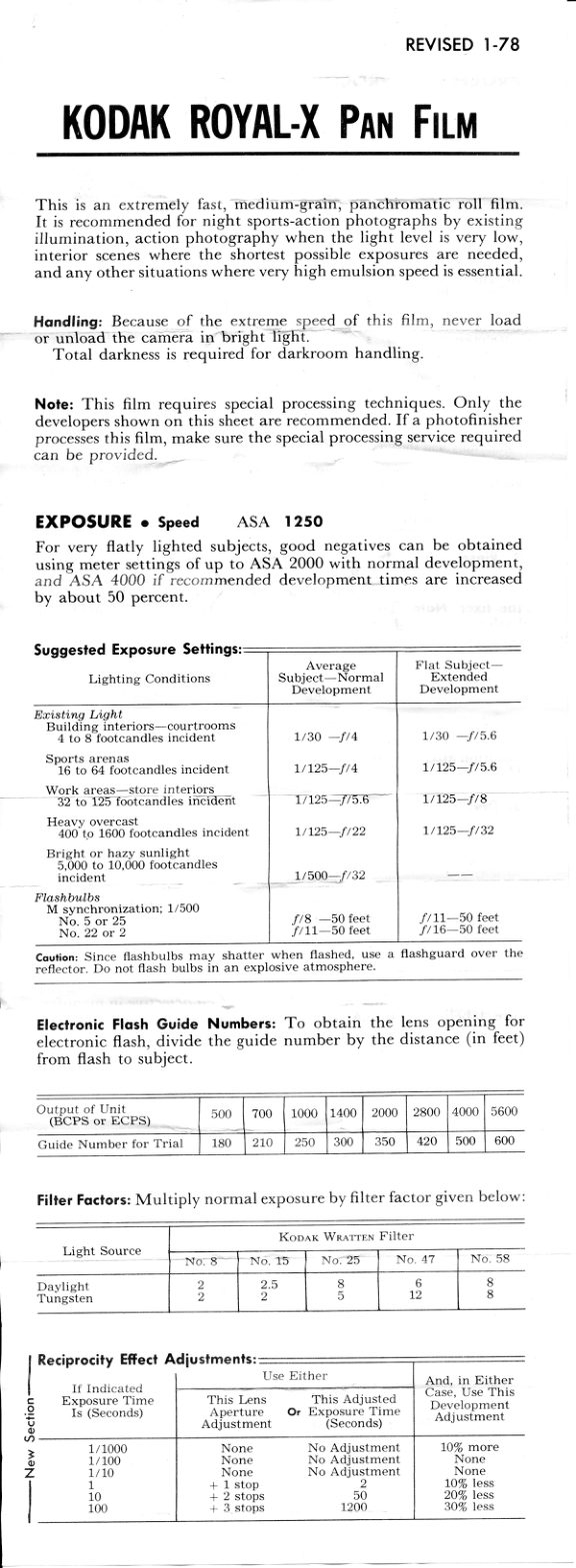
KodakPDF
Kodak Royal X Pan
User manual
2 pages · EnglishRead →
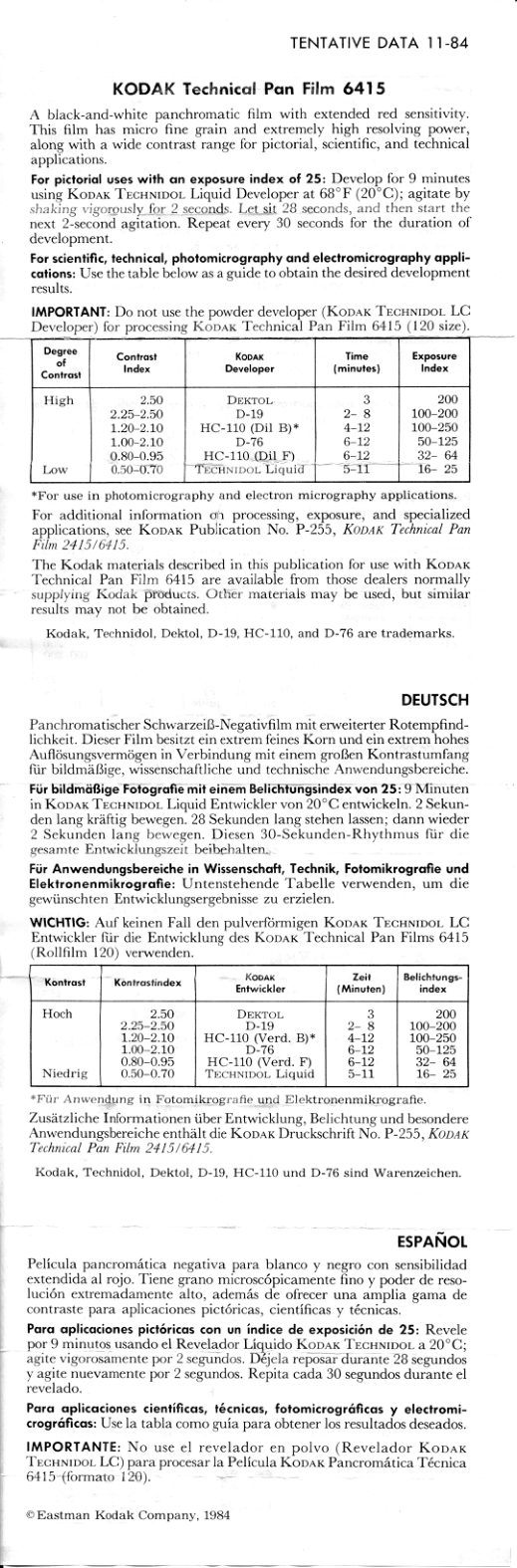
KodakPDF
Kodak Tech Pan 6415
User manual
2 pages · EnglishRead →
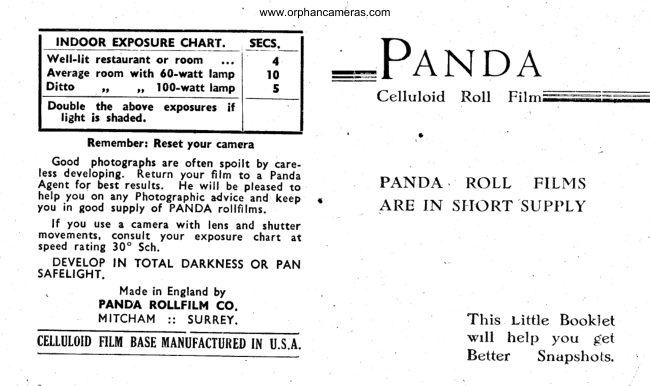
PandaPDF
Panda film
Product booklet
3 pages · EnglishRead →
Various brandsPDF
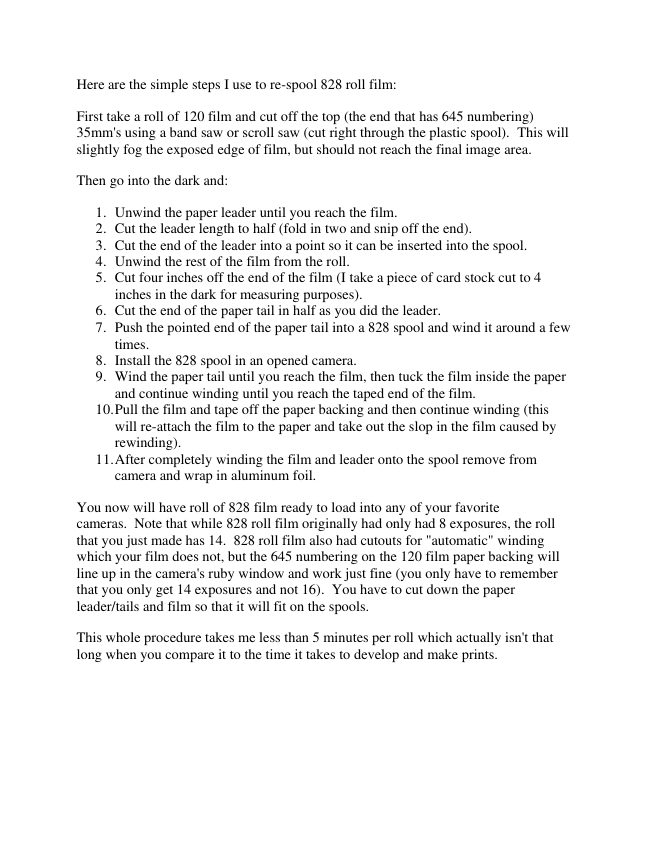
Re-spooling 120 film for 828 cameras
Reference guide
1 pages · EnglishRead →

TiffenPDF
Black and White Filters - Tiffen Filter Chart
Product booklet
3 pages · Not specifiedRead →
Various brandsPDF
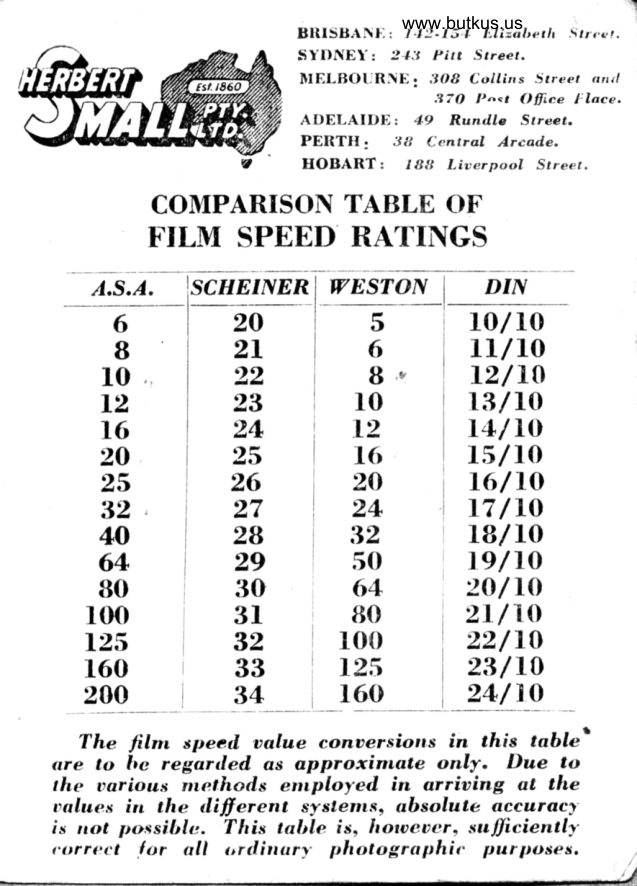
Comparison of film speed ratings
Reference guide
3 pages · Not specifiedRead →
From the M. Butkus Camera Manual Library. Original publisher and archive notices are retained.
Check the model and edition against your equipment.
PDF verified 2026-10-10.