Film cameras
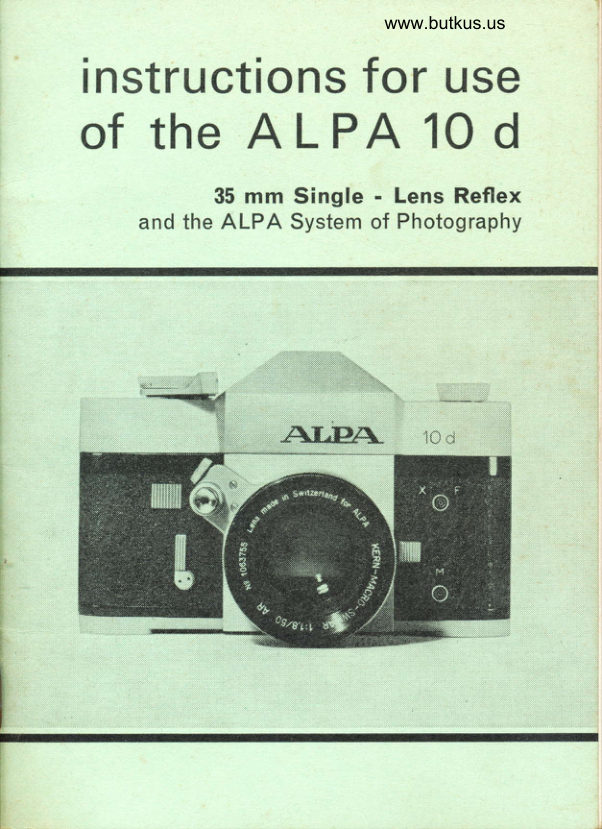
ALPA REFLEX 10D User manual
User manual for ALPA REFLEX 10D. 41 pages in English. Read the original PDF, download or print a copy without registration.
41 pagesEnglish13.2 MB PDF
Loading your manual…Open PDF directly
Document details
- Brand
- Alpa
- Model / document
- ALPA REFLEX 10D
- Document type
- User manual
- Language
- English
- Pages
- 41
- File size
- 13.2 MB
- Category
- Film cameras
- Document date
- Not specified in catalog
Search available document text
Find a term, then jump to its page in the original PDF. Image-only pages may not be searchable; check the PDF for exact wording and diagrams.
Page 2 · Read text
Perfect knowledgn of your
      ALPA, all its functions
       and features ot:ill give you,
        the best protographic results.
        Please study th,ese instructions
         careJully, starting u;ith,
        the brief instruction guide
        attached to
        the insicle bach cot)er.


PIGNONS S. A. Ballaigues (Switzerland)
View original page 2Page 3 · Read text
www.butkus.us
   Instructions for use
   of the
  ALPA 10 d


The ALPA 10d and the complete ALPA    mically streamlined for instant fingertip
system of photography are the culmina-    controls, quickest operation and rapid
tion of over 30 years of research and    action photography.
development,  to meet the most demand-   ALPA's ingenious, electronic behind-ing requirements of today's photo-    the-lens meter system thinks for your.
graphers.                                Foregoing inaccurate and delicate  link-
Purpose of this manual is to give you   age systems,  it couples optically-withcomplete instructions for the best   any lens, any lens accessory, at any
possible performance from your ALPA    distance, for an extreme film speed
eq u ip ment.                            range from 3-6400 ASA. The 3 CdSFor general information on photography,     cells with highly sensitive galvanometer
please refer to the many excellent photo-   compute absolutely precise exposure
graphic handbooks available.                    setti ngs.
                                The precision ground prism with paral-
A. THEALPAIOd.GENERAL   temlax-free,guaranteesthrough-the-lensprecise framing,viewingfocus-sys-
  DESCRIPTION                  ing and depth-of-field control-with any                                         lens, at any distance. You have your
A  masterpiece of Swiss precision   choice of attractive chrome or deepengineering, the ALPA 10d is literally    satiny black finish,with black, dark red
custom built to your order like the finest   or dark green leather covering that is
Swiss watch.  lt  is an ALL-lN-ONE    scuff proof, sweat proof and unaffected
camera of unbelievable  versatility with   by heat, cold and other climatic influ-
all desirable features, yet compact and    ences.
lightweight for maximal convenience.  The ALPA 1Od's uncompromisingly
Highly automated and functional-the    solid and exclusive light metal construc-
ALPA 10d is virtually foolproof, for   tion, is geared for more than 100,000utmost handling ease. Easy to frame,    operations, withstands the most rugged
easy to focus, easy to expose,  it is the    use, for lifelong durability. lt is virtually
dream of picture taking simplicity. You    impossible to deform the ALPA body.
can completely concentrate on your  The complete range of     f unctional
photographic assignment, without fum-    accessories. more than 30 ALPA lenses
bling for a dial, a ring, or a knob-even   and supplementary equipment  fit the
when wearing gloves.                          earlier ALPA models, 4-5-6-7-8, 4b-5b-
Automatic, instant exposure readings,   7b-8b, 6c, 9d and 9f, with a few minor
clear visibility of exposure needle, dials    exceptio ns.
and figures, rapid diaphragm and speed   Every precaution has been taken to
settings, quickchange bayonet lens   make the ALPA 'l0d as foolproof as
mount, high speed, short stroke wind-   possible. Nevertheless, we strongly
ing lever (without removing ALPA from   recommend that you read at least theyour eye), high speed parallelogram    brief instruction guide (see inside back
rewind crank, etc.-everything  is dyna-   cover) before using your ALPA 10d.
View original page 3Page 4 · Read text
Bitte spenden Sie 2,50 Euro, um diese Website über E-Bay zu unterstützen ... www.PayPal.me/butkusView original page 4
Page 6 · Read text
www.butkus.us


Fig.2

4) Shuttet Release                     provides for light readings, previewing
                                             depth-of-field and accidental exposureLocated on the front of the ALPA 10d    prevention. The lock does not  f unction, itD) Fig. 2) the               hair-trigger                           release                                   instan-   you                                                            release                                      use                                                 cable                                      a                                                                        in the releasetaneously          operates                  the quiet,                                lightning-                                                     the                                               camera                                                                                          itself.                                        button                                                    offast reflex-mirror and smooth-gliding,vibration-free shutter. Press your thumb   For extreme wide angle lenses withagainst the camera back in the opposite    protruding rear elements, the ALPA
direction, so as to hold your ALPA as    mirror can be locked in its flip-up posi-
steadily as possible. The conical thread    tion. Wind the high speed winding lever,inside the release button acceots a   holding it in its extreme position andcable release (see page 21 ). All lenses   depress the camera release button.with automatic diaphragm have integra-   Then release both release button and
ted release buttons, which in  turn    lever. For smoothest possible shutterdepress the release button on the    release with extreme telephoto lenses,camera. The flip-up reflex-mirror imme-   lor ultra close-ups, photomicrography,diately returns to its normal position,    etc. depress the release button veryafter the shutter is closed, even if you    slowly, so that the mirror flips up firstkeep the release button depressed.   and the shutter is released afterwards
Any vibration you may feel is caused by    o nly.
the flipping down of the mirror, which    Intentional double exposures can be
has no longer any influence on the   taken as follows: After the first expo-
sharpness of the picture.                sure press the rewind release knob at
                                   the bottom of the ALPA (Q Fig. 6),
lmportant: lf you still depress the    while operating the high-speed winding
release button when starting to wind the    lever the second time. The film will not
camera, the mirror may not flip up for   advance, so that a second exposure can
your next exposure and one frame would   be taken on the same frame. However,
be lost.                                    perfect registration cannot be guaran-The shutter release lock (V Fig. 2)    teed, as the take-up spool is stillturning.
View original page 6Page 8 · Read text
www.butkus.us
 naked eye. And it can still easily be
 seen, when stopping down to small apertures for depth-of-fi eld control.
 When using longer telephoto lenses or
 close-up attachments, the upper edge
  ol. the image may become slightly shad-
 ed, because the reflex-mirroi does not
 reflect the entire cone of light rays.
 However, this has no effect whatsoever
 on the actual picture.                                                 i'rltttt+i*l+1,i                              ffi The     eyepiece                of the             ALPA 10d                                         is equip-                                                   b                                                 Frg. ped with        a large,                  soft-rubber                          eyecup                                           to
 exclude        extraneous                      stray                                light.                             can                                                   lt
 rotated for            taking                    horizontal                                       vertical                        and                                     be   ,       l-{r, B[!a0/( pictures.            bayonet                  mount           lts                                offers                                               in-
 stant interchanging with a magnifier or   photograph. And last but not least.  it isangle viewfinder. The standard 1:1    indispensable  for extreme close-ups at ocular of the ALPA viewing system can    high. magnifications and photomicro-
be replaced by a special 1:0,7eyepiece,    graphy. The image is in perfect focus
 so that people who wear glasses or have   when both the serial image and one ofrecessed eyes easily see the entire   the two lines (L Fig. 4) appear equally image. An adapter with standard diop-    snarp.
ter or.prescription lenses snaps easily   Bot-h semi-circular prisms will appear into the eyecup (see also page 22i.   uniformly bright under normal iondi-                                       tions. Under certain circumstances
                                             (smaller lens apertures, close-up photo-
2) Focusing                             graphy) one of the semi-circular prisms
                                may appear to be shaded. In this caseTurn the focusing ring on the lens to   you can align your image between the
set the p-rgper distance. You have your   other, bri.ght p.rism of the split-imagechoice of 3 focusing methods:           and the clear glass ring.
                                     lmportant:                                       The perfected                                                                           optical                                                                                sys-   Grou          n dg lass.a)                                                     of the ALPA                                                           10d with 1:                                                                                         size                                                                                                                      i LIFE     imageuntil              is criticallyT ur n d i stansharp.ce setti n a r  i n q   tem                                    magnification on  the  groundglass
b) 45o Diagonal Split-lmage Rangefinder   makes focusing remarkably easy. How-
                                             ever, this should not tempt you to takeThe standard groundglass sreen has a   photographs of subjects which coverbuilt-in optical rangefinder with a 45o    only a small part of the entire area. you
diagonal split-image, formed by a pair   can easily avoid this by comparisonof prisms which appear as 2 sdmi-    with the 3 rapid reference scales on the
circles (Fig. 5). You can 'veiticalpinpoint focus  ALPA groundglass: The diameter offor both horizontal or            lines    the rangefinder is 3 mm, the width of the
ins.tantly-with any lens, at any distance.    clear glass ring is 1 mm which brings
Select a specific detail in the-subject to   the total diameter to 5 mm. The overallbe photographed and turn the foiusino   length of the cross-hair is 10 mmring      until         the           image in the                         2 semi-circle6                                            (Fig. 3,                                  4 and                                                                         reference                                                          5). These                                              3     perfectis in             alignment,                      with                       no displa-    scales                                                     clearly                                                          indicate                                                   when                                                                                      different                                                        acement at the dividing line. Now your    (telephoto) lens ought to be used. Theyfocus is perfect (Fig.3and 4).             are even more useful for measurements
                             and comparisons in macro-photogra-The cle?r glass ring (aerial image)    phv.
around the rangefinder (diam. S mhipermits               see-everything                                    visually       ygu to                                     c) Distance Scalesharp,      which               is                                                               tfrir                 in front or UetrinO
depth-of-field            zone                     of sharpness                            on                                    the                                                 interchangeable                           ALPA                                                                 lenses                                                                        are                                                                                                   cali-groundglass.          You can                     also use                                         for    brated                                                 with                                                                           preset                                                 it                                                   distance scales                                                                      torapid location of the subject you wish to    specific distance, where focusing on thea
View original page 8Page 14 · Read text
www.butkus.us
 are set with the diaphragm ring (G).
The disc (H) on the release button
 changes the diaphragm from automatic
 (opposite two white dots) to manual
 (opposite single white dot).
d) Schneider Zoom Lenses
ALPA-Variogon 45-100 mm f/2.8
ALPA-Tele-Variogon 80-240 mm f/4
 (Fis. 17)
The automatic diaphragm  is controlled
by the cable release and pistolgrip, and
can be disconnected by removing them.
The small metal lock on top of the
camera mount allows instant rotation of
camera from horizontal to  vertical
 position (separate leaflet on request).

4) Other Lenses
Diaphragms and apertures are set with
the usual focusing and diaphragm rings
(see also separate leaflet).
a) Kilfitt lenses with preset diaphragm
ALPA-Macro-Kilar 40 mm f/2.8 Model D                                           Fis. 18
focuses down to 2" (reproduction  1:1
 ratio)
ALPA-Macro-Kilar 40 mm f/2.8 Model E
focuses down to 4" (reproduction   'l :2
 ratio)
ALPA-Super-Macro-Kilar                mm f/2.8                    90                                               1:1,                                           Fis. 19focuses                                ratio        to 5" (reproductionFis. 18) attaches without standard
mount to Combextan bellows for fo-
cusing from infinity to ultra close-ups
(see page 20).
ALPA-Pan Tele-Kilar300 mm f/4
focuses to 5112
ALPA-Tele-Kilar 600 mm f/5.6
b) Schneider Lenses with preset
   diaphragm
ALPA-Xenar 75 mm f/3.5
ALPA-Tele-Xenar 360 mm f/5.5
c) Kinoptik lenses
ALPA-Super-Tegea 1.9 mm f/l,9
(image of 8.7 mm diam.)
ALPA-Tegea 9.8 mm l/1.8 (18 x 24 mm
coverage)
ALPA-Kinoptik l8 mm f/1.8 Apochro-
mat ('18 x 24 mm coverage)
ALPA-K|noptik 2'10 mm f/2.8
View original page 14Page 20 · Read text
17
                                      www.butkus.us
G. HOW TO HOLD YOUR    H. COMPLETE RANGE OF
  ALPA                 ALPA ACCESSORIES
The right hand sets the speed dial,   1) ALPA Filters (Fig. 25)
winds the ALPA with the high speed  The complete set of solid snap-inwinding lever and releases.                    filters, precision ground of finest opti-The lelt hand adjusts the exposure by    cal glass dyed-in-the-mass, plane paral-turning the aperture ring and focuses     lel and coated on both surfaces. match
the lens.                                   the superior quality of the ALPA lenses.The ALPA remains in perfect balance  ALPA tradename and the filter number
and at eye level at all times.                   for the various color tints are marked on
Fig.24 shows the method of holding the   the filter itself.ALPA with preselected shutter speed    Polarizing filters are also available forand turning the diaphragm to cr:nter the   most ALPA lenses,
needle.                                    Gelatine discs in ALPA filter mount orFig. 23 shows the method of holding the   empty mounts can be supplied for colorcamera with preselected f/stop and    tints not available as dyed-in-the-massturning the speed dial to center the    glass filters.
needle.                                Each filter is individually inspected and
                                           carries an unconditional guarantee for
                                             ootical excellence.
                                     Most ALPA filters snap into the front of
                                        the lens or on top of another fiiter with
                            a slight pressure. Remove them by a
                                         gentle pull and a slight turn (separate
                                                           filter leaflet on request).


                                                                                           Fig. 25
     @m
View original page 20Page 21 · Read text
18

                                     mage. When using botn a supplemen-
                                          tary close-up and a filter, mount the
                                        close-up lens first, then snap the filter
                                    on top of  it.

                                       3) ALPA Lens l'{oods (Fis.27)
                                     Most lens hoods snap on the outside of
                                  the lens mount, independent of the
                                                        filters, by a slight pressure on the loop
                                                of the flat spring. When not in use, they
                                   can be reversed and slipped over the
                                               lens, so that they fit into the everready,
                                            lens or compartment cases.

                                     4) Photomicrography  (Fig. 28)
                             The microfix adaoter fits the ALPA
                                    without lens to any standard micro-
Fig.26                              scope with 25 mm outside diameter, for                                      photomicrography. The special micran
                                      adapter can be made to order to  fit
                                         other microscopes.
                              The inversbag lens inversion ring sys-
2) Supplementary Close-Up Lenses   tem fits the ALPA with lens to micro-
(Fig.26)                             scopes. (See also 8 below.)
                                  Both combinations reouire the use of
You have your choice between *  I (for    the tuban A 4 and 3 extension tubes orsize A and B diam.) and *  0,5 diopters   a bellows attachment and a  cable
(for size B diam, only)                        release. The behind-the-lens CdS meter
Whenever a supplementary close-up   system offers precise exposure readings
lens is used, the diaphragm should be   through the microscope (separate book-
stopped down {urther to get a sharp    et on req uest).


Fig.27
View original page 21Page 22 · Read text
www.butkus.us


 Fig. 28

5) Endoscopic Photography etc.
The endobag adapter fits the ALPA to
endoscopes, bronchoscopes and other
instruments, for endoscopic photogra-
phy etc.
6) TUBAN Extension Tubes
Fig. 29 shows the complete set, consist-
ing of the following components:
2 intermediate rings tuban A (outside                                           Fis. 31
bayonet, inside thread) and tuban B
(inside thread and outside bayonet)
with a total extension of 6 mm, plus the
actual extension tubes tuban 4 (48 mm),
3 (24 mm),2 (12 mm) and 1 (6 mm), with
a total length of 96 mm. Their use is
shown in Fig. 30 with tuban A and B
between camera body and lens, while
the actual extension tubes tuban 4,3,2,
1 fit between the rings A and B accord-
ing to the required extension. The
extension tubes can also be usedwithout tuban A and B rings.  if a lens
with detachable mount is used like the
ALPA-Xenar 75 mm f/3.5 or the ALPA-
Tele-Xenar 360 mm f/5.5.
View original page 22
Page 25 · Read text
of the plunger from being transferred
                                            to the ALPA itself.
                            When using a wide angle lens such as
                                          the 28 mm or 24 mm, check the position
                                            of the cable release, so that it does not
                                                interfere with the picture.
                              The automatic lens diaphragm feature
                                          is retained by using the bipres twin
                                         cable release (Fig.36). lts plungers must
                                   be adjusted in such a way that the lens
                                   diaphragm closes before the camera
                                          shutter is released.

                                      12) Prescription Lenses for Viewing
                                        Gig. a2)
                              Most wearers of glasses can focus
                                               perfectly on the groundglass or with the
                                          split-image rangefinder of the ALPA
                                                  '10d. For photographers who have diffi-
                                           culties in accommodating their eyes,
                                 the montur adapter for  prescription
                                         lenses is recommended.  lt snaps easily
                                      into the reflex eyecup and can be
                                       supplied with standard coral correction
                                         lenses of + 1, + 2, + 3, + 4, and     1,                                       3 diopters. Special prescription-                                       -2,lenses- can be fitted to the adapter by a
                                                local optician.

                                         l3) Everready Cases (Fig. 39/a0)
                                         Available in dark brown or black wash-
                                             able, top quality cowhide, the streamlin-
                               ed everready case protects the ALPA
Fig. 41                                 10d with any lens from 35 mm to 75 mm                                         focal length. The drop front with snap
                                            fastener (Fiq. a0) can easily be detached
                                     from the main case. The camera is held
                                          securely inside the case by the bottom
                                      screw which has its own tripod socket.
                        A special soft case with round shaped
                                    shoulder strap (benblak) holds the
                         ALPA with larger and longer lenses,
                                   such as 24 mm,28 mm, 75 mm, 90 mm,
                                         100 mm, 135 mm, 150 mm and 180 mm.
View original page 25Page 26 · Read text
www.butkus.us
14) Shoulder Strap (Fig. a1)
Made of round shaped, braided leather
the adjustable shoulder strap attaches
to the 2 recessed sockets on both sides
of the ALPA 10d. This is an invaluable
accessory, whenever you use your
ALPA without case.

15) ALPA Lens Cases (Fig. 43)
A complete set of well padded leather
cases with zippers protects the inter-
changeable ALPA lenses against dus.
and shock (see charts on page 27).

16) ALPA Gadset Baqs (Fig. 44)
These sturdily built carry-all cases come
in black leather with red velvet lin-
ing. Special "velcro" dividers can be
moved and compartments re-arranged
according to the equipment used. 1 or 2
ALPA camera with standard  lens.
lenshood, 2-4 ALPA lenses and a
number of accessories will easily  fit.
The inside cover accommodates the
pistol grip with shoulder support,
filters and additional accessories. The     Fis. 43case is locked with a key for best possi-
ble protection. Dimensions: 11" long,
5" deep and 9" high.

17) ALPA Electric Motor (Fig. 45)
The electric motor converts the ALPA
into an automatic camera for rapid
action and sequence photography.
Operated by a compact, rechargeable
           12       rodbattery              Volt DC                       or a transformer-         '110rectifier               ACl12           Volt                      Volt DC,  it     Fig. 44
View original page 26Page 27 · Read text
l9) ALPA 100 Ft. Magazine  (Fis. 46)
                                     Completing the ALPA electro-automa-
                                              tic recording system is this indispen-
                                          sable tool for large volume photography.
                                  Accepting standard 100 ft.  daylight
                                        loading reels, the ALPA 100 ft. maga-
                                        zine offers uninterrupted sequences of
                               up to 800 exposuresr without winding
                                    and reloading.
                                                        It is equipped with a built-in cutting
                                               knife and a resettable exposure counter
                                          that both adds and subtracts. Exacting
                                     pin registration, as found only in the
                                  most sophisticated 35 mm professional
                                     movie cameras, guarantees an unbelie-
Fig. 45                               vable spacing accuracy of 0.02 mm   !
                                          (separate booklet on request).
                                      20) ALPA 18 x 24 mm (17 x 22.5 mm)
                                       Half Frame Gameras
                            When used with the 100 ft. magazine
                                      these special ALPA 10d models pro-
                                    vide up to'1600 uninterrupted expo-
                                         sures, with the same spacing accuracy
automatically transports the film, counts    of 0.02 mm ! They are ideally suited forthe exposures and cocks the shutter.    filmstrips, education, sales promotion,
You press the red button for automatic    training, any AV application,  etc.one-by-one shots, the blue button for
uninterrupted automatic sequences
(separate booklet on request).            21) ALPA Timer and Programmer
                                The tempo timer provides preset inter-
18) ALPA Remote Releases            vals from 1-72 seconds and time expo-                                         sures from 1/1000-36 seconds.
The ALPA electric motor can also be   The intermo programmer offers one-by-
operated by remote control from dis-   one shots with preset intervals from
tances up to 300 ft., or with a wireless   1 second to 27 hours, or sequences of
remote release from up to 2 miles   1-10 exposures with preset intervals
(separate booklet on request).             from'l-100 seonds. Time exposures can

Fis. 46
View original page 27Page 28 · Read text
www.butkus.us


Fis.47
be setlrom 1/1000-100 seconds (separate   easily solves any problems of copY
booklet on request).                  work and macro-photography, includ-                                     ing ultra close-ups, copying of small
                             and large documents, duplicating of22, ALPA Macrostat (Fig.47)              slides and film-strips, etc.
This collapsible, easily portable minia-    Special components such as refiectors,ture photo stLrdio is ideally suited for   close-up light, adjustable macro and
copy work as well as indoor and outdoor    micro-stages, two-way mirror, film, du-
close-up (Macro-) photography.  lt    plicating attachment, groundspikes, ca-
combines light-weight compactnes,    mera cradle, etc. give the Macrostat lite-
rugged stability, closest tolerances and     rally unlimited possibilities.
extreme versatility with utmost ease    Originally designed for the ALPA, the
and speed of operation. Thanks to the   Macrostat can also be used with anyingenious modular design for multiple    other 35 mm and most 2 114 x 2114'
combinations   it is the only system that   cameras.
View original page 28Page 29 · Read text
26

                                                   knowledge                                            only                                                extensive                                                          and                                                                                           skills, but I. USEFUL ALPA HINTS                                                                    guarantee                                  also                                                     tools. Your                                           special
ALPA cameras are well known for their   becomes void, if the ALPA or ALPA
 exceptionally solid and exclusive  light-    lenses are serviced by any unauthorized metal construction that withstands the   person or service station.
 most rugged use, This has been proved
time and again under the most trying   8) The ALPA is not watertight. Special climatic conditions,  in many expeditions    water-tight cases are available for
to the artic, the tropics, the ocean    underwater photcgraphy.   lf the camera depths and up the highest mountains    is dropped accidentally into the water,
 of the world.                                                     it should be dried immediately and sent
 Nevertheless, the ALPA is also a    at once to an authorized service station precision instrument, which deserves   or to the ALPA factory. lf dropped
your continued care, so as to maintain    into salt water, the camera must first
 its high performance standards. The   be rinsed several times in fresh watersame principle applies to all ALPA len-   before being dried. lf salt water driesses and accessories, Please pay special   inside the camera, the  increasingattention to the following points:          concentration of salt will erode the                                    metal components including chronne,1) Protect your ALPA from sudden   and destroy the mechanism.blows and falls, by using a carrying
case. Avoid continuous vibration (on   9) Standard 35 mm film c-artridges may
the floor of a car close to the propeller   sometimes be faulty. When loadingshaft, on the luggage grid of a motor-   your ALPA make sure that the film
cycle, etc.)                          moves easily out of the cartridge and
2) Do not leave your ALPA wound    that its lips are not too tight or dented.during prolonged periods of time.              lf the film does not pull out freely,                                          gently insert a penknife blade between
3) Keep your ALPA away from dust,   the back of the film and the lip of the
wind-blown sand and too much humi-    cartridge and open the mouth slightly.
dity. ln the tropics keep it in an airtight   Make sure that there are no loose velvet
container together with a desiccating    threads hanging from the cartridge  lips.
agent such as silica gel. In winter, when   They may tear lose and get caught in the
carrying your ALPA  f rom outdoors    film window, which produces shadows
into a warm room, metal and glass   on your photographs.
surfaces may become misted over with
condensation. Do not wipe this off, but   10) Register your ALPA with the agent
wait until the mist disappears as the    in your country to validate the warranty.
camera warms up.
4) Clean the film channel and pressure   11) lf your ALPA is lost or stolen,
plate from time to time with a piece to    report the serial number of both camerafluff-free cloth (never use cotton or  and lens to your dealer, the ALPAwool).                                agents in your country or the ALPA                                         factory immediately. This is the only5) Do not touch the reflex-mirror with    possible method of finding the camera
your fingers, which may smudge or   and returning  it to you. We strongly
scratch its surface. Your nearest dealer   recommend that you insure your ALPA
or service station will be happy to clean    equipment.
it for you.
6) Dci not try to lubricate the ALPA    12) Over 40 % of the ALPA factory aremechanism and shutter. They are   engaged in most severe, total qualitygeared for more than 100,000 operations    controls,  certified by an inspection  labelwithout lubrication.                      attached to every ALPA. And each                          ALPA carries a world-wide guarantee
7) Do not attempt to dismantle the   for highest mechanical, electronic and
ALPA. This operation requires not    optical performance.
View original page 29Page 30 · Read text
27
                                       www.butkus.us
    Table of interchangeable ALPA lenses, lenshoods, filter and cases
      lens    f:mm    1: Ienshood filter        case
     Retrofocus       24       3,5  aucun   filtrado    reblak
     Retrofocus       28       3,5  aucun   filtrado    reblak
     Curtagon         35       2,8  curtabe filtrabe    reblak w/o lenshood
                                                            et reblak with lenshood
     PA-Curtagon    35     4,0 cu rtabe
     Macro-Kilar      40       2,8            ecrana      reblak
    Xenon           50     1,9 omxabe    filtrabe     reblak
     Macro-Switar    50     1,8 omxabe    filtrabe     reblak
     Xenar             75     3,5 omxana   filtrana     xetdark
      Alfitar           90     2,5 telebe     filtrabe     reblak w/o lenshood
                                                       mulblak with lenshood
     Macro-Kilar   90    2,8 aucun  filtrana/    noblak
                                                                    fitkitt
    Apochromat   100  2  parso   filtrado     noblak
     Tele-Xenar   135   3,5 telebe  filtrabe      reblak     Apochromat   150   2,8 parast  filtrado      kinblak
      Alitar      180   4,5 alibe     filtrabe     mulblak     Pan-Tele-Kilar 300   4,0 parast  filkitt       trade
                                            incl
     Tele-Xenar   360   5,5 parante x filtran    texblak     Sport-Fern-   600   5,6 parast  filkitt        trave
       Kilar                                incl
     Variogon       45-100 2,8 incl       filvar       pafour
     Tele-Variogon   80-240 4,0 incl       befil        pafour


l
View original page 30Page 31 · Read text
28
           TABLE OF CONTENTS
       OF THE DIRECTIONS FOR USE
                              Page                                 Page
A. The ALPA 10d - General             9) Lens Caps                       12
    Description                                      1    10) Infra-Red Photography        12
B.  External Control                 2   F. Exposure Readings            13
 1) Winding                          2    1) Basic Principles                13
 2) Setting of ASA Film Speed            2) Two Methods                   14
    Rating                            2      a) Correct Aperture for
 3) Setting of Shutter Speed          2          given Shutter Speed 4) Shutter Release                   3         (Fiq.24)                                    't4
 5) Selftimer                            4      b) Correct Shutter Speed for
 6) Flash Synchronization              4          given Aperture (Fig. 23)      14
c.  Framing, Focusing and              3) Recommendations           14
    Depth-of-Field Control           4    4) Range of CdS Meter-System  15
 1) Single-Lens Reflex System        4    5) Battery Change                   15  2',t Focusing                           5    6) Filter Factors                    15
   a) Ground Glass                   5  G. How to Hold Your ALPA      17
    b) 45o Diagonal Split-lmage         H. Gomplete Range of
     Rangefinder                 5    ALPA Accessories            17
   c) Distance Scale                5    1) ALPA Filters (Fig,25)                 '17
D. Loading and Unloading        6    2) Supplementary Close-Up 1) Loading                          6      Lenses (Fig.26)                 18 2) Unloading                       8    3) ALPA Lens Hoods (Fis.27)     18
E. The usual ALPA lenses        I    4) Photomicrography  (Fig. 28)      18
 1) Changing of Lenses            8    5) Endoscopic Photography
 2) Standard 50 mm Lenses with             etc.                               19
   Automatic Diaphragm          9    6) TUBAN Extension Tubes       19
   a) Kern ALPA-Macro-                7) Bellows Attachments         20
       Switar 50 mm f/1 .8                   a) NIVEX and DOVEX
      Apochromat (Fig, 13)         9        Bellows                    20
   b) Schneider ALPA-Xenon              b) ALPA COMBEXTAN
      50 mm f/1.9 (Fig. 1a)              I              '   Bellows System (Fig. 32)     20
 3) Wide Angle and Telephoto Lenses    8) INVERSBAG Lens
    with Automatic Diaphragm    10        lnversion Ring System
   a) Schneider Lenses           10         (Fis. 35)                             21
   b) Angenieux Lenses           10    9) USAN Camera Cradle
   c) Kinoptik Apochromate     10         (Fis. 36)                             21
   d) Schneider Zoom Lenses      11   10) KIGRIP Pistol Grip with
 4) Other Lenses                                  1'l       Shoulder Support (Fig. 37)      2l
   a) Kilfitt Lenses with preset             11) Cable Realeses                  21
     diaphragm                       11    12) Prescription Lenses for   b) Schneider Lenses with               Viewins (Fig.42l                22       preset diaphragm                     13) Everready Cases (Fig.39/a0)   22
   c) Kinoptik Lenses                    11    14) Shoulder Strap (Fig. 41)        23
 5) Special Lenses                    12    15) ALPA Lens Cases (Fig. a3)     23   a) Schneider ALPA                       16) ALPA Gadset Bags (Fis.44)   23
      PA-Curtagon 35 mm                  17) ALPA Electric Motor
        f/a (Fiq. 19)                     12         (Fis. a5)                        23
     b). Zeiss ALPA-Luminar                  18) ALPA Remote Releases       24
      25 mm f/3.5 Special                     1e) ALPA 100 Ft. Magazine
      Close-up Lens                          't2         (Fis. aO)                       24 6) Depth-of-Field                     12    20) ALPA 18 x 24 mm (17 x 22.5 mm)
 7) Relation between Distance                 Half Frame Cameras          24
   and lmage-to-Subject  or               21) ALPA Timer and Programmer 24
   Reproduction Ratio                12    22) ALPA Macrostat (Fig. a7)      25
 8) Exposure Factors                  12      t.  Useful ALPA Hints            26
View original page 31Page 36 · Read text
www.butkus.us

                                     Eyepiece can be         for vertical
                                          pictures.


Loading camera:
The take-up spool should be
turned by hand until one layer of
the film is wound around  it,

Battery (sign  *  facing towards
you).


Coupling knob to be pressed
before rewinding film.To open camerabody, turn key to                       r:
the right, then pull,
View original page 36Page 40 · Read text
www.butkus.us


     Fis. 1


* lf a cable release is inserted directly in the shutter release D (Fig. 2), the
shutter lock V is ineffective and the reading should be taken before the
shutter  is wound on. When a cable release  is fitted into the release D (Fig.2),
the operation of the lock V is not affected.
View original page 40Related documents and language editions

From the M. Butkus archive. Original publisher and archive notices are retained.
Check the model and edition against your equipment.
PDF verified 2026-10-10.