Film cameras
ANOTHER THE CALUMET 4X5 VIEW CAMERA User manual
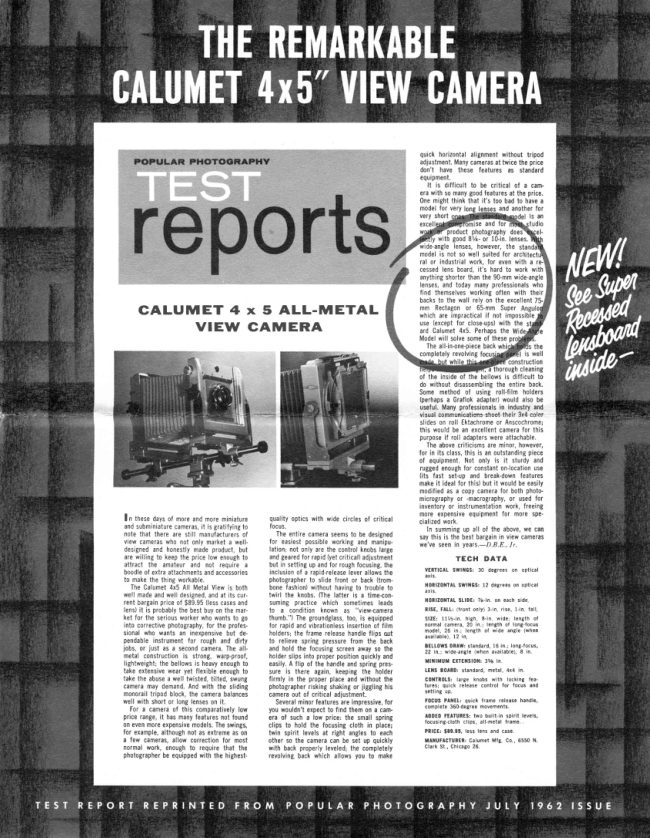
User manual for ANOTHER THE CALUMET 4X5 VIEW CAMERA. 21 pages in English. Read the original PDF, download or print a copy without registration.
21 pagesEnglish4.3 MB PDF

Loading your manual…Open PDF directly
Document details
- Brand
- Various brands
- Model / document
- ANOTHER THE CALUMET 4X5 VIEW CAMERA
- Document type
- User manual
- Language
- English
- Pages
- 21
- File size
- 4.3 MB
- Category
- Film cameras
- Document date
- Not specified in catalog
Search available document text
Find a term, then jump to its page in the original PDF. Image-only pages may not be searchable; check the PDF for exact wording and diagrams.
Page 3 · Read text
Check  this year's  prize winning  pro-$lhy-e-                   fessional  photographs.   Or  thumb
                                          through  any  fashion  magazine  and
                                          glance  at the  illustrations.   Chances
                                                are, seven times  out  of nine,  these professionslphotographs  were taken with a view
                                      camera.
                                                     In every  field, the  versatile  view
                                     camera  is tremendously   important.
                                       For  instance,  commercial  photo-photogrophers                                         graphers  specializing   itt advertising
                                        photography   find   it  indispensable.
                                  They  compose and  design  their
                                        photograph    right  on  the  ground preferthe                glass;  or when  the  layout   is  fur-
                                           nished,   it  is traced  on the  ground
                                           glass-then    the  subject  matter   is
                                       photographed   to conform  exactly  to vlettttumgrtl         the layout.  In no other type  of cam-
                                      era has the  p h o t o g r a p h e r   s u c h
                                              control  over  his composition.


            If you  look  through  the product  photo  files of the  big names  in the
     automotive   industry         or any  industrial   plant  that makes wide use
      of photography     .  .  . you  will  find  that  view camera  shots predominate.
      The professional photographer   finds more enjoyment  and satisfaction
      in working  with  a view camera, because he knows  that  the swings and
     controls   will  enable him  to produce  the photograph   exactly  the way
     the customer  wants   it.  Actually,  view camera adjustments  permit  the
     lens to see like  the human  €!€,  for   it  permits  the  correction   of image
     distortions  inherent  in lens design.
     When you use it,  you'll  agree that you don't  waste many  shots with
     a CALUMET.     Ordinarily,  you  can be sure and  safe with  just  one.
  TWO MODELSFROMWHICHTO CHOOSE
        l. The STANDARD   4 x 5 CAMERA   is designed for Ienses having
      normal covering power over a 4 x 5 negative format,  with  a L6"
       bellows extension, making   it  suitable for  all normal view camera
       work, including wide angle with moder ate use of swings.
     2. The LONG FOCUS 4 x 5 CAMERA   is built  with a 22" bellows,
        for those who prefer to use longer focal length lenses. (Not recom-
      mended for wide angle work. )
Ca,  lLrrTret
M A N U F A C T U R I N G  C O M P A N Y   6 5 5 0 N . C L A R K  S T .
c H t c A G o   2 6 ,  t L L . .  7 4 3 - 2 4 4 2


   2

                          www.orphancameras.com
View original page 3Page 4 · Read text
whotwill
columet's
 sll metsl
  5
vrewc0meros
doforyou?
... plentyf
theygiveyou..o


@ tgOZ Columet Monufocturing Compony
View original page 4
Page 5 · Read text
+>goodfe0s0nsWhy
 columet4 x 5 viewcomeros
   AnswerALLyourneedsl
q
       Rising,folling front                      Verticol swings to
       to shoot something,                    eliminote perspec-
      o b o v e o r  b e l o w                         tive distortion.
      you.


 lr


                                           Revolving bock (ro-
      Spring bock releose                                        t o t e s  i n c o m p l e t e
      g i v e s e o s y ,  f o s t                      c i r c l e l o l l o w s  f o r
                l o o d i n g . . . w i t h n o                 chonges in oriento-
       iorring, no chonge                       tion without chong-
        of cqmero position.                     ing tripod.


            www.orphancameras.com
View original page 5Page 6 · Read text
t . VERTICAL SWINGS (30 degrees) are pivoted on the optical axis. To correct
     distortion  or increase depth  of focus in vertical  plane. Can be locked in
    any  position  by simple turn  of knob.  spirit  levels, mounted  on top  of
    camera back, indicate when camera is level.
  2. HoRlzoNTAt  swlNGS, both front and back, are pivoted on the optical
     axis. Can be swung 12 degrees in either direction  for horizontal  distortion
     correction, and for increasing depth  of focus.
  3. HoRlzoNTAt  stlDE makes it possible to move film and lens up to 74,,
      in either direction when obstruction  prevents centering camera on subject.
    Both  front and back have this adjustment.
  4. RlSlNG-FAttlNG front  is easily controlled, locks in any desired position.
     3" rise,  t'   fall. used when  it  is desired to include more of the top of a
      tall building,  or some other subject, or to eliminate excessive foreground,
    without  tipping  the camera.
  5. SMAtt  slZE, light weight, portable. LLrz'  high, 8" wide. Modern  tech-
    niques make enlargements  of 4 x b sharp, satisfactory.
  6. ALUMINUM FRAME, satin-finished, gives complete rigidity, has long life.
     Attractive,  well-designed,   it  is built  for years of service.
  7. REVotvlNG BACK enables camera to be used not  only  in  vertical  or
     horizontal  positions, but at any point throughout  a complete circle. This
    permits  dramatization   of an ordinary  subject  through  the use of an
    unusual camera angle.  ft ako enables you to make horizontal  alignment
    without  adjusting  tripod.
 8. BEttows  are tough,  grey  material.  Meet  highest Government  specifi-
     cations.
 9. METAT tENs BOARDS are interchangeable;  pilot hote in center.
to. EASY RELEASEof ground glass frame. Big handle pulls down, tension
     is relieved, back opens to receive holder.
 l l .  BIG KNOBS, easy to handle, simple to operate
12. FltM HOLDERSdesigned to use standard film or plate holders as well as
     film pack adapters. The 4 x 5 proportions  permit exact 2X enlargements
     to 8 x 10 and exact 4X enlargements to LG x 20.

              SPECIFICATIONS-   All Models
Verticol Swing (Froniond Bock)-30o              Minimum Extension-Lensboord-to-film3% inches
Horizontol Swing (Frontond Bock)-'12"            Lens Boord-Stondord 4-inch
Rising-Folling            Front-Roised 3 inches, lowered       Film Ho ld e rs-L o c k- r ibtype doublefilm or plote     'l
    inch                                             h o ld e rso n d film pock odopter
Horizonlol Slide (Frontond Eock)-%  inch           Dimensions- I I 7r incheshigh
RevolvingBock-360"                                             8 incheswide
                ADDITIONAI. SPECIFICATIONS
                  Stondord Comero                long Focus Comerq
                    Bellows drow-16  inches         Bellowsdrow-22  inches
                      Totol length-20 inches           Totol length-26 inches


  2 , .  . . . :      . h ; ; .
View original page 6Page 8 · Read text
ports                                                                     o o o             focusing

   l.  Releoselever       T o m o v e  t h e  f r o n t o n d b o c k c o r r i o g e s o n
    (focusing)                     the monoroil:
 2.    Center locking             t. LoosenFRONT and BACK LOCKING SCREWS.    screw
                               2.  !{ q_uick movement   is desired,  lift up on FOCUS-
 3. Bock locking            ING KNOB  RELEASE  LEVER,  ahd slide along
    screw                           rail.
                          3 . F o r    f u r t h e r  a d j u s t m e n t s ,   u s e F O C U S I N G
 4. Bock focusing           K N O B S .
    knob                    After  the camera  has
                        been positioned  to give
 5. Roil knob             approximate  image size
                            desired,  slig.ht chang-es 6. Front focusing                                in image  size can  be
   knob              made  by  racking  the
                      camera  and  monorail 7. Frome releose                          o n   t h e   t r i p o d  b l o c k .
   hondle              To do this:
 8. Risingfront knob                 l .  L o o s e n   t h e C E N -
                           T E R   L O C K I N G
 9. Verticol swing          S C R E W .
    lock knob               2. Rack camera back-
                      w a r d  o r   f o r w a r d
I O. Horizontol swing          with RAIL  KNOB.
    lock knob             3 . T i g h t e n C E N T E R
                                    T. O C  K    I N G
I l. Clompinglever       SCREW   after  ad-
    (revolving bock)          justment   is made.
12. Monoroil comero
    bed                        F o c u s i n g  c l o t h  c l i p s
13. Tripod block          are provided.  To  hold
                            cloth securely:
| 4. Focusingcloth                 l.  Fold edge of cloth.
    clips                          2 . P l a c e  o v e r  b a c k .
                                                          f r a m e ,  h o l d    t a u t
                             against bellows; slip
                             d e s c e n d i n g    f o l d s
                                                                        i n t o  F O C U S I N G
                      C L I P S .
View original page 8Page 9 · Read text
't,


loodingthe comeroo. .
The  camera  has an improved  method   of releasing  the ground  glass
frame  which  makes   it  possible  to remove  or  insert  the  film  holder
without  disturbing  the camera  position:
( | )  Pull  out on the FRAME  RELEASE  HANDLE      till   it extends  at
     right  angles  to  back  and  small  rollers  rest  in  the  depressions.
     fnsert  film  holder.
(2) See that  bottom   of holder  rests on protruding   stops. Release the
    frame  release handle.
(3) Wait   until  lens has been  set  for  exposure  before  withdrawing
    holder  slide.
functionsof theswings.. .
The  swings,  horizontal   slide,  rising  and  falling  front,  and  rotating
film back give the Calumet  4 x 5 View Camera  the versatility  desired
in a commercial  camera. The purpose of these swings is to position the
lens and  film  plane so that  the image  will  appear as desired by  the
photographer.   This may  be a correction   of converging  or  divergi.tg
lines or  it may be a deliberate  distortion   td  fit the mood  of the picture.
It  may  be the  elimination   of  foreground   or   it may  be an image
running  diagonally  across the  film.


8
                    www.orphancameras.com
View original page 9Page 10 · Read text
FARTHESTPOINT IN SUBJECT
                                           RECORDSON NEARESTPOINT
                                                     OF FII.M


The swing (horizontal or vertical  ) of the camera back is used to control
the line relationships  of the subject - converging or divergitrg parallel
 Iines. As long as the camera back  is parallel to the subject plane, the
image shape is similar  to the subject shape.

Sometimes the c:ontrol of line relationships must be sacrificed to ob-
tain sharp focus, particularly  when the subject has considerable depth
and  is at an angle to the camera. When  this  is the case, the swing of
the camera back must be such that  the farthest  point  in the subject
will be recorded on the nearest point on the film. This swing does not
prevent  line  correction  in  the remainder  of the subject  (vertical  or
horizontal  ), since the back can be swung or tilted  to a position which
is parallel to that  plane.

The function  of the swinging,  tilting  camera front  is to swing the lens
to place the plane  of sharp  focus  in the  correct  relationship   to the
subject. Good photographic  lenses are constructed  to  give a sharp
image  of a subject  plane  in a  flat  field, and  for every  subject  plane
there  is a corresponding  sharp image plane. The angle of the lens to
produce sharp focus  (in relation  to subject and film planes) is shown
in the illustration.

The  rising and  falling  front   is simply  another  means  of controlling
subject, lens, and film relationship. This application can best be shown
by an example.

By use of the rising  or  fallitrg  front,  the lens can be moved above or
below  the  optical  axis without  disturbing  the  parallel  relationshilr
                                   between subject plane and film
                                        plane.  If  the camera  is above
                                       the subject,  the same results
                                    can be obtained by lowering the
                                                front.  However,  since the  ad-
                                       justment  possible with  the  fall-
                                                    itrg front  is limited,  the camera
                                   bed  is usually  tilted  down and
                                         the camera  front  and back are
                                                   tilted  to a position  vertical  to
                INTERSECNNGPOINT          the subject  plane.
                OF SUEJECTAND FII^i
                   PI,ANESDETERMINES
                PO$nON  Or  [E]tS TO
                 GIVE s}IARP FOCUS

          /
View original page 10Page 11 · Read text
ou,g
ta,
ot,
IU
L
ol-
Fu    - - - - lt.rt
o3rt

            POSSfEIESUTJECTCOv-    CATiERAFRONT RAISEDTO   THE SAI^E RESUTTCAN BE OBTAINTD
           ER^GE IH^T CANNOT 8E   GIVE COMPTETECOVERAGE  IT THE CAMERAI5 TITTEDUP AND
           USED WIT}I CANIERAIN                           THT CAMERAFRONTAND BACK KEPT
               NORrilAt PO$nON                              PARALLELTO THE SUBJECT


                         Similar  results are a('('omplished horizontally  by
                       using the horizontal  slide of the  front  and rear
                        carriages;  only  in  this  ('ase, instead  of moving
                       only  the lens, the lens and back are moved  in
                       opposite direc'tions to provide greater movement.

                    The  principal  use of  the  revolving  back  is  to
                         loc.ate the film  in the c'orrect position  to provide
                       subject ('overage; that  is, horizontal  or vertical.
                                       It   is often  used  to make  slight  corrections  of
                    image alignment  of the film  to save tipping  the
                                     ('amera. It can also be used to orient
                                      the  subjec't in any  position on the
         SI'TJECTTO BE COVERED             film,  and  is o f t e n  e m l t l o y e d    f o r
                                                        " glamour shots. "
   PORNON OF SUBJECT
   COVEREDBY CAIAI
    IN NORMATSETUP                An exc'ellent way to become familiar
                                      with the swings is to set u1t the cam-
                                    era and experiment, actually watch-
                   OBSTRUCTION       ing the results on the ground  glass.                   PREVENTS
                   CENTERING
                  CAMERAON
                   SUBJECT


        ENNRESUBJECT
        COVEREDWHEN
         SLIDINGFRONTAND


                         www.orphancameras.com
View original page 11Page 12 · Read text
howto operoteswings-sfides-ri
CAUTION:Knobslockwith o simpleturn. Do not tightenex(essively.

TO SWING VERTICAIIY  (front and back r: loosen the VIJITTICAL  SWIN(;
   LOCK  KNOB.    tilt  the camera.

TO SWING HORIZONTALLY(frontand back): loosen HOI{ZONTAL    SWIN(;
   LOCK  KNOB,   pivot  front  or back  of camera. Spring-pressed  ball
    catches indicate normal positions on both horizontal and vertical swings.

Horizonlol Slide (front and back t: loosen horizontal swing lock knob, slide
     carriage  horizontall.y.  Tighten   lock  knob  when  carriage  is correctly
     located.

Rising ond Folling Fronl:'fo  raise front, press in and turn ITISING  F'RON'l'
   KNOB  counter clockwise.'fo  lower, press in and turn knob clockwist'.
     Front  stays  in position when you release knob.

Rototing Bock: Release CLAMPING   LEVER.  Turn  back  to position you
    want. Can be locked at any point withclamping   lever. Spring pressed
     ball catches show normal  vertical and horizontal  position.
View original page 12Page 13 · Read text
verticolswingof
          comerobock(tift)

                                          This  movement    is used  to  correct T h e o b o v e  p h o t o g r o p h  s h o w s c o b i n e t
 p h o t o g r o p h e d  s t r o i g h t o n - n o   o d i u s t -         converglng  or diverglng  vertical  lines.
 ments.
                                      For  instance,   if you  are shooting
The photo below shows correction of verticol        something  above you,  tilt  the camera
lines with proper verticol swing odiustment.
                                      upward    till you see the entire  subject
                                                    in the ground  glass. Then  return  the
                                                        tilting  back and  front  to a vertical
                                             position  parallel  to the subject.
                                                                       If you are shooting something  below
                                          you,  such as furniture,   food,  etc.,
                                             point  the camera  downward,   then
                                                                          tilt  back  to  a  vertical   position  so
                                               that   it  is parallel  to the front  verti-
                                               cal plane  of the subject.
                                   As long as the camera back  is paral-
                                                          lel  to  the  subject  plane,  the image
                                     shape is sirnilar  to the subject shape.

                                                                 Horizontal     lines  can  be  corrected    in  the  same
                                                      manner   by  using  the  horizontal   swinge.


                        www.orphancameras.com
View original page 13Page 14 · Read text
combinotion
of verticolond          #honzontilswinr,U

There may be distortion in both vertical and horizontal lines.
This is often the case when shooting up or down at an object
showing two sides. In such a case, you use both horizontal
and vertical swings until your film-plane is parallel to both
the vertical and horizontal subject planes.

    horizontolslide
          Use this primatily  when an obstruction  prevents your
             centering the camera on the subject. Without  moving the
              tripod, you can take a photograph as if your camera were
             located in the center of the subject  .    . and still get around
             the obstruction.
View original page 14Page 15 · Read text
-
                        4

  swrngbock
  usedto increosedepthof field
       To get all parts  of the subject  in sharp focus, in instances where there
           is considerable  depth  in the  subject:   Tilt  the back so that  the  part
          of the subject  farthest  from  the camera  is recorded on the side of the
          film nearest the subject.  Distortion  may  result from  this method,  so it
        should be used with  discretion,  and  after  experimentation.


Depth of  fiel'd of  lens  is insufficient to                     Use of swing bock shorpens the entire
bring entire subiect in focus.                                          picture.


t 4
                            www.orphancameras.com
View original page 15Page 16 · Read text
(.rq           res


You can make slight changes in orientation  without  moving  the tripod
     . just  by turning  the revolving  back.
If you are working  with  a long, narrow  subject, you can add almost
an inch  to the image  size. This  is done by  turning  the back so that
you use the diagonal  of the  film.
It makes  it possible, too, for you to shoot from unusual and interesting
angles.


                           tr
View original page 16Page 20 · Read text
soeosyto
ondthe odiustmenlsossurepictures0s youwontthem


  Hereis o brief summory:


 A  long bellows drow  is  re-            The full use of view comerq
    quired  for very  long focus                 odiuslmenls requires  a lens
     lenses,  or  for  large  im-                   with   adequate   covering
    ages of small  objects.                     power.


 The swing bcck (horizontal                                  The tilting lens (horizontal   and vertical)  (a) is used                                    and vertical  ) positions     to  rectify  image  distor-                                              lens so that plane of sharp     tion or (b) to adjust the                                            focus coincides with  the     focal plane to the                        {eqth                principal  plane of the      r e q u i r e m e n t s  o f  t h e                                                subject.    subject.


  T h e  r i s i n g  o n d   f o l l i n g    f r o n l           The rotoling bock rotates the
    (and/or  horizontal  slide)               negative as desired to  fit
    secures correct  lens and                the placement of the sub-
     film relationship  for cases                 ject  without   the  neces-
   when the subject  is not                   sity of tilting  the camera.
   on the camera axis.
View original page 20Related documents and language editions

From the M. Butkus archive. Original publisher and archive notices are retained.
Check the model and edition against your equipment.
PDF verified 2026-10-10.